The Well of Jacob Myth Meaning & Symbolism
A story of a weary traveler, a sacred well, and a transformative encounter that reveals the source of living water within.
The Tale of The Well of Jacob
The sun was a hammer on the land of Samaria. It beat the color from the hills and baked the road to dust. At the sixth hour, when the shadows were shortest and [the world](/myths/the-world “Myth from Tarot culture.”/) held its breath in the heat, a traveler came to Sychar. He was weary, bone-weary, from a journey of miles and of years. The dust of the road clung to him like a second skin.
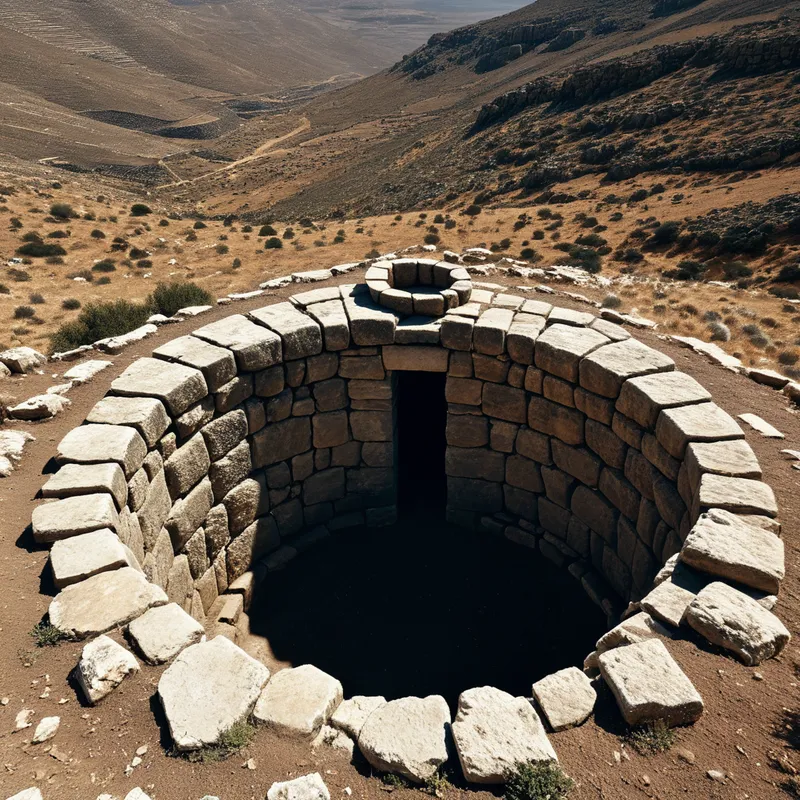
Before him lay the Well of [Jacob](/myths/jacob “Myth from Biblical culture.”/). Not a spring, bubbling with life, but a deep, silent shaft cut through stone, a dark mouth in the thirsty earth. It was old, older than memory, a gift from the patriarch who dug through doubt to find [water](/myths/water “Myth from Chinese culture.”/) for his flocks. The traveler sat by its rough-hewn rim, the stone warm against his back. The world was silent, save for the buzz of flies and the sigh of his own breath.
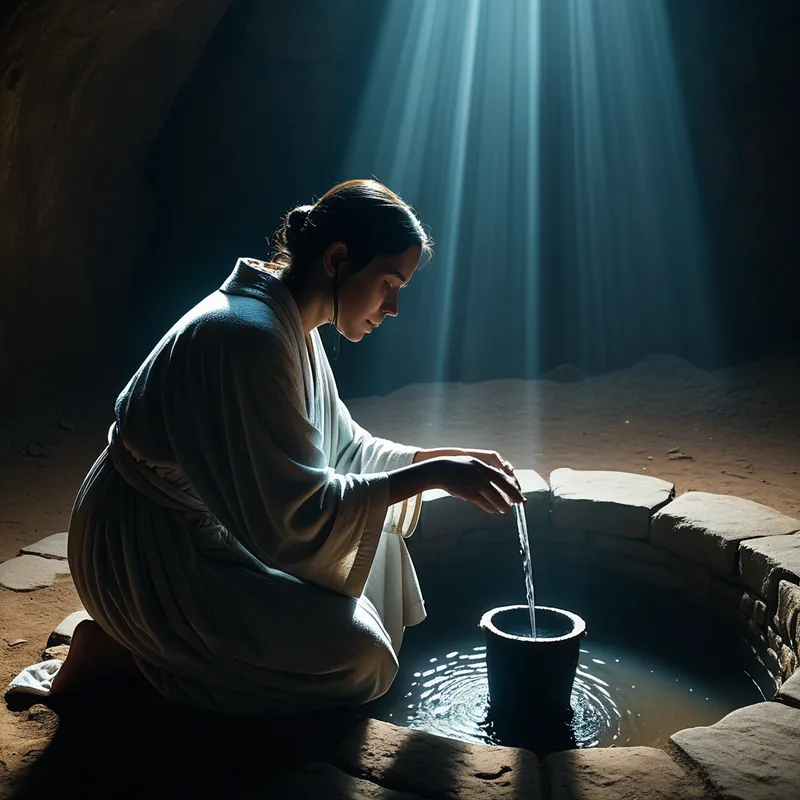
Then, a figure approached from the town. A woman, with a water jar balanced on her shoulder. Her steps were measured, her eyes downcast. She came at this hour to avoid the whispers, the sidelong glances of the other women at the cool dawn. Here, in the furnace of noon, she could be alone with her thirst and her shame.
She did not expect a man, a Jew, at the well. Their peoples were divided by centuries of bitterness, a wall built of old wounds and older pride. A man did not speak to a strange woman in public. A Jew did not share vessel or word with a Samaritan. Yet, as she lowered her rope into the deep, dark coolness, he spoke.
“Give me a drink.”
His voice was not a command, but an exhaustion so profound it became an invitation. She drew back, the social script flashing in her mind. “How is it that you, a Jew, ask for a drink from me, a Samaritan woman?”
He looked at her, not at her jar, not at her status, but at her. “If you knew the gift of God, and who it is that is saying to you, ‘Give me a drink,’ you would have asked him, and he would have given you living water.”
Living water. The words hung in the hot air. She knew the well’s depth; her arms knew the ache of hauling its gift to the surface. This was no flowing spring. “Sir, you have nothing to draw water with, and the well is deep. Where do you get that living water? Are you greater than our father Jacob, who gave us this well?”
Then he spoke of a water that would become a spring within, welling up to eternal life. A water that would quench not the throat’s dryness, but the soul’s. Intrigued, yet still anchored in the practical world, she said, “Sir, give me this water, so that I will not be thirsty, nor have to come here to draw.”
“Go, call your husband, and come here.” “I have no husband.” “You are right in saying, ‘I have no husband’; for you have had five husbands, and the one you now have is not your husband. What you have said is true.”
The words were not an accusation, but a revelation. In the stark light of noon, at the mouth of the ancient well, she was seen. Truly seen. Not as the woman of Sychar, but as herself, in all her complex history of seeking and loss. The walls of division—Jew and Samaritan, man and woman, righteous and outcast—dissolved in the clarity of that gaze. He spoke to her of spirit and truth, of a worship that needed no mountain or temple, but only the authentic heart.
The woman left her water jar. The very vessel that defined her daily struggle, her reason for coming to this lonely place, was abandoned at the well’s edge. She ran back to the town, not to hide, but to proclaim: “Come, see a man who told me all that I ever did. Can this be the Messiah?”
And they came. Not because of a dogma, but because of the transformation they witnessed in her—a woman who had found, at the Well of Jacob, a different kind of water.
Cultural Origins & Context
This narrative is found in the Gospel of John. It is not a folktale passed down by bards, but a theological and biographical account embedded within a community defining its identity around the figure of [Jesus Christ](/myths/jesus-christ “Myth from Christian culture.”/). Its cultural setting is a powder keg of ethnic and religious tension. Samaritans and Jews shared a common ancestry but were bitterly divided over the proper place of worship and the authenticity of their traditions. The well itself was a tangible relic of their shared, yet disputed, patriarch Jacob, making it a perfect symbol of both connection and conflict.
The story functioned subversively within its early context. It elevates a double outsider—a Samaritan and a woman of questionable repute—as the first theological conversant and evangelist for the Messianic revelation. It was told to challenge boundaries, to illustrate that the “living water” of spiritual insight bypasses social and ritual barriers to address the core human condition of thirst.
Symbolic Architecture
The Well of Jacob is the central, multifaceted [symbol](/symbols/symbol “Symbol: A symbol can represent an idea, concept, or belief, serving as a powerful tool for communication and understanding.”/). It is [depth](/symbols/depth “Symbol: Represents profound layers of consciousness, hidden truths, or the unknown aspects of existence, often symbolizing introspection and existential exploration.”/), tradition, and the inherited past—a resource that requires laborious [effort](/symbols/effort “Symbol: Effort signifies the physical, mental, and emotional energy invested toward achieving goals and personal growth.”/) to access. It represents the [collective unconscious](/symbols/collective-unconscious “Symbol: The Collective Unconscious refers to the part of the unconscious mind shared among beings of the same species, embodying universal experiences and archetypes.”/), the deep, stored [history](/symbols/history “Symbol: History in dreams often represents the dreamer’s past experiences, lessons learned, or unresolved issues that continue to influence their present.”/) of a people and a person.
The well is the depth of the past we return to, but the living water is the spring of the future we must become.
The “living [water](/symbols/water “Symbol: Water symbolizes the subconscious mind, emotions, and the flow of life, representing both cleansing and creation.”/)” is the antithesis of the well’s stagnant, drawn-up water. It symbolizes spontaneous, inner wisdom; the libido or psychic [energy](/symbols/energy “Symbol: Energy symbolizes vitality, motivation, and the drive that fuels actions and ambitions.”/) that flows from within, rather than being laboriously hauled from the [depths](/symbols/depths “Symbol: Represents the subconscious, hidden emotions, or foundational aspects of the self, often linked to primal fears or profound truths.”/) of tradition or personal history. The encounter at the well models a profound psychological shift: from seeking sustenance from external sources (approval, relationships, social standing) to discovering an authentic, internal [source](/symbols/source “Symbol: The origin point of something, often representing beginnings, nourishment, or the fundamental cause behind phenomena.”/) of [life](/symbols/life “Symbol: The symbol of ‘Life’ represents a journey of growth, interconnectedness, and existential meaning, encompassing both the joys and challenges that define human experience.”/) and meaning.
The woman represents the [anima](/symbols/anima “Symbol: The feminine archetype within the male unconscious, representing soul, creativity, and connection to the inner world.”/) or [soul](/symbols/soul “Symbol: The soul represents the essence of a person, encompassing their spirit, identity, and connection to the universe.”/)-complex in a state of seeking and [fragmentation](/symbols/fragmentation “Symbol: The experience of breaking apart, losing cohesion, or being separated into pieces. Often represents disintegration of self, relationships, or reality.”/). Her five husbands symbolize failed attempts at outer completion, psychic projections that did not hold. The [moment](/symbols/moment “Symbol: The symbol of a ‘moment’ embodies the significance of transient experiences that encapsulate emotional depth or pivotal transformations in life.”/) she is “seen”—her [truth](/symbols/truth “Symbol: Truth represents authenticity, honesty, and the quest for knowledge beyond mere appearances.”/) named without condemnation—is the moment of [integration](/symbols/integration “Symbol: The process of unifying disparate parts of the self or experience into a cohesive whole, often representing psychological wholeness or resolution of internal conflict.”/). Leaving her water jar signifies the [abandonment](/symbols/abandonment “Symbol: A dream symbol representing feelings of being left behind, isolated, or emotionally deserted, often tied to primal fears of separation and loss of support.”/) of her old, exhausting method of seeking fulfillment.

The Dreamer’s Resonance
To dream of [Jacob’s Well](/myths/jacobs-well “Myth from Biblical culture.”/) is to dream of a pivotal encounter with [the Self](/myths/the-self “Myth from Jungian culture.”/) at a place of deep, ancestral memory. The somatic feeling is often one of profound thirst or weariness, a fatigue of the spirit. The well in the dream may be dry, overflowing, impossibly deep, or contain a reflective surface showing not water, but the dreamer’s own face.
This dream pattern signals a critical juncture in individuation. The dream-ego (the traveler or the woman) is being called to a meeting at the border of the known and unknown. The “other” figure in the dream—whether a sage, a stranger, or a shadowy version of oneself—offers not a solution, but a revelation that re-contextualizes the dreamer’s entire history. The psychological process is one of recognition and re-sourcement: seeing one’s fragmented story in the clear light of consciousness, and in that seeing, discovering an inner wellspring of authority that makes the old, laborious methods of seeking obsolete.

Alchemical Translation
The alchemy here is not of lead to gold, but of well-water to living water. It is the transmutation of personal history from a burden to be hauled into a depth to be integrated, and of libido from a sought-after object to a self-renewing subject.
[The first stage](/myths/the-first-stage “Myth from Alchemical culture.”/) ([nigredo](/myths/nigredo “Myth from Alchemical culture.”/)) is the weary journey, the heat of the conscious ego’s struggle, and the confrontation with the “shadow” well of one’s past—the failed relationships, the societal judgments, the inherited pains. The conversation at the well is the albedo, the washing in the illuminating light of truth. Here, the contents of the unconscious (the woman’s history) are not rejected but named and brought into relationship with the conscious mind (the traveler).
The miracle is not in drawing water from a deep well, but in realizing the well itself is within you, and its water is already rising.
The [rubedo](/myths/rubedo “Myth from Alchemical culture.”/), the reddening or culmination, is the abandonment of the water jar. This is the ultimate alchemical act: letting go of [the ego](/myths/the-ego “Myth from Jungian culture.”/)‘s cherished tool for managing its thirst. The old identity—“the woman who fetches water”—dies. What is born is the evangelist, the one who has met the source and must now, from integrated wholeness, engage with the world. The living water is the aqua permanens, the permanent water of the alchemists—the symbol of the timeless, circulating energy of the unified [psyche](/myths/psyche “Myth from Greek culture.”/) that forever quenches, forever renews, from within. The individual no longer journeys to the sacred well, but becomes [the vessel](/myths/the-vessel “Myth from Alchemical culture.”/) from which the sacred springs.
Associated Symbols
Explore related symbols from the CaleaDream lexicon: