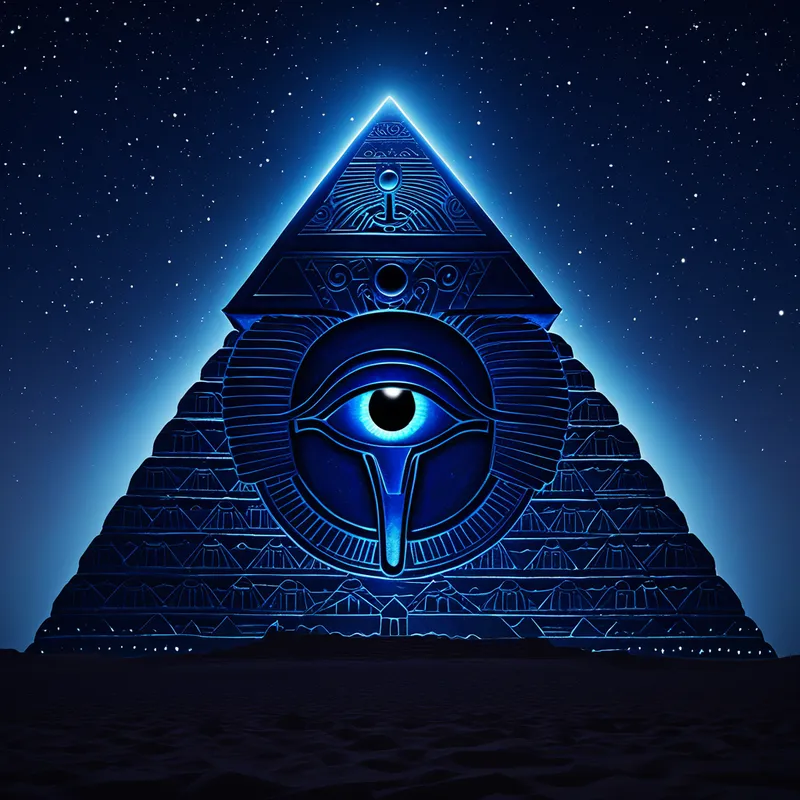
The Wedjat Myth Meaning & Symbolism
The story of how the god Horus lost and restored his divine eye, creating a symbol of sacrifice, healing, and the triumph of order over chaos.
The Tale of The Wedjat
Listen. The story begins not in light, but in the searing heat of vengeance and the choking dust of the desert. The air itself tasted of copper and old blood. Horus, the Avenger, the Falcon-Lord, stood facing his uncle, Seth, the Red One. This was no mere duel; it was the grinding of cosmos against chaos, the future of Ma’at—Divine Order—hanging in the balance.
Their battle was a storm of flesh and divinity. Horus, with the piercing sight of the heavens, fought to reclaim the throne of his murdered father, Osiris. Seth, with the brute force of the untamed desert, sought to shatter the lineage of the gods forever. In a furious clash, Seth’s hand, like a mountain of malice, struck out. Not at Horus’s heart, but at his left eye—the Eye of the Moon, the vessel of his sacred sight.
A scream tore the sky. Not of pain, but of profound loss. The divine eye was shattered. Six luminous pieces—the pupil, the brow, the corner—scattered like fallen stars into the abyss of the world. The light in Horus’s face dimmed; his vision became partial, broken. The world slid out of focus. In that moment, chaos grinned.
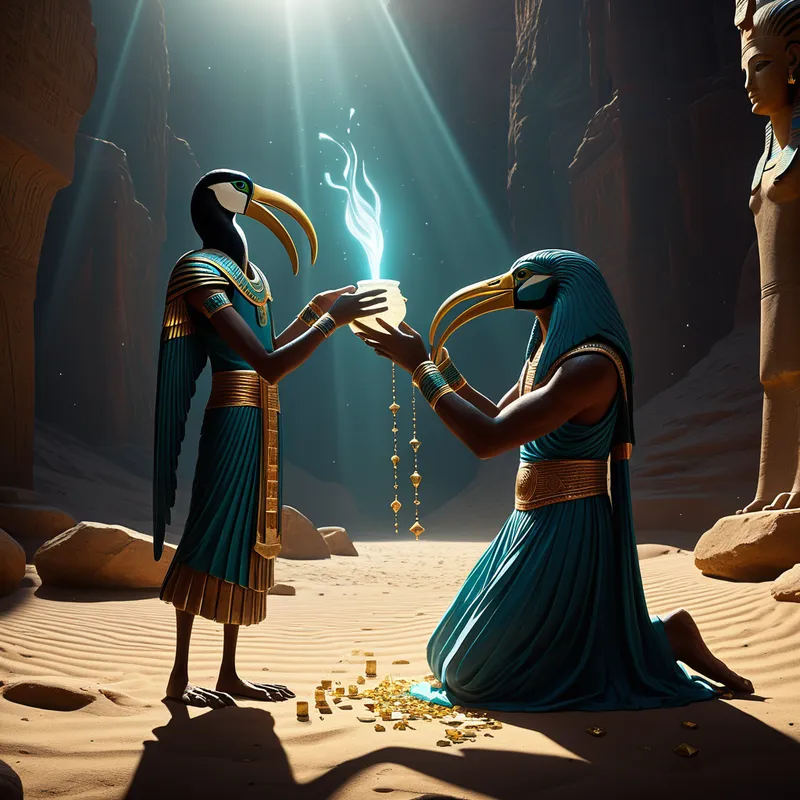
But the story does not end in darkness. For the gods themselves cannot abide such a wound to perception, to wholeness. The divine physician, Thoth, he of the ibis beak and the silent knowledge, descended. With fingers that understood the grammar of creation, he began the search. He gathered the fragments from the river mud, the desert sand, the deep roots of the papyrus thicket. Each piece hummed with a memory of light.
Under the cool, silver gaze of the very moon it once mirrored, Thoth worked. He did not merely glue the pieces back. He sang over them. He recited the spells of binding, the formulas of restoration. He anointed each seam with spit and starlight. And as the final fragment clicked into place, a miracle occurred. The eye did not just return. It was renewed. It pulsed with a deeper, more potent luminescence—the Wedjat, the Sound One, the Whole One.
Horus, his sight restored not to its old state but to a new, transcendent clarity, offered this Wedjat to his father, Osiris, in the silent halls of the Duat. This act of filial sacrifice fed the resurrected god, granting him vitality and sovereignty in the afterlife. The Wedjat became more than an eye; it became a gift of wholeness that could heal the very fabric of existence.
Cultural Origins & Context
The myth of the Wedjat is woven into the bedrock of Egyptian civilization, appearing in the Pyramid Texts, the Coffin Texts, and the Book of the Dead. It was not a single, canonical story told in one sitting, but a living, breathing narrative constellation invoked in temple rituals, medical papyri, and royal coronations. Priests recited it to maintain cosmic order. Physicians drew the symbol on prescriptions, believing its power of restoration could channel into bodily healing. Every pharaoh was the living Horus, and thus the keeper of the Wedjat’s promise—the ruler who sees truly, who restores order (Ma’at) after chaos (Isfet).
The myth functioned as a foundational metaphor for the Egyptian worldview. It explained the phases of the moon (the eye’s injury and restoration). It modeled the ideal of filial piety and the transfer of legitimate kingship. Most importantly, it provided a template for healing—of the state, the body, and the soul. The Wedjat was a divine “how-to” for reassembling what had been broken, making it a central icon in both public statecraft and the most intimate personal amulets placed on mummies for protection in the journey beyond.
Symbolic Architecture
At its core, the Wedjat is a map of fragmentation and integration. The six shattered pieces represent any form of loss, trauma, or dissociation—a break in our perceptual wholeness. Seth’s violence is the inevitable, chaotic force that shatters naive unity. We all carry fragments of a self wounded by life’s battles.
The journey to wholeness is not a return to a pristine, untouched state, but the arduous creation of a new integrity, scarred and sacred, born from the conscious re-membering of what was dis-membered.
Thoth, the archetypal psychopomp and magician, symbolizes the mediating intellect, wisdom, and the healing power of language and ritual. He is the inner capacity to name our wounds, to gather the scattered parts of our psyche, and to perform the sacred act of self-reconciliation. The restoration is an act of magic—not supernatural, but super-natural, reaching for a order higher than the one that was broken.
The final offering of the Wedjat to Osiris completes the symbolic circuit. It translates personal healing into generative sacrifice. The restored vision is not for hoarding, but for feeding a greater purpose—nourishing the “ancestral” or foundational parts of our being (our Osiris), allowing new life and authority to emerge from what we thought was dead.
The Dreamer’s Resonance
When the pattern of the Wedjat stirs in the modern unconscious, it often manifests in dreams of searching for lost objects, piecing together broken pottery or glass, or experiencing a sudden, shocking injury to the face or senses. The dreamer may find themselves in a library (Thoth’s domain) trying to reassemble a torn manuscript, or watching a skilled artisan repair a priceless, fractured artifact.
Somatically, this process correlates with the nervous system’s shift from a state of fragmentation (dissociation, panic, hyper-vigilance) toward integration. It is the psyche’s innate drive toward coherence. The dream is the nocturnal Thoth at work, gathering the psychic shards of a difficult memory, a lost relationship, or a neglected talent. The feeling upon waking may be one of poignant sadness mixed with a quiet determination—the somatic signature of the healing intelligence beginning its meticulous work.

Alchemical Translation
The alchemy of the Wedjat is the opus of psychic individuation. It begins with the nigredo: the blackening, the brutal confrontation with Seth—our own inner chaos, rage, or trauma that shatters our innocent self-conception. We are left one-eyed, seeing the world through the lens of our wound.
The albedo is the whitening, the moon-phase of Thoth’s work. This is the conscious, often painstaking process of analysis, reflection, and retrieval. We must go into the mud and the reeds of our past to find the lost pieces of ourselves. This requires the cool, detached wisdom of the sage—not to avoid the pain, but to hold it with understanding.
The restored Wedjat is the philosopher’s stone of the soul: not a stone at all, but a perfected organ of perception, forged in the fires of loss and cooled in the waters of mindful compassion.
Finally, the rubedo: the reddening, the culmination. This is not merely having the pieces back, but the act of offering the restored wholeness to a higher function. In psychological terms, this is when healed trauma is no longer a closed loop of pain but becomes a source of empathy, insight, and creative power (fed to Osiris). The integrated self, bearing the marks of its restoration, gains the true sovereignty of clear sight. The Wedjat eye becomes the “third eye” of completed awareness—seeing the world and oneself not as they were, but as they are, in their heartbreaking and magnificent wholeness. We become, in a humble, human way, sound and whole.
Associated Symbols
Explore related symbols from the CaleaDream lexicon: