
The Wedding Feast of Peleus and Thetis Myth Meaning & Symbolism
A divine wedding marred by a single uninvited guest, whose golden apple of discord sets in motion the chain of events leading to the Trojan War.
The Tale of The Wedding Feast of Peleus and Thetis
Hear now of the last great gathering, the final feast where all [the world](/myths/the-world “Myth from Tarot culture.”/)’s joy was gathered in one place, only to be shattered by a single, gleaming seed of strife. It began not with a war, but with a wedding. On the sun-blessed slopes of Mount Pelion, the air itself was drunk on nectar. The hero Peleus, favored by the gods for his piety, had won a prize beyond any mortal’s dreaming: the hand of [Thetis](/myths/thetis “Myth from Greek culture.”/), the silver-footed nymph of [the sea](/myths/the-sea “Myth from Greek culture.”/). A prophecy hung over her like a storm cloud—that her son would surpass his father—and so Zeus himself, wary of a rival, had decreed she be wed to a mortal.
All of Olympus descended to earth that day. The very grass turned to emerald silk beneath their feet. Rivers of ambrosia flowed, and the roast of a hundred sacred beasts perfumed the air. There was Hera in her peacock splendor, [Poseidon](/myths/poseidon “Myth from Greek culture.”/) with his trident laid aside, laughing. [The Muses](/myths/the-muses “Myth from Greek culture.”/) sang, and [the Graces](/myths/the-graces “Myth from Greek culture.”/) danced in spirals of effortless beauty. At the center sat Peleus, mortal and proud, beside his breathtaking bride, Thetis, whose eyes held the changing depths of the ocean. For a moment, it seemed the ancient rift between mortal and immortal had healed in celebration.
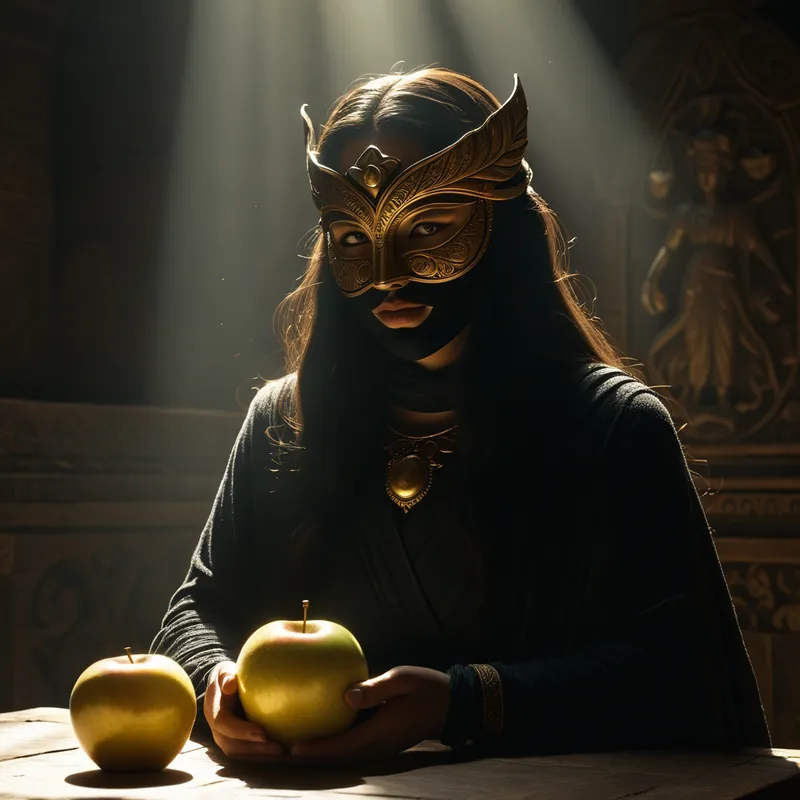
But one had been forgotten. One whose name is Strife. As the laughter reached its peak, a cold shadow fell across the feast. Uninvited, unwelcome, she stood at the edge of the gathering: Eris. Her form was sharp where the others were soft, her silence a wound in the music. No greeting was offered to her; no cup was poured. A smile, thin and terrible as a blade, touched her lips. Without a word, she drew forth a single fruit—a golden apple, more perfect than any work of [Hephaestus](/myths/hephaestus “Myth from Global/Universal culture.”/). With a motion both casual and final, she rolled it into the midst of the reveling gods. It came to rest upon the high table with a soft, fateful thud.
A hush fell. Etched upon the apple’s burnished skin was a single phrase: ΤΗΙ ΚΑΛΛΙΣΤΗΙ—To the Fairest. The music died. The dancing ceased. All eyes turned from the apple to the three great goddesses whose pride now hung in the balance: Hera, the sovereign queen; Athena, gray-eyed and mighty; and Aphrodite, born of sea-foam and irresistible. Each claimed the prize. Each demanded the apple. Their divine voices, once raised in song, now rose in argument, a crackle of celestial lightning threatening to tear the joyous day asunder. No god dared judge between them, for to choose one was to earn the eternal hatred of two.
And so, the solution was found in a mortal. The cunning Zeus commanded the messenger god [Hermes](/myths/hermes “Myth from Global/Universal culture.”/) to lead the three disputing goddesses to a remote mountain peak, to a young shepherd named Paris. There, on the lonely slopes of Ida, far from the wedding’s light, the fate of the world was placed in the hands of a dazzled, mortal man. The wedding feast was over. The path to Troy was now open, paved with gold and blood, all born from a single apple cast by the one guest no one thought to name.
Cultural Origins & Context
This pivotal myth functions as the essential prologue to the epic cycle of [the Trojan War](/myths/the-trojan-war “Myth from Greek culture.”/), most famously recounted in [Homer](/myths/homer “Myth from Greek culture.”/)’s Iliad and later elaborated in the fragmentary Cypria, part of the Epic Cycle. It was not merely a story of divine pettiness, but a foundational etiological myth for the Greek world-view. It explained the ultimate cause of the most famous war in their legendary history, framing a colossal human conflict as originating in a divine slight and a mortal’s choice.
The tale was performed by bards and rhapsodes, serving as a gripping prelude to the sagas of Achilles, Hector, and [Odysseus](/myths/odysseus “Myth from Greek culture.”/). Its societal function was profound. It reinforced the Greek concept of Moira—the inescapable thread of destiny—showing how the whims of the gods and the flaws of mortals were inextricably woven into a single, catastrophic tapestry. It also explored the perilous interface between the human and divine realms, warning of the chaos that ensues when mortal lives become the chessboard for immortal disputes. The wedding feast itself represents a fragile, idealized moment of harmony, making its shattering by Eris a powerful metaphor for the inherent instability of a world governed by competing powers and passions.
Symbolic Architecture
At its core, the myth is an archetypal [drama](/symbols/drama “Symbol: Drama signifies narratives, emotional expression, and the exploration of human experiences.”/) of the excluded [shadow](/symbols/shadow “Symbol: The ‘shadow’ embodies the unconscious, repressed aspects of the self and often represents fears or hidden emotions.”/) and the poison of comparison. The wedding symbolizes a state of potential wholeness, a sacred union (hieros gamos) between mortal striving (Peleus) and divine, transformative potential (Thetis). It is the [moment](/symbols/moment “Symbol: The symbol of a ‘moment’ embodies the significance of transient experiences that encapsulate emotional depth or pivotal transformations in life.”/) before creation, where all elements are present in [harmony](/symbols/harmony “Symbol: A state of balance, agreement, and pleasing combination of elements, often associated with musical consonance and visual or social unity.”/).
The uninvited guest is never absent; she is merely waiting outside the gates of our awareness.
Eris represents the indispensable, disruptive force of the [psyche](/myths/psyche “Myth from Greek culture.”/)—[the shadow](/myths/the-shadow “Myth from Jungian culture.”/), the repressed, the necessary [friction](/symbols/friction “Symbol: Friction represents resistance, conflict, or the necessary tension required for movement and transformation in dreams.”/) that catalyzes all development. To exclude her is to invite catastrophe. Her golden [apple](/symbols/apple “Symbol: An apple symbolizes knowledge, temptation, and the duality of good and evil, often representing the pursuit of wisdom with potential consequences.”/) is not merely a prize; it is a mirror. The [inscription](/symbols/inscription “Symbol: A permanent mark, carving, or writing on a surface, often carrying messages, records, or artistic expression meant to endure.”/) To the Fairest is a question masquerading as a [statement](/symbols/statement “Symbol: A statement in a dream can symbolize the need to express one’s thoughts or beliefs, reflecting a desire for honesty or clarity.”/), forcing [differentiation](/symbols/differentiation “Symbol: The process of distinguishing or separating parts of the self, emotions, or identity from a whole, often marking a developmental or psychological milestone.”/) where [none](/symbols/none “Symbol: The absence represented by ‘none’ can signify emptiness, potential, or a yearning for substance.”/) was sought. It shatters collective unity into competing fragments of [identity](/symbols/identity “Symbol: Identity represents the sense of self, encompassing personal beliefs, cultural background, and social roles.”/): sovereignty (Hera), wisdom (Athena), and desire (Aphrodite). These are not just goddesses but fundamental psychic forces within the individual and the culture.
The Judgment of Paris that follows is the inevitable consequence. When [the Self](/myths/the-self “Myth from Jungian culture.”/) (the [assembly](/symbols/assembly “Symbol: Assembly symbolizes collaboration, unity, and the coming together of individuals or ideas in pursuit of a common goal.”/) of gods) cannot integrate its own conflicting values, it projects the conflict [outward](/symbols/outward “Symbol: Movement or orientation away from the self or center; expansion, expression, or externalization of inner states into the world.”/) onto the naive ego (Paris). The [choice](/symbols/choice “Symbol: The concept of choice often embodies decision-making, freedom, and the multitude of paths available in life.”/) he makes—for love and personal desire over power or wisdom—is a psychological inevitability at a certain stage of development, yet it binds the chooser to a [fate](/symbols/fate “Symbol: Fate represents the belief in predetermined outcomes, suggesting that some aspects of life are beyond human control.”/) of immense consequence. The apple, therefore, is the [symbol](/symbols/symbol “Symbol: A symbol can represent an idea, concept, or belief, serving as a powerful tool for communication and understanding.”/) of fateful choice, of the moment an unconscious complex becomes activated and sets a [life](/symbols/life “Symbol: The symbol of ‘Life’ represents a journey of growth, interconnectedness, and existential meaning, encompassing both the joys and challenges that define human experience.”/)-narrative in [motion](/symbols/motion “Symbol: Represents change, progress, or the flow of life energy. Often signifies transition, personal growth, or the passage of time.”/).
The Dreamer’s Resonance
When this myth pattern stirs in the modern dreamer, it often manifests as dreams of disrupted celebrations: a wedding where a fight breaks out, a family dinner poisoned by a sudden, bitter argument, or a triumphant achievement overshadowed by a nagging, critical voice. The somatic experience is one of tension in a moment of relaxation, a knot in the stomach during a party, or a sudden chill in a warm room.
Psychologically, this signals the eruption of a repressed complex—the “Eris” within. The dreamer may be attempting to maintain a facade of harmony, success, or perfection (the wedding feast), while systematically excluding a part of themselves deemed unacceptable: their envy, their anger, their ambition, or their insecurity. The golden apple in a dream might appear as a coveted job offer that pits colleagues against each other, an inheritance that divides a family, or even a simple compliment that triggers intense self-comparison. The dream is indicating that a forced, artificial unity is breaking down. The psyche is demanding that its conflicting values—the inner Hera, Athena, and Aphrodite—be acknowledged and consciously related to, rather than left to battle in the shadows, projecting chaos into one’s external relationships and life choices.

Alchemical Translation
The alchemical process modeled here is the negredo—the blackening, the necessary death of naive unity that precedes any genuine integration. The wedding feast is the unio mentalis, the mental union, an idealistic conception of wholeness. Eris is the caput corvi, the head of the crow, the darkening agent that introduces the essential [ferment](/myths/ferment “Myth from Alchemical culture.”/).
The first stage of the Great Work is not creation, but the recognition of the corruption that makes creation necessary.
The individual’s journey begins with the realization that their conscious personality—their “feast”—is built upon an exclusion. The task is not to vanquish Eris, but to invite her in, to consciously host the discord. This means acknowledging the competing, often contradictory, values and desires within: the part that seeks power and recognition (Hera), the part that seeks mastery and understanding (Athena), and the part that seeks connection and sensual fulfillment (Aphrodite). The “Judgment of Paris” is then internalized. It is no longer a fatal, external choice, but an ongoing, internal dialogue.
The alchemical goal is not to choose one goddess forever, but to hold the tension of the triad, to suffer the conflict without projecting it outward. From this sustained tension, a fourth, transcendent function can emerge—the consciousness that can witness and contain the claims of power, wisdom, and love. This is the true “child” of the union of Peleus and Thetis: not the doomed, glorious Achilles of the old myth, but a resilient, conscious awareness born from the marriage of our mortal limits with our divine potentials, a Self forged in the full acknowledgment of both our capacity for celebration and our inherent, catalytic strife. The golden apple transforms from an object of discord into the philosopher’s stone of self-knowledge, heavy with the weight of all we are.
Associated Symbols
Explore related symbols from the CaleaDream lexicon: