The Wedding at Cana Myth Meaning & Symbolism
A wedding runs out of wine, a mother's quiet plea, and a reluctant son performs a miracle that transforms water into the finest vintage.
The Tale of The Wedding at Cana
Listen. There is a story whispered on [the wind](/myths/the-wind “Myth from Various culture.”/) that carries the scent of crushed grapes and new hope. It begins not in a temple or on a mountaintop, but in the beating heart of a village, in the simple, sacred chaos of a wedding.
In the town of Cana, the air was thick with laughter and the music of flutes. A celebration was unfolding, a joining of two lives, a promise against the uncertainty of [the world](/myths/the-world “Myth from Tarot culture.”/). Among the guests was a woman whose eyes held the quiet depth of a well, Mary. And with her, her son, a man whose presence was like a still pool in a rushing stream.
The feast roared on, a tide of joy. But beneath the surface, a cold dread began to seep through the host’s household. The wine was running out. To fail in hospitality, to let the cup of celebration run dry at a wedding—this was more than embarrassment. It was a social death, a crack in the very foundation of community joy, a shadow falling across the new beginning.
Mary felt the shift in the air, the strained smiles of the servants. She moved to her son’s side, her voice a low murmur only for him. “They have no wine.” It was not a demand, but a statement of fact, heavy with unspoken faith and a mother’s knowing. His reply was enigmatic, a boundary drawn: “Woman, what does this have to do with me? My hour has not yet come.”
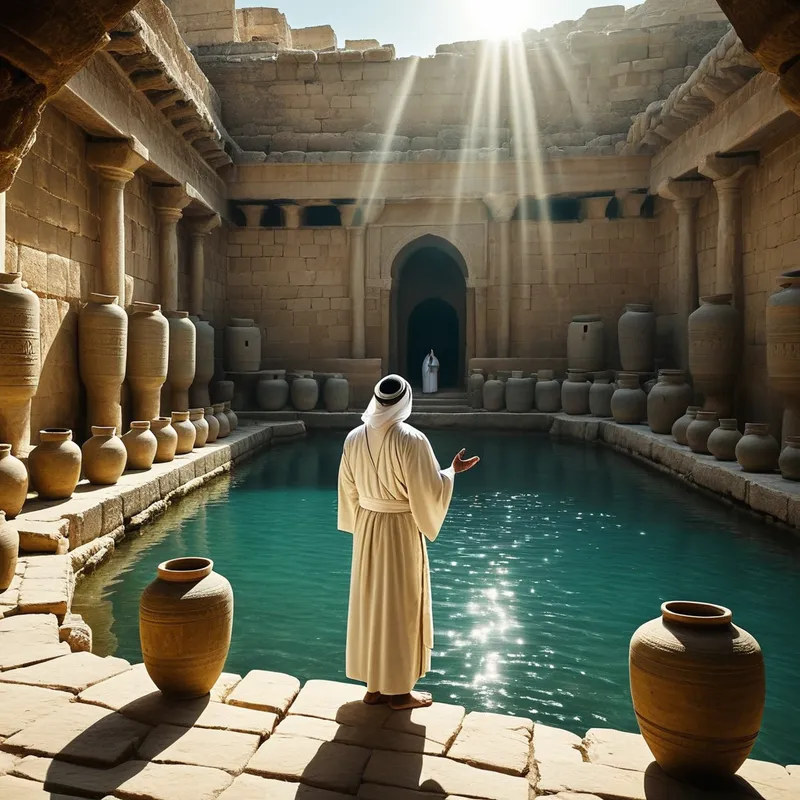
Yet, she turned to the waiting servants, her instruction simple and absolute: “Do whatever he tells you.” Six stone [water](/myths/water “Myth from Chinese culture.”/) jars stood nearby, massive vessels for the rites of purification, each holding twenty or thirty gallons. “Fill the jars with water,” he said. And they filled them to the brim.
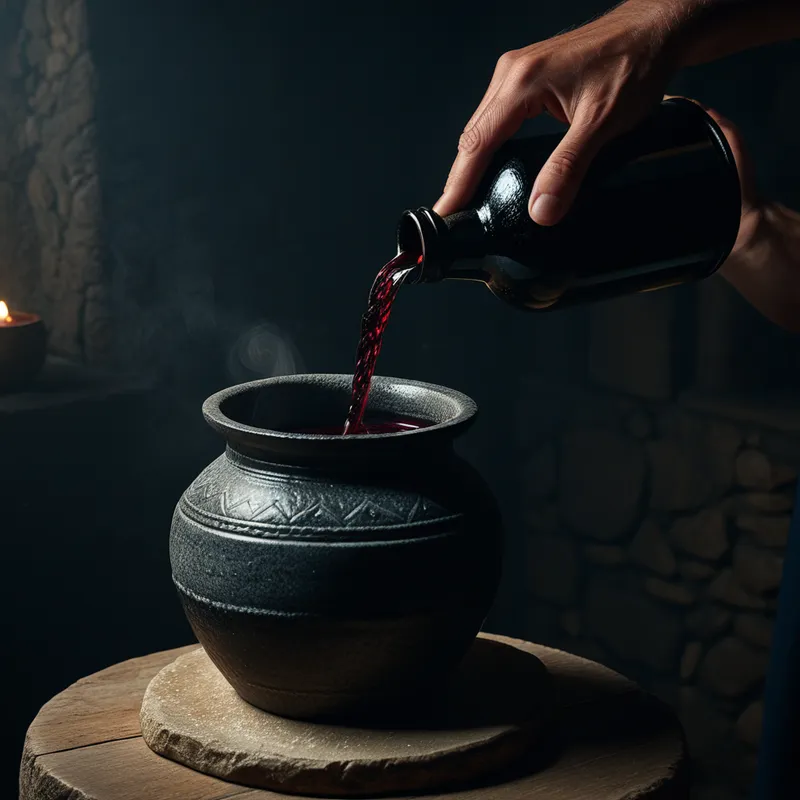
Then, the quiet command: “Now draw some out and take it to the master of the feast.” The servant dipped a cup into the jar that moments before held only well-water. He drew it out. The liquid that swirled in [the vessel](/myths/the-vessel “Myth from Alchemical culture.”/) was not clear, but a deep, rich crimson. He carried it, his heart a drum, to the master of the feast.
The master tasted it, and his eyes widened. He called the bridegroom, baffled and delighted. “Everyone serves the good wine first,” he exclaimed, “and when people have drunk freely, then the poor wine. But you have kept the good wine until now.”
The celebration, saved from the brink of despair, surged anew with a wonder it had not known before. The water of obligation had become the wine of astonishment. And in that moment, in the back of the house by the stone jars, the first of his signs was revealed, and his disciples believed in him.
Cultural Origins & Context
This narrative is found solely in the Gospel of John, a text composed towards the end of the first century CE. Unlike the more action-oriented synoptic gospels, John’s account is deeply theological and symbolic, structured around seven “signs” that point to a greater reality. The Wedding at Cana is the inaugural sign, the opening note in a symphony of revelation.
Set in the deeply communal culture of Galilean village life, the story leverages a profound social anxiety. Wine was not mere alcohol; it was a symbol of berakhah (blessing), joy, covenant, and the goodness of creation. To lack wine at a wedding was to publicly fail in providing shalom—wholeness and peace—for the new community forming around the couple. The story was passed down within early Christian communities not just as a biography of a miracle, but as a foundational parable about the nature of the Christ event: the arrival of a new and overflowing quality of life, a superior covenant of grace replacing the old rites of purification.
Symbolic Architecture
The myth is a dense [matrix](/symbols/matrix “Symbol: A dream symbol representing the fundamental structure of reality, consciousness, or the self. It often signifies feelings of being trapped, controlled, or questioning the nature of existence.”/) of symbols. The wedding itself is a universal [archetype](/symbols/archetype “Symbol: A universal, primordial pattern or prototype in the collective unconscious that shapes human experience, behavior, and creative expression.”/) of union, not just between individuals, but between the divine and the [human](/symbols/human “Symbol: The symbol of a human represents individuality, complexity of emotions, and social relationships.”/), the promised fulfillment of a [covenant](/symbols/covenant “Symbol: A binding agreement or sacred promise between parties, often carrying deep moral, spiritual, or social obligations and consequences.”/). The running out of [wine](/symbols/wine “Symbol: Wine often symbolizes celebration, indulgence, and the deepening of personal connections, but it can also represent excess and escape.”/) symbolizes the exhaustion of the old order, the limits of ordinary [human](/symbols/human “Symbol: The symbol of a human represents individuality, complexity of emotions, and social relationships.”/) joy and religious [ritual](/symbols/ritual “Symbol: Rituals signify structured, meaningful actions carried out regularly, reflecting cultural beliefs and emotional needs.”/). The six [stone](/symbols/stone “Symbol: In dreams, a stone often symbolizes strength, stability, and permanence, but it may also represent emotional burdens or obstacles that need to be acknowledged and processed.”/) [water](/symbols/water “Symbol: Water symbolizes the subconscious mind, emotions, and the flow of life, representing both cleansing and creation.”/) jars, used for Jewish purification rites, represent the old law, the [structure](/symbols/structure “Symbol: Structure in dreams often symbolizes stability, organization, and the framework of one’s life, reflecting how one perceives their environment and personal life.”/) of preparation and cleansing.
The miracle is not in the creation of something from nothing, but in the transmutation of what is already present. The water of the law becomes the wine of grace.
Mary represents the [soul](/symbols/soul “Symbol: The soul represents the essence of a person, encompassing their spirit, identity, and connection to the universe.”/)’s intuitive wisdom, the part of us that perceives a need and, despite apparent rebuff, trusts in a hidden potential. Her instruction to the servants—“Do whatever he tells you”—is the essential [posture](/symbols/posture “Symbol: Posture in dreams represents one’s stance in life, social presentation, and inner confidence or submission. It reflects how one carries themselves through challenges and relationships.”/) of [the ego](/myths/the-ego “Myth from Jungian culture.”/) surrendering to the [guidance](/symbols/guidance “Symbol: The act of receiving or seeking direction, advice, or leadership in a dream, often representing a need for clarity, support, or a higher purpose on one’s life path.”/) of the deeper Self. The master of the feast, who recognizes the quality of the wine but not its [source](/symbols/source “Symbol: The origin point of something, often representing beginnings, nourishment, or the fundamental cause behind phenomena.”/), embodies conventional [consciousness](/symbols/consciousness “Symbol: Consciousness represents the state of awareness and perception, encompassing thoughts, feelings, and experiences.”/), which often enjoys the fruits of transformation without understanding their [origin](/symbols/origin “Symbol: The starting point of a journey, often representing one’s roots, source, or initial state before transformation.”/).
The Dreamer’s Resonance
When this myth stirs in the modern dreamer, it often surfaces during a psychological “wedding”—a time of attempted integration, a new relationship, career, or creative project that has begun with joy but now feels barren, drained of its initial spirit. The dreamer may find themselves at a party that is turning sour, or desperately searching for a drink that cannot be found.
Somatically, this can feel like a hollow exhaustion, a dryness in the throat of the soul. The conflict is between the social [persona](/myths/persona “Myth from Greek culture.”/) (the “host” who must maintain appearances) and the inner authority (the “son” who knows his own timing). The dream is pointing to a profound lack, not of external resources, but of inner intoxicant—the authentic passion, meaning, or spirit that makes the endeavor truly alive. It calls for an appeal to the deeper maternal wisdom within (the Mary function) to initiate a process of drawing from the vast, often ignored, reservoirs of the unconscious (the water jars).
Alchemical Translation
Psychologically, the Wedding at Cana is a masterful map of the alchemical opus, the work of individuation. The process begins in the [nigredo](/myths/nigredo “Myth from Alchemical culture.”/), the blackening: the celebration has turned ashen, the wine is gone. This is the moment of despair, the recognition that one’s old ways of finding joy and meaning are bankrupt.
The instruction to fill the jars to the brim is the crucial step of immersio—fully engaging with the contents of the unconscious, the “water” of our emotions, instincts, and forgotten potentials. We must confront these depths completely, not just superficially.
The transformation occurs in the obedience to the counter-intuitive command: to draw out and serve the water as if it were already wine. This is the act of faith that catalyzes the transmutation.
The reluctant son figure symbolizes [the Self](/myths/the-self “Myth from Jungian culture.”/), the central organizing principle of the [psyche](/myths/psyche “Myth from Greek culture.”/). Its “hour” is not clock time, but psychological rightness, the [kairos](/myths/kairos “Myth from Global/Universal culture.”/). The miracle reveals that the longed-for spirit, the “good wine,” is not imported from outside but is the latent potential within the most ordinary, even ritualistic, aspects of our being. The old structures (the stone jars of habit, duty, or dogma) are not destroyed; they become the very vessels for the new, more intoxicating consciousness. The finest vintage, saved for last, signifies that the culmination of the psychic journey—the integrated life—is of a quality unimaginable at the outset, a revelation that comes only after one has faithfully drawn from the deep, stone-cool wells of the soul.
Associated Symbols
Explore related symbols from the CaleaDream lexicon: