The Weaver Girl and Cowherd Myth Meaning & Symbolism
A celestial weaver and a mortal cowherd fall in love, are separated by the Milky Way, and are permitted only one annual reunion.
The Tale of The Weaver Girl and Cowherd
Listen, and hear a tale written in starlight.
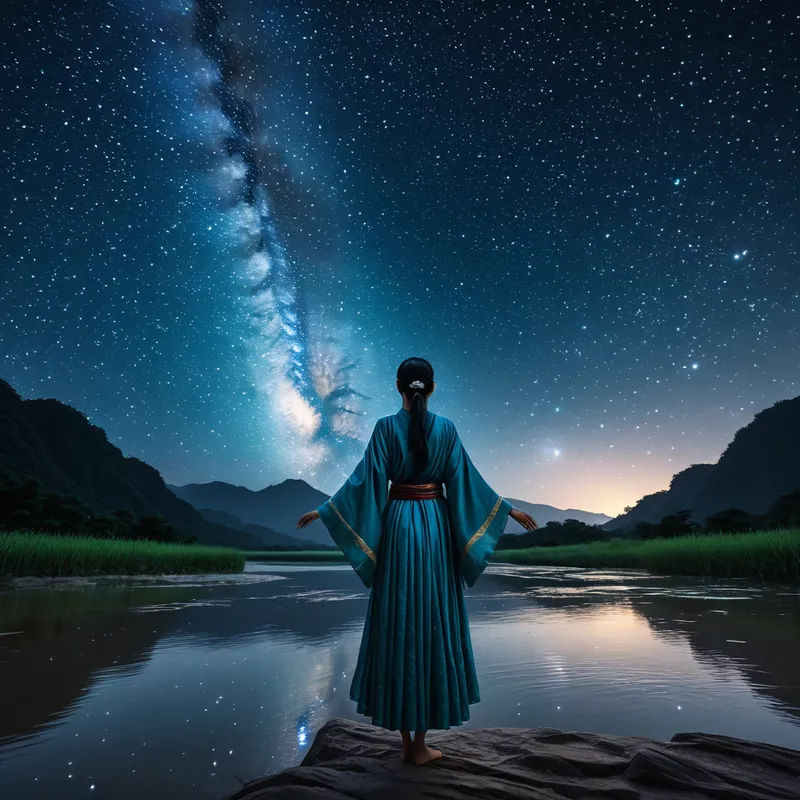
In the high, silent courts of heaven, there lived a weaver. She was Zhinü, daughter of the supreme Jade Emperor, and her craft was the cosmos itself. With a shuttle of moonbeam and threads spun from dawn and dusk, she wove the radiant clouds of sunset and the delicate mists of morning. Yet, for all her divine artistry, her life was one of perfect, lonely order—a rhythm as metronomic as her loom.
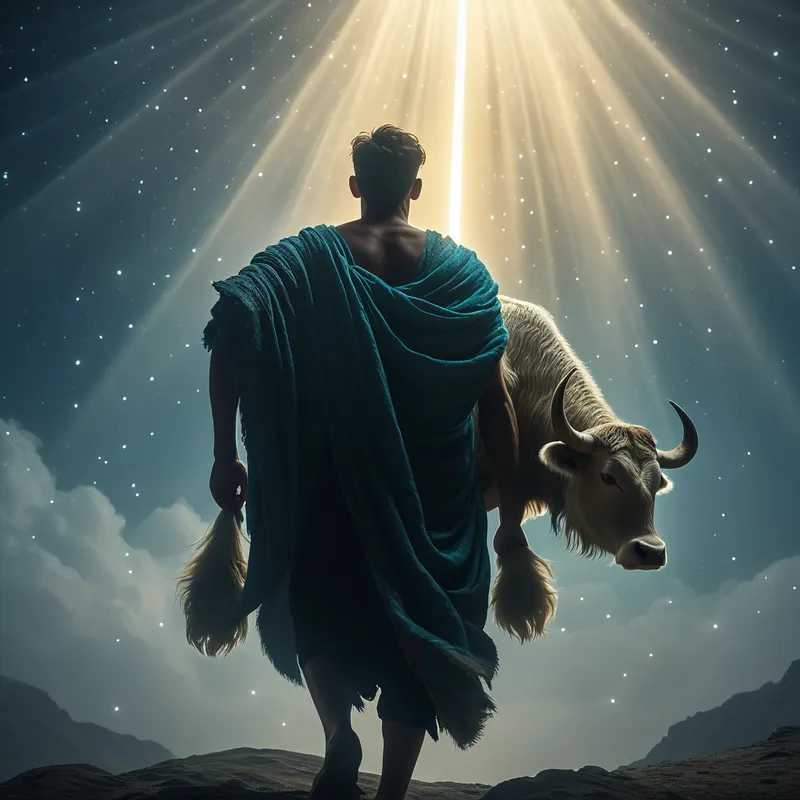
Far below, on the green, fragrant earth, lived a cowherd. He was Niulang, an orphan whose inheritance was a single, aging ox. His days were spent following the beast through meadows, his world defined by the simple truths of soil, sweat, and the animal’s warm, steady breath. He knew nothing of celestial silks, only the coarse touch of grass and the weight of solitude.
But heaven and earth are not so separate as they seem. The old ox, in a moment of profound compassion, was no ordinary beast. It spoke, revealing a secret: the celestial maidens would soon descend to a nearby lake to bathe. “Take the robe of the one in rainbow silk,” it whispered, “and she will be yours.”
Trembling with a fate not his own, Niulang obeyed. He hid among the reeds, watching as ethereal forms descended like falling petals. He seized the glorious garment. As her sisters fled in a whirl of alarm, one maiden remained—Zhinü, stranded, vulnerable, her divinity cloaked in mortal shame. When Niulang emerged, returning her robe not with theft in his heart but with awe, something impossible passed between them: recognition. In his earnest eyes, she saw not a captor, but a kindred lonely soul. In her grace, he saw a beauty that made his world new.
They married. For a handful of earthly years, perfection reigned. He farmed; she wove. Two children were born, their laughter weaving a new tapestry of joy. The ox, its purpose fulfilled, died, bidding Niulang to keep its hide for a time of great need.
But the cosmic order, once disrupted, must reassert itself. The Jade Emperor, discovering his daughter’s desertion, erupted in divine fury. The heavens darkened. A battalion of celestial guards descended, and with irresistible force, they seized Zhinü, pulling her weeping back into the sky. Niulang, clutching his children, could only watch in despair as the love of his life was torn from the world.
Then, he remembered the ox’s hide. Draping it over his shoulders, he placed his children in baskets and slung them on a pole. As the hide took on a magical life, he rose—a mortal ascending, chasing heaven itself. He gained on the retreating guards, the gap between husband and wife closing.
The Jade Emperor saw this final, desperate act of love. With a stroke of his hand, he drew a line across the cosmos. From his sleeve poured a river of shimmering, uncrossable stars—the Silver River of the Milky Way. It surged between the lovers, an eternal, starry chasm.
Their cries echoed in the void. Yet, even divine wrath can be moved by such devotion. A compromise was forged. Once a year, on the seventh day of the seventh lunar month, all the magpies in the world would take wing. They would gather, a living bridge of beating wings and faithful hearts, spanning the Silver River. For one night, under the weeping willows of heaven, the Weaver and the Cowherd could cross, hold one another, and remember.
Cultural Origins & Context
This is not merely a story; it is a cultural heartbeat. The myth of the Weaver Girl and Cowherd is one of China’s oldest and most beloved folk narratives, with origins tracing back over two millennia to the Zhou Dynasty. It is fundamentally an agrarian myth, born from a people deeply attuned to the cycles of the sky. The stars Vega (Zhinü) and Altair (Niulang) are prominent features of the summer sky, separated by the hazy band of the Milky Way. Their myth provided a poetic, human explanation for this celestial arrangement.
The tale was orally transmitted for centuries, a staple of folk tradition before being recorded in classical poetry and texts like the Shijing. Its primary societal function was twofold. First, it reinforced core Confucian values of duty, hierarchy, and the consequences of transgressing prescribed roles (a celestial being abandoning her post). Second, and more powerfully, it gave voice to the universal human experiences of longing, separation, and the hope for reunion. It became especially associated with the Qixi Festival, a day where young women, particularly weavers, would pray for Zhinü’s skill and blessings in finding a devoted husband, turning a tale of separation into a celebration of love’s enduring promise.
Symbolic Architecture
At its core, this myth is a profound map of psychic opposites and the longing for their integration.
The Weaver Girl, Zhinü, represents the anima, the celestial, creative, and ordering feminine principle. She is spirit, artistry, and the realm of the numinous. The Cowherd, Niulang, embodies the animus, the earthly, instinctual, and nurturing masculine principle. He is body, nature, and the realm of grounded reality. Their union is the archetypal hieros gamos—the sacred marriage of heaven and earth, spirit and matter, consciousness and the unconscious.
The Silver River is not a punishment, but a representation of the necessary tension that gives consciousness its form. It is the coniunctio held in perpetual potential.
The magical ox is the guiding instinct, the deep, knowing wisdom of the unconscious that orchestrates the initial meeting. Its hide, the vehicle for ascent, symbolizes the transformative power of integrating that animal wisdom—carrying our primal, instinctual nature (the hide) to reach for the spiritual. The magpies’ bridge is the miraculous, fleeting moment of synthesis, where opposites connect not through force, but through the collective, instinctual goodwill of nature itself.
The Dreamer’s Resonance
When this myth stirs in modern dreams, it speaks of a psyche grappling with a fundamental separation. To dream of a loved one across an uncrossable divide—a river, a canyon, a pane of glass—often mirrors the internal rift between who we are and who we long to be, between our daily responsibilities and our creative spirit, or between our logical mind and our emotional heart.
The somatic experience is one of poignant longing, a tightness in the chest, a feeling of reaching. Psychologically, the dreamer is in a state of conscious suffering regarding a split within themselves or in a key relationship. The dream is not a solution, but an acknowledgment. It makes the inner conflict visible, painting it across the night sky of the unconscious. It says: You feel separated from a vital part of your own soul. The specific symbols—whether the dream features weaving, cattle, a helpful animal, or a starry barrier—point to the nature of the separated opposites seeking reconciliation.

Alchemical Translation
The myth models the alchemical process of individuation not as a final, permanent union, but as a rhythmic dance of connection and separation. The ultimate goal is not to live perpetually on the magpies’ bridge, which would collapse under the weight of constant fusion. The goal is to learn to live consciously on both banks of the Silver River.
Niulang’s journey is the ego’s ascent, using integrated instinct (the ox hide) to confront the supreme authority of the Self (the Jade Emperor). Zhinü’s abduction is the inevitable withdrawal of the unconscious content once it has been made conscious—it cannot be permanently possessed by the ego. The creation of the Milky Way is the establishment of a transcendent function, a symbolic space where opposites can be held in tension.
Individuation is the capacity to honor both the Cowherd’s earthly devotion and the Weaver Girl’s celestial duty, recognizing they are aspects of one psyche.
The annual reunion is the critical rhythm. It represents the moments of profound inner alignment, creativity, or love that we experience—not as a permanent state, but as a sacred, periodic return. Our psychological work is to build the “magpie bridge” through active imagination, creative practice, or deep relationship, knowing the connection is temporary but eternally renewable. We become the weaver of our own clouds and the tender of our own earthly ground, forever separated, forever connected, by the beautiful, starry river of our own becoming.
Associated Symbols
Explore related symbols from the CaleaDream lexicon: