The Weaver and the Cowherd
A celestial romance between a weaver goddess and a mortal cowherd, separated by the Milky Way and permitted to meet just once each year.
The Tale of The Weaver and the Cowherd
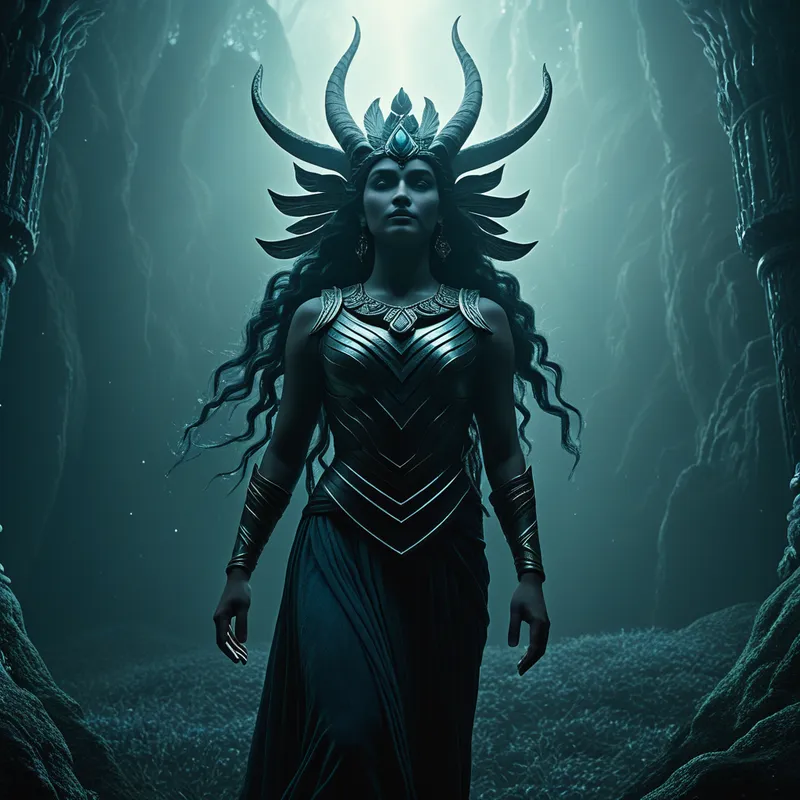
In the celestial realm of the heavens, where the rivers of stars flow, lived Jiknyeo, the Weaving Maiden. She was a daughter of the Haneullim, a goddess whose skilled hands wove not mere cloth, but the very fabric of the clouds and the shimmering robes of the dawn. Her loom was a constellation of its own, its rhythmic click-clack the heartbeat of orderly creation. Yet, for all the beauty she spun, her life was one of solitary perfection, a duty-bound existence where her eyes saw only threads and patterns, never the living world below.
Across the starry expanse, on the green earth, lived Gyeonwu, the Cowherd. He was a mortal of humble means, tending his single, aging ox with a gentle, patient heart. His world was one of soil, grass, and the slow, warm breath of his companion. His gaze was turned downward, to the needs of the earthbound creature in his care, his life a quiet hymn to simple, devoted labor.
Fate, in its inscrutable design, orchestrated their meeting. Some say the ox, a creature of both earth and subtle wisdom, spoke to Gyeonwu, guiding him to a hidden pool where Jiknyeo bathed with her celestial sisters. Others whisper that the Haneullim himself, observing the profound loneliness within his daughter’s perfect craft, allowed the winds to carry a thread from her loom down to the mortal realm, where it tangled around the cowherd’s heart. However it began, when their eyes met, a silent lightning struck. In him, she saw the grounded warmth, the embodied love, she had never known. In her, he saw a beauty and grace that spoke of a realm beyond toil, a [divine spark](/myths/divine-spark “Myth from Gnostic culture.”/) that ignited his soul.
Their love was immediate and all-consuming. They married, and for a time, heaven and earth were united in their joy. Jiknyeo abandoned her loom; the clouds grew ragged and the dawn arrived unadorned. Gyeonwu neglected his herd; his ox grew thin and the earthly order faltered. Their union, while personally blissful, caused a cosmic imbalance. The sacred divisions between divine duty and mortal responsibility, between celestial order and earthly care, had been dissolved by passion.
The Haneullim, as the guardian of cosmic harmony, could not let this stand. With a sweep of his hand, he parted the lovers, creating a vast, shimmering river of stars—[the Milky Way](/myths/the-milky-way “Myth from Greek culture.”/)—between them. Jiknyeo was returned to her celestial palace on one shore, Gyeonwu to his earthly field on the other, each condemned to gaze eternally at the other’s faint, beloved light across an impassable abyss.
Their grief was so profound, so pure, that it moved even the stern heart of heaven. The magpies, touched by their sorrow, pleaded on the lovers’ behalf. Moved by this intercession, the Haneullim decreed a compromise, a single thread of mercy in the tapestry of fate. Once a year, on the seventh day of the seventh lunar month, all the magpies in [the world](/myths/the-world “Myth from Tarot culture.”/) would fly up to the heavens. There, with their own bodies, they would form a living bridge across the Silver River, allowing the Weaver and the Cowherd one precious night of reunion.
Thus, the lovers wait, their longing marking the passage of the year. When that night arrives, and if the skies are clear, one might see the Milky Way burn a little brighter, witnessing the silent, joyous crossing. And if rain falls the next day, it is said to be their tears, already shed at the moment of parting, as the magpies scatter and the inexorable river of stars flows once more between them.
Cultural Origins & Context
This myth, known as Jiknyeo and Gyeonwu, is one of Korea’s most beloved folktales, with deep roots in East Asian star lore. It is the Korean interpretation of a widespread myth originating from China (the legend of Zhinü and Niulang), which itself is an ancient human story projected onto the stars Vega and Altair. In Korea, the tale was not merely imported but deeply naturalized, reflecting indigenous shamanic and Confucian values.
The story operates within a Korean cosmological framework that emphasizes harmony, balance, and the fulfillment of one’s prescribed role (bun). Jiknyeo’s weaving is not a hobby; it is a cosmic function. Gyeonwu’s herding is his earthly duty. Their transgressive love, while emotionally valid, disrupts the Great Order. The Haneullim’s judgment is not one of petty cruelty, but of necessary cosmic rectification. The annual reunion, therefore, is not just a romantic reprieve, but a ritual re-balancing—a sanctioned moment where the tension between personal desire and collective order is temporarily resolved, affirming both the power of love and the supremacy of harmony.
The myth is central to the festival of Chilseok, the “Evening of the Seventh.” It is a day of rituals, prayers for skilled hands (especially in weaving and sewing), and romantic hopes. The weather on Chilseok is closely observed; clear skies promise a successful [magpie bridge](/myths/magpie-bridge “Myth from Chinese culture.”/) and a good harvest, while rain signals the lovers’ sorrow and potential misfortune. The tale thus bridges astronomy, agriculture, social order, and intimate human emotion, embedding itself into the very rhythm of the Korean year and [psyche](/myths/psyche “Myth from Greek culture.”/).
Symbolic Architecture
At its core, the myth is a profound map of the psyche’s own [landscape](/symbols/landscape “Symbol: Landscapes in dreams are powerful symbols representing the dreamer’s emotional state, personal journey, and the broader context of life situations.”/). The [Milky Way](/symbols/milky-way “Symbol: The Milky Way represents both the vastness of the universe and the interconnectedness of existence, serving as a metaphor for the journey of life and cosmic consciousness.”/) is the ultimate [symbol](/symbols/symbol “Symbol: A symbol can represent an idea, concept, or belief, serving as a powerful tool for communication and understanding.”/) of [separation](/symbols/separation “Symbol: A spiritual or mythic division between realms, states of being, or consciousness, often marking a transition or loss of connection.”/), representing any [chasm](/symbols/chasm “Symbol: A deep fissure in the earth representing a profound division, transition, or psychological gap between states of being.”/) that divides the [soul](/symbols/soul “Symbol: The soul represents the essence of a person, encompassing their spirit, identity, and connection to the universe.”/): between conscious and unconscious, ego and [anima](/symbols/anima “Symbol: The feminine archetype within the male unconscious, representing soul, creativity, and connection to the inner world.”/)/[animus](/symbols/animus “Symbol: In Jungian psychology, the masculine inner personality in a woman’s unconscious, representing logic, action, and spiritual guidance.”/), duty and desire, the spiritual and the [material](/symbols/material “Symbol: Material signifies the tangible aspects of life, often representing physical resources, desires, and the physical world’s influence on our existence.”/). Jiknyeo and Gyeonwu are not just individuals, but archetypal principles longing for wholeness.
Jiknyeo represents the anima, the soul-image of connection to the transcendent, the creative spirit, and the longing for earthly embodiment. Her abandoned loom signifies creativity stifled by unintegrated passion.
Gyeonwu embodies the animus, the spirit of connection to the earth, practical care, and the longing for divine inspiration. His neglected ox symbolizes instinct and sustenance ignored for idealized love.
Their union is [the ego](/myths/the-ego “Myth from Jungian culture.”/)’s fleeting experience of wholeness (the hieros gamos or sacred [marriage](/symbols/marriage “Symbol: Marriage symbolizes commitment, partnership, and the merging of two identities, often reflecting one’s feelings about relationships and social obligations.”/)), which the psyche’s self-regulating principle (the Haneullim) cannot sustain indefinitely. The psyche must differentiate; the conscious mind must return to its duties. The annual meeting, then, is the periodic, sacred [moment](/symbols/moment “Symbol: The symbol of a ‘moment’ embodies the significance of transient experiences that encapsulate emotional depth or pivotal transformations in life.”/) when the conscious self consciously re-engages with the [depths](/symbols/depths “Symbol: Represents the subconscious, hidden emotions, or foundational aspects of the self, often linked to primal fears or profound truths.”/), a [ritual](/symbols/ritual “Symbol: Rituals signify structured, meaningful actions carried out regularly, reflecting cultural beliefs and emotional needs.”/) of reconnection essential for psychological [health](/symbols/health “Symbol: Health embodies well-being, vitality, and the balance between physical, mental, and spiritual states.”/) and creative renewal.
The Dreamer’s Resonance
For the modern dreamer, this myth echoes in every experience of profound, fateful connection that is constrained by circumstance. It speaks to the love separated by distance, the creative calling stifled by practical demands, the part of [the self](/myths/the-self “Myth from Jungian culture.”/) we feel is exiled across an internal Milky Way. The longing it depicts is not pathological, but archetypal—the soul’s inherent yearning for its missing counterpart.
The myth offers a paradoxical comfort: it sanctifies the longing itself. The value is not only in the union, but in the faithful waiting, the hope that structures time. It suggests that some loves are defined not by constant possession, but by the quality of the bond that persists across the separation. In therapeutic terms, it mirrors the process of holding a tension between opposites without forcing a premature, ego-driven solution, trusting that the “magpies” of the unconscious will, in their own time, provide a bridge for integration.

Alchemical Translation
In the alchemical vessel of the soul, the myth narrates the process of [coniunctio](/myths/coniunctio “Myth from Alchemical culture.”/) (union) and [separatio](/myths/separatio “Myth from Alchemical culture.”/) (separation), essential phases in the work of individuation. The initial, blissful marriage is the [nigredo](/myths/nigredo “Myth from Alchemical culture.”/)—a chaotic, all-encompassing fusion that is necessary but unsustainable. The Haneullim’s decree is the separatio, the often-painful differentiation where the elements are pulled apart to be purified.
The annual meeting on the magpie bridge is the albedo, the silver, lunar phase of conscious, ritualized reunion. It is not the final, solar gold of permanent integration, but a recurring, celestial reminder that the work is cyclical. The lovers are distilled by their longing, their love made more potent precisely because it is concentrated into a single, sacred night.
The ultimate goal hinted at is not a permanent earthly union, but a transformation of both principles through their faithful attendance to the cycle. Jiknyeo’s weaving, after each meeting, may gain a thread of earthly warmth; Gyeonwu’s herding, a touch of celestial patience. They are slowly alchemizing each other across the divide, their very natures evolving through the discipline of their love and the acceptance of their fate.
Associated Symbols
Explore related symbols from the CaleaDream lexicon:
- Fate (Urðr / Wyrd) — The inexorable weaving of destiny that both separates the lovers and provides the single, threaded path of their annual reunion, embodying a cosmic order that encompasses both law and mercy.
- Star — The celestial bodies of Vega and Altair, eternal fixed points of longing and hope in the night sky, guiding lights for separated souls.
- River — The Milky Way as the Silver River, a flowing, insurmountable boundary of light and space that represents the fundamental divides within existence and the psyche.
- Bridge — The living magpie bridge, a miraculous, temporary construct of collective sacrifice and natural sympathy that allows passage across the impossible.
- Separation — The core wound and central condition of the myth, the state of being cleft from one’s other half, which generates the profound longing that defines the lovers’ existence.
- Weave — The act of creation, order, and cosmic duty embodied by Jiknyeo’s loom, representing the structured fabric of reality from which the soul can stray for love.
- Herd — Gyeonwu’s earthly charge, symbolizing the responsibilities, instincts, and grounded, caring nature that must be tended to as part of one’s earthly duty.
- Love — The transcendent, disruptive, and ultimately redeeming force that defies cosmic order and, in doing so, forges a new, cyclical law of its own.
- Dream — The realm where such longing is most acutely felt and where the magpie bridge might first be glimpsed, a nightly internal Chilseok.
- Tapestry of Fate — The grand design woven by cosmic forces, into which the golden thread of the lovers’ story is intricately, if tragically, knotted.