The Way Myth Meaning & Symbolism
A story of the nameless source, the ten thousand things, and the path of returning to simplicity through non-action and natural harmony.
The Tale of The Way
Before the first name was spoken, before the first distinction was made, there was only the Tao. It was not a [thing](/myths/thing “Myth from Norse culture.”/), but the mother of all things. A silence so profound it was [the womb](/myths/the-womb “Myth from Various culture.”/) of all sound. A darkness so complete it was the canvas for all light. It moved, but not with effort; it flowed like a great, dark river through the heart of nothingness, and its current was the first and only law: to be as it is.
From this boundless, undifferentiated source, a breath was drawn. This was not a separation, but a gentle turning. This breath was the [Tai Chi](/myths/tai-chi “Myth from Chinese culture.”/), the Supreme Ultimate. Within it, two rhythms began to pulse—not as enemies, but as lovers in an eternal dance. The soft, yielding, receptive darkness of Yin. The bright, active, creative light of Yang. Their interplay was not conflict, but courtship. From their embrace, the Wan Wu—the ten thousand things—were born. Stars, stones, rivers, tigers, and human hearts all spilled forth from this generative dance, each carrying the imprint of the original Way in its essence.
Yet, in their birth, a forgetting occurred. The ten thousand things, beautiful and myriad, became fascinated with their own forms. [The river](/myths/the-river “Myth from Buddhist culture.”/) believed it was only its current, forgetting it was also the [water](/myths/water “Myth from Chinese culture.”/) and the bed. The tiger knew only its strength, forgetting the yielding grass that supported its leap. Humanity, most clever of all, began to carve names onto [the uncarved block](/myths/the-uncarved-block “Myth from Taoist culture.”/) of reality. They prized the bright Yang—action, possession, achievement—and grew to fear the dark Yin—stillness, emptiness, release. They built dikes against [the river](/myths/the-river “Myth from Buddhist culture.”/)’s flow and cages for their own wild hearts. [The world](/myths/the-world “Myth from Tarot culture.”/) grew loud with striving and quiet with a deep, unspoken sorrow. The harmonious hum of [the Tao](/myths/the-tao “Myth from Taoist culture.”/) faded to a distant whisper beneath the clamor of human making.
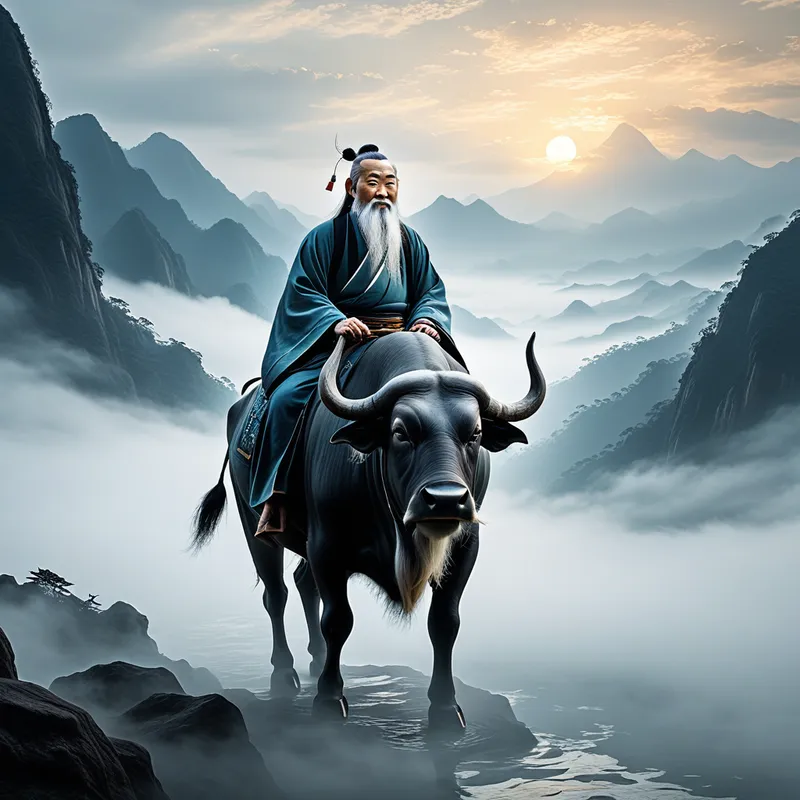
But the Way does not cease. It flows around all obstructions, wears down all hardness with soft persistence. It called not with a shout, but with a deepening silence. In the courts of kings, amidst the clatter of chariots and the debates of scholars, a keeper of the archives named [Laozi](/myths/laozi “Myth from Chinese culture.”/) felt the whisper become an ache. He saw the suffering inherent in all this forced carving. One evening, as the sun bled into the western mountains, he saddled his black water buffalo. Without a word to the world of names and duties, he turned his back and rode towards the mountain pass, towards the source of the whispering.
At the border gate, a keen-eyed keeper, Yin Xi, recognized the sage in the humble traveler. He implored him, “Master, if you are to withdraw from the world, will you not leave behind your wisdom, so that we who remain in the dust might find our way back?” Moved by this request, Laozi paused. He did not build a lecture hall or summon scribes. He simply sat, took a brush, and in the space of a few sunrises, inscribed five thousand characters onto bamboo slips. He spoke not of conquering the world, but of aligning with it. He wrote of [Wu Wei](/myths/wu-wei “Myth from Taoist culture.”/)—action without forcing. He described the power of the soft water that cleaves the hard stone. He pointed to the Pu, the Uncarved Block, as the truest state of being.
When the last character was set down, he handed the slips to Yin Xi. Then, without ceremony, he urged his buffalo forward, passed through the gate, and faded into [the mist](/myths/the-mist “Myth from Celtic culture.”/)-wreathed mountains, becoming one with the very mystery he described. He did not leave a religion, but a map—a map that leads not out, but in; not forward, but back. Back to the simplicity before the first cut was made, back to the harmony of the original dance, back to The Way that was, is, and ever shall be, flowing silently beneath the noise of the ten thousand things.
Cultural Origins & Context
The myth of the Tao is not a story with a single author or date of origin, but the crystallized essence of an ancient Chinese worldview. Its most famous vessel is the Tao Te Ching (The Book of the Way and Its Virtue), a text of enigmatic poetry compiled around the 4th century BCE, a time of immense social upheaval known as the Warring States period. In an era of brutal conflict, rigid Confucian hierarchies, and complex political scheming, the Taoist sages offered a radical counter-narrative.
This wisdom was transmitted orally by reclusive masters and “fangshi” (method masters) long before being written down. The figure of Laozi is likely a composite—a legendary sage onto whom this deep, anti-institutional wisdom was projected. The myth functioned as a profound critique of civilization’s excesses. It was a guide for rulers on governing by minimal interference, for hermits seeking harmony with nature, and for ordinary people navigating a chaotic world. It provided a cosmological framework that explained natural cycles, personal health, and social order through the principles of [Yin-Yang](/myths/yin-yang “Myth from Taoist culture.”/) balance and alignment with the impersonal, nurturing force of the Tao.
Symbolic Architecture
Psychologically, the myth maps the [journey](/symbols/journey “Symbol: A journey in dreams typically signifies adventure, growth, or a significant life transition.”/) from a state of psychic [fragmentation](/symbols/fragmentation “Symbol: The experience of breaking apart, losing cohesion, or being separated into pieces. Often represents disintegration of self, relationships, or reality.”/) (the ten thousand things) back to a state of wholeness (the Uncarved Block). The Tao represents the unconscious Self in its totality—the ground of being from which the conscious ego (Yang) and the unconscious [shadow](/symbols/shadow “Symbol: The ‘shadow’ embodies the unconscious, repressed aspects of the self and often represents fears or hidden emotions.”/)/[animus](/symbols/animus “Symbol: In Jungian psychology, the masculine inner personality in a woman’s unconscious, representing logic, action, and spiritual guidance.”/)/[anima](/symbols/anima “Symbol: The feminine archetype within the male unconscious, representing soul, creativity, and connection to the inner world.”/) (Yin) differentiate.
The goal is not to become the source, but to let the source become through you.
The Wan Wu symbolizes [the ego](/myths/the-ego “Myth from Jungian culture.”/)‘s identification with its myriad roles, possessions, and thoughts—the “[persona](/symbols/persona “Symbol: The social mask or outward identity one presents to the world, often concealing the true self.”/)” complex that believes it is separate from the whole. Wu Wei is the symbolic [antidote](/symbols/antidote “Symbol: A substance or remedy that counteracts poison, illness, or harmful influences, symbolizing healing, protection, and restoration.”/): it represents [the ego](/myths/the-ego “Myth from Jungian culture.”/)‘s surrender of its compulsive control, allowing the [direction](/symbols/direction “Symbol: Direction in dreams often relates to life choices, guidance, and the path one is following, emphasizing the importance of navigation in personal journeys.”/) of the larger Self. It is conscious [action](/symbols/action “Symbol: Action in dreams represents the drive for agency, motivation, and the ability to take control of situations in waking life.”/) that feels instinctive and frictionless, like a skilled [artist](/symbols/artist “Symbol: An artist symbolizes creativity, expression, and the exploration of the human experience through various forms of art.”/) whose hand moves without deliberate thought.
The journey of Laozi—leaving the civilized world (the conscious ego’s domain) for the misty mountains (the unconscious)—is the archetypal journey of introversion, necessary for reconnecting with the neglected, devalued Yin aspects of the [psyche](/myths/psyche “Myth from Greek culture.”/): receptivity, [intuition](/symbols/intuition “Symbol: The immediate, non-rational understanding of truth or insight, often described as a ‘gut feeling’ or inner knowing that bypasses conscious reasoning.”/), and quietude.
The Dreamer’s Resonance
When this myth activates in the modern psyche, it often manifests in dreams of profound simplicity or frustrating obstruction. A dreamer may find themselves in a complex, labyrinthine building (the constructed ego) only to discover a hidden, perfectly round, empty room at its center (the Pu). They may dream of trying to force a door open, only to exhaust themselves, then watch as it swings open effortlessly when they stop pushing.
Somatically, this process can feel like a deep fatigue with striving—a “burnout” that is less about exhaustion and more about the soul’s rebellion against a life of forced carving. There is a longing for “less”: less noise, less clutter, less doing. Psychologically, it is the recognition that one’s conscious efforts to “fix” or “achieve” wholeness are often the very obstacle. The psyche is initiating a process of undoing—releasing identifications, softening rigid judgments, and making space for the autonomic wisdom of the body and the unconscious to guide the way.
Alchemical Translation
The alchemical work modeled by this myth is not one of aggressive purification or heroic conquest, but of patient subtraction and humble alignment. The modern individual’s “individuation” is reframed not as a heroic journey to build a superior self, but as a sage’s return to the original, authentic self that existed before cultural conditioning and trauma carved it into a socially acceptable shape.
The alchemy is in the erosion, not the erection.
The first operation is Observation: learning to witness the compulsive dance of the “ten thousand things” within one’s own mind—the plans, worries, and self-narratives—without identifying with them. This creates inner space.
The second is Receptivity: consciously cultivating the devalued Yin. This means practicing stillness, listening to intuition, and allowing emotions to flow through without immediate analysis or action. It is the water wearing down the stone of the rigid ego.
The final, ongoing process is Alignment: Wu Wei. This is where action arises not from the ego’s anxiety or desire for recognition, but from a deep sense of inner necessity and fit. It feels like “being in the zone,” where decisions make themselves and one’s actions become a natural expression of the moment’s demand. The individual becomes a clear vessel through which the Tao, [the Self](/myths/the-self “Myth from Jungian culture.”/), can flow into the world. The [triumph](/myths/triumph “Myth from Roman culture.”/) is not a trophy, but a sigh of homecoming—the recognition that you were never lost, only looking in the wrong direction.
Associated Symbols
Explore related symbols from the CaleaDream lexicon: