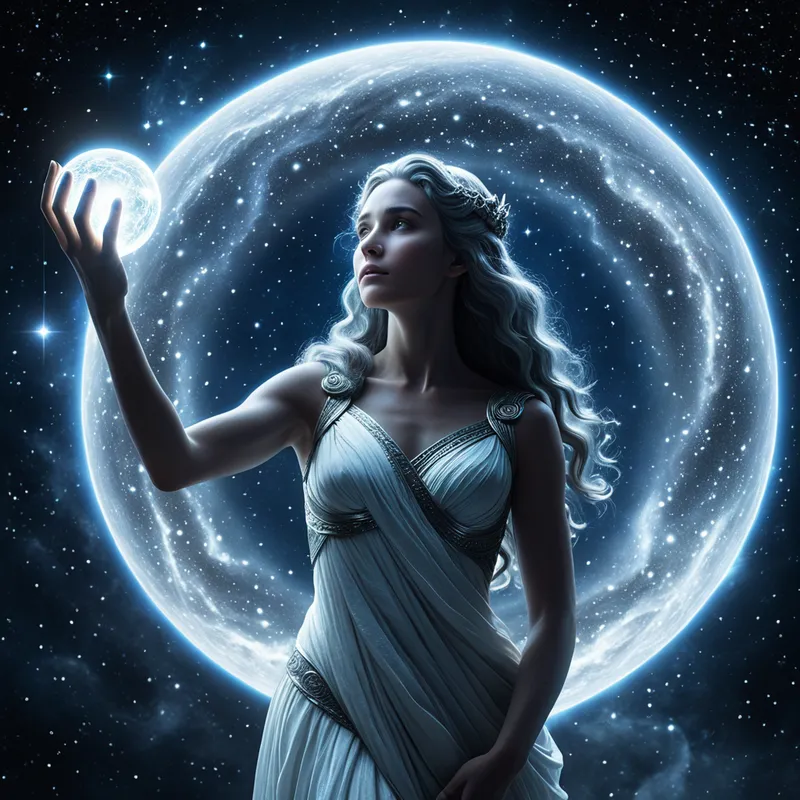
The Waxing Gibbous Moon Myth Meaning & Symbolism
A myth of a celestial artisan who sacrifices her perfect form to gather the scattered light of creation, becoming the luminous, almost-full moon.
The Tale of The Waxing Gibbous Moon
Listen, and hear the story written in light upon the dark.
In the time before time, when the First Silence was broken only by the scattered breath of unborn stars, there existed Elara. She was a daughter of the Primal Pulse, and her nature was to make whole. Her first and most beloved creation was herself: a sphere of perfect, polished silver, a mirror to the infinite potential. She was the Complete Reflection, and her light was a calm, unwavering song.
But as she turned her gaze upon the newborn cosmos, she saw not order, but a heartbreaking diaspora. The sparks of the First Ignition had flown out in a cataclysm of beauty and chaos. These sparks—potential worlds, souls, ideas—were now adrift as fractured, lonely shards in the cold expanse. They glittered, lost and un-remembered, their light too faint to find their kin.
The song of Elara’s perfect light faltered. The harmony of her own completion felt hollow against the silent weeping of the scattered ones. A choice, terrible and clear, crystallized within her. To remain whole was to be a monument to solitude. To help was to become something… else.
She did not hesitate. With a sound like a crystal sigh, she pressed her perfect silver form against the sharp, cold edge of a Cosmic Law. A segment of herself, a crescent of pure being, sheared away. This sacrifice was not a loss, but an opening—a vessel made from her own substance.
Now incomplete, she began her labor. No longer the Complete Reflection, she became the Keeper of the Gleaning. She traversed the velvet abyss, her light no longer a perfect broadcast but a focused, seeking beam. With hands made of gentle gravity, she reached into the darkness. One by one, she gathered the shivering shards. A fragment of a forgotten melody here. A speck of a dream of green there. A tear of unformed joy. A splinter of courageous anger.
Each shard was sharp, each carried the memory of its violent birth. As she placed them into the vessel of her sacrifice, they did not fit neatly. They jostled and glimmered, their edges catching, their lights conflicting. Her form, once smooth, now bulged with their captured, struggling luminescence. She was no longer a mirror, but a crucible. Her light became a complex, pulsing thing—mostly brilliant and full, yet forever marked by the ragged, glowing line where her own wholeness had been given away. She became the light that is almost enough, the promise that is being kept, the beauty that is real because it is scarred by care. This is the form she bears forever: the Waxing Gibbous, forever in the act of becoming full through the grace of what she has gathered.

Cultural Origins & Context
This myth originates from the observational priestesses and philosophers of the ancient Lunar coastal cultures, for whom the moon was not a distant symbol but a visceral timekeeper of tides, cycles, and planting. The myth of Elara was not a story of a remote goddess, but a functional cosmology. It was recited during the specific nights of the waxing gibbous phase, a time considered neither beginning nor culmination, but of critical, vulnerable work.
It was traditionally told by the Tide-Counters, often elders or healers, during communal gatherings under the very moon it describes. Its societal function was multifaceted: it explained the moon’s “imperfect” appearance not as a flaw, but as evidence of a sacred, ongoing duty. It served as a foundational ethic for a society that relied on communal gathering, care for the lost or broken, and the understanding that true strength often requires a willing incompleteness. The myth validated the hard, often messy work of integration—of refugees, of new ideas, of personal flaws—as a divine, lunar process.
Symbolic Architecture
At its core, the myth dismantles the archetype of perfect, static divinity. Elara begins as the Complete Reflection, a psychological state of idealized self-sufficiency that is ultimately isolating. The scattered shards represent the fragmented contents of the personal and collective unconscious: traumas, forgotten potentials, orphaned talents, and unintegrated aspects of the self that feel “not me.”
The first act of true creation is often an act of deliberate de-creation of the old self.
Elara’s sacrifice of her perfect crescent is the critical psychological move from being to doing, from identity to vocation. The vessel she creates is the ego’s capacity to hold and process unconscious material. The Waxing Gibbous Moon, therefore, is not a symbol of lack, but of active curation. It represents the psyche in a state of strenuous integration, where gathered contents have not yet been fully assimilated. The “bulging” light is the palpable pressure of this psychological work—the anxiety, excitement, and somatic tension that accompanies real growth. The myth posits that wholeness is not a pristine starting condition, but an achievement born of compassionate gathering and the courage to be visibly unfinished.
The Dreamer’s Resonance
When this myth pattern activates in the modern dreamer, it often manifests as dreams of collection, burden, or nearing—but not reaching—a goal. One might dream of frantically gathering important papers in a windstorm, of trying to hold too many precious, fragile objects at once, or of watching a gauge or progress bar climb to 85% and stall. The somatic sensation is one of fullness, pressure, and anticipatory tension in the chest or hands.
Psychologically, this indicates the dreamer is in a potent, yet precarious, phase of individuation. They have moved beyond initial inspiration (the new moon) and have gathered significant insights, skills, or self-knowledge (the shards). Now, they are carrying this load. The dream state is processing the anxiety of this “gibbous” phase: the fear that the gathered pieces won’t cohere, the weight of responsibility for one’s own growth, and the vulnerability of being so clearly in progress. It is the psyche’s way of validating the struggle, whispering that this pressured, almost-full state is not failure, but the essential, messy morphology of becoming.

Alchemical Translation
The alchemical journey mirrored here is the Ablutio and the beginning of Coniunctio. Elara’s perfect silver sphere (the prima materia of the self) must first be “cut” or dissolved by the waters of compassion. This is the necessary death of the idealized, self-contained ego.
The modern individual undergoes this when a moment of empathy—for one’s own past wounds or for the fragmentation in the world—compels them to abandon a previous, simpler identity. They open a vessel (a therapy journal, a new practice, a committed relationship) into which they begin to gather their own scattered shards: repressed memories, unexpressed emotions, denied talents.
The goal is not to return to a perfect sphere, but to become a more luminous, complex, and useful shape—a shape defined by what it holds.
The “alchemical fire” is the friction of holding these conflicting elements together within oneself. The triumph is not a return to perfect, silent silver, but the generation of a new, more resonant light—the gibbous light, which is wise precisely because it has made room for the world’s brokenness. The individual learns that their worth is not diminished by their scars of care, but is fundamentally constituted by them. They become, like the Waxing Gibbous Moon, a beacon for the lost, not because they have all the answers, but because their very form is a testament to the sacred work of gathering.
Associated Symbols
Explore related symbols from the CaleaDream lexicon: