The waves of Yemoja in Yoruba Myth Meaning & Symbolism
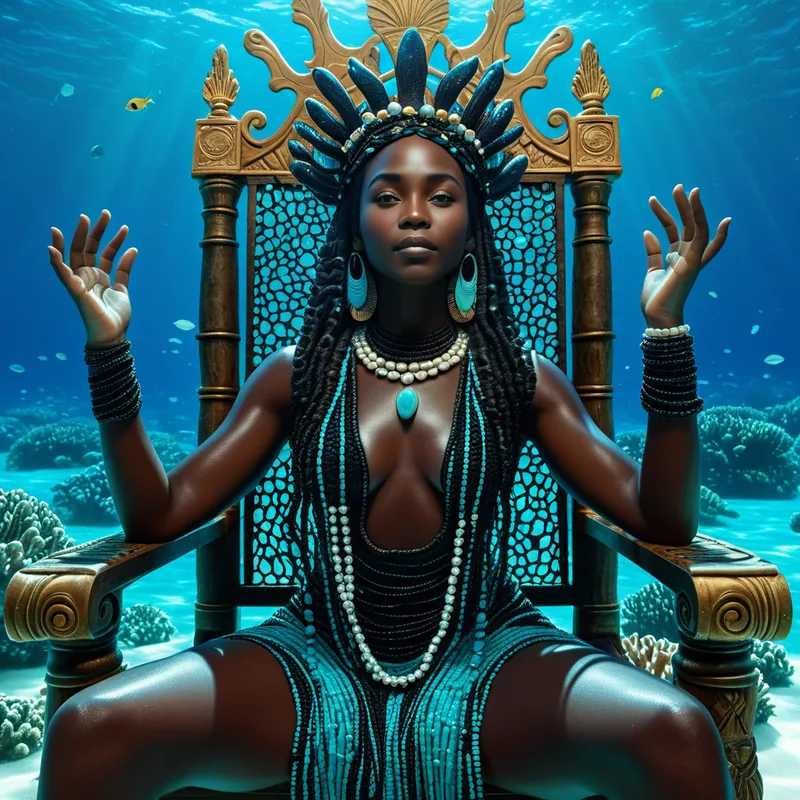
The primordial mother Yemoja, grieving her lost children, weeps an ocean of creation, transforming boundless sorrow into the source of all life.
The Tale of The waves of Yemoja in Yoruba
In the beginning, there was not water, but longing.
Before the first shore was kissed, before the first fish drew breath, there was Yemoja. She was the womb of the world, a vessel of infinite potential, her body the firmament of the first earth. Her heart beat a slow, deep rhythm that was the only music in the stillness. And from that rhythm, from the fertile darkness of her being, she brought forth life. Sixteen perfect children, gods and goddesses of fire, thunder, iron, and forest. She loved them with a fierceness that could have shaped mountains.
But children of divinity are born with destinies larger than a mother’s embrace. One by one, they left her. They strode into the raw clay of the world to forge their own realms, to become powers worshipped in their own right. Ogun took to the forge. Shango claimed the sky. Eshu danced at the crossroads. Yemoja’s vast courtyard, once echoing with their voices, fell silent.
The silence was a new kind of void. It pressed upon her, heavier than the sky. She looked at her empty hands, which had cradled creation, and felt a hollow wind blow through the chambers of her soul. The love she had poured forth had nowhere to go. It pooled inside her, a great inland sea of unmet nurture, turning bitter and saline with the ache of absence.
Then, the grief came. It did not come as a sigh, but as a cataclysm.
It began as a pressure behind her eyes, a gathering storm in her breast. The first tear was not water, but a piece of her soul, molten and luminous. It fell upon the parched ground and hissed. Then the floodgates broke. A torrent of sorrow erupted from her—a weeping so profound it shook the foundations of the earth. She did not sob; she unleashed. Rivers of tears poured from her eyes, streams from her fingertips, great geysers from the very core of her being. She wept for the children gone, for the emptiness left behind, for the love that had become a weight.
Her tears did not vanish. They gathered. They flowed into the low places of the world, filling the deepest cracks and fissures. They rose and rose, a churning, tempestuous expanse of blue-green anguish. Yemoja, the mother, was dissolving into her own sorrow. Her body softened, her form merging with the surging waters. Her bones became the reefs, her breath the tides, her flowing robes the currents. The very substance of her grief became the world’s first ocean.
And in that vast, saline womb of her own making, a miracle stirred. The life-giving power of her essence, even in its form of profound sadness, remained. Her tears, saturated with her nurturing ase, became fertile. From the foam of her turbulent waves, new forms emerged. Fish darted like living thoughts. Whales sang the deep songs of her heart. Coral grew in intricate patterns of remembered lace. The ocean, born of unbearable loss, became the mother of all life on Earth. Yemoja did not die; she transmuted. She became the sea itself—no longer a mother grieving in a courtyard, but the Iya Mi, the ultimate source, whose waves were now both her tears and her nurturing embrace for all creation.
Cultural Origins & Context
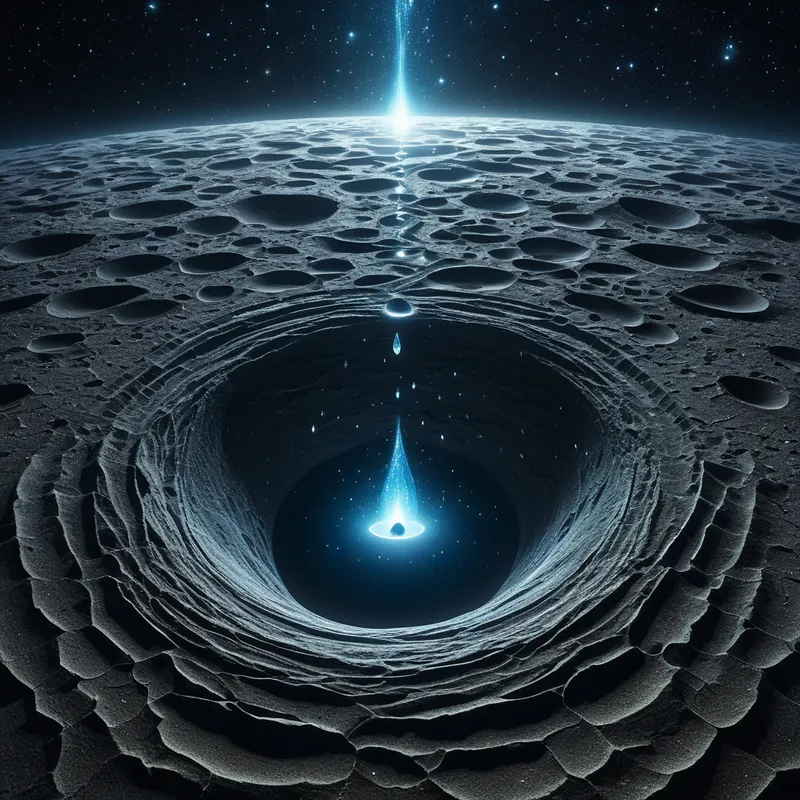
This narrative of Yemoja originates from the Yoruba people of what is now southwestern Nigeria and parts of Benin and Togo. It is a foundational itan passed down orally for centuries by arokin and priests within the intricate system of Ifá. Far from a simple “creation myth,” this story functioned as a profound cosmological map and a social-psychological anchor. It explained the origin of the vital, life-sustaining sea and positioned a maternal, emotional principle at the very root of existence. In a patriarchal societal structure, the myth of Yemoja established the indispensable, ultimate power of the feminine as source and sustainer. Her worship, particularly among women, addressed fertility, childbirth, and the healing of emotional wounds, recognizing grief not as a weakness, but as a potentially creative, transformative force as fundamental as the ocean itself.
Symbolic Architecture
The waves of Yemoja are not merely water; they are the visible form of emotional and psychic energy in its most raw and potent state. The myth presents a non-linear, alchemical model where the endpoint (the life-giving ocean) is born directly from the catalyst of unmediated feeling (devastating grief).
The deepest well of creation is often dug with the spade of unbearable loss.
Yemoja represents the archetypal container. Initially, she contains potential (her children), then she contains the pain of their departure. When that container can no longer hold the pressure, it does not break—it transforms. The “waves” symbolize this dynamic process: the rhythmic, inevitable surge of emotion that cannot be statically held. The salt in her tears is crucial; it is the preservative, the element of wisdom and experience that prevents grief from being mere passing sadness. It makes the emotion substantive, eternal, and fertile. Psychologically, Yemoja embodies the totality of the mother complex—not just the nurturing aspect, but the terrifying aspect of the mother who must let go, who feels abandoned, and whose love can feel like an engulfing sea. Her transformation suggests that to navigate this complex, one must not avoid the flood of feeling, but learn to become the ocean.
The Dreamer’s Resonance
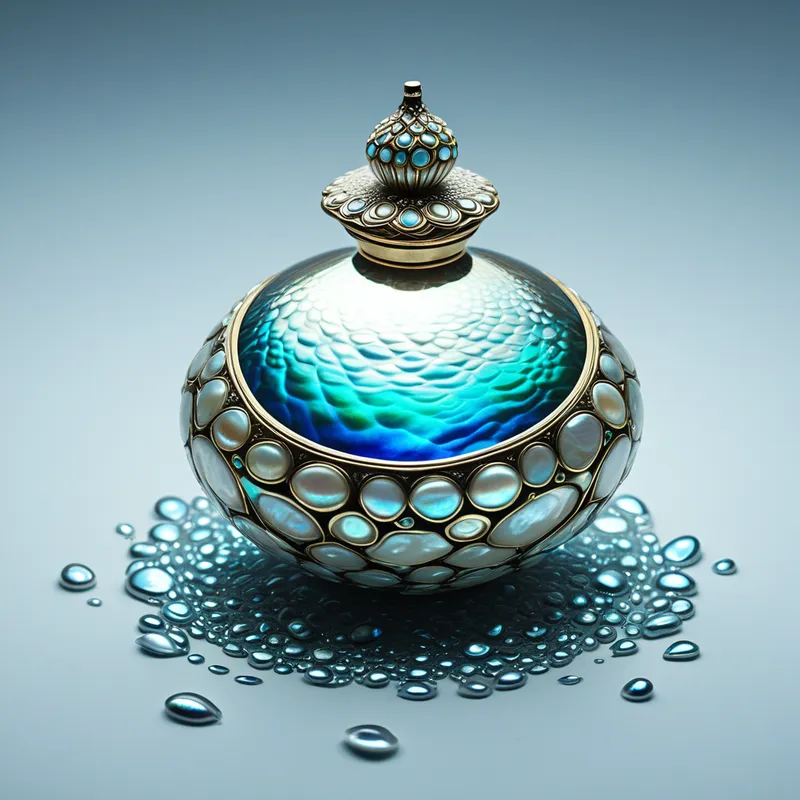
To dream of Yemoja’s waves is to dream of a somatic and emotional threshold. Common motifs include being caught in a tidal wave of feeling (sadness, anger, longing), finding oneself breathing underwater, or watching a calm shoreline suddenly be engulfed. Somatically, the dreamer may report sensations of pressure in the chest, a lump in the throat, or the sound of roaring in the ears upon waking.
These dreams often surface during life transitions involving profound release or loss: the end of a primary relationship, children leaving home, the death of a parent, or the conclusion of a long creative project. The unconscious is presenting the Yemoja process. The rising water is not a threat of drowning in the classical sense, but an imperative to feel fully. The dream asks: What vast, unexpressed emotional sea is building within you? What maternal or creative role are you being asked to release, and what grief have you not yet honored? The dream may feel terrifying, but its purpose is initiatory—it signals that the psyche is attempting to transmute a held-back reservoir of life experience into a new, more expansive medium of being.

Alchemical Translation
The individuation journey modeled by Yemoja is the solve et coagula of the heart. The modern ego, like the young Yemoja, often identifies itself as a container of roles, relationships, and achievements—the “mother” of its own created world. When life inevitably dissolves these attachments (the children leaving), the ego faces the arid ground of its own emptiness. The instinct is to fortify the container, to resist the flood of grief, shame, or fear.
Individuation requires the courage to let the vessel of the old self be dissolved by its own contents, trusting that a vaster, more authentic form will coalesce from the flood.
Yemoja’s path instructs us to do the opposite: to allow the container to be overwhelmed by its contents. This is the solve (dissolution). To weep the ocean is to fully surrender to the emotional truth, without analysis or mitigation. It is the death of the ego’s small, controlled identity. The coagula (coagulation) is not a return to the old form, but the emergence of a new, elemental one. The salt of conscious suffering gives weight and permanence to the experience. From this surrendered state, what emerges is not the same person, but a being who has become identified with a deeper, more universal principle. One no longer has emotions; one is a medium through which the emotional and creative currents of life flow. The individual becomes like the sea: a source of life, capable of deep nurturance, holding mysteries, weathering storms, and connecting all shores. The personal grief becomes transpersonal creativity. The mother becomes the world.
Associated Symbols
Explore related symbols from the CaleaDream lexicon: