The Waters of Marah Myth Meaning & Symbolism
A parched people find water in the desert, only to discover it is poisonously bitter, forcing a confrontation with despair and the revelation of a hidden cure.
The Tale of The Waters of Marah
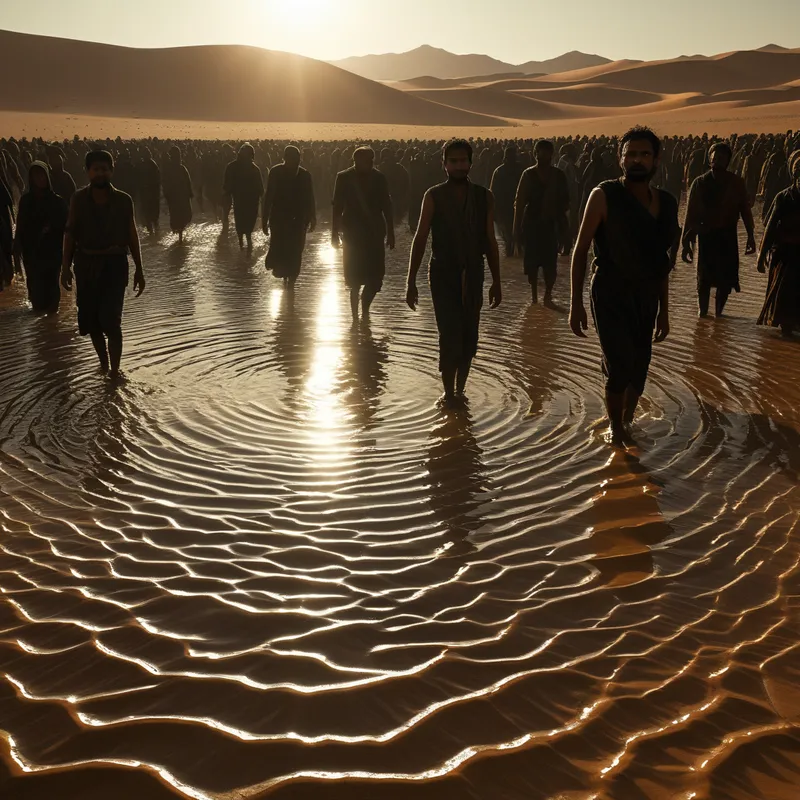
The sun was a hammer on an anvil of sand. Three days. Three days without a drop, their mouths full of dust, their throats lined with grit. The euphoria of escape, of the parted sea, had evaporated like a mirage, leaving behind the raw, scraping truth of [the wilderness](/myths/the-wilderness “Myth from Biblical culture.”/). The great host of Israel moved as one parched beast, a whisper of hope dying with every dragging step.
Then, a cry went up—not of joy, but of desperate discovery. [Water](/myths/water “Myth from Chinese culture.”/)! A pool, nestled in a rocky depression at a place they would name [Marah](/myths/marah “Myth from Biblical culture.”/). A stampede of cracked lips and desperate hands. They surged forward, cupping the liquid to their faces.
And the taste was betrayal.
It was not water. It was a lie. A bitter, acrid, poisonous lie that seized the tongue and clenched the gut. It was the taste of hope curdled. Men spat, women wept, children wailed. The murmuring began, a low, dangerous rumble against [Moses](/myths/moses “Myth from Biblical culture.”/) and against the heavens. “What shall we drink?” The question was not a plea but an accusation. Had they been led from the iron house of [Pharaoh](/myths/pharaoh “Myth from Egyptian culture.”/) only to die of thirst in the freedom of [the desert](/myths/the-desert “Myth from Biblical culture.”/)? The water before them was a cruel mirror, reflecting their deepest fear: that their liberation was a mistake, that the wilderness was not a passage but a tomb.
In the center of the despair stood Moses. The weight of their eyes upon him was heavier than stone. He did not argue. He did not promise. He turned from the bitter pool and the bitter crowd, and he cried out. His voice did not rise in anger to the people, but in a raw, solitary supplication to the Lord. And there, in the silence that followed his cry—a silence filled only with the sound of suffering—a revelation was given.
Not a [thunderclap](/myths/thunderclap “Myth from Various culture.”/). Not a miracle from nothing. A showing. The Lord showed him a tree. Not a mighty cedar, but a piece of wood, ordinary, weathered, lying at the desert’s edge. A simple [thing](/myths/thing “Myth from Norse culture.”/). An instruction whispered to the soul: Take. Cast.
Moses took the wood. He walked back to the edge of the murmuring crowd, to the lip of the bitter pool. All eyes were on him, filled with doubt, with anger, with a last flicker of desperate hope. He did not speak. He lifted the wood and cast it into the heart of the waters of Marah.
A ripple spread. Then a change, not seen but tasted. The acrid bite on the air softened. A man, daring, bent and sipped from his hand. His eyes widened. He drank deeply, then cried out—this time, a sound of pure, unadulterated shock and relief. It was sweet. The water was sweet. The poison was gone. The lie had become truth. The crowd surged again, but this time in laughter and weeping of a different kind, drinking not just water, but a lesson made liquid.

Cultural Origins & Context
This episode, recorded in the book of Exodus (Chapter 15), is a foundational wilderness narrative. It belongs to the corpus of stories crafted and refined during the Second Temple period, though its roots are far older, emerging from the oral traditions of tribal confederations seeking to define their identity. The story was not merely history but theology enacted. It was told around campfires and later recited by priests to answer a perennial human and national question: how does a people navigate the terrifying gap between promise and fulfillment?
Its societal function was multifaceted. For a community often in crisis—exiled, oppressed, or struggling—it was a narrative anchor. It acknowledged the reality of bitterness (Marah) on the journey toward a promised future. It established a pattern: crisis, complaint, divine response, and statute. The “statute and ordinance” given at Marah immediately after the sweetening of the waters served to root the miraculous in enduring ethical and ritual practice, binding the community’s identity to obedience and trust, even when the immediate reality was unpalatable. The storytellers, likely the Levitical priests, used it to teach that the divine response to human despair is often not removal from the bitter circumstance, but a revelation of the transformative agent already present within the landscape of the trial.
Symbolic Architecture
The myth’s power lies in its stark, almost alchemical [symbolism](/symbols/symbolism “Symbol: The use of symbols to represent ideas or qualities, often conveying deeper meanings beyond literal interpretation. In dreams, it’s the language of the unconscious.”/). The Waters themselves represent the emotional and spiritual sustenance we seek. They are our hopes, our longed-for solutions, our “promised lands.” To find them bitter is one of [life](/symbols/life “Symbol: The symbol of ‘Life’ represents a journey of growth, interconnectedness, and existential meaning, encompassing both the joys and challenges that define human experience.”/)‘s most profound disillusionments—the job that becomes a [prison](/symbols/prison “Symbol: Prison in dreams typically represents feelings of restriction, confinement, or a lack of freedom in one’s life or mind.”/), the [relationship](/symbols/relationship “Symbol: A representation of connections we have with others in our lives, often reflecting our emotional state.”/) that turns sour, the freedom that feels like [abandonment](/symbols/abandonment “Symbol: A dream symbol representing feelings of being left behind, isolated, or emotionally deserted, often tied to primal fears of separation and loss of support.”/).
The bitterness of Marah is not the presence of poison, but the absence of the expected cure.
Moses represents the conscious ego, the [leader](/symbols/leader “Symbol: A leader signifies authority, responsibility, and guidance; representing aspirations for achievement or fear of following.”/) burdened with [responsibility](/symbols/responsibility “Symbol: Responsibility in dreams often signifies the weight of duties and the expectations placed upon the dreamer.”/), facing the mutiny of the unconscious (the complaining people) when its needs are not met. His turn from the crowd to cry out to the divine symbolizes the essential pivot from managing external complaints to seeking internal [guidance](/symbols/guidance “Symbol: The act of receiving or seeking direction, advice, or leadership in a dream, often representing a need for clarity, support, or a higher purpose on one’s life path.”/)—a [movement](/symbols/movement “Symbol: Movement symbolizes change, progress, and the dynamics of personal growth, reflecting an individual’s desire or need to transform their circumstances.”/) from [problem](/symbols/problem “Symbol: Dreams featuring a ‘problem’ often symbolize internal conflicts or challenging situations that require resolution and self-reflection.”/)-solving to prayerful receptivity.
The [Tree](/symbols/tree “Symbol: In dreams, the tree often symbolizes growth, stability, and the interconnectedness of life.”/) (or [wood](/symbols/wood “Symbol: Wood symbolizes strength, growth, and the connection to nature and the environment.”/)) is the central [symbol](/symbols/symbol “Symbol: A symbol can represent an idea, concept, or belief, serving as a powerful tool for communication and understanding.”/) of [transmutation](/symbols/transmutation “Symbol: A profound, alchemical process of fundamental change where one substance or state transforms into another, often representing spiritual evolution or personal metamorphosis.”/). In the [logic](/symbols/logic “Symbol: The principle of reasoning and rational thought, often representing order, structure, and intellectual clarity in dreams.”/) of the myth, it is not created for the occasion but shown. It was already there, unnoticed. It represents the hidden resource, the forgotten [insight](/symbols/insight “Symbol: A sudden, deep understanding of a complex situation or truth, often arriving unexpectedly and illuminating hidden connections.”/), the archetypal [pattern](/symbols/pattern “Symbol: A ‘Pattern’ in dreams often signifies the underlying structure of experiences and thoughts, representing both order and the repetitiveness of life’s situations.”/) or [truth](/symbols/truth “Symbol: Truth represents authenticity, honesty, and the quest for knowledge beyond mere appearances.”/) that, when applied to the bitter [situation](/symbols/situation “Symbol: The ‘situation’ symbolizes the junction between the subconscious and conscious realms, often reflecting the current challenges or dynamics in the dreamer’s waking life.”/), changes its very [nature](/symbols/nature “Symbol: Nature symbolizes growth, connectivity, and the primal forces of existence.”/). In broader mythological [language](/symbols/language “Symbol: Language symbolizes communication, understanding, and the complexities of expressing thoughts and emotions.”/), it is the World [Tree](/symbols/tree “Symbol: In dreams, the tree often symbolizes growth, stability, and the interconnectedness of life.”/), the connecting principle between [heaven](/symbols/heaven “Symbol: A symbolic journey toward ultimate fulfillment, spiritual transcendence, or connection with the divine, often representing life’s highest aspirations.”/) (the divine instruction) and [earth](/symbols/earth “Symbol: The symbol of Earth often represents grounding, stability, and the physical realm, embodying a connection to nature and the innate support it provides.”/) (the bitter [reality](/symbols/reality “Symbol: Reality signifies the state of existence and perception, often reflecting one’s understanding of truth and life experiences.”/)). Its casting into the waters is an act of symbolic sacrifice—applying a principle of life ([wood](/symbols/wood “Symbol: Wood symbolizes strength, growth, and the connection to nature and the environment.”/)) to a [situation](/symbols/situation “Symbol: The ‘situation’ symbolizes the junction between the subconscious and conscious realms, often reflecting the current challenges or dynamics in the dreamer’s waking life.”/) of [death](/symbols/death “Symbol: Symbolizes transformation, endings, and new beginnings; often associated with fear of the unknown.”/) ([bitterness](/symbols/bitterness “Symbol: A taste or sensation associated with unpleasantness, resentment, or unresolved emotional pain, often signaling toxicity or a need for acceptance.”/)).

The Dreamer’s Resonance
When this myth stirs in the modern [psyche](/myths/psyche “Myth from Greek culture.”/), it often manifests in dreams of poisoned or undrinkable water. A dreamer may find themselves at a beautiful spring only to taste metallic, foul liquid. They may turn on a tap and find it spews mud or sludge. The somatic feeling is one of intense thirst coupled with visceral revulsion.
This dream pattern signals a “Marah moment” in the dreamer’s waking life. Psychologically, they are in a state where a long-sought goal or a foundational source of emotional nourishment has been attained, only to reveal a hidden, bitter quality. This could be the emptiness after a promotion, the loneliness within a new relationship, or the anxiety that accompanies a hard-won freedom. The dream is not merely reflecting disappointment; it is highlighting a critical initiation. The bitterness must be fully tasted and acknowledged—the “murmuring” must occur—for the psyche to register the depth of the problem. The dream is the psyche’s way of forcing a confrontation with the toxic element in an otherwise life-giving situation, preventing the dreamer from drinking poison while calling it sustenance.

Alchemical Translation
The process at Marah is a perfect model for psychic individuation—the transformation of the leaden, bitter experiences of the soul into the gold of wisdom and wholeness. [The first stage](/myths/the-first-stage “Myth from Alchemical culture.”/), [Nigredo](/myths/nigredo “Myth from Alchemical culture.”/), is represented by the three days in the desert and the discovery of the bitter waters: a state of blackening, despair, and putrefaction of old hopes.
The pivotal act is the Coniunctio, [the sacred marriage](/myths/the-sacred-marriage “Myth from Various culture.”/). This is not a union of opposites, but of the problem and its hidden, transformative counterpart. The bitter water (the conscious, painful complex) is united with the wood (the unconscious, archetypal remedy). Moses, as the mediating consciousness, performs this operation.
Individuation often requires us to throw the log of our deepest, most rooted wisdom into the bitter pools of our present suffering.
The sweetening of the waters is the Albedo, the whitening, the purification. The poison is not removed; it is transmuted. The experience of bitterness remains in memory, but its psychic charge is neutralized and integrated, becoming a source of resilience rather than toxicity. Finally, the establishing of a “statute and ordinance” corresponds to the [Rubedo](/myths/rubedo “Myth from Alchemical culture.”/), the reddening or embodiment. The insight gained from the transformation is codified into a lasting principle for [the ego](/myths/the-ego “Myth from Jungian culture.”/)—a new rule for living born from direct encounter with the divine. For the modern individual, this translates to the hard-won personal creed that emerges after a crisis: a non-negotiable understanding about trust, self-care, or integrity that was forged in the very moment they tasted the bitterness of their own personal Marah.
Associated Symbols
Explore related symbols from the CaleaDream lexicon: