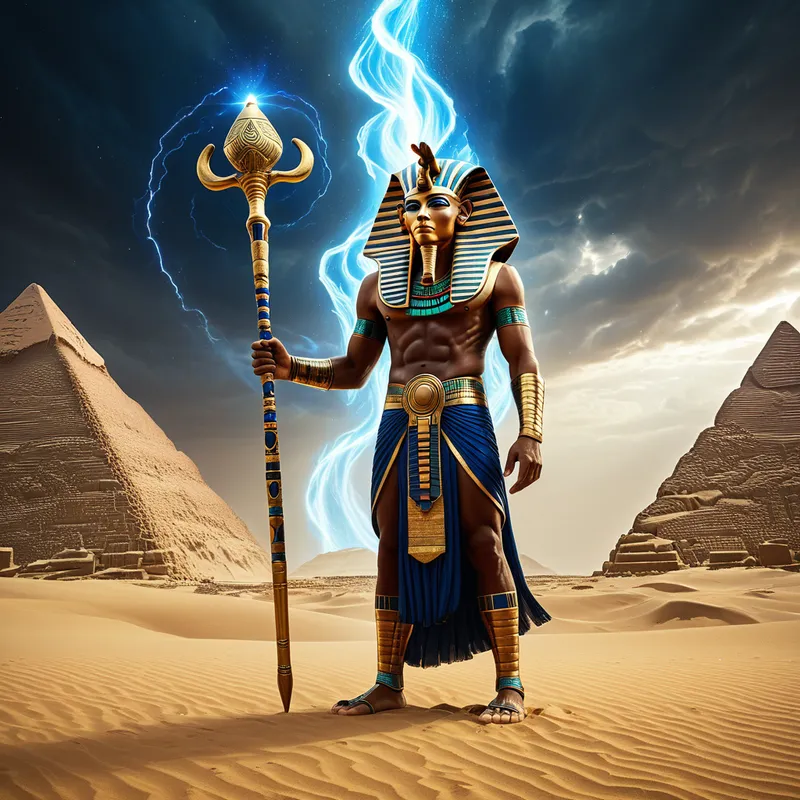
The Was Scepter Myth Meaning & Symbolism
A myth of the divine scepter that channels the power to bind chaos, wielded by gods and pharaohs to establish cosmic and earthly order.
The Tale of The Was Scepter
Before [the world](/myths/the-world “Myth from Tarot culture.”/) knew its name, [the desert](/myths/the-desert “Myth from Biblical culture.”/) knew its thirst. In the time when the gods walked the black soil of Kemet, a great unease stirred in the belly of the cosmos. It was a whispering, formless [thing](/myths/thing “Myth from Norse culture.”/)—[the shadow](/myths/the-shadow “Myth from Jungian culture.”/) of Isfet. It slithered at the edges of Maat, threatening to unravel the ordered paths of the sun and the steady flow of the Nile.
The Ennead, the great company of gods, felt this tremor. [Horus](/myths/horus “Myth from Egyptian culture.”/) the Avenger, his eye still fierce with the memory of his battle, gripped his spear, but a spear could only pierce, not bind. [Thoth](/myths/thoth “Myth from Global/Universal culture.”/), he of the measured word, unrolled his [papyrus](/myths/papyrus “Myth from Egyptian culture.”/), but words could describe, not contain. The chaos was not a beast to slay, but a force to master, a wild energy that needed a vessel, a key to transform its raw fury into structured might.
Then, from the furnace of necessity, [the divine smith](/myths/the-divine-smith “Myth from Various culture.”/) Ptah conceived a form. He took the sturdy leg of a desert creature, one that could stand unshaken on shifting sands. He fashioned its base into a mighty fork, like the jaws of a trap or the roots of a mountain, designed to pinion disorder to [the earth](/myths/the-earth “Myth from Hindu culture.”/). Upon its shaft, he carved the patterns of eternity, the ankh and the djed, weaving permanence into its very grain. And at its apex, he set the serene, watchful head of the desert Set-animal, the creature who dwells in the liminal wastes, who knows the secrets of storms and the boundaries of the world.
This was no mere rod. It was a covenant, a lightning rod for sovereignty. The gods presented it first to Set, the untamable one, he who rides the storm. “You who know the shape of the wild,” they intoned, “you must learn to hold its leash.” And Set, in a moment of profound transformation, took the scepter. He did not fight the chaos; he stood within it, planted the forked base deep into the swirling dust, and the chaos coiled around it, held fast. The scepter hummed, not with suppression, but with dominion.
Thus, the Was Scepter passed to Amun-Ra, who raised it to chart the sun’s unerring course. It passed to [Osiris](/myths/osiris “Myth from Global/Universal culture.”/), the resurrected king, who leaned upon it as the pillar of his eternal rule in the Duat. And finally, it was placed into the mortal hand of the [Pharaoh](/myths/pharaoh “Myth from Egyptian culture.”/). As the [herald](/myths/herald “Myth from Greek culture.”/)‘s voice echoed through the hypostyle hall—“The Was is mighty!”—the king felt its weight. It was the weight of the world, not as a burden, but as an anchor. With it, he could command the waters, decree [justice](/myths/justice “Myth from Tarot culture.”/), and stand before the maelstrom of human fate, declaring with silent, absolute authority: Here, there shall be a line. Here, there shall be order.
Cultural Origins & Context
The Was Scepter was not born from a single, codified myth but emerged from the very bedrock of Egyptian kingship ideology. Its story is woven into the fabric of temple reliefs, royal regalia, and funerary texts like the [Pyramid Texts](/myths/pyramid-texts “Myth from Egyptian culture.”/) and the Book of the Dead. It was a living symbol, its narrative told not by bards around a fire, but by priests in rituals and artisans in stone.
Its primary tellers were the state and [the temple](/myths/the-temple “Myth from Jewish culture.”/). In the Heb-[Sed festival](/myths/sed-festival “Myth from Egyptian culture.”/), the aging pharaoh would perform ritual runs holding the Was Scepter, demonstrating his continued physical and sovereign power to renew the land’s vitality. In divine iconography, gods are perpetually depicted holding it, asserting their eternal governance over their domains. The scepter’s societal function was unequivocal: it was the visible, tangible proof of legitimate authority, a direct line of power from the chaotic potency of the gods (especially Set) to the ordered rule of the king. It mediated between the terrifying, necessary force of raw power and the civilized imperative of stable rule.
Symbolic Architecture
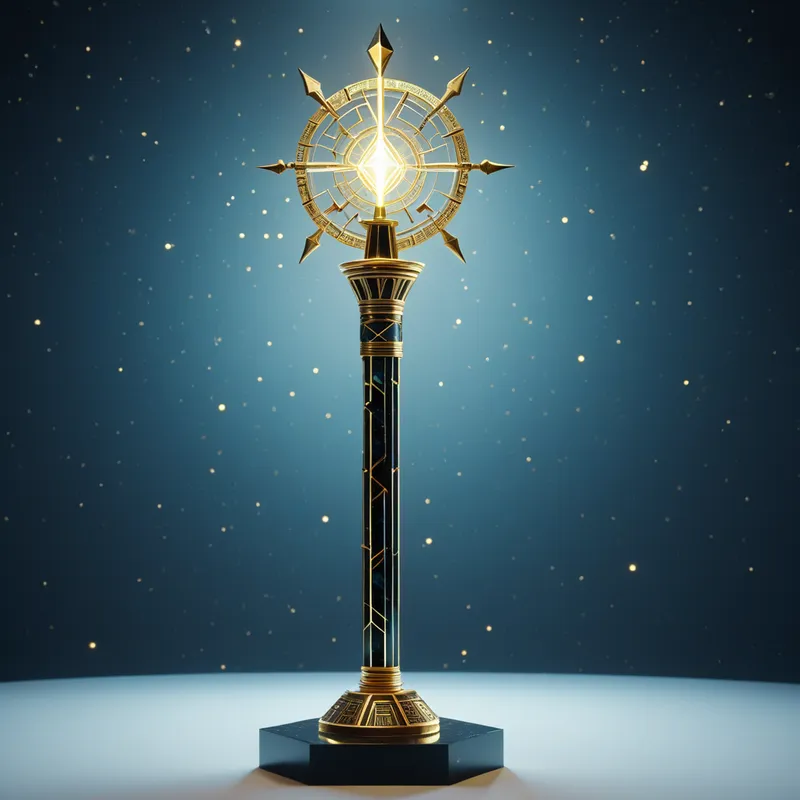
At its core, the Was Scepter is an alchemical diagram for the transformation of [chaos](/symbols/chaos “Symbol: In Arts & Music, chaos represents raw creative potential, uncontrolled expression, and the breakdown of order to forge new artistic forms.”/) into sovereignty. Its [symbolism](/symbols/symbolism “Symbol: The use of symbols to represent ideas or qualities, often conveying deeper meanings beyond literal interpretation. In dreams, it’s the language of the unconscious.”/) is a tripartite map of mastery.
The forked base represents the act of grounding and binding. It is the [decision](/symbols/decision “Symbol: A decision in a dream reflects the choices one faces in waking life and can symbolize the pursuit of clarity and resolution.”/) to meet formlessness not with [flight](/symbols/flight “Symbol: Flight symbolizes freedom, escape, and the pursuit of one’s aspirations, reflecting a desire to transcend limitations.”/), but with firm stance. Psychologically, this is [the ego](/myths/the-ego “Myth from Jungian culture.”/)‘s necessary confrontation with the unconscious, the act of “pinning down” a swirling [mass](/symbols/mass “Symbol: Mass often symbolizes a gathering or collective experience, representing shared beliefs, burdens, or the weight of emotions within a community.”/) of [anxiety](/symbols/anxiety “Symbol: Anxiety in dreams reflects internal conflicts, fears of the unknown, or stress from waking life, often demonstrating the subconscious mind’s struggle for peace.”/), [passion](/symbols/passion “Symbol: Intense emotional or physical desire, often linked to love, creativity, or purpose. Represents life force and deep engagement.”/), or creative potential so that it can be seen and worked with.
The long, straight [shaft](/symbols/shaft “Symbol: A vertical passage or structural element, often representing transition, connection, or hidden depths in dreams.”/) is the [axis](/symbols/axis “Symbol: A central line or principle around which things revolve, representing stability, orientation, and the fundamental structure of reality or consciousness.”/) of will and [intention](/symbols/intention “Symbol: Intention represents the clarity of purpose and direction in one’s life and can symbolize motivation and commitment within a dream context.”/). It is the channel through which the bound [energy](/symbols/energy “Symbol: Energy symbolizes vitality, motivation, and the drive that fuels actions and ambitions.”/) is directed. It represents the discipline, the laws, the “straight [path](/symbols/path “Symbol: The ‘path’ symbolizes a journey, choices, and the direction one’s life is taking, often representing individual growth and exploration.”/)” of Maat that must be maintained for power to be constructive rather than destructive. It is the [spine](/symbols/spine “Symbol: The spine symbolizes strength, support, and the foundational structure of one’s life and identity.”/) of [consciousness](/symbols/consciousness “Symbol: Consciousness represents the state of awareness and perception, encompassing thoughts, feelings, and experiences.”/) itself.
The Set-animal head is the most profound element. It signifies that true sovereignty does not come from purging the wild, chaotic, or “[shadow](/symbols/shadow “Symbol: The ‘shadow’ embodies the unconscious, repressed aspects of the self and often represents fears or hidden emotions.”/)” aspects of [the self](/myths/the-self “Myth from Jungian culture.”/), but from integrating them. Set, the god of foreign lands and storms, is not destroyed; his essence is placed at the [pinnacle](/symbols/pinnacle “Symbol: The highest point or peak, representing achievement, culmination, or spiritual transcendence.”/), as the watcher and wielder.
The scepter teaches that power is neutral; it becomes sovereignty only when chaos is not denied, but engaged, bound by will, and directed by a consciousness that includes the knowledge of the wild within itself.
The Dreamer’s Resonance
When the Was Scepter appears in modern dreams, it rarely manifests as a literal Egyptian artifact. Instead, one dreams of a unique staff, a charged rod, a strangely forked walking stick, or simply an object that carries an immense sense of authoritative weight. The dreamer is often in a situation of psychological or social chaos—a crumbling workplace, a turbulent relationship, a flood of overwhelming responsibilities or emotions.
The somatic feeling is crucial: a sense of density in the hand, a vibrating hum up the arm. To dream of finding the scepter suggests the nascent emergence of the inner “ruler” archetype, the discovery of a latent capacity to set boundaries and establish order. To dream of struggling to lift it speaks to feelings of inadequacy in the face of life’s demands, a fear of one’s own authority. To dream of it shattering is a profound crisis of legitimacy, where one’s internal or external structures of control have catastrophically failed. The dream is an unconscious enactment of the [psyche](/myths/psyche “Myth from Greek culture.”/) grappling with the fundamental human task: how to responsibly wield one’s own power.
Alchemical Translation
The myth of the Was Scepter models the individuation journey as the achievement of conscious sovereignty. The initial “chaos” is the undifferentiated psyche—the mix of drives, complexes, inherited patterns, and shadow material that governs us unconsciously. The modern individual lives in this “desert” of internal Isfet, blown by every wind of emotion and external demand.
The alchemical process begins with the Forking (Confrontatio): One must stop running and turn to face the chaos. This is the difficult, often painful work of shadow integration, of acknowledging the “Set” within—the anger, the ambition, the untamed desires. This is pinned down through introspection, therapy, or creative expression.
Next is the Channeling (Rectificatio): The bound energy must be given a direction. The raw force of anger becomes the energy for setting boundaries. Unfocused creativity is given the discipline of a daily practice. The shaft is built through the establishment of personal rituals, ethics, and conscious choices—one’s personal Maat.
The ultimate transmutation is not the crown, but the scepter. It is not about being served, but about the capacity to serve order—first within the self, then in one’s world—by consciously wielding the totality of what one is.
The final stage is the Enthronement of the Watcher (Individuatio): The integrated Set-animal at the top signifies that the individual no longer identifies solely with the orderly [persona](/myths/persona “Myth from Greek culture.”/) or fights the chaotic shadow. They have become the ruler who contains both. The power they wield is now authentic, grounded, and resilient because it acknowledges its own source in the wild, creative, and potentially destructive depths. They hold the Was Scepter: their life is no longer a reaction to chaos, but a deliberate, sovereign act of creation.
Associated Symbols
Explore related symbols from the CaleaDream lexicon: