
The Waq-Waq Tree Myth Meaning & Symbolism
A legendary tree on a mythical island that bears fruit in the form of human heads, whispering prophecies and warnings to those who dare to seek it.
The Tale of The Waq-Waq Tree
Listen, and let the desert wind carry you beyond the maps of men, to the edge of the world where the sea boils with mystery. There lies an island, shrouded in perpetual mist, where the very air tastes of salt and prophecy. This is the home of the Waq-Waq Tree.
No ordinary tree is this. Its trunk is ancient, gnarled like the spine of a leviathan, and its bark shines with a strange, metallic sheen. But it is the branches that still the heart. From them hang not leaves, nor dates, nor any common fruit. They bear heads. Human heads, each one a perfect, silent visage—men, women, young and old—suspended by the hair. And when the wind shifts, or when a soul of singular destiny draws near, these heads stir. Their eyes open, unseeing, and their lips part. A chorus of voices rises, a cacophony of whispers and cries. They speak all the tongues of the earth. They utter names—your name. They recite fragments of poetry, they scream warnings of doom, they sigh secrets of love and betrayal not yet born.
The journey to this tree is a sieve for the spirit. Many have set sail, lured by tales of ultimate knowledge. Most are turned back by tempests sent by jinn, or driven mad by the siren song of the heads heard from leagues away. But one, perhaps a seeker cursed with unbearable curiosity or blessed with a fate too large to ignore, finds the shore. They walk through forests that watch them, past streams that run with silver, until they stand in the clearing.
The tree looms. The heads turn, slowly, their gazeless eyes fixing upon the intruder. The whispers coalesce into a single, clear voice. It speaks a truth so personal, so devastatingly precise, that it cracks the seeker’s world in two. It might be a prophecy of greatness, or a revelation of a hidden shame. It is always the truth they needed, never the one they wanted. The seeker leaves, but they are not the same. They carry the whisper in their skull, a seed of destiny or madness, and the world of men feels flat and silent ever after.
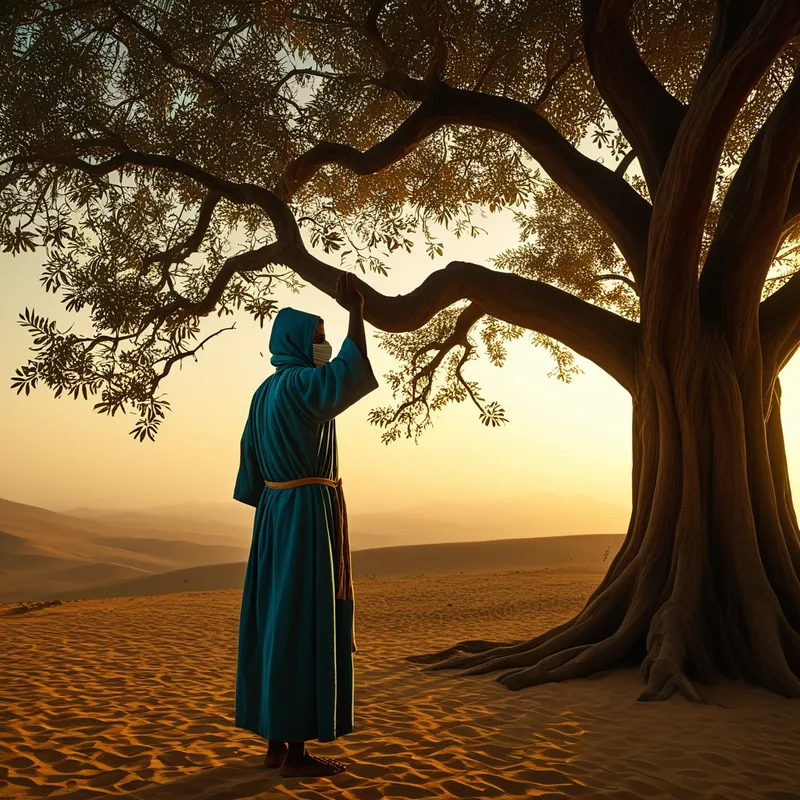
Cultural Origins & Context
The myth of the Waq-Waq Tree is a fascinating strand in the rich tapestry of Arabian cosmology, later elaborated in Persian and Islamic geographical and wonder-literature. It appears in the works of scholars like al-Idrisi and the tales of The Thousand and One Nights, often situated at the literal edge of the known world—sometimes in the far east, near the “Isles of Waq-Waq.” This placement is key: the tree exists in the liminal space beyond, where the orderly rules of creation break down and nature reveals its most arcane secrets.
It was a story told by sailors, merchants, and storytellers not merely as entertainment, but as a ontological anchor. It served a profound societal function: to map the boundaries of human knowledge and ambition. The tree represented the ultimate, dangerous prize of exploration—the point where seeking understanding risks encountering something that understands you better than you do yourself. It was a narrative check against unchecked human hubris, a mythical “here be dragons” that warned that some knowledge has a consciousness, and a cost, of its own.
Symbolic Architecture
The Waq-Waq [Tree](/symbols/tree “Symbol: In dreams, the tree often symbolizes growth, stability, and the interconnectedness of life.”/) is no simple [oracle](/symbols/oracle “Symbol: An oracle represents wisdom, foresight, and divine communication, often serving as a mediator between the spiritual and physical worlds.”/). It is the World [Tree](/symbols/tree “Symbol: In dreams, the tree often symbolizes growth, stability, and the interconnectedness of life.”/) inverted, its roots not in the nourishing [earth](/symbols/earth “Symbol: The symbol of Earth often represents grounding, stability, and the physical realm, embodying a connection to nature and the innate support it provides.”/) but in the [collective unconscious](/symbols/collective-unconscious “Symbol: The Collective Unconscious refers to the part of the unconscious mind shared among beings of the same species, embodying universal experiences and archetypes.”/), its [fruit](/symbols/fruit “Symbol: Fruit symbolizes abundance, nourishment, and the fruits of one’s labor in dreams.”/) not sustenance but sentient [knowledge](/symbols/knowledge “Symbol: Knowledge symbolizes learning, understanding, and wisdom, embodying the acquisition of information and enlightenment.”/). The [human](/symbols/human “Symbol: The symbol of a human represents individuality, complexity of emotions, and social relationships.”/) heads are not victims, but manifestations. They symbolize the totality of human experience, thought, and potential—every possible [destiny](/symbols/destiny “Symbol: A predetermined course of events or ultimate purpose, often linked to spiritual forces or cosmic order, representing life’s inherent direction.”/) hanging ripe on the bough of time.
The tree does not speak to you; it speaks the part of you that is already written in the cosmos, the latent self waiting to be born or acknowledged.
The central conflict is not man versus tree, but the conscious self versus the revealed Self. The [seeker](/symbols/seeker “Symbol: A person actively searching for meaning, truth, or a higher purpose, often representing the dreamer’s own quest for identity or fulfillment.”/) approaches seeking an external answer—“What will happen to me?”—and is given an internal [revelation](/symbols/revelation “Symbol: A sudden, profound disclosure of truth or insight, often through artistic or musical means, that transforms understanding.”/): “This is who you are, and therefore, what must be.” The whispering heads represent the myriad voices of the psyche: the ancestral, the prophetic, the critical, the desirous. To listen is to be forced to integrate a fragment of this overwhelming whole, a process that is inherently traumatic and transformative.
The Dreamer’s Resonance
When this myth pattern stirs in the modern dreamer, it signals a profound encounter with the Self, what Jung termed the Self-archetype. Dreaming of a tree that speaks, especially with human features or voices, indicates the psyche is ready to deliver a non-negotiable truth.
The somatic experience is often one of eerie stillness and acute auditory sensitivity—a feeling of being “addressed” by the environment itself. Psychologically, the dreamer is at a threshold. The “whisper” they hear (or fear hearing) is the voice of their own destiny or deepest complex breaking through the noise of the ego. It may feel like a calling, a diagnosis, or a verdict. The terror and awe in the dream mirror the ego’s resistance to being re-contextualized by a larger, more authoritative psychic reality. This is the process of the unconscious presenting a piece of one’s own wholeness, a piece that may initially feel alien and overwhelming.
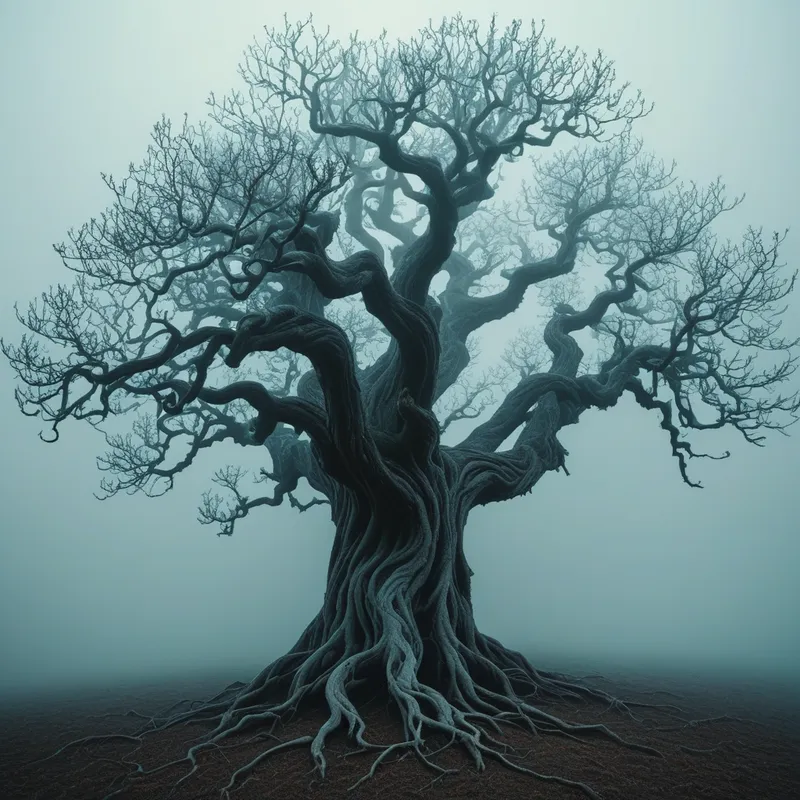
Alchemical Translation
The journey to and from the Waq-Waq Tree is a perfect model for the alchemical stage of nigredo, the descent into darkness for the purpose of illumination. The seeker’s voyage is the opus of individuation.
First, there is the Calling—an irresistible pull toward a truth that promises to reorder one’s life. This is the ego’s ambition for growth. Then, the Ordeal—the journey through psychic defenses (the stormy seas, the confusing forests) that guard the core of the Self. Arrival at the tree is the Confrontation. The tree is the objective psyche in its raw, unmediated form. The whisper it delivers is the lapis philosophorum in its most potent, unintegrated state—a truth so dense it is toxic to the old personality.
The transmutation occurs not in hearing the prophecy, but in bearing it. The return journey is the slow, painful process of digestion, where the golden whisper of the Self is assimilated into the leaden substance of daily life.
The final stage is Translation. The seeker does not become a king or a wizard in the outer world because of the knowledge. Instead, they become a vessel for it. Their old life dies, and they must learn to live with a divine secret etched into their soul. This is the ultimate alchemy: the transformation of personal identity into a conscious participant in a cosmic narrative. One is no longer merely living a life; one is fulfilling a destiny spoken by the world-tree of the soul.
Associated Symbols
Explore related symbols from the CaleaDream lexicon:
- Tree of Life — The Waq-Waq is its shadowed twin, representing not benevolent connection but the terrifying, conscious totality of existence from which individual destinies are plucked.
- Fruit-Laden Tree — Its fruit is the harvested potential of human consciousness, each head a complete archetypal possibility waiting to be realized or announced.
- Destiny — The core product of the tree; it speaks not of random futures but of fated, inescapable truths woven into the seeker’s very essence.
- Whisper — The mode of its prophecy, indicating knowledge that is intimate, subtle, and meant for the soul’s ear alone, bypassing rational understanding.
- Journey — The essential prerequisite to encountering the tree, symbolizing the arduous inner pilgrimage required to reach the truths of the Self.
- Mirror — The tree functions as a cosmic mirror, reflecting back not the seeker’s face, but the hidden architecture of their soul and fate.
- Fear — The primary somatic response to the tree, representing the ego’s terror at being dissolved or redefined by a greater truth.
- Oracle — The tree’s primary function as a mouthpiece for the objective psyche, delivering knowledge from beyond the personal unconscious.
- Root — While unseen, the tree’s roots metaphorically tap into the primordial bedrock of collective human experience and archetypal patterns.
- Shadow — The tree embodies the shadow of the World Tree archetype—the frightening, sentient, and morally ambiguous aspect of cosmic knowledge.
- Vision — The encounter grants a devastatingly clear vision of one’s own psychic and fateful reality, an epiphany that cannot be unseen.
- Island — The isolated setting of the myth, representing the psyche itself as a remote, self-contained realm where ultimate truths reside.