
The Wandering Jew Myth Meaning & Symbolism
A man cursed to walk the earth until the Second Coming for an act of scorn, embodying the eternal exile and witness of history.
The Tale of The Wandering Jew
The sun was a hammer on the stones of [Jerusalem](/myths/jerusalem “Myth from Biblical culture.”/). The air, thick with dust and the metallic scent of fear, vibrated with the shouts of a mob and the slow, terrible scrape of wood on stone. A condemned man, bearing the weight of a world he did not make, stumbled under a crossbeam down the [Via Dolorosa](/myths/via-dolorosa “Myth from Christian culture.”/). His feet were raw, his breath a ragged prayer.
At [the threshold](/myths/the-threshold “Myth from Folklore culture.”/) of a doorway, shadowed and cool, the man faltered. The weight drove him to his knees. From the darkness of the doorway emerged a figure—a tradesman, a cobbler named Ahasuerus. His face was not cruel, but impatient, etched with the petty concerns of the day. He had been working, hammering nails into leather, and the procession was a delay, an inconvenience.
The fallen man looked up, his gaze holding a universe of sorrow and a silent plea for a moment’s respite, a simple gesture of human mercy against the machinery of empire.
“Move along,” the cobbler muttered, his voice sharp with irritation. “Why do you linger? Get up and go on your way.”
A silence fell, deeper than the crowd’s noise. The condemned man turned his head. The gaze that met the cobbler’s was no longer solely human; it was the gaze of eternity looking into a single, hardened heart.
“I go,” the man said, and his voice was the sound of a door closing on one age and opening onto another. “But you shall wait. You shall tarry until I return.”
In that instant, the cobbler’s world shattered. The cool shadow of his doorway became the only shade he would ever truly know. The hammer in his hand fell silent forever. A chill wind, not of that place or season, wrapped around his bones. He felt the solid stone of his threshold turn to shifting sand beneath his feet. He was unmoored. The sentence was not death, but an endless postponement of rest. He was condemned to walk—to walk the borders of kingdoms, the ruins of cities, the birth and death of languages. He would be a stranger at every hearth, a ghost at every feast, a living memory where all other memories turned to dust. His journey began with a single, unwilling step backward, as the procession moved on, leaving him alone in the suddenly immense and echoing street, a citizen of nowhere, a witness to everything, waiting for a return he had scorned.

Cultural Origins & Context
The figure of the Wandering Jew is not a singular myth from a fixed time, but a story that accreted like layers of sediment upon a restless soul. Its earliest clear seeds appear in 13th-century chronicles, where a bishop or pilgrim claims to have met an ancient Jew who was present at the Crucifixion. But the myth truly took root in the fertile soil of late medieval and early modern European folk imagination.
This was not a tale told in royal courts, but in taverns, by hearths, and on pilgrim roads. It was carried by travelers, merchants, and monks—a perfect “folk” narrative because it was about the ultimate traveler. The teller would often claim a friend-of-a-friend had seen him: in Hamburg, in Madrid, in a remote Alpine pass. He was a shapeshifter of report: sometimes a humble shoemaker, sometimes a learned rabbi, sometimes a ragged prophet. His function was multifaceted. For a Christian populace, he was a living relic and a moral lesson—a perpetual reminder of the perceived guilt of the Jewish people in the death of Christ, and a stark warning against the sin of hard-heartedness. Yet, beneath the didactic surface, he served a deeper, more universal folkloric role: he was the eternal witness. In an age before mass media, he was the one who had seen it all—[the fall](/myths/the-fall “Myth from Biblical culture.”/) of Rome, the Black Death, the rise and fall of kings. He personalized history and gave it a pair of weary, observing eyes.
Symbolic Architecture
At its core, the myth is not about a historical Jew, but about the [archetype](/symbols/archetype “Symbol: A universal, primordial pattern or prototype in the collective unconscious that shapes human experience, behavior, and creative expression.”/) of the eternal [exile](/symbols/exile “Symbol: Forced separation from one’s homeland or community, representing loss of belonging, punishment, or profound isolation.”/). He is the part of the [psyche](/myths/psyche “Myth from Greek culture.”/) that can never fully belong, the [consciousness](/symbols/consciousness “Symbol: Consciousness represents the state of awareness and perception, encompassing thoughts, feelings, and experiences.”/) that is forever separate, observing the [human](/symbols/human “Symbol: The symbol of a human represents individuality, complexity of emotions, and social relationships.”/) [condition](/symbols/condition “Symbol: Condition reflects the state of being, often focusing on physical, emotional, or situational aspects of life.”/) from its periphery.
The curse is not merely to walk, but to remember. He is the embodied tension between the timeless and the temporal, the soul that experiences epochs as seasons but is denied the winter of death.
The act of scorn at the [doorway](/symbols/doorway “Symbol: A doorway signifies transition, opportunities for new beginnings, and the choice to walk through into the unknown.”/) is profoundly symbolic. The doorway is a threshold—between home and world, [compassion](/symbols/compassion “Symbol: A deep feeling of empathy and concern for others’ suffering, often involving a desire to help or alleviate their pain.”/) and [indifference](/symbols/indifference “Symbol: A state of emotional detachment or lack of interest, often signaling avoidance, protection, or disconnection from feelings or situations.”/), the sacred and the profane. By refusing a [moment](/symbols/moment “Symbol: The symbol of a ‘moment’ embodies the significance of transient experiences that encapsulate emotional depth or pivotal transformations in life.”/) of mercy at this liminal [space](/symbols/space “Symbol: Dreaming of ‘Space’ often symbolizes the vastness of potential, personal freedom, or feelings of isolation and exploration in one’s life.”/), Ahasuerus condemns himself to live as a threshold, forever between destinations, never crossing into the rest of home. His [punishment](/symbols/punishment “Symbol: A dream symbol representing consequences for actions, often tied to guilt, societal rules, or internal moral conflicts.”/) perfectly mirrors his [crime](/symbols/crime “Symbol: Crime in dreams often symbolizes guilt, inner conflict, or societal rules that are being challenged or broken.”/): he refused another’s rest, so he shall have [none](/symbols/none “Symbol: The absence represented by ‘none’ can signify emptiness, potential, or a yearning for substance.”/). He demanded [movement](/symbols/movement “Symbol: Movement symbolizes change, progress, and the dynamics of personal growth, reflecting an individual’s desire or need to transform their circumstances.”/), so he shall never stop.
Psychologically, he represents the burden of a hardened [attitude](/symbols/attitude “Symbol: Attitude symbolizes one’s mental state, perception, and posture towards life, influencing emotions and actions significantly.”/), a cynical or impatient part of [the self](/myths/the-self “Myth from Jungian culture.”/) that, once activated, severs us from the flow of human [connection](/symbols/connection “Symbol: Connection symbolizes relationships, communication, and bonds among individuals.”/) and divine grace. He is the personification of a [life](/symbols/life “Symbol: The symbol of ‘Life’ represents a journey of growth, interconnectedness, and existential meaning, encompassing both the joys and challenges that define human experience.”/) lived from a place of perpetual judgment and [separation](/symbols/separation “Symbol: A spiritual or mythic division between realms, states of being, or consciousness, often marking a transition or loss of connection.”/), which ultimately becomes a [prison](/symbols/prison “Symbol: Prison in dreams typically represents feelings of restriction, confinement, or a lack of freedom in one’s life or mind.”/) of one’s own making.

The Dreamer’s Resonance
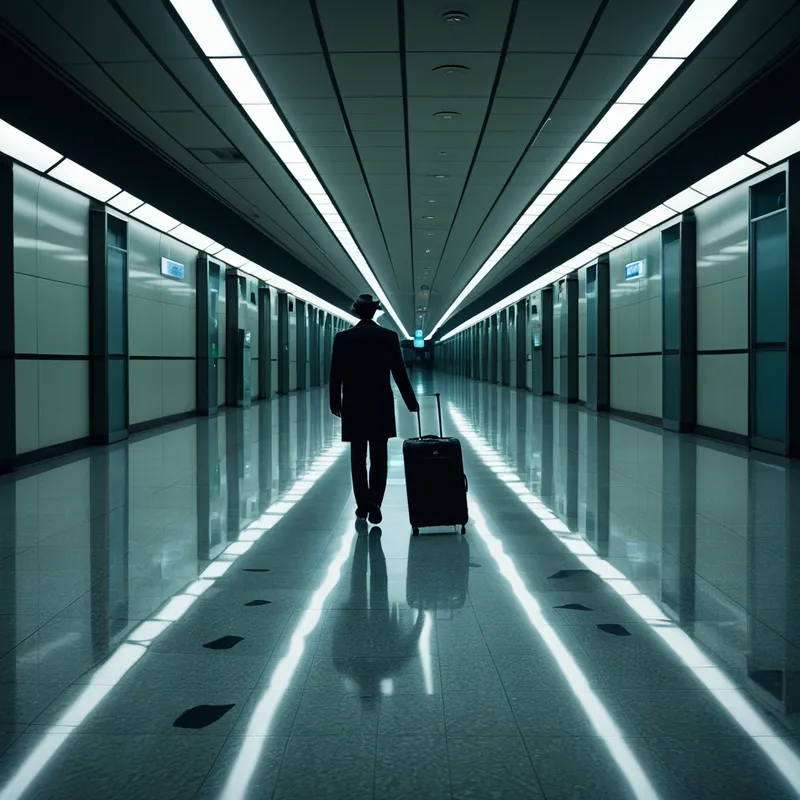
When this myth stirs in the modern unconscious, it rarely appears as a medieval cobbler. Instead, the dreamer may find themselves in an endless, repetitive commute where the destination never arrives. They may be packing a suitcase that is never full, or walking through a familiar city that has become a [labyrinth](/myths/labyrinth “Myth from Various culture.”/) of identical, anonymous streets. The somatic feeling is one of profound, wearying motion without progress—a jet lag of the soul.
This dream pattern signals a psychological state of existential exile. The dreamer may feel fundamentally out of sync with their life, their community, or their own time. They are witnessing their own life rather than living it, carrying a burden of old judgments (perhaps toward themselves or a group they identify with) that has become a cage. The Wanderer’s fatigue in the dream points to a deep need to confront the original “scorn”—the moment where compassion was withheld, where they became hardened to their own suffering or the suffering of others. The dream is the psyche’s way of saying, “The attitude you adopted to survive has now become your prison. You are waiting for a redemption you are actively postponing.”
Alchemical Translation
The individuation process modeled here is the alchemical transmutation of the curse of exile into the vocation of witness. [The Wanderer](/myths/the-wanderer “Myth from Taoist culture.”/)’s path is the ultimate night sea journey, where the goal is not to find a home, but to realize that the journey itself, with all its burden of memory and observation, is the home.
The first step in the alchemy is to stop seeing the wandering as a punishment and to begin to see it as a perspective. The weight of memory becomes the substance of wisdom.
The modern individual facing this archetype must perform a profound internal reversal. They must find the “Ahasuerus” within—the impatient, scornful, separating voice—and offer it the compassion it once denied. This is the key to the curse. By integrating this outcast part, the endless flight turns into a chosen pilgrimage. The wanderer is no longer running from a return, but consciously attending to [the world](/myths/the-world “Myth from Tarot culture.”/), gathering the shards of experience.
His ultimate return at the Second Coming is symbolic of a psychic event: the moment when the exiled consciousness is finally reconciled with the source of meaning. For the individual, this is the achievement of wholeness, where the part that felt forever outside of life is welcomed back into the center. The worn staff is laid down not because the journey ends, but because the division between wanderer and home, seeker and sought, is finally dissolved. The exile ends when the heart that judged learns to bless the road it walks.
Associated Symbols
Explore related symbols from the CaleaDream lexicon: