
The Wandering Bard Myth Meaning & Symbolism
A bard, stripped of home and harp, wanders the world carrying only memory, discovering that true song is forged in the crucible of loss and longing.
The Tale of The Wandering Bard
Listen. The wind in the oak leaves is not just wind. It is the first breath of this story, a sigh that carries the scent of peat smoke and salt. In a time when the world was younger and the veil between the hills was thin, there was a bard. His name is lost, as such names often are, for he became his journey. In the hall of a great king, under a roof thatched with song, he was the sun at the center. His fingers on the harp-strings could make warriors weep for their mothers and queens remember their girlhood dreams. His voice held the genealogy of the tribe, the victories of the ancestors, the very soul of the land itself. He was not a man who owned a harp; he was the harp through which the land sang.
But kings are jealous gods, and the soul of a land is a coveted prize. A rival, whose songs were ash in the mouth, whispered poison. The accusation was theft—not of gold, but of a melody sacred to the king’s lineage. The truth was as irrelevant as a single raindrop in a storm. The sentence was exile. Not just banishment from the hall, but a deeper, more profound severing. Before the assembled tribe, the king’s smith took the bard’s harp, the cruit, and with a cruel twist of hot iron, snapped its pillar. The sound of that breaking was not wood, but bone. Then they took the bard’s own hands and bound them, not with rope, but with a geis sworn on the sacred waters: he was to never craft or touch another instrument, lest the land itself reject him.
Cast out with only the cloak on his back and the memory of the fracture echoing in his skull, he wandered. He crossed the sídhe mounds where the grass grew a greener, more dangerous green. He slept in the forests of the Dagda, eating bitter berries and nameless roots. Seasons wheeled. His voice, unused, grew rusty in his throat. His story was over. He was a vessel emptied.
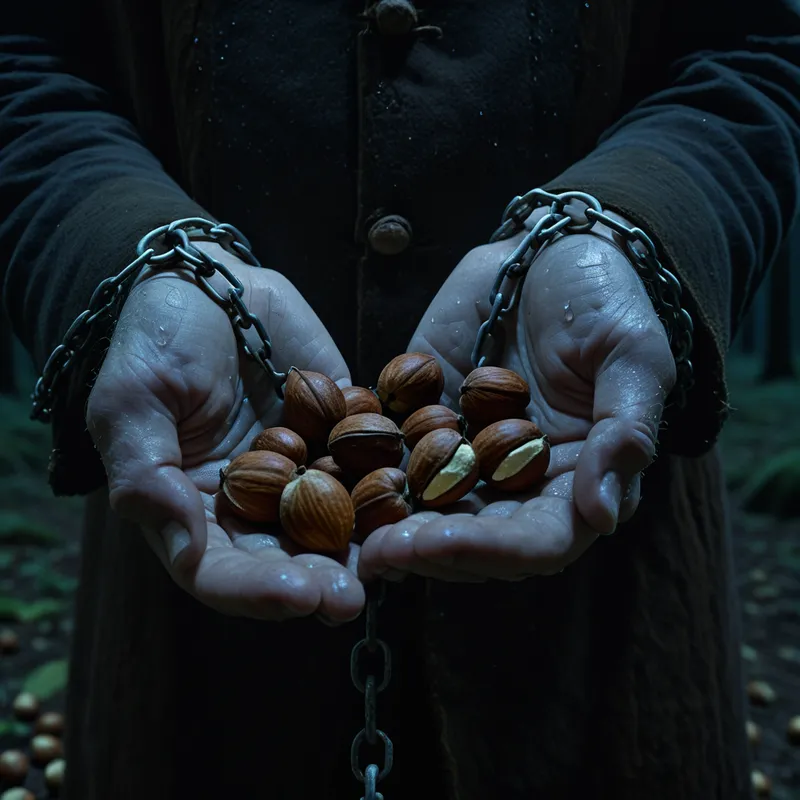
Then, in the deep of a winter wood, he came upon a tobar that never froze. Hungry beyond thought, he scrabbled in the mud at its edge and found a cluster of hazelnuts fallen from the wisdom-tree above. As he cracked one open, the simple, sweet taste was a lightning strike. It was the taste of his grandmother’s hearth. It was the taste of the first song he ever learned. It was memory, pure and unmediated.
He did not sing. He could not. But sitting by that well, the memories began to arrange themselves. Not as a plea or a lament, but as a new shape. He saw his life not as a broken line, but as a spiral. The exile, the hunger, the silence—they were not the end of the song, but its essential middle movement. That night, under a sky dusted with the cold fire of the Síl na Síoch, he understood. The harp was gone. The prohibition held. But the music was not in the wood and wire. It was in the conduit of his lived experience, in the alchemy of memory meeting the raw stuff of the world.
He stood, and he began to walk again. But now, he was not wandering aimlessly. He was tracing the melody of his exile upon the land itself. When he spoke to a farmer at a crossroads, he did not recite epic poetry. He described the exact quality of light on the lake the morning he was cast out, and in that description, the farmer heard his own lost mornings. He hummed no tune, but the rhythm of his walking staff on the road taught a rhythm to a restless child. He carried no instrument, but his very presence became a resonance. He had become the song. The wandering was no longer a punishment, but the performance.
Cultural Origins & Context
The figure of the Wandering Bard is not a single myth from a single text, but a powerful archetype woven through the fragmentary tapestry of Celtic tradition, particularly Irish and Welsh. In a society where history, law, and identity were stored not in parchment but in poetry, the bard (fili) was the living hard-drive of the tribe. He was a sacred technician of memory, a status near to priesthood. Stories like that of the sons of Uisneach, or the exile of Neide, echo this pattern of the poet severed from their social function.
This myth was not merely entertainment; it was a societal safety valve and a profound teaching story. It was told in the great halls not just to warn of a king’s folly, but to illustrate the indestructible nature of the poetic impulse. It affirmed that the source of imbas was not granted by kings, but flowed from the encounter between the human soul and the animate world. The bard’s exile mirrors the soul’s necessary journey outside the comfort of collective identity to discover its individual, authentic voice.
Symbolic Architecture
At its core, this myth is about the crucifixion and resurrection of the creative Self. The harp represents the structured, socially-approved vessel for expression—our talents, our roles, our accepted identities. Its destruction is the shattering of the persona.
The breaking of the harp is not the end of music, but the brutal beginning of the musician.
The imposed geis symbolizes the internalized critic, the trauma, or the depression that tells us our creative life is over. The wandering in the wilderness is the liminal space of depression, dissociation, or lostness—the essential, if painful, nigredo of the psyche where all former structures fail. The hazelnut from the sacred well is the kernel of true memory, the unadulterated core experience that has not been shaped for an audience. It is the moment of soul-food that reconnects the exile to their own essence, not their function.
Finally, the transformation from a bard with a song to a bard who is the song represents the ultimate psychic achievement: when one’s life, in all its raw, unvarnished truth—its wounds, its wanderings, its epiphanies—becomes the primary artistic medium. The external artifact is secondary to the embodied truth.
The Dreamer’s Resonance
When this myth stirs in the modern dreamer, it often manifests as dreams of profound loss of voice or tool: a musician dreaming their instrument is made of melting ice; a writer dreaming their pen leaks only blood or dust; a speaker finding their tongue is knotted. Somatically, this can feel like a constriction in the throat or chest, a literal “choking” on unexpressed life.
The dream may then shift to landscapes of exile: endless, unfamiliar roads; abandoned train stations; wandering through a childhood home that is now empty and echoing. This is the psyche enacting the necessary wandering. The healing symbol—the hazelnut—might appear as a forgotten but deeply comforting object from the past, a taste of a specific food, or a sudden, clear memory of a moment of pure, uncomplicated being. The dream is mapping the journey from identified talent to embodied authenticity, signaling that the dreamer is in the painful but fertile ground between who they were supposed to be and who they are becoming.

Alchemical Translation
The alchemy here is one of spiritual distillation. The myth provides a precise map for individuation through creative or personal catastrophe.
- Calcinatio (The Burning/Breaking): The public humiliation and breaking of the harp. This is the burning away of the old identity, the valued social self. It is experienced as ruin.
- Solutio (The Dissolution/Wandering): The exile into the formless wilderness. The ego is dissolved, adrift in the waters of the unconscious. Purpose is lost.
- Coagulatio (The Revelation): Finding and ingesting the hazelnut at the tobar. The scattered psyche finds a nucleus, a core of genuine, nourishing Self around which new life can coalesce. This is the “aha” moment born not of thinking, but of embodied, sensory memory.
- Sublimatio (The Transcendent Return): The transformation of the man into the song. The leaden experience of loss is transmuted into the gold of embodied wisdom. The wanderer does not return to the old hall with a new harp; he becomes a new kind of hall—a mobile, living sanctuary of meaning. His journey itself is his gift.
The ultimate creation is not a poem about the journey, but a life that has become poetic through the conscious integration of the journey.
For the modern individual, this myth says: your greatest wound, your period of silent lostness, is not the enemy of your creativity or your Self. It is the raw material. The instruction is not to “get your old harp back,” but to discover, through humble, sensory engagement with the world (the taste of the hazelnut), that you never needed it to sing. Your song is the truth of your path, heard in the rhythm of your own footsteps.
Associated Symbols
Explore related symbols from the CaleaDream lexicon: