The Wandering Aengus Myth Meaning & Symbolism
A god dreams of a woman of impossible beauty and spends eternity wandering the world to find her, a quest for the soul's lost counterpart.
The Tale of The Wandering Aengus
Listen, and I will tell you of a longing that shaped [the world](/myths/the-world “Myth from Tarot culture.”/).
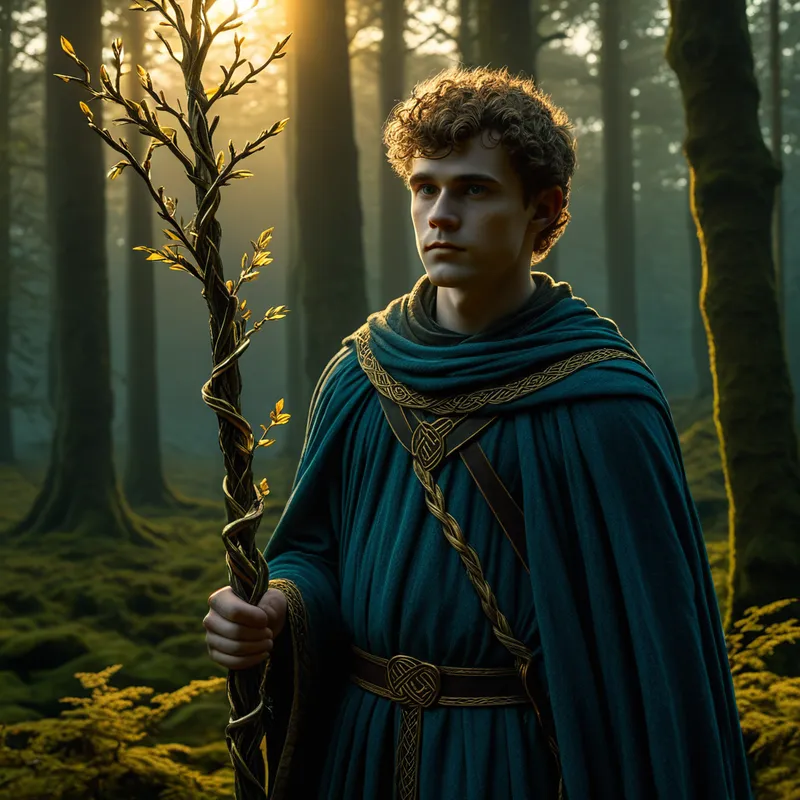
In the time when the Tuatha Dé Danann still walked the green hills of Ireland, there lived a god named Aengus Óg. He was the son of the great Dagda and [the river](/myths/the-river “Myth from Buddhist culture.”/) goddess Bóann, and from them, he inherited a heart that felt the pulse of every stream and a spirit that sang with the birds at dawn. He dwelt in Brug na Bóinne, a palace of such beauty that its walls shimmered with the light of perpetual youth.
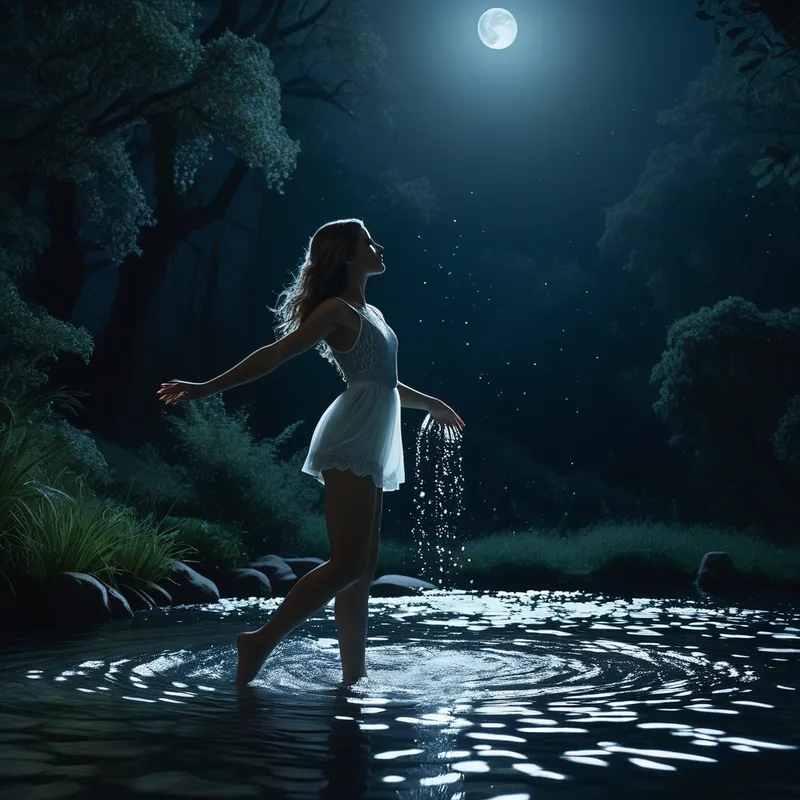
But one night, a dream came to him—not as a vague shadow, but as a vision of piercing clarity. He saw a woman. Her hair was the dark flow of a midnight river, cascading over shoulders pale as [hawthorn](/myths/hawthorn “Myth from Celtic culture.”/) blossom. Her eyes held the deep, quiet light of a forest pool. She stood beside [water](/myths/water “Myth from Chinese culture.”/), and the very air around her hummed with a melody he had spent his immortal life trying to compose. When he reached for her, she vanished, leaving behind only the scent of apple blossoms and an ache in his chest so profound it felt like a new organ had grown there.
He awoke, and the world was ash. The splendor of his home meant nothing. The songs of his birds were empty noise. The vision had taken root in his soul, and he knew he would know no peace until he held her in waking life. He fell into a wasting sickness, a poet’s malady of the spirit, his body growing thin and pale as his mind replayed the single, luminous frame of his dream.
His mother, Bóann, and the Dian Cécht, the healer, were summoned. They could find no physical ill. But [the Dagda](/myths/the-dagda “Myth from Celtic culture.”/), his father, understood. This was a sickness of fonn, of deep desire. For a year and a day, Aengus languished. Finally, the Dagda and the king of the gods, [Nuada](/myths/nuada “Myth from Celtic culture.”/), embarked on a search across all of Ireland. They scoured every [sidhe](/myths/sidhe “Myth from Celtic culture.”/), every valley, every lake shore.
And on the shores of a lake, they found her.
Caer Ibormeith. She stood with one hundred and fifty other women, each linked by a silver chain, and each was her, and yet not her. For she, and all her companions, were under a geis—a sacred enchantment. For one year, they lived as mortal women. But on the feast of [Samhain](/myths/samhain “Myth from Celtic culture.”/), they would transform into swans, and remain so for the next year.
The Dagda brought Aengus to that lakeshore. The moment his eyes fell upon Caer, the world snapped into focus. The dream and the waking world fused. He knew her. But he could not have her, for she was under the power of her father, a king of the Fir Bolg.
Aengus, with the cunning of a lover and a god, went to the king. He did not demand; he requested to speak with Caer. The king agreed, but with a condition: Aengus must pick her out from among the one hundred and fifty identical women when they were in their swan forms. It was an impossible test.
Samhain eve arrived. The air crackled with the thinning of [the veil](/myths/the-veil “Myth from Various culture.”/). The lake was a mirror of a leaden sky, and upon it floated one hundred and fifty swans, each more magnificent than the last, their feathers white as the first snow. Aengus stood at the water’s edge, his heart a drum. He did not look with his eyes alone. He listened with the part of him that had been dreaming. And there—one swan, distinguished by a crown of shimmering silver threads around her neck. He called her name: “Caer.”
She glided to him. He shed his mortal-seeming form and, in an act of perfect recognition, transformed himself into a swan. They circled the lake three times, and as they did, they sang a song so piercingly beautiful that all who heard it fell into a deep, enchanted sleep for three days and three nights. Then, linked not by a chain of silver but by a bond of soul-deep knowing, the two swans flew away to Brug na Bóinne. And there, they live still, in the palace of youth, their song echoing in the hearts of all who yearn.
Cultural Origins & Context
The myth of Aengus and Caer is preserved primarily within the Cycle of the Kings and other later manuscript traditions, most notably in the tale Aislinge Óenguso (“The Dream of Aengus”). While written down by Christian monks, its bones are palpably older, resonating with the pre-Christian, oral culture of the Gael.
This was not a story told merely for entertainment. It was a narrative encoding deep principles of the Celtic worldview. The central action—a god falling into a wasting sickness over a dream—highlights the immense power accorded to the dream-realm. Dreams were not random neural firings but visitations, prophecies, and communications from the [Otherworld](/myths/otherworld “Myth from Celtic culture.”/). Aengus’s quest is a divine ratification of this belief: the dream is real, and it demands a real-world response.
Furthermore, the story functions as a etiological myth for the divine sovereignty of the Brugh na Bóinne, one of Ireland’s most sacred Neolithic sites. Aengus, through his union with Caer—a figure whose name and swan-form connect her to sovereignty and the land itself—becomes the rightful, eternal guardian of that place. The story was likely recited or performed to affirm the sacredness of the landscape and the mystical connection between the ruler, the land, and the Otherworldly forces that bless it.
Symbolic Architecture
At its core, the myth is a profound map of the [psyche](/myths/psyche “Myth from Greek culture.”/)’s [movement](/symbols/movement “Symbol: Movement symbolizes change, progress, and the dynamics of personal growth, reflecting an individual’s desire or need to transform their circumstances.”/) toward wholeness. Aengus represents the conscious ego—beautiful, gifted, dwelling in a [palace](/symbols/palace “Symbol: A palace symbolizes grandeur, authority, and the pursuit of one’s ambitions or dreams, often embodying a desire for stability and wealth.”/) of potential (the conscious [personality](/symbols/personality “Symbol: Personality in dreams often symbolizes the traits and characteristics of the dreamer, reflecting how they perceive themselves and how they believe they are perceived by others.”/)). Yet, he is incomplete. The dream is the [eruption](/symbols/eruption “Symbol: A sudden, violent release of pent-up energy or emotion from beneath the surface, often representing transformation or crisis.”/) of the [anima](/symbols/anima “Symbol: The feminine archetype within the male unconscious, representing soul, creativity, and connection to the inner world.”/), the [soul](/symbols/soul “Symbol: The soul represents the essence of a person, encompassing their spirit, identity, and connection to the universe.”/)-[image](/symbols/image “Symbol: An image represents perception, memories, and the visual narratives we create in our minds.”/), from the [depths](/symbols/depths “Symbol: Represents the subconscious, hidden emotions, or foundational aspects of the self, often linked to primal fears or profound truths.”/) of the unconscious. She is not invented; she is recognized, indicating she is an innate, archetypal component of his own being that has yet to be integrated.
The call of the soul is not a gentle suggestion; it is a sickness that dismantles the comfortable palace of the self. To ignore it is to choose a living death.
The wasting sickness is the critical psychological [truth](/symbols/truth “Symbol: Truth represents authenticity, honesty, and the quest for knowledge beyond mere appearances.”/): when the soul’s deepest image is glimpsed but not pursued, the [energy](/symbols/energy “Symbol: Energy symbolizes vitality, motivation, and the drive that fuels actions and ambitions.”/) of [life](/symbols/life “Symbol: The symbol of ‘Life’ represents a journey of growth, interconnectedness, and existential meaning, encompassing both the joys and challenges that define human experience.”/) withdraws. [The ego](/myths/the-ego “Myth from Jungian culture.”/) becomes neurotic, fixated on the unattained. The search conducted by the Dagda and Nuada symbolizes the necessity of engaging the wider psyche—the [father](/symbols/father “Symbol: The father figure in dreams often symbolizes authority, protection, guidance, and the quest for approval or validation.”/) ([authority](/symbols/authority “Symbol: A symbol representing power structures, rules, and control, often reflecting one’s relationship with societal or personal governance.”/), tradition) and the [king](/symbols/king “Symbol: A symbol of ultimate authority, leadership, and societal order, often representing the dreamer’s inner power or external control figures.”/) (order, [consciousness](/symbols/consciousness “Symbol: Consciousness represents the state of awareness and perception, encompassing thoughts, feelings, and experiences.”/))—to help locate this lost content.
The transformation into swans is the ultimate [symbol](/symbols/symbol “Symbol: A symbol can represent an idea, concept, or belief, serving as a powerful tool for communication and understanding.”/) of [integration](/symbols/integration “Symbol: The process of unifying disparate parts of the self or experience into a cohesive whole, often representing psychological wholeness or resolution of internal conflict.”/). The swan is a [creature](/symbols/creature “Symbol: Creatures in dreams often symbolize instincts, primal urges, and the unknown aspects of the psyche.”/) of two realms: [water](/symbols/water “Symbol: Water symbolizes the subconscious mind, emotions, and the flow of life, representing both cleansing and creation.”/) (the unconscious, [emotion](/symbols/emotion “Symbol: Emotion symbolizes our inner feelings and responses to experiences, often guiding our actions and choices.”/), the dream) and air (the intellect, [spirit](/symbols/spirit “Symbol: Spirit symbolizes the essence of life, vitality, and the spiritual journey of the individual.”/), consciousness). By becoming swans together, Aengus and Caer achieve a unified existence in both states. The silver chain that once bound Caer to others is replaced by a voluntary, harmonious bond. They do not conquer each other; they join in a third, transcendent form.
The Dreamer’s Resonance
When this myth stirs in a modern dream, it rarely appears as a literal god and goddess. Instead, it manifests as the pattern of the Wandering Aengus. The dreamer may experience:
- The Irresistible Image: A recurring dream of a mysterious, deeply compelling person or a place of overwhelming beauty and nostalgia that feels like “home.” Upon waking, a palpable sense of loss or longing lingers.
- The Wasting Sickness: Dreams of being stuck, ill, or trapped in a barren, once-familiar environment (a childhood home now empty, a workplace that is a [labyrinth](/myths/labyrinth “Myth from Various culture.”/)). This reflects the ego’s stagnation when it refuses the call of the deeper self.
- The Transformative Test: Dreams of being asked to identify something or someone under impossible conditions (picking the right key in the dark, recognizing a face in a crowd of identical masks). This is the psyche presenting the crucial challenge: can you recognize your soul by its essence, not its appearance?
- The Swan Song: Dreams of flying in tandem, of duets, or of a profound, wordless understanding with another being. This signals the nascent, often fleeting, experience of inner alignment.
Somatically, the dreamer may feel a literal ache in the heart center, a restless energy, or a profound fatigue that sleep does not cure—the bodily echo of Aengus’s fonn.
Alchemical Translation
The journey of Aengus is a perfect allegory for the Jungian process of individuation. It models the alchemical opus of turning leaden longing into golden wholeness.
-
[Nigredo](/myths/nigredo “Myth from Alchemical culture.”/) (The Blackening): The dream and the ensuing sickness. The conscious, sunlit world (Aengus’s palace) is invaded by the dark, unknown content of the unconscious (the dream of Caer). The old identity begins to dissolve in the “wasting.” This is the necessary, painful first step: the realization that one is not whole.
-
Albedo (The Whitening): The search and the identification of Caer among the swans. This is the stage of illumination, clarification, and discernment. The raw, dark longing is purified into a specific image. The ego, with help from other psychic structures (the Dagda, Nuada), learns to distinguish the true soul-image from its countless reflections and projections in the world. It is a movement from confused yearning to clear recognition.
The quest is not to find the beloved in the world, but to develop the eyes that can see her—and in seeing, to become the self that can join her.
- [Rubedo](/myths/rubedo “Myth from Alchemical culture.”/) (The Reddening) & Coniunctio ([The Sacred Marriage](/myths/the-sacred-marriage “Myth from Various culture.”/)): The dual transformation into swans and their union. This is the culmination: the fusion of opposites (conscious/unconscious, masculine/feminine, human/divine) into a new, transcendent state of being. The “song that puts all to sleep” is the new, harmonious vibration of the integrated Self, which temporarily suspends the old, conflict-ridden world of the ego. They fly to the Brugh na Bóinne—no longer just a physical palace, but the symbolic, internal [temenos](/myths/temenos “Myth from Greek culture.”/) (sacred precinct) of the completed psyche.
For the modern individual, the myth instructs: Your deepest longing is not a pathology to be cured, but a divine summons to be followed. It asks you to honor the dream, to endure the disorienting sickness of growth, to seek help in your search, and ultimately, to have the courage to transform—to shed the singular form of the ego and join your soul in a dance of two becoming one. The wandering does not end in finding the other; it ends in becoming, with the other, something entirely new.
Associated Symbols
Explore related symbols from the CaleaDream lexicon: