The Walls of Troy Myth Meaning & Symbolism
A king builds divine walls to protect his city, but a mortal insult to the gods ensures those same walls will one day be its fatal flaw.
The Tale of The Walls of Troy
Hear now the tale of a city born from a lie, a fortress raised by divine hands and doomed by mortal pride. In the age when gods walked with men, there stood a king, Laomedon, whose ambition was as vast as the plains of Ilium. He dreamed of a citadel that would stand eternal, a beacon of power that no army of men could ever breach. Yet [the earth](/myths/the-earth “Myth from Hindu culture.”/) was stubborn, and the stones were heavy, and the labor of mortal men was but a whisper against the winds of time.
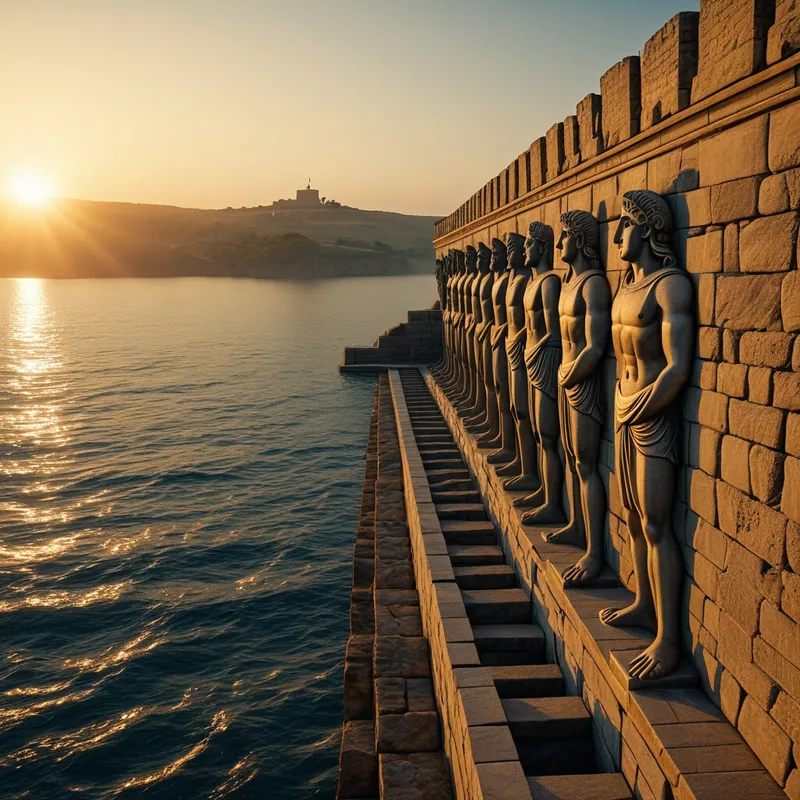
Seeing his struggle, two great gods descended from Olympus. [Poseidon](/myths/poseidon “Myth from Greek culture.”/), the Earth-Shaker, whose trident could split mountains, and Apollo, the Far-Shooter, whose truth was as sharp as his arrows. For a year, they labored not as gods, but in the guise of mortal men. The air thrummed with their hidden power. Where [Poseidon](/myths/poseidon “Myth from Greek culture.”/)’s hands touched the earth, foundations sank deep into the bedrock, unyielding as the ocean floor. Where Apollo’s will directed, stones flew into place, fitting together with a harmony that sang of celestial music. The walls rose, not as a pile of rock, but as a living testament to divine craft—gleaming, immense, and seemingly impregnable. They curved around the city like a giant’s embrace, so high they scraped the belly of the clouds, so strong they laughed at the notion of siege engines.
The year of service ended. The walls stood complete, a masterpiece that would make Troy the envy of [the world](/myths/the-world “Myth from Tarot culture.”/). The gods, having fulfilled their pact, stood before Laomedon to claim their promised wage. But the king’s heart had been hardened by the sight of his own invincibility. Greed, that old serpent, coiled in his chest. He looked upon the divine builders and saw only hired hands. With a wave of dismissal, he broke his oath. “What walls?” he scoffed, his voice echoing off the very stones they had laid. “You have built nothing I could not have built myself. Be gone from my city, and be grateful I do not have you whipped for your idleness.”
A silence fell, colder than a midwinter sea. The air itself grew heavy. The gods did not rage; they simply withdrew, their forms shimmering back into their full, terrible majesty upon the ramparts they had built. In that moment, the fate of Troy was sealed not by an external enemy, but from within its own heart. Poseidon’s voice was the rumble of a coming earthquake. “These walls will stand,” he declared, “but they will not protect you. They will be your prison and your tomb. For the strength we gave them, we now take away. A flaw is woven into their heart, a secret weakness born of your betrayal. The very [thing](/myths/thing “Myth from Norse culture.”/) you coveted will be the instrument of your fall.” With that curse hanging in the air, they departed, leaving Laomedon alone with his perfect, doomed fortress.
Generations passed. The walls stood, and Troy prospered. Laomedon’s son, Priam, ruled from within them, believing in their safety. Yet the gods’ curse was a seed in the stone. It grew silently through the decades, waiting. It waited for the day a Spartan queen would be stolen, for the thousand ships to beach upon the shore, for the nine-year siege that would test the divine masonry. And ultimately, it waited for a clever, desperate king from Ithaca to conceive of a hollow horse—a vessel of deception that would pass through the gates pride opened. The walls, built to be untakeable, were never breached by force. They were undone by the very flaw Laomedon had placed in their foundation: not a crack in the stone, but a crack in the soul. The gates were opened from within, and the glorious, god-built walls watched, impassive and immortal, as the city they were made to protect burned to ashes beneath them.
Cultural Origins & Context
The myth of the Walls of Troy is not a standalone fable but a crucial prelude embedded within the vast epic cycle of [the Trojan War](/myths/the-trojan-war “Myth from Greek culture.”/), most famously preserved in [Homer](/myths/homer “Myth from Greek culture.”/)’s Iliad and later elaborated by poets and mythographers. It functions as an etiological myth, explaining not just how Troy got its legendary fortifications, but more importantly, why such an unconquerable city could ever fall. It roots the cataclysm of the war not in a single moment of passion (the abduction of Helen), but in a foundational act of moral failure generations prior.
This story was passed down through the oral tradition of aoidoi (bards), who would sing of the war’s origins to aristocratic audiences. Its societal function was multifaceted. On one level, it was a religious lesson on the sacred nature of oaths (horkos) and the dire consequences of insulting the gods (hubris). On another, it served a deep psychological and national purpose for the Greek audience: it framed the ultimate Greek victory not merely as a military [triumph](/myths/triumph “Myth from Roman culture.”/), but as the inevitable working-out of divine [justice](/myths/justice “Myth from Tarot culture.”/). The Trojans were doomed by the sins of their forefather, making their tragic fate a cosmic necessity rather than a simple tragedy of war.
Symbolic Architecture
The Walls of Troy are one of mythology’s most potent symbols of the paradoxical [nature](/symbols/nature “Symbol: Nature symbolizes growth, connectivity, and the primal forces of existence.”/) of [defense](/symbols/defense “Symbol: A protective mechanism or barrier against perceived threats, representing boundaries, security, and resistance to external or internal challenges.”/) and the [psyche](/myths/psyche “Myth from Greek culture.”/)’s citadel.
The strongest fortress is always the one we build to contain our own weaknesses; its gate is guarded by our pride, and its downfall is engineered by our deceit.
Psychologically, the walls represent the ego complex—the constructed [identity](/symbols/identity “Symbol: Identity represents the sense of self, encompassing personal beliefs, cultural background, and social roles.”/) we present to the world and believe will protect our inner, vulnerable self. Built with the aid of “gods” (our innate talents, societal blessings, or early nurturing), they can seem magnificent and unassailable. We identify with them completely: “I am my achievements, my reputation, my strengths.” [King](/symbols/king “Symbol: A symbol of ultimate authority, leadership, and societal order, often representing the dreamer’s inner power or external control figures.”/) Laomedon is the [archetype](/symbols/archetype “Symbol: A universal, primordial pattern or prototype in the collective unconscious that shapes human experience, behavior, and creative expression.”/) of the inflated ego that believes its own [construction](/symbols/construction “Symbol: Construction symbolizes creation, building, and the process of change, often reflecting personal growth and the need to build a solid foundation.”/) is entirely self-made, denying the divine (or transpersonal) forces that contributed to it.
The fatal flaw, the “secret weakness,” is the repressed [shadow](/symbols/shadow “Symbol: The ‘shadow’ embodies the unconscious, repressed aspects of the self and often represents fears or hidden emotions.”/) of this construction. Laomedon’s [betrayal](/symbols/betrayal “Symbol: A profound violation of trust in artistic or musical contexts, often representing broken creative partnerships or artistic integrity compromised.”/)—the refusal to pay, to honor the [debt](/symbols/debt “Symbol: A symbolic representation of obligations, burdens, or imbalances that extend beyond financial matters into psychological and moral realms.”/)—is the primal act of psychological dishonesty. It is [the ego](/myths/the-ego “Myth from Jungian culture.”/) claiming sole authorship, disowning its dependencies, vulnerabilities, and moral contracts. This unintegrated [shadow](/symbols/shadow “Symbol: The ‘shadow’ embodies the unconscious, repressed aspects of the self and often represents fears or hidden emotions.”/) does not vanish; it becomes a latent [fault](/symbols/fault “Symbol: A fault signifies an imperfection or error, often representing feelings of guilt or inadequacy in dreams.”/) line in the [personality](/symbols/personality “Symbol: Personality in dreams often symbolizes the traits and characteristics of the dreamer, reflecting how they perceive themselves and how they believe they are perceived by others.”/). The walls, therefore, are not just protection but also a [prison](/symbols/prison “Symbol: Prison in dreams typically represents feelings of restriction, confinement, or a lack of freedom in one’s life or mind.”/), isolating [the self](/myths/the-self “Myth from Jungian culture.”/) from the very sources of its own [strength](/symbols/strength “Symbol: ‘Strength’ symbolizes resilience, courage, and the ability to overcome challenges.”/) and ensuring that any [threat](/symbols/threat “Symbol: A threat in dreams often reflects feelings of vulnerability, anxiety, or fear regarding one’s safety or well-being. It can indicate unresolved conflicts or the presence of external pressures.”/) must ultimately come from within, in the form of a “Trojan Horse”—an accepted deception, a repressed complex, or an unrecognized need that bypasses all conscious defenses.

The Dreamer’s Resonance
When the Walls of Troy appear in modern dreams, they signal a profound confrontation with the dreamer’s own defensive architecture. The somatic experience is often one of paradoxical sensation: feeling simultaneously safe and trapped, powerful and exposed.
Dreaming of standing atop immense, perfect walls may reflect a period of identified strength or success, but often with an undercurrent of isolation or anxiety about maintaining that position. The dream ego is in the role of Laomedon or Priam, trusting in an externalized structure of defense. More commonly, the dream involves searching for a weakness in a wall, seeing a hairline crack, or discovering a small, neglected gate. This points to the psyche’s innate drive toward wholeness, attempting to locate the repressed flaw—the unpaid debt, the unacknowledged hurt, the arrogant blind spot—that is limiting growth.
The most potent dream is witnessing the walls being breached not by assault, but by a deceptive gift from within one’s own camp—[the Trojan Horse](/myths/the-trojan-horse “Myth from Greek culture.”/). This is a direct manifestation of [the shadow](/myths/the-shadow “Myth from Jungian culture.”/) integration process. The “horse” represents a content from the unconscious that the conscious mind (the city) willingly brings inside, believing it to be beneficial (a gift, a solution, a new idea), only to have it unleash transformative, and often destructive, change. The dreamer is undergoing a necessary, if terrifying, dismantling of an old ego structure that has become a prison.
Alchemical Translation
The myth models the alchemical process of individuation, specifically the stages of [nigredo](/myths/nigredo “Myth from Alchemical culture.”/) (blackening, despair) and mortificatio (death, dissolution).
The path to the golden self (aurum) requires the willing sacrifice of the gilded wall. We must become the city that burns so the phoenix of the true self can rise from the same stones.
The initial state is the opus (work) of building the conscious personality—the walls. This is necessary and good. The fatal error is identificatio—the king’s total identification with the wall, believing “I am this.” The alchemical translation begins with the divine curse, which represents the unconscious delivering a necessary shock, a [prima materia](/myths/prima-materia “Myth from Alchemical culture.”/) of suffering (the siege) that forces a confrontation with the limits of the ego’s defenses.
The nine-year siege is the long, painful period of analysis, depression, or life crisis where the old ways no longer work, but the new way is not yet visible. The ego feels besieged. The breakthrough is not an attack but a subterfuge of the soul: the Trojan Horse. In individuation, this is the symbolic, often paradoxical, insight or affect that emerges from the unconscious. It looks like a solution (the end of the siege) but is actually the agent of the old self’s death. Accepting it—bringing the horse inside the walls—is the ultimate act of surrender to a process larger than the ego.
The burning of Troy is the mortificatio, the necessary destruction of the old, rigid identity structure. It is a psychic catastrophe that feels like total loss. Yet, from the alchemical perspective, this is not an end, but the essential purification. From these ashes, the liberated spirit (exemplified by survivors like Aeneas) can found a new, more authentic inner city—one not built on the hubris of perfect defense, but on the wisdom of integrated vulnerability. The walls of the new city will remember the flaw, not as a weakness, but as the sacred gate through which the divine and the human must forever traffic.
Associated Symbols
Explore related symbols from the CaleaDream lexicon: