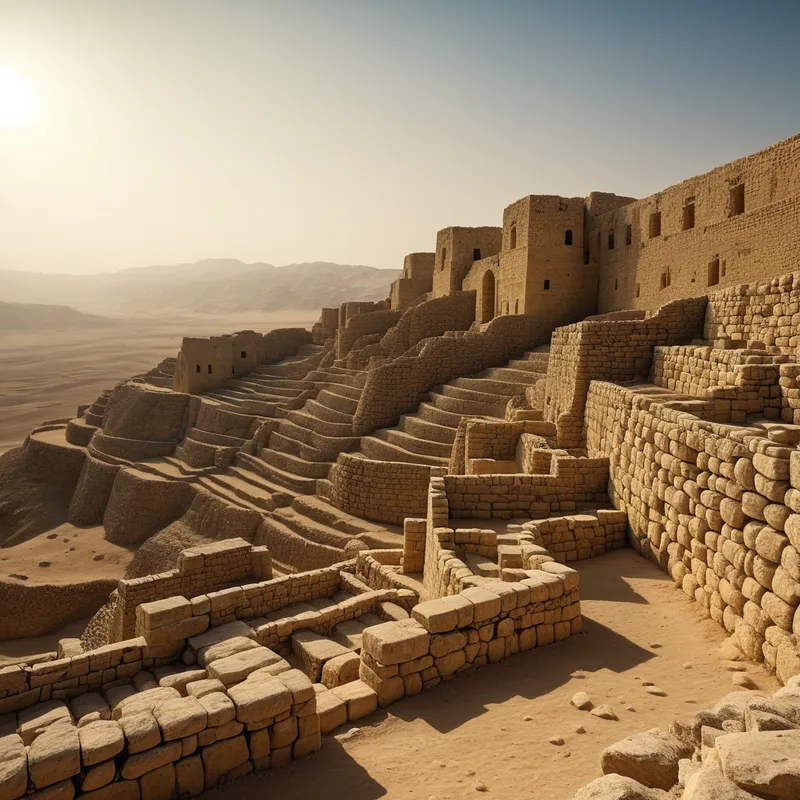
The Walls of Jericho Myth Meaning & Symbolism
A story of faith, sound, and collapse, where marching and trumpets bring down an ancient city's walls, revealing a deeper psychic architecture.
The Tale of The Walls of Jericho
Hear now, a tale whispered on the wind that scours the plains of the Canaan. It is a story of a city that was a fortress of the heart, a story of silence, sound, and surrender.
For generations, the city of Jericho had stood. Its walls were not mere stone; they were a statement. They were the clenched fist of a kingdom, high and thick, a bulwark against the wilderness and against the strange god of a wandering people who camped in the dust beyond the Jordan. Inside, hearts beat fast with a dread that tasted of iron and old wine. They had heard the stories: of a parted sea, of a pillar of fire, of a people led by a man who spoke with their deity face to face. His name was Joshua.
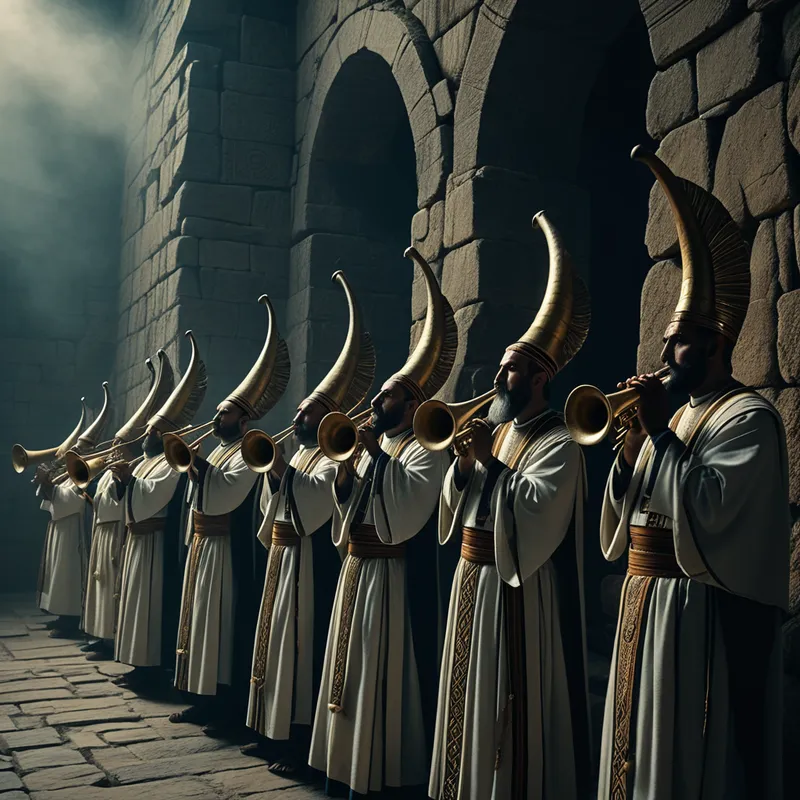
And Joshua received a command that defied all reason of war. The strategy was not of siege towers or battering rams, but of sacred procession. The might of Israel was not to be an army, but a congregation. The vanguard was not its fiercest warriors, but its priests, bearing the Ark of the Covenant, and before them, seven priests with seven trumpets made from the horns of rams.
For six days, they marched. A silent army, save for the tramp of feet on the hard earth and the bleak, bleating cry of the shofar. Once each day, a single circuit around the immense, looming walls. The defenders watched from the parapets, their mockery turning to a cold, creeping unease. What madness was this? What power resided in such patient, silent circling?
Then came the seventh day. As the dawn bled into the sky, they began again. But this day, they did not stop. Once. Twice. Six times. The air grew thick with anticipation, charged with a silence that was itself a sound. On the seventh circuit, as the priests’ lungs filled for a final blast, Joshua’s voice tore through the stillness: “Shout! For the YHWH has given you the city!”
And they shouted. A roar that rose from the belly of a people, a cry of faith and pent-up destiny. The priests blew the shofars, a sound that was not music but a declaration of divine sovereignty. And the earth, the stone, the very foundations of human arrogance, heard it.
The great walls did not crack. They did not fall. They came down. A deep, groaning sigh rose from the earth, and the mighty stones slid from their place, collapsing inward and outward in a cloud of dust and thunder, laying the city’s heart bare. The shout and the trumpet blast had become a physical force, the audible edge of a will greater than stone. The fortress was open. The obstacle was gone. All that remained was the dust settling, and the stunned silence that follows a miracle.
Cultural Origins & Context
This narrative is anchored in the Book of Joshua, a foundational text of national identity for ancient Israel. It functions as a etiological myth—a story explaining how the Israelites came to possess the land they believed was promised to them by their God. The tale was preserved and transmitted by priestly and prophetic circles, likely recited during festivals and retellings of national history to reinforce communal identity, theological orthodoxy, and the doctrine of divine retribution and reward.
The story served a crucial societal function: it established a template for holy war (herem), where victory was attributed not to military superiority but to strict ritual obedience and faith in YHWH’s direct intervention. Jericho, as the first major conquest in Canaan, became the archetypal example. Its total destruction (save for Rahab and her household) set a severe precedent and symbolized the complete rejection of the existing Canaanite religious and social order. The story cemented Joshua as the legitimate successor to Moses and validated the Israelites’ claim to the land through divine, rather than merely human, agency.
Symbolic Architecture
The myth’s power lies not in historical veracity, but in its profound symbolic architecture. The walls represent more than a military barrier; they are the ultimate symbol of entrenched resistance, hardened defense, and separation. They are the ego’s fortifications, the psychological barriers we build from fear, tradition, and a desire for permanence. They separate “us” from “them,” safety from threat, the known from the unknown.
The wall is the psyche’s petrified fear. The shout is the soul’s imperative to become.
The prescribed, ritualized actions—the silent marching, the precise number of circuits, the blast of the ram’s horn—symbolize a discipline that precedes breakthrough. It is not chaotic force but aligned, patient, faithful action that prepares the ground for collapse. The shofar itself is a rich symbol: an instrument made from the horn of a sacrificed animal, its sound is raw, non-melodic, and meant to awaken, announce, and shatter complacency. It is the voice of the transcendent breaking into the realm of the rigidly immanent.
The final, collective shout is the release of potent, focused intentionality. It is the moment when internal conviction must become externalized sound and action. The collapse that follows signifies a paradigm shift so complete that the old structure of reality cannot stand. The walls do not just fall; they are given. The victory is received, not taken.
The Dreamer’s Resonance
When this myth stirs in the modern dreamer, it signals a profound psychological process at the threshold of consciousness. To dream of an immense, unscalable wall encircling something—a city, a garden, the self—is to encounter one’s own Jericho. This is the somatic experience of a core defense mechanism: the fortress of personality that has outlived its usefulness but feels essential to survival.
The dream may involve circling the wall, feeling its imposing presence, or hearing a distant, compelling sound. The emotional tone is key: a mixture of awe, dread, and a strange, potent hope. This is the psyche preparing for a de-structuring. The “shout” in the dream may manifest as a sudden, powerful emotion—a cry that erupts unbidden, a surge of long-suppressed anger or grief, or a moment of crystal-clear insight that feels audible. The subsequent collapse of the barrier is often experienced not as violence, but as relief, a yielding, or a terrifying yet necessary opening. The dreamer is undergoing the somatic unraveling of an old, rigid complex, making way for a vulnerability that is also a liberation.
Alchemical Translation
In the alchemical vessel of individuation, the myth of Jericho models the opus of psychic transmutation. The first stage is circumambulatio—the sacred circling. This is the conscious, patient work of self-observation. We circle our problem, our complex, our wall. We study it from all angles in silence, gathering understanding without yet engaging in attack. This is the nigredo, the blackening, where the enormity of our own defenses becomes clear.
The seven priests with seven trumpets represent a sacred, internal order—the guiding principles or values (the Self) that must lead the process. The number seven signifies completeness and divine process. The final, seventh day’s seven circuits culminate in the shout: this is the critical moment of sublimatio, where the spirit, long focused and contained, must erupt into decisive expression. It is the act of speaking one’s truth, setting a boundary, making a choice that one’s entire being has been prepared for.
The alchemy is in the timing: the patient preparation makes the explosive release transformative, not destructive.
The falling walls are the solutio—the dissolution of rigid, outworn structures of the personality. The dust that settles is the albedo, the whitening, the clarity that comes after the collapse. The city, once hidden, is now exposed and can be integrated (or, in the harsh symbolism of the myth, purged). For the modern individual, this translates to the collapse of an old self-image, a limiting belief, or a toxic pattern. The open space left behind is not a victory of conquest over others, but of the Self over the ego’s imprisoning fortifications. It is the creation of psychic territory where something new, and more authentic, can finally be built.
Associated Symbols
Explore related symbols from the CaleaDream lexicon: