The Voyage of Bran Myth Meaning & Symbolism
A prince follows a silver branch to a timeless island, only to discover the soul's price for tasting paradise and the impossibility of going home.
The Tale of The Voyage of Bran
Listen, and let the salt-spray fill your lungs. Let the memory of a world not yet hardened by time stir in your blood. This is the voyage of Bran mac Febail.
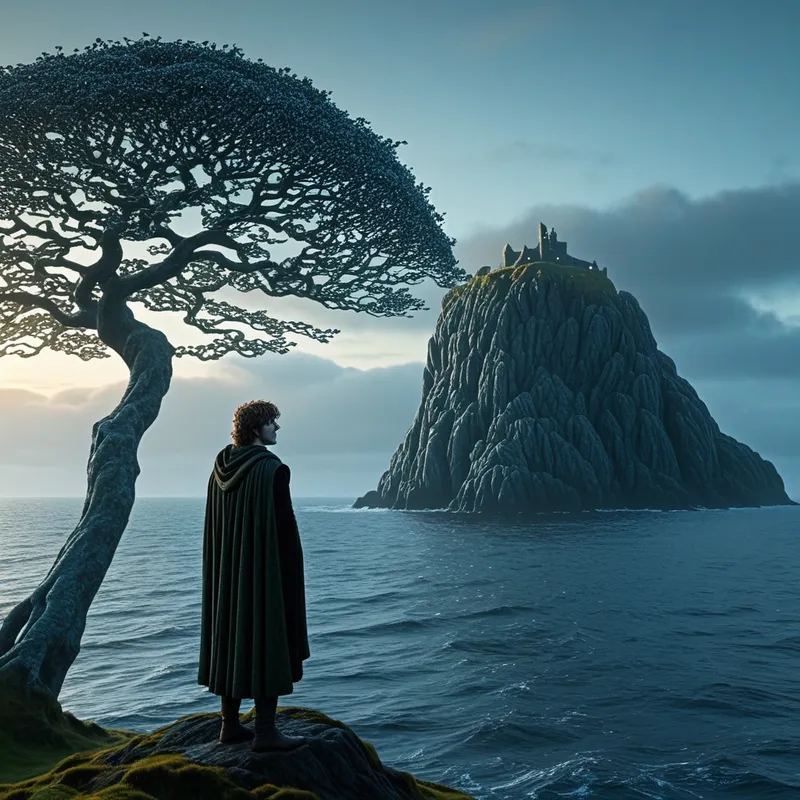
One day, as Bran walked alone, a sound began to weave through the ordinary air—a music so sweet it stilled the birds and hushed the wind. It came from behind him, a melody that was both a lament and a promise. He turned, and turning, saw nothing. But when he turned again to face the sea, a branch of silver lay at his feet, heavy with white blossoms that shone with their own inner moon. As he lifted it, the music swelled, and a woman appeared. Her cloak was the green of deep ocean trenches, her eyes held the calm of ages. She sang not to his ears, but to the marrow of his bones. She sang of Tír na nÓg, an island beyond the sunset where sorrow is unknown, where feasts never end, and beauty does not fade. Her song was a hook in his soul.
Driven by a longing he could not name, Bran gathered three companies of nine men each—the sacred number—and set sail in his curragh. For two days and two nights, they sailed west into the unknown. On the third, a figure moved across the waves towards them. It was the sea-god Manannán mac Lir, driving his chariot over flowering plains that only he could see. “To you, you are on a choppy sea,” he called to the awestruck crew. “To me, I ride through a plain of clover in bloom.” He blessed their voyage and vanished into the mist.
Then, they saw it. A land, radiant as a jewel. They approached a shore where the people laughed with a joy that had no edge of grief. A host greeted them, and for what felt like a year, they feasted in a hall where the mead never ran dry and the harps played themselves. In that land, one of Bran’s men, consumed by a sudden, crushing homesickness for Erin, begged to return. The king of the land warned them gravely: if you must go, do not set foot upon the soil of your homeland.
But the pull of the known is a powerful tide. They sailed back. From their boat, the coast of Ireland looked strange, the people on shore like distant insects. Bran called out his name and the name of his father to the gathered crowd. A withered elder shouted back, “We know of a Bran mac Febail only from ancient tales, a hero who sailed to the Otherworld centuries ago!” The homesick man, in his despair, leapt from the boat onto the familiar sand. The moment his feet touched the earth, he crumbled into a pile of ash, as if all the centuries he had lived without aging in Tír na nÓg fell upon him at once. Seeing this, Bran and his crew turned their boat around. They did not land. They raised their sail to a wind that no one on that shore could feel, and they were never seen again. Some say they still sail the border waters, forever between the world of time and the world of timelessness.
Cultural Origins & Context
The Voyage of Bran (Immram Brain) is a seminal tale of the immram tradition, preserved in manuscripts like the Lebor na hUidre (Book of the Dun Cow) from the 11th century. These tales existed in the rich oral tradition of the filid, the poet-seers of early Ireland, long before being committed to vellum by Christian monks. While the scribes may have added a gloss of monastic piety, the myth’s bones are pagan, rooted in a pre-Christian Celtic worldview where the boundaries between this world and the Sídhe were thin and permeable.
The societal function was multifaceted. On one level, it was pure wonder-tale, a map of the imagination pointing to Tír na nÓg and other Mag Mell. On another, it was a profound meditation on exile, sovereignty, and the nature of time. For a culture deeply connected to its land and ancestry, the tale posed a terrifying, beautiful question: what happens when you find a “better” land? And what is the cost of looking back? It served as a cautionary narrative about the irreversible nature of certain choices and the soul’s transformation when it encounters the numinous.
Symbolic Architecture
The myth is a perfect symbolic vessel for the psyche’s encounter with the unconscious. Bran is the ego-consciousness, comfortable in his known world, until the unconscious—in the form of the enchanting woman and her silver branch—issues its irresistible call. The voyage is the journey inward, across the perilous, unknown sea of the psyche.
The silver branch is the call itself, the luminous, haunting symbol that appears when the soul is ready for a deeper life, but which also signifies the end of life as it has been known.
Tír na nÓg is not a geographical place but a psychological state: the realm of the Self, where opposites are reconciled. Here, time (chronos) ceases, and only meaningful duration (kairos) exists. It represents the state of psychic wholeness sought in individuation. Manannán’s vision reveals the ultimate symbolic truth: the same reality—the journey—is perceived utterly differently depending on one’s level of consciousness. The choppy sea of anxiety and effort for Bran is a flowering plain of unity for the god.
The fatal return and the ash-pile of the companion constitute the myth’s devastating core. It symbolizes the impossibility of the transformed psyche reintegrating into the old, unconscious life. You cannot bring the wisdom of the timeless back into the framework of time on time’s terms. To try is to disintegrate.
The Dreamer’s Resonance
When this myth stirs in modern dreams, it often manifests as dreams of profound, melancholic beauty just out of reach, or of disastrous returns. You may dream of finding a room in your house you never knew existed, filled with light and music, only to wake with the certain knowledge you can never find it again. You may dream of returning to your childhood home to find it alien, the doors locked, the faces of your family blurred and unrecognizable.
Somatically, this can feel like a deep, resonant ache in the chest—a “sehnsucht” or longing for a home you have never known. Psychologically, it signals a process of irreversible awakening. The dreamer is navigating the aftermath of a transformative insight, a spiritual experience, or a deep therapy session that has altered their foundational perspective. The conflict is between the newly expanded self and the old world that now feels like a ill-fitting skin. The dream is the psyche working on the cruel, necessary law of the myth: you cannot un-know what you have learned. Integration requires building a new vessel, not trying to cram the ocean back into a cup.
Alchemical Translation
The alchemical process mirrored here is the nigredo followed by a permanent dissolution of the old prima materia. The call (the silver branch) is the initial stirring, the albedo or whitening represented by the radiant isle. But the true alchemy is in the failed return.
Individuation is not about reaching paradise and bringing back trophies. It is about being so fundamentally changed by paradise that the old world ceases to be your home.
Bran’s final, eternal voyage is the alchemical goal. He does not regress to his former state, nor does he disintegrate upon trying. He becomes the Lapis Philosophorum, the Philosopher’s Stone, himself. He lives in a permanent state of transmutation, sailing the liminal sea between consciousness and the unconscious. For the modern individual, this translates to a lasting state of engagement with the inner world. One no longer “visits” insight or creativity but lives from it, navigates by it. The “homeland” of rigid identity is abandoned. The Self is no longer a destination to be reached and left, but the ocean upon which one continually sails. The triumph is not in the finding, but in the courageous, perpetual navigating of the newfound, boundless deep.
Associated Symbols
Explore related symbols from the CaleaDream lexicon: