The Volva Myth Meaning & Symbolism
A tale of a seeress summoned by Odin to reveal the doom of gods and cosmos, embodying the terrifying power of fate and forbidden knowledge.
The Tale of The Volva
Hear now a tale not of thunder, but of silence. Not of the clash of swords, but of the whisper from the grave. In the days when the Æsir were young and arrogant, a shadow fell upon the heart of Odin, the All-Father. A chill gnawed at him, a foreboding that coiled around the roots of Yggdrasil itself. He had drunk from the well of wisdom, sacrificed an eye for sight, yet the future was a sealed tomb. He needed a key. He needed one who walks between.
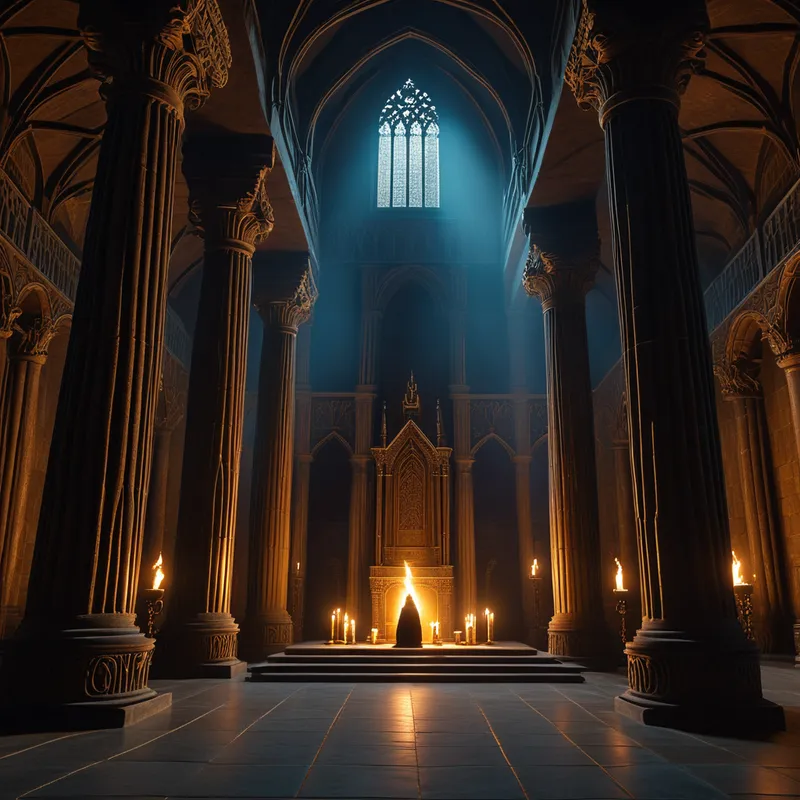
He sought a Völva. Not just any wise-woman, but one long dead, a prophetess of such power that the earth itself remembered her song. To a grave-mound they went, Odin and his retinue, a place where the wind carried the scent of cold stone and old bones. The gods raised a high seat for her, draped it with rich cloth, and piled it with cushions. They kindled a fire that did not warm, and Odin, the lord of the slain, began the chant. He sang in the tongue of spirits, his voice a low river pulling at the shores of death. He called her forth, not by force, but by need—a king summoning a queen from a darker court.
And she came.
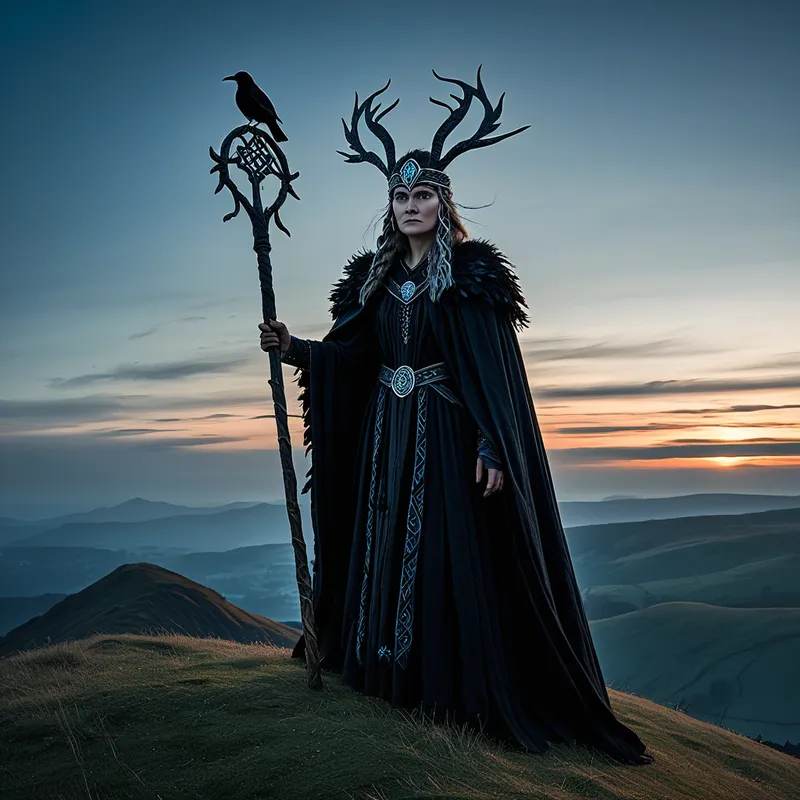
The air grew thick and tasted of iron. From the mound, a presence gathered, formless at first, then settling upon the high seat like a cloak of mist. They saw her then: a figure of terrible dignity, her face shadowed, her eyes like wells into a starless night. She wore a cloak of blue-black, and at her side hung a pouch of charms—the teeth of beasts, the feathers of far-flying birds, stones that had slept in riverbeds for a thousand years. In her hand was a staff, the wood dark with age and power.
She spoke, and her voice was the sound of roots breaking stone. “Why do you break my sleep, Odin? Why drag me from the mold, from the embrace of the earth? I have traveled the nine worlds. I have sat with giants and sung with dragons. I know the beginning, and I see the end. Do you truly wish to hear it?”
Odin, the god who hung himself on the World Tree for knowledge, did not flinch. “Speak, wise one. I must know the fate of my sons. I must know the fate of the gods.”
And so, from lips that had tasted grave-earth, the prophecy unfolded. She sang of the golden age past, of the first war, of the death of Baldr, the shining one. Her words painted his murder in the air, a tragedy that would crack the sky. Then her gaze turned outward, beyond the halls of gods, to the final grinding of the gears of time. She sang of Ragnarök. She sang the names of the doom-bringers: the wolf Fenrir, the serpent Jörmungandr, the ship of nails, Naglfar. She described the fall of Odin, of Thor, of Freyr. She sang of the sun turning black, the stars vanishing, and the earth sinking into the boiling sea.
But in the ashes of that ending, her vision did not stop. She saw the green shoot. A new earth, rising from the water, fresh and green. She saw the surviving gods gather, and a new generation of humans emerge from the world tree’s wood. Life, stubborn and resilient, would begin again.
Her song ceased. The fire guttered. The weight of the prophecy hung in the hall, a tangible thing. The Völva, her duty done, began to fade. “Now I must go back,” she murmured, her voice now faint as a memory. “Back to the burial mound, to the long night. I have said what must be said.” And like mist before a morning sun, she was gone, leaving behind only the echo of doom and the fragile promise of a dawn yet to come.
Cultural Origins & Context
The figure of the Völva was not merely a mythological construct but a potent reality in the Norse world. These were women of immense social and spiritual power, operating outside the conventional structures of family and clan. They were itinerant seeresses, traveling from community to community, often with a retinue of assistants. Their primary function was seiðr, a form of sorcery that involved entering a trance state to foretell the future, locate lost items, or influence outcomes.
The myth of Odin consulting the dead Völva, preserved primarily in the poem Völuspá (“The Prophecy of the Seeress”) from the Poetic Edda, is a cultural snapshot of this profound respect and fear. It encapsulates the Norse understanding that the most critical knowledge—the fate of the cosmos itself—resided not in the halls of gods or kings, but in the liminal space accessed by this marginalized yet essential figure. The Völva’s knowledge comes from her journeys, her outsider status granting her a perspective that even Odin, with all his sacrifices, cannot attain alone. The myth served as a sacred narrative validating the seeress’s role, reminding all of a wisdom that predates and will outlast the current order, a wisdom that speaks the uncomfortable, necessary truths.
Symbolic Architecture
The Völva is the archetype of the Deep Knower, the one who accesses the objective psyche, the collective unconscious that holds the blueprint of existence, past and future. She is not a personal unconscious figure but a personification of the Self in its most transpersonal, fateful aspect.
To consult the Völva is to willingly face the pattern woven into the fabric of one’s being, a pattern that includes both glorious creation and necessary destruction.
Her staff is her axis mundi, the tool that connects the heavens, earth, and underworld, just as Yggdrasil does. Her pouch of charms represents the fragmented, yet potent, contents of the unconscious—instincts, ancestral memories, and archetypal images. Her seat upon a grave-mound is crucial: her wisdom is chthonic, born of the earth and of death. It is not intellectual knowledge, but gnosis earned through dissolution and recombination. Odin’ summoning of her represents the ego’s desperate, courageous attempt to integrate this terrifying, fate-laden knowledge into consciousness, to see the full pattern, even if it spells one’s own doom.
The Dreamer’s Resonance
When a modern dreamer encounters the Völva archetype, it often signals a profound confrontation with personal or collective fate. This is not a figure of gentle guidance, but of oracular truth-telling. Dreaming of such a seeress may manifest as meeting a formidable, older woman in a liminal space (an attic, a cave, a deserted road), being shown a book with irrevocable writing, or hearing a pronouncement about one’s life path that feels both alien and utterly true.
Somatically, this process can feel like a deep, unsettling resonance—a chill, a sense of weight, or a visceral knowing in the gut. Psychologically, it marks a point where the ego’s plans are being overridden by a deeper, more impersonal current of the psyche. The dreamer is being asked to acknowledge a destiny or a calling that may disrupt their comfortable identity. It is the psyche’s way of initiating a necessary, though often feared, transformation by forcing an encounter with what must be, not merely what is desired.

Alchemical Translation
The myth of the Völva models the alchemical stage of nigredo—the blackening, the confrontation with the primal matter and the shadow of one’s own destiny. The process begins with Odin’s discontent, the prima materia of psychic suffering and yearning. The journey to the grave-mound is the descent into the unconscious. The chanting and summoning are the focused attention and ritual required to engage the deepest layers of the Self.
The prophecy itself is the coniunctio oppositorum, the union of opposites: it contains both annihilation and rebirth, the death of the old god-identity and the emergence of a new, more conscious relationship to the Self.
For the modern individual, this translates to the painful but essential process of “fate-reading.” It is the moment we stop running from our core wounds, our inherited patterns, and our deepest callings, and instead, like Odin, actively seek them out. We must sit in the high seat of introspection and call up the buried prophet within—that part of us that knows the trajectory of our life, including the necessary endings (the fall of our personal “gods” or cherished self-images). The triumph is not in avoiding the prophesied struggle, but in hearing it fully. By integrating this knowledge, we move from being victims of fate to conscious participants in it. The green world that rises after Ragnarök is the new psychic structure born from this courageous act of seeing: an individuality no longer based on illusion, but forged in the full, terrible, and beautiful knowledge of what it means to be human.
Associated Symbols
Explore related symbols from the CaleaDream lexicon: