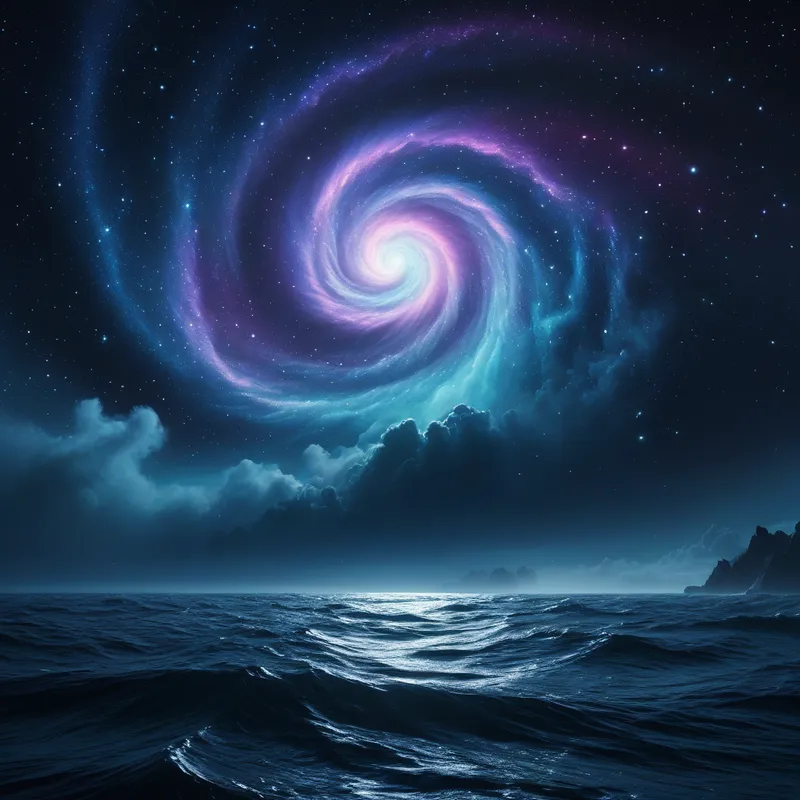
The Void / Chaos Myth Meaning & Symbolism
Before the world was, there was a formless, boundless potential—the Void. From its fertile darkness, all things are born and to it they return.
The Tale of The Void / Chaos
Listen. Before the first word was spoken, before the first light was kindled, there was… not nothing. That is the first mistake of the thinking mind. There was a presence, a state so profound that our words for absence fail to contain it. It was the Chaos of the Greeks, a yawning gap, but one that breathed. It was the Tiamat, salt waters mingling with sweet, a serpentine, maternal darkness. It was the Tohu wa-Bohu, a desolation and an emptiness that was, paradoxically, full of potential.
In the north, there was only Ginnungagap, the mighty gap. To its north lay Niflheim, a realm of ice, mist, and silence so deep it was a substance. To its south lay Muspelheim, a realm of fire, sparks, and a heat that was a roar. And between them, Ginnungagap waited. It was not passive. It was a womb of possibility, a stage set for a drama not yet written. And then… the meeting. The fiery sparks from Muspelheim flew into the gap, meeting the freezing rime of Niflheim. Where fire and ice touched in that vast emptiness, a dripping, a melting, a quickening occurred. From that alchemical reaction in the void, the first being stirred: Ymir, the frost giant, formed from the very substance of potential itself.
In the islands of the Pacific, in the beginning, there was only Po. A deep, impenetrable night that stretched without measure, without time, without division. Within Po, the great gods slept, unborn. There was no sound but the pulse of potential. Then, from within that profound darkness, a stirring of thought, a whisper of will. The god Io existed within Po, and from his sacred breath and word, he began the process of separation, of drawing forth the world from the womb of night.
And from the sands of Egypt rose the story of Nun. Before the first mound of earth, before the sun god Ra sailed his barque, there was an infinite, dark, watery chaos. Nun was not a deity in a form we would recognize, but the very essence of the unordered, the latent. It was a cosmic ocean, without shore or surface, containing all that ever would be in a state of perfect, undifferentiated suspension. From those waters, by an act of will or a spoken command, the first island emerged, and upon it, the first light.
Cultural Origins & Context
These are not the stories of a single fire, but embers from countless hearths, glowing with the same primordial truth. They are the foundational layer of human cosmology, emerging independently across continents and epochs. The Greek Chaos was formalized by Hesiod in his Theogony, a text that sought to order the divine lineage for a burgeoning city-state culture. The Mesopotamian Tiamat comes to us from the Enuma Elish, a creation epic recited during the Babylonian New Year festival to reaffirm the king’s divine mandate and the cosmic order’s triumph over chaos.
The Norse accounts are preserved in the Poetic Edda and the Prose Edda of Snorri Sturluson, texts compiled centuries after the Christianization of Scandinavia, yet holding fast to a worldview born in the harsh, elemental struggle of the Nordic landscape. The Polynesian Po and the Egyptian Nun were transmitted orally for millennia by priests and storytellers, their recitation a sacred act that ritually re-enacted the creation of the world, ensuring the continuity of life, seasons, and society. These myths were not mere explanations; they were the psychic and social bedrock. To tell the story of the Void was to remind the community of the fragile, wondrous nature of the ordered world, wrested from an eternal, surrounding potential for dissolution.
Symbolic Architecture
The Void, the Chaos, is the ultimate symbol of the unformed. It is not evil, nor is it benevolent. It is prior to such distinctions. It represents pure potentiality, the state of all possibilities existing simultaneously without manifestation. It is the psychological ground of being from which consciousness itself emerges.
The Void is not the enemy of creation, but its necessary precondition. It is the blank page, the silent mind, the fertile darkness of the unconscious before the spark of ego ignites.
In this light, the entities born from it—Ymir, the first gods from Po, even the differentiated world from Nun—are not merely characters but acts of distinction. They represent the primordial act of consciousness: making a distinction, drawing a line, saying “this” is not “that.” This is the birth of order from chaos, of identity from anonymity. The Void, therefore, symbolizes the unconscious psyche in its totality—the repository of all we are, have been, and could be, before the light of our waking awareness falls upon it to create the familiar landscape of our identity.
The Dreamer’s Resonance
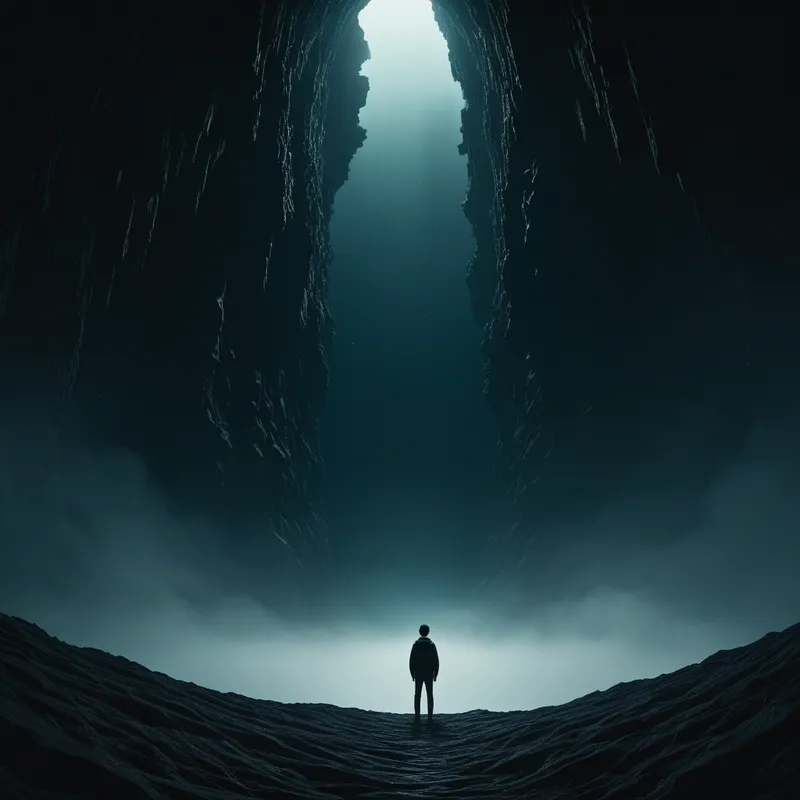
When this myth stirs in the modern soul, it often surfaces in dreams of profound disorientation or fertile emptiness. You may dream of standing in an endless, grey plain under a starless sky, or floating in a dark, warm ocean with no land in sight. You may find yourself in a familiar room that has lost all its furniture and features, becoming a blank, echoing shell. These are not nightmares of threat, but of potential.
Somnatically, this can feel like a dissolution—a loss of the familiar boundaries of the self. Psychologically, it signifies a moment when the old structures of one’s life or identity have broken down, but the new forms have not yet coalesced. It is the psychic equivalent of the Ginnungagap between the ice of a frozen, outlived past and the fire of a future not yet grasped. The dreamer is in the liminal space, the chaos, that necessarily precedes a rebirth. The anxiety felt is the anxiety of the unformed, the call to participate in one’s own creation.
Alchemical Translation
The journey of individuation, the process of becoming whole, is not a linear path of accumulation. It is a cyclical dance with the Void. We build a conscious personality—a well-ordered world—but to grow, we must periodically allow that world to be deconstructed, to return its elements to the primal soup of the psyche for recombination.
The alchemical goal is not to defeat chaos, but to develop the courage to consciously enter it, to hold the tension of opposites within the crucible of the self, and to midwife new forms from the fertile dark.
The modern individual faces this when a career ends, a relationship dissolves, or a long-held belief shatters. This is the personal Tiamat rising. The heroic task is not to slay it outright, but to engage with it, to recognize it as a part of one’s own depth. By facing the inner void without fleeing into premature certainty, one performs the same act as the creator gods: one begins to separate, to name, and to shape a new, more authentic order from the raw material of the self. One learns that creation is not a one-time event, but a continuous dialogue with the creative darkness from which we all emerge and to which we all ultimately return, ready to be remade.
Associated Symbols
Explore related symbols from the CaleaDream lexicon: