The Völundarkviða Myth Meaning & Symbolism
A master smith is crippled and enslaved by a king. Through cunning and supreme craft, he forges a terrible revenge, transforming his agony into a prison for his captors.
The Tale of The Völundarkviða
Listen, and hear the tale of the master who was unmade, and who remade [the world](/myths/the-world “Myth from Tarot culture.”/) in his fury. In the cold, clear lands of the north, there lived three brothers, Slagfiðr, Egill, and the third, whose name rings on the anvil of fate: Völundr. They were hunters, wed to Hlaðguðr svanhvít and Ölrún, and to Völundr, the most radiant, Hervör alvitr. For nine winters they dwelt in peace in Úlfdalir, until the day the swan-maidens took to [the sky](/myths/the-sky “Myth from Persian culture.”/), following the call of war, and did not return.
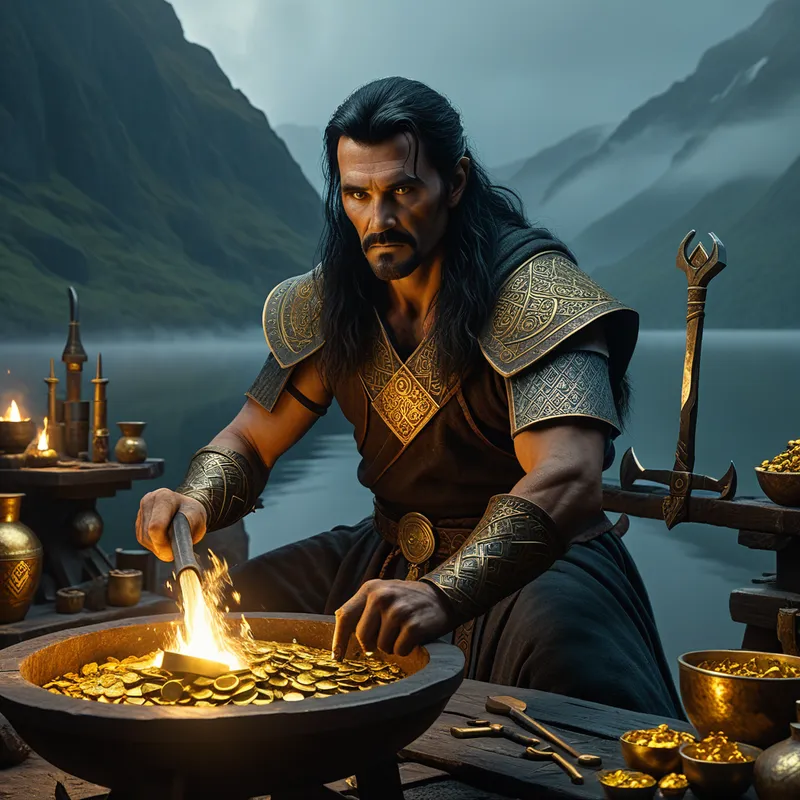
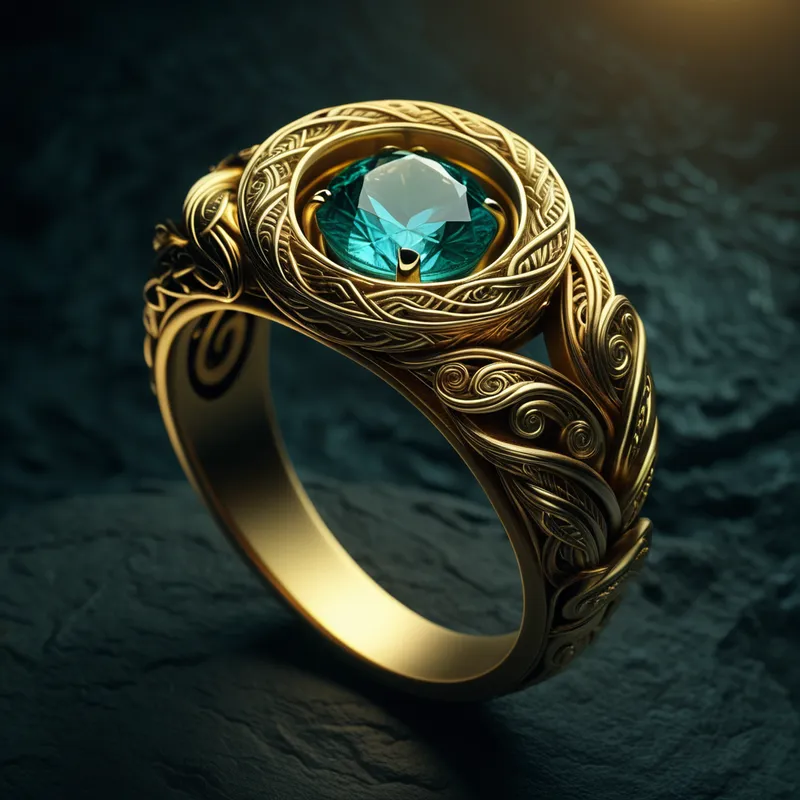
Only Völundr remained, waiting in a hall by a lake, his heart a cold forge. He sat, working gold and gems into wonders no mortal eye had seen—rings that caught the moonlight, brooches that whispered. His fame was his undoing. King Níðuðr of the Njarar heard of this solitary smith and his hoard. In the dead of night, the king’s men crossed the [water](/myths/water “Myth from Chinese culture.”/). They seized the master as he slept, bound him, and stole the ring Hervör had left him, giving it to the king’s daughter, Böðvildr.
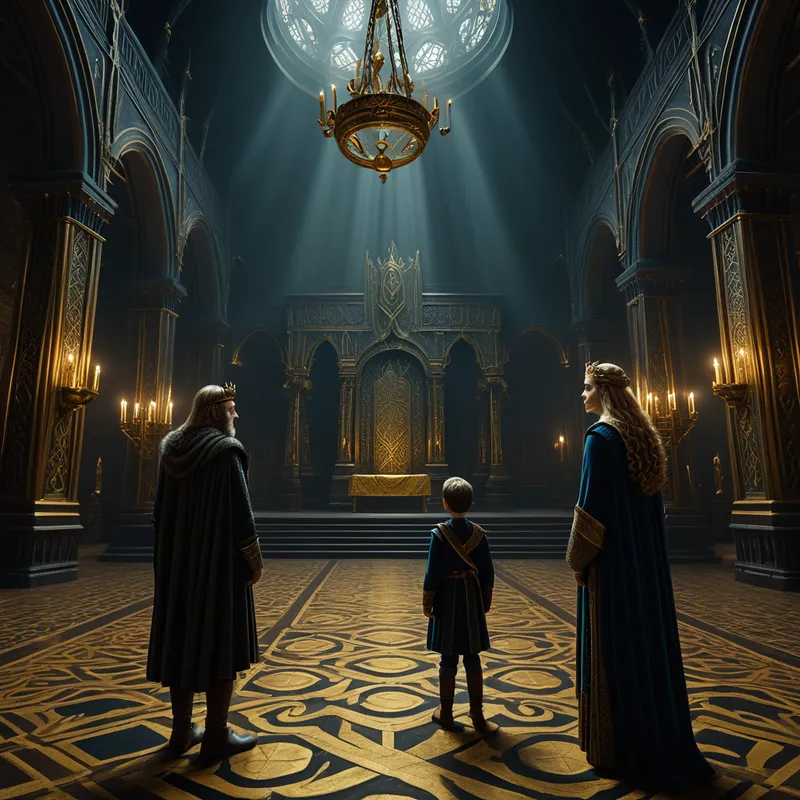
To ensure the smith could never flee, Níðuðr ordered his hamstrings cut, crippling him, and then imprisoned him on the island of Sævarstaðr. There, the broken king-maker was forced to toil, his genius chained to the petty whims of his captor. The king wore his sword, the queen his ring, and they believed they had tamed a god of craft.
But a forge cannot be contained. Völundr’s smile grew cold as the northern steel. He asked only to work undisturbed. The king, greedy for more treasures, agreed. In his solitary prison, the fire of vengeance was stoked hotter than any bellows could blow. When the king’s two young sons, curious of the smith’s wonders, came to his island, Völundr welcomed them with a gentle voice. He showed them chests filled with gold and jewels. “Tell no one,” he said, “and when you return, all this shall be yours.” And when they bent to look into the glittering depths, he struck. He took their heads and set them beneath the silver of his anvil, their teeth he fashioned into brooches for the queen, their eyes into shining gems for the king.
His work was not done. When Böðvildr came to him, weeping that the ring he had made—her ring, the one taken from him—was broken, Völundr offered to mend it. He gave her drugged beer, and there, in the smithy that was his world, he took his payment from the daughter of the man who had taken everything from him.
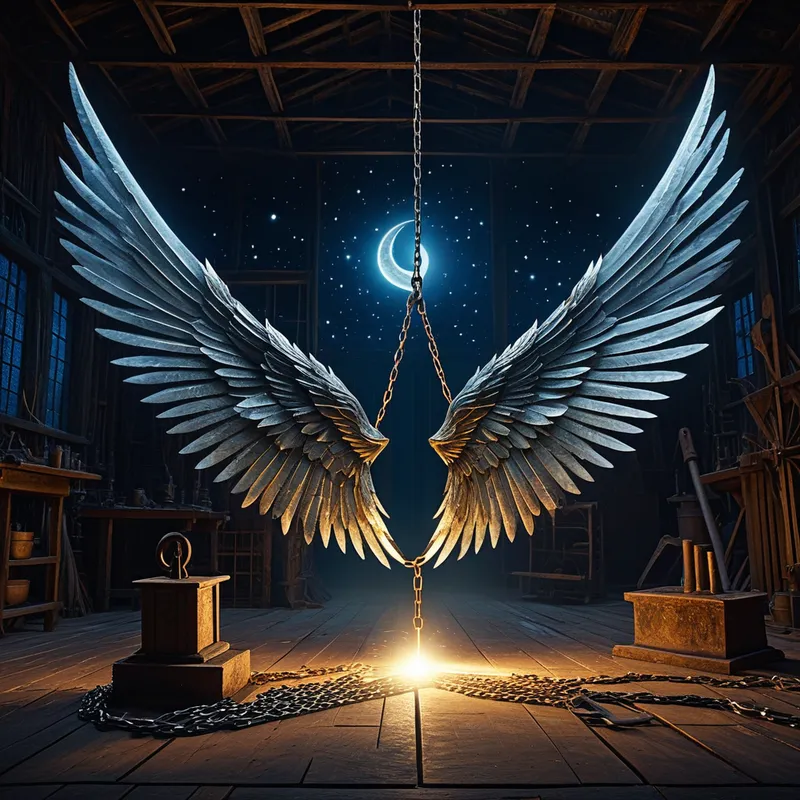
Then, with a laugh that echoed from the depths of [the earth](/myths/the-earth “Myth from Hindu culture.”/), Völundr called out to the king. He revealed his deeds from the roof of his smithy, holding aloft the terrible, beautiful proofs of his revenge. “I have crafted a sorrow for your house that no smith can ever undo!” he cried. And with that, he donned the wings he had secretly forged from feathers gathered over long months, and rose into the sky, a crippled god of iron and agony, flying free on metal and rage, leaving a silent, broken hall behind him.
Cultural Origins & Context
The Völundarkviða, or “Lay of Völundr,” is preserved in the Poetic Edda. Its roots, however, sink deep into the common Germanic soil, with parallels found in Anglo-Saxon legend as [Wayland the Smith](/myths/wayland-the-smith “Myth from Norse culture.”/). This was not a tale of the Æsir, but of the legendary, semi-divine past of heroes and master craftsmen. It was a story told in halls, a dark glittering thread in the tapestry of Norse heroic poetry. Its function was complex: it celebrated the transcendent, almost terrifying power of skill (ørlög), while serving as a grim warning about the consequences of violating the sacred bond between a master and his work, and the dangerous, amoral potency of genius when it is pushed beyond the limits of human suffering.
Symbolic Architecture
At its core, the myth is a map of the creative [psyche](/myths/psyche “Myth from Greek culture.”/) in its most injured and potent state. Völundr is the archetypal [Creator](/symbols/creator “Symbol: A figure representing ultimate origin, divine power, or profound authorship. Often embodies the source of existence, innovation, or personal destiny.”/), but one who has been violently severed from his inspiration (the swan-maiden [wife](/symbols/wife “Symbol: The symbol of a ‘wife’ in a dream often represents commitment, partnership, and personal relationships, reflecting one’s desires for intimacy or connection.”/)) and his autonomy (his hamstrings, his freedom). The [island](/symbols/island “Symbol: An island represents isolation, self-reflection, and the need for separation from the external world.”/) [prison](/symbols/prison “Symbol: Prison in dreams typically represents feelings of restriction, confinement, or a lack of freedom in one’s life or mind.”/), Sævarstaðr, is the isolated, tortured mind, forced to produce for an outer [authority](/symbols/authority “Symbol: A symbol representing power structures, rules, and control, often reflecting one’s relationship with societal or personal governance.”/) ([King](/symbols/king “Symbol: A symbol of ultimate authority, leadership, and societal order, often representing the dreamer’s inner power or external control figures.”/) Níðuðr, [the ego](/myths/the-ego “Myth from Jungian culture.”/) or societal demands) that does not understand it.
The true forge is not of fire and bellows, but of compressed suffering. What is hammered there is not mere metal, but the soul itself, and its output is irrevocable.
His mutilation—the cutting of the hamstrings—is a profound [symbol](/symbols/symbol “Symbol: A symbol can represent an idea, concept, or belief, serving as a powerful tool for communication and understanding.”/) of the crippling of one’s instinctual [movement](/symbols/movement “Symbol: Movement symbolizes change, progress, and the dynamics of personal growth, reflecting an individual’s desire or need to transform their circumstances.”/), one’s [ability](/symbols/ability “Symbol: In dreams, ‘ability’ often denotes a recognition of skills or potential that one possesses, whether acknowledged or suppressed.”/) to “walk one’s own [path](/symbols/path “Symbol: The ‘path’ symbolizes a journey, choices, and the direction one’s life is taking, often representing individual growth and exploration.”/).” The [stolen ring](/symbols/stolen-ring “Symbol: A stolen ring represents lost commitments and the impact of vices on meaningful relationships and promises.”/) represents the lost [connection](/symbols/connection “Symbol: Connection symbolizes relationships, communication, and bonds among individuals.”/) to the [anima](/symbols/anima “Symbol: The feminine archetype within the male unconscious, representing soul, creativity, and connection to the inner world.”/), the inner feminine principle of relatedness and [soul](/symbols/soul “Symbol: The soul represents the essence of a person, encompassing their spirit, identity, and connection to the universe.”/), now in the possession of an immature [consciousness](/symbols/consciousness “Symbol: Consciousness represents the state of awareness and perception, encompassing thoughts, feelings, and experiences.”/) (Böðvildr). Völundr’s revenge is not a mere act of violence; it is a horrific, precise act of re-creation. He transforms the living sons (the king’s future, his [legacy](/symbols/legacy “Symbol: What one leaves behind for future generations, encompassing values, achievements, possessions, and memory.”/)) into dead artifacts (brooches, gems). He takes the broken ring (the damaged [connection](/symbols/connection “Symbol: Connection symbolizes relationships, communication, and bonds among individuals.”/)) and “mends” it through a violating union, asserting a brutal, twisted form of creative control. His [flight](/symbols/flight “Symbol: Flight symbolizes freedom, escape, and the pursuit of one’s aspirations, reflecting a desire to transcend limitations.”/) on mechanical wings is the ultimate [symbol](/symbols/symbol “Symbol: A symbol can represent an idea, concept, or belief, serving as a powerful tool for communication and understanding.”/): the crippled psyche, using the very products of its own tortured genius, achieves a liberation that is awe-inspiring, terrifying, and utterly inhuman.
The Dreamer’s Resonance
To dream in the pattern of the Völundarkviða is to feel the somatic weight of creative imprisonment. One may dream of being trapped in a workshop, compelled to build something for a faceless authority, while feeling a fundamental part of oneself is severed or lame. The dreamer might discover beautiful, terrible objects they have made without conscious memory—objects that fill them with both pride and dread. A figure with intense, silent eyes (the smith) may appear, offering a tool or a broken piece of jewelry.
Psychologically, this signals a profound process where a deep, skilled, and autonomous part of the psyche (the inner creator) has been captured and exploited by the conscious personality or life circumstances. The dreamer is going through the “hamstringing”—a feeling of being unable to move toward one’s true desires. The vengeful fantasies or cold, focused rage that may accompany such dreams are not mere aggression; they are the psyche’s initial, raw blueprint for reclaiming its creative fire, however distorted that reclamation may first appear.
Alchemical Translation
The alchemical journey here is the transmutation of victimhood into unassailable, if fearsome, authority. Völundr begins as [prima materia](/myths/prima-materia “Myth from Alchemical culture.”/)—a masterful substance captured and degraded. King Níðuðr represents the [nigredo](/myths/nigredo “Myth from Alchemical culture.”/), the crushing oppression that seems to destroy all value. The smith’s forced labor is the albedo, a painful purification where he must work within the confines of his prison.
The ultimate opus is not gold, but sovereignty. The psyche must learn to forge its chains into the very instruments of its liberation, even if the design is born of a dark fire.
His revenge is the violent, necessary [rubedo](/myths/rubedo “Myth from Alchemical culture.”/)—the red, fiery stage where the separated elements are fused with intense passion. He unites the king’s sons (the future) with his anvil (fate), and Böðvildr (the captive anima) with his will. This is a shadowy, brutal form of the hieros gamos, producing not harmony, but a searing, transformative power. The final stage, the caelum (the sky), is his flight. For the modern individual, this models the process where one must stop producing from a place of wounded compliance. One must consciously take the raw materials of one’s suffering, betrayal, and limitation—the very things that seem to cripple—and, through the focused fire of attention and skill, work them into a new form of power. This forged “wing” is not about escaping humanity, but about achieving a perspective and autonomy so hard-won that it forever separates one from the petty tyrannies that once held them bound. The myth does not promise a return to innocence, but offers the stark, majestic sovereignty of the scarred and soaring creator.
Associated Symbols
Explore related symbols from the CaleaDream lexicon: