The Vitrum Myth Meaning & Symbolism
A myth of a divine vessel shattered by its own perfection, whose scattered fragments must be gathered to forge a new, more resilient consciousness.
The Tale of The Vitrum
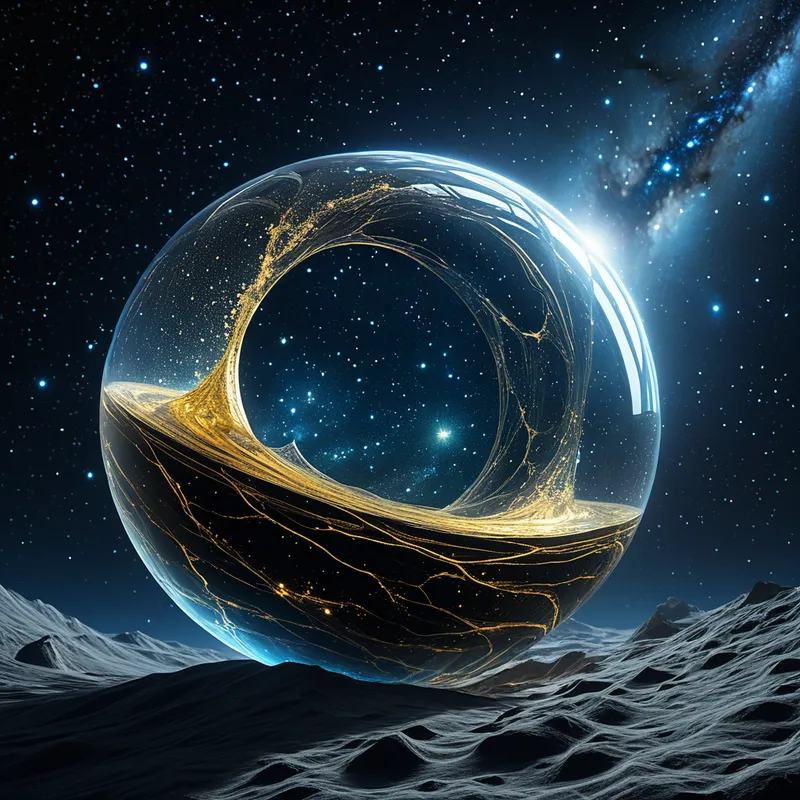
Listen, and hear the tale of the First Vessel, the [Vitrum](/myths/vitrum “Myth from Alchemical culture.”/). In the time before time, when the Chaos was still and the Anima Mundi slept, the Great Artificer wrought a vessel from the breath of stars and the silence between thoughts. It was not clay, nor metal, nor stone, but a substance translucent and perfect: a living glass. This was the [Vitrum](/myths/vitrum “Myth from Alchemical culture.”/), crafted to contain the nascent song of creation, to hold the unformed light of [the world](/myths/the-world “Myth from Tarot culture.”/)-to-be.
The Artificer poured into the Vitrum the [quintessence](/myths/quintessence “Myth from Alchemical culture.”/) of all things—the heat of fire, the flow of [water](/myths/water “Myth from Chinese culture.”/), the solidity of earth, the flight of air, and the spark of spirit. [The vessel](/myths/the-vessel “Myth from Alchemical culture.”/) swelled with this radiant burden, glowing from within like a captured dawn. It was beautiful beyond measure, a flawless orb reflecting the infinite potential of the cosmos. For eons, it held the light steady, and the first rhythms of existence pulsed from its core.
But perfection is a lonely and rigid state. The light within yearned not just to be held, but to be known, to experience contrast and relation. It began to stir, to test its boundaries. A subtle vibration, a note of longing, hummed through the Vitrum’s perfect form. The vessel, in its absolute purity, could not flex. It could only be.
The vibration became a resonance, the resonance a tremor. A single, hairline fracture, finer than a [spider](/myths/spider “Myth from Native American culture.”/)‘s thread, appeared on its surface. A sigh escaped—the first wind. Then another crack, and a drop of condensed light fell—the first rain. The Vitrum, in its agony of expansion, began to sing a song of breaking. It was not a song of destruction, but of unbearable pressure becoming expression. With a sound like a galaxy sighing, the Vitrum did not explode. It unfolded. It shattered into ten thousand thousand fragments, each a unique prism, each holding a sliver of the original, unified light.
The fragments flew into [the void](/myths/the-void “Myth from Buddhist culture.”/). Some became stars, cold and distant. Others became the seeds of souls, warm and seeking. Most became mere dust, glittering on the shores of being. The great, silent light was now a chorus of individual notes, scattered and lost.
And so the Artificer set a new task, not of making, but of mending. The call went out, not to the gods, but to the lonely and the seeking: the Traveler on [the Way](/myths/the-way “Myth from Taoist culture.”/). Their journey was not to find a treasure, but to gather the scattered glass. To walk the dark earth and the bright void, to find the shining fragments—in the depth of a sorrow, in the peak of a joy, in the heart of a stranger, in the memory of a dream—and to bring them back. Not to restore the old, perfect vessel, for that shape was gone forever. But to gather them in [the crucible](/myths/the-crucible “Myth from Alchemical culture.”/) of their own experience, to heat them in the fire of attention and suffering, until they could melt and merge into something new: a Vitrum Reconditum—a glass twice-made, flawed, stained with the journey, yet stronger for its seams, and infinitely more brilliant for holding the light of all its gathered pieces.

Cultural Origins & Context
The myth of the Vitrum is not a folktale of a single people, but the foundational narrative of the Alchemical worldview. It emerged from the scriptoriums and laboratories of medieval and Renaissance practitioner-philosophers across Europe and the Middle East. These were not mythmakers in the traditional sense, but scholars who observed processes in their retorts and furnaces and saw in them the precise operations of the soul. The myth was transmitted through encrypted texts, symbolic woodcuts, and oral instruction within guilds and secret societies. Its primary function was initiatory. To hear the tale was to be given a map of the [Magnum Opus](/myths/magnum-opus “Myth from Alchemical culture.”/) itself. It served as a theoretical framework that transformed the literal work with metals and minerals into a disciplined metaphor for psychological and spiritual development. It answered the profound human question: why are we born whole in potential, yet feel so scattered in experience? And it provided a sacred purpose: the labor of recollection.
Symbolic Architecture
At its [heart](/symbols/heart “Symbol: The heart symbolizes love, emotion, and the core of one’s existence, representing deep connections with others and self.”/), the Vitrum myth is a profound [allegory](/symbols/allegory “Symbol: A narrative device where characters, events, or settings represent abstract ideas or moral qualities, conveying deeper meanings through symbolic storytelling.”/) for the [structure](/symbols/structure “Symbol: Structure in dreams often symbolizes stability, organization, and the framework of one’s life, reflecting how one perceives their environment and personal life.”/) and [destiny](/symbols/destiny “Symbol: A predetermined course of events or ultimate purpose, often linked to spiritual forces or cosmic order, representing life’s inherent direction.”/) of the [psyche](/myths/psyche “Myth from Greek culture.”/). The pristine Vitrum represents the original, unconscious wholeness of the [infant](/symbols/infant “Symbol: The infant symbolizes new beginnings, innocence, and the potential for growth and development.”/)—a state of potential perfection but also of ignorance and containment. It is [the Self](/myths/the-self “Myth from Jungian culture.”/) before [the fall](/myths/the-fall “Myth from Biblical culture.”/) into individuality.
The first vessel must break, for consciousness is born in the act of separation.
The shattering is not a [punishment](/symbols/punishment “Symbol: A dream symbol representing consequences for actions, often tied to guilt, societal rules, or internal moral conflicts.”/), but the necessary fiat lux of individual [consciousness](/symbols/consciousness “Symbol: Consciousness represents the state of awareness and perception, encompassing thoughts, feelings, and experiences.”/). It is the [trauma](/symbols/trauma “Symbol: A deeply distressing or disturbing experience that overwhelms the psyche, often manifesting in dreams as unresolved emotional wounds or psychological injury.”/) of [birth](/symbols/birth “Symbol: Birth symbolizes new beginnings, transformation, and the potential for growth and development.”/), the pain of [differentiation](/symbols/differentiation “Symbol: The process of distinguishing or separating parts of the self, emotions, or identity from a whole, often marking a developmental or psychological milestone.”/), the inevitable “fall” into the multiplicity of the world and the conflicts of [the ego](/myths/the-ego “Myth from Jungian culture.”/). Each fragment symbolizes a complex, a talent, a [memory](/symbols/memory “Symbol: Memory symbolizes the past, lessons learned, and the narratives we construct about our identities.”/), a [trauma](/symbols/trauma “Symbol: A deeply distressing or disturbing experience that overwhelms the psyche, often manifesting in dreams as unresolved emotional wounds or psychological injury.”/), a sub-[personality](/symbols/personality “Symbol: Personality in dreams often symbolizes the traits and characteristics of the dreamer, reflecting how they perceive themselves and how they believe they are perceived by others.”/)—a [piece](/symbols/piece “Symbol: A ‘piece’ in dreams often symbolizes a fragment of the self or a situation that requires integration, reflection, or understanding.”/) of our total potential that has split off and lives a [semi](/symbols/semi “Symbol: A semi, or semi-trailer truck, symbolizes movement, transition, and the carrying of burdens, often related to progress and growth in various aspects of life.”/)-autonomous [life](/symbols/life “Symbol: The symbol of ‘Life’ represents a journey of growth, interconnectedness, and existential meaning, encompassing both the joys and challenges that define human experience.”/), often in the shadows.
The [Traveler](/symbols/traveler “Symbol: A person on a journey, representing movement, transition, and the search for new experiences or self-discovery.”/) is the ego, tasked with the impossible: to re-collect the Self. This is the core of the [individuation process](/symbols/individuation-process “Symbol: The psychological journey toward self-realization and wholeness, integrating conscious and unconscious aspects of personality.”/). The gathering of fragments is the work of introspection, therapy, creative [expression](/symbols/expression “Symbol: Expression represents the act of conveying thoughts, emotions, and individuality, emphasizing personal communication and creativity.”/), and [relationship](/symbols/relationship “Symbol: A representation of connections we have with others in our lives, often reflecting our emotional state.”/)—any act that reclaims a disowned part of ourselves. The [crucible](/symbols/crucible “Symbol: A vessel for intense transformation through heat and pressure, symbolizing spiritual purification, testing, and alchemical change.”/) is the conscious psyche itself, and the fire is the heat of honest self-confrontation and emotional experience.
The final [product](/symbols/product “Symbol: This symbol represents tangible outcomes of one’s efforts and creativity, often reflecting personal value and identity.”/), the Vitrum Reconditum, is the achieved Self. It is not a return to infantile [innocence](/symbols/innocence “Symbol: A state of purity, naivety, and freedom from guilt or corruption, often associated with childhood and moral simplicity.”/), but an earned, conscious wholeness. Its [beauty](/symbols/beauty “Symbol: This symbol embodies aesthetics, harmony, and the appreciation of life’s finer qualities.”/) lies in its imperfections—the visible seams (the integrated wounds) and the varied colors (the assimilated experiences) that make it uniquely capable of refracting the light of consciousness in a new, more complex, and compassionate way.
The Dreamer’s Resonance
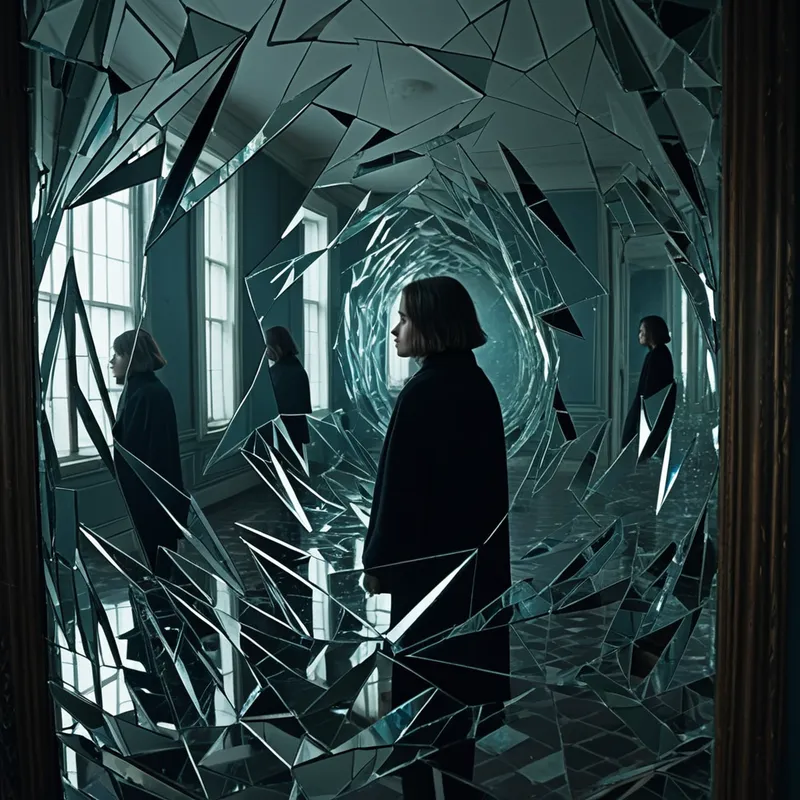
When this myth stirs in the modern unconscious, it often manifests in dreams of fragmentation and meticulous searching. To dream of picking up pieces of broken glass, pottery, or mirror is a direct resonance. So too are dreams of trying to reassemble a shattered object, or of carrying a fragile, precious vessel that is cracking. The somatic feeling is often one of acute anxiety mixed with focused determination—a sense of vital, urgent work.
Psychologically, this dream pattern signals a active process of psychic integration. The dreamer is likely in a phase where long-ignored aspects of the self are surfacing, demanding recognition. It may follow a period of breakdown (a personal “shattering”)—a job loss, the end of a relationship, an illness—where the old, rigid structure of the personality has failed. The dream is not a portent of further disaster, but an image of the healing work already begun. The unconscious is illustrating the task: to carefully, patiently gather the insights and emotional truths scattered by the crisis. The dream affirms that the broken pieces are not garbage, but precious fragments of the self that must be recovered.
Alchemical Translation
For the modern individual walking the path of individuation, the Vitrum myth provides a non-pathologizing, heroic model for a lifetime’s work. It translates the archaic stages of the [Nigredo](/myths/nigredo “Myth from Alchemical culture.”/), Albedo, Citrinitas, and [Rubedo](/myths/rubedo “Myth from Alchemical culture.”/) into a psychological journey.
The Shattering (Nigredo) is the descent. It is the depression, the confusion, the “dark night of the soul” where one’s identity feels dissolved. The modern seeker must learn to see this not as failure, but as the necessary precondition for growth. The old vessel of the personality, however well-constructed, was ultimately limiting.
The Gathering (Albedo) is the work of illumination. This is the stage of analysis, reflection, and “washing” the fragments in the pure water of honest observation. It involves journaling, dialogue, artistic creation, and therapy—any practice that brings unconscious material into the light of awareness.
The new whole is not a repaired antique, but a wholly new creation born of conscious choice and forged suffering.
The Melting & Re-forming (Citrinitas & Rubedo) is the integration and embodiment. This is the most challenging phase, where insights must be made flesh. It is the “yellowing” of applying understanding to one’s life and relationships, leading to the “reddening” of a new, vital, and engaged consciousness. The Vitrum Reconditum is the person who has metabolized their history. They are tempered. They hold their complexity consciously. Their wounds have become sources of wisdom, not just scars. Their light is not the blinding, uniform glare of the original vessel, but a multifaceted, compassionate luminescence that acknowledges the darkness between the fragments. They have become, at last, both the Artificer and the Artifact, the traveler and the destination, forever a work in progress, yet profoundly, resiliently whole.
Associated Symbols
Explore related symbols from the CaleaDream lexicon: