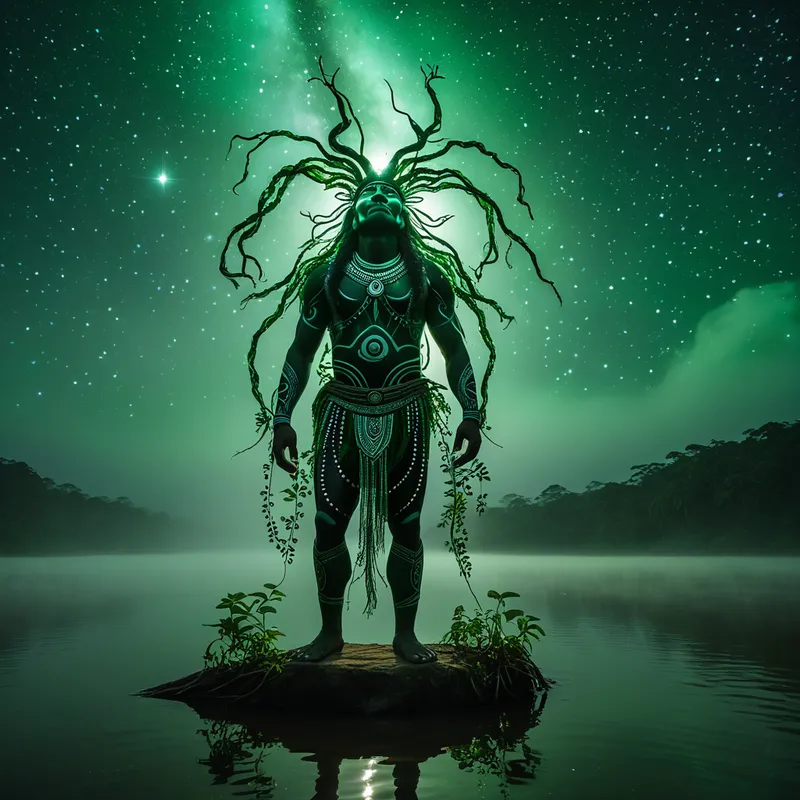
The Vine of the Dead Myth Meaning & Symbolism
A mythic hero journeys down a cosmic vine to the land of the dead, seeking wisdom and restoring the connection between the living and the ancestors.
The Tale of The Vine of the Dead
In the time before time, when [the world](/myths/the-world “Myth from Tarot culture.”/) was still soft and the rivers were the veins of [the earth](/myths/the-earth “Myth from Hindu culture.”/), there was a great silence. The people lived, and the people died, and the dead were gone. They slipped away into the black [water](/myths/water “Myth from Chinese culture.”/), their memories fading like mist in the morning sun. The living were left with only hollow grief and a terrible, echoing question: Where have they gone?
This silence was a wound in the world. It was felt most deeply by a young man named Yanomami. His heart was a heavy stone, for he had lost his wise grandfather, the one who knew the songs of the trees and the language of the jaguar. In his mourning, Yanomami walked deep into the forest, beyond the trails, to a place where the kapok trees touched the belly of [the sky](/myths/the-sky “Myth from Persian culture.”/).
There, under a moon that was a sliver of bone, he saw it. From the highest branch of the oldest tree, a vine descended. It was no ordinary liana. It shimmered with a light that was not of the sun or moon—a deep, green-silver luminescence. It hummed with a sound like distant bees and flowing water. It was the Vine of the Dead.
A voice, not in his ears but in his bones, spoke: If you wish to see, you must dare to fall. [The way](/myths/the-way “Myth from Taoist culture.”/) down is the way back.
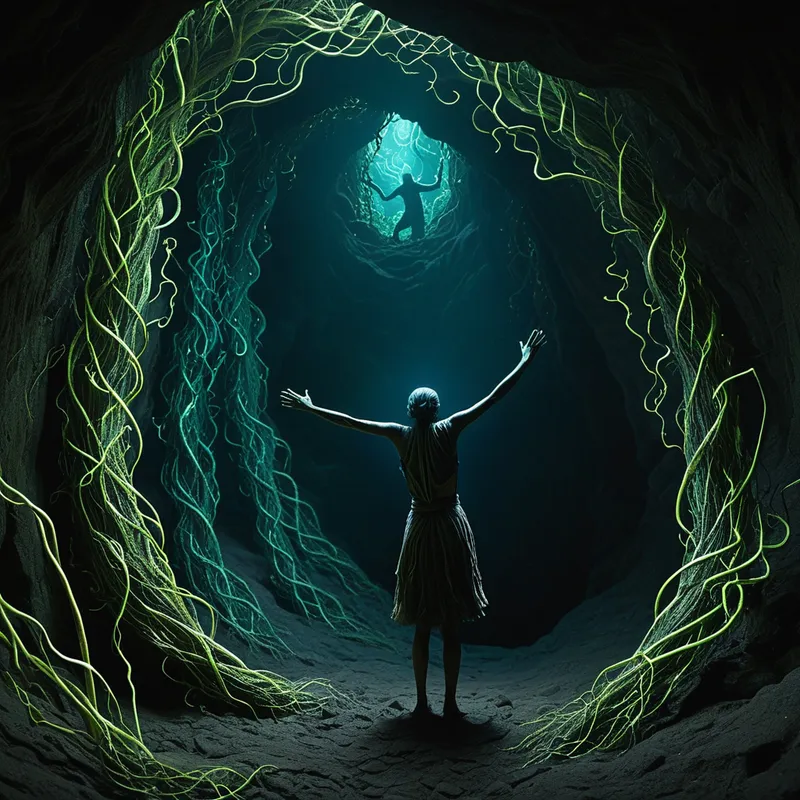
Without a thought for his own life, Yanomami grasped the vine. It was warm and vibrated with a slow, powerful pulse. He began to climb down, hand under hand, into the earth. The air grew cool and thick, smelling of damp clay and night-blooming flowers. The light from the vine was his only guide, illuminating walls of root and stone. He descended for a night and a day, the world above becoming a memory of light.
He emerged not into darkness, but into a vast, subterranean world. A great, silent river flowed through caverns lit by glowing fungi and crystals. This was Kamarakoto, the Land of Shadows. Along the banks, he saw them—[the forms](/myths/the-forms “Myth from Platonic culture.”/) of the dead. They were not skeletal, but luminous, woven from memory and starlight. They moved in a slow, graceful dance, tending to ghostly gardens of phosphorescent plants.
But they were silent. Their mouths moved, yet no sound came out. Their eyes held stories, but they were locked away. The connection was severed.
Yanomami’s grandfather saw him. His spirit-form brightened, and he approached, placing a translucent hand on his grandson’s chest. In that touch, Yanomami felt the weight of all the unspoken words, all the unsung songs, all the love that had nowhere to go. The grief of the living was a wall, and the silence of the dead was a prison.
The grandfather pointed to the center of [the river](/myths/the-river “Myth from Buddhist culture.”/), where the Vine of the Dead plunged into the black water. The voice spoke again in Yanomami’s bones: To break the silence, you must give it sound. To bridge the worlds, you must become the bridge.
Yanomami understood. He waded into the cold, timeless river until he reached the great vine. He opened his mouth and began to sing. Not a song of joy, but the song of his grief—the raw, aching cry of loss. He sang for his grandfather, for his people, for all the unanswered questions. His voice, frail and human, echoed through the caverns.
As he sang, a miracle unfolded. The luminous dead turned toward him. From their silent mouths, a sound began to emerge—a soft hum that harmonized with his lament. The vine itself began to vibrate, conducting the sound. Yanomami’s solitary song became a chorus, a weaving of living memory and ancestral presence. The hum traveled up the vine, a resonant cord connecting the land of shadows to the world of light.
When his song was finished, the silence was gone. In its place was a gentle, perpetual resonance. His grandfather smiled, and in a voice like rustling leaves, spoke the first direct words from the dead to the living in an age: “We are here. We remember. We are with you.”
Yanomami climbed back, the vine now thrumming with the shared song. He emerged into the dawn and brought the truth to his people: the dead are not lost. They are just down a different root. We must sing to them, and in our singing, we build the vine anew.
Cultural Origins & Context
This myth, in its myriad local variations, is a cornerstone of spiritual understanding for many Indigenous peoples of the Amazon basin. It is not a relic of a forgotten past but a living narrative, recounted by shamans (payés) and elders during rites of passage, times of collective grief, or ceremonies for the dead. Its primary function is ontological: it maps the cosmos. It defines the structure of reality as multi-layered—a world of the living, a world of the dead, and the connective tissue between them.
The Vine of the Dead is a classic axis mundi. In a world defined by the immense, vertical complexity of the rainforest canopy and the deep, hidden river systems, the vine is the perfect symbol for a vertical conduit between realms. The myth was passed down not to explain natural phenomena, but to provide a psychological and social technology for dealing with mortality. It transforms the terrifying void of death into a navigable geography, giving the bereaved a ritual action—song, remembrance, ceremonial descent in trance—to maintain relationship. It asserts that community includes the ancestors, and that psychological health depends on this connection being actively tended.
Symbolic Architecture
At its core, the myth is about the necessity of conscious descent to heal a collective [rupture](/symbols/rupture “Symbol: A sudden break or tear in continuity, often representing abrupt change, separation, or the shattering of established patterns.”/). The [hero](/symbols/hero “Symbol: A hero embodies strength, courage, and the ability to overcome significant challenges.”/)’s [journey](/symbols/journey “Symbol: A journey in dreams typically signifies adventure, growth, or a significant life transition.”/) is not [outward](/symbols/outward “Symbol: Movement or orientation away from the self or center; expansion, expression, or externalization of inner states into the world.”/) to slay a [monster](/symbols/monster “Symbol: Monsters in dreams often symbolize fears, anxieties, or challenges that feel overwhelming.”/), but [inward](/symbols/inward “Symbol: A journey toward self-awareness, introspection, and the exploration of one’s inner world, thoughts, and unconscious mind.”/) and downward to face the ultimate [human](/symbols/human “Symbol: The symbol of a human represents individuality, complexity of emotions, and social relationships.”/) fear—the oblivion of [death](/symbols/death “Symbol: Symbolizes transformation, endings, and new beginnings; often associated with fear of the unknown.”/)—and to recover what was lost: communion.
The underworld is not a place of punishment, but the psychic repository of all that has been lived, all that has been lost. It is the soil of memory.
The [Vine](/symbols/vine “Symbol: Represents connection, growth, entanglement, or suffocation. Often symbolizes relationships, life force, or binding emotions.”/) of the Dead symbolizes the connective principle of [life](/symbols/life “Symbol: The symbol of ‘Life’ represents a journey of growth, interconnectedness, and existential meaning, encompassing both the joys and challenges that define human experience.”/) itself—the nervous [system](/symbols/system “Symbol: A system represents structure, organization, and interrelated components functioning together, often reflecting personal or social order.”/) of the world-[soul](/symbols/soul “Symbol: The soul represents the essence of a person, encompassing their spirit, identity, and connection to the universe.”/), the DNA of [spirit](/symbols/spirit “Symbol: Spirit symbolizes the essence of life, vitality, and the spiritual journey of the individual.”/). It is the [pathway](/symbols/pathway “Symbol: A symbol of life’s journey, direction, and personal progress, representing choices, transitions, and the unfolding of one’s destiny.”/) of [relationship](/symbols/relationship “Symbol: A representation of connections we have with others in our lives, often reflecting our emotional state.”/). Yanomami represents the part of the [psyche](/myths/psyche “Myth from Greek culture.”/) that can no longer tolerate the [dissociation](/symbols/dissociation “Symbol: A psychological separation from one’s thoughts, feelings, or identity, often experienced as a journey away from the self during trauma or stress.”/) caused by unmourned [loss](/symbols/loss “Symbol: Loss often symbolizes change, grief, and transformation in dreams, representing the emotional or psychological detachment from something or someone significant.”/). His [grief](/symbols/grief “Symbol: A profound emotional response to loss, often manifesting as deep sorrow, yearning, and a sense of emptiness.”/) is not a weakness, but the fuel for his [quest](/symbols/quest “Symbol: A quest symbolizes a journey or search for purpose, fulfillment, or knowledge, often representing life’s challenges and adventures.”/). The silent dead represent not just ancestors, but all the disowned, unintegrated, and forgotten parts of our own personal and collective histories. Their silence is the [symptom](/symbols/symptom “Symbol: A physical or emotional sign indicating an underlying imbalance, distress, or message from the unconscious mind.”/) of our refusal to engage with them.
The climactic act is not a battle, but a vocalization. He gives sound to the silence. This is the key symbolic act: making the unconscious conscious. His song is an act of emotional [truth](/symbols/truth “Symbol: Truth represents authenticity, honesty, and the quest for knowledge beyond mere appearances.”/)-telling, which becomes the catalyst for reconnection. The restored [chorus](/symbols/chorus “Symbol: A chorus in dreams symbolizes unity, collaboration, and the harmony of diverse voices contributing to a greater whole.”/) signifies the individuated Self—no longer a solitary ego, but a psyche in living [dialogue](/symbols/dialogue “Symbol: Conversation or exchange between characters, representing communication, relationships, and narrative flow in games and leisure activities.”/) with its own [depths](/symbols/depths “Symbol: Represents the subconscious, hidden emotions, or foundational aspects of the self, often linked to primal fears or profound truths.”/).
The Dreamer’s Resonance
When this mythic pattern stirs in the modern dreamer, it often manifests as dreams of descending—finding a hidden staircase, riding an elevator into the earth, or discovering a root cellar or basement full of forgotten things. The somatic sensation is one of weight, gravity, and a cool, earthy pressure. Psychologically, the dreamer is being called to a necessary descent.
This is not a descent into depression, though it may share the topography. It is a descent into the shadow and the personal collective unconscious. The “dead” in the dream may appear as forgotten childhood selves, ex-partners, lost opportunities, or inherited family traumas. They are silent because the dreamer has cut off the narrative thread connecting them. The dream is an invitation to end the silence.
To dream of a luminous vine, root, or cord is a powerful sign of the psyche’s innate healing structure activating. It indicates that the connection to one’s foundational soul-stuff, one’s “ancestral” psychic material, is attempting to re-establish itself. The process feels like deep, sometimes painful, emotional archaeology, but its goal is restoration.
Alchemical Translation
The alchemy modeled here is the transmutation of grief into connection. The modern individual, often spiritually orphaned from ancestral traditions and adrift in a culture that pathologizes grief, faces the same primordial silence. Our dead are medically managed, our grief given a timeline. The myth provides the blueprint for a psychic operation of immense value.
Individuation requires a voluntary journey to the land of the dead within us. We must go down to come up whole.
[The first stage](/myths/the-first-stage “Myth from Alchemical culture.”/), descent ([nigredo](/myths/nigredo “Myth from Alchemical culture.”/)), is Yanomami’s choice to grasp the vine. It is the conscious decision to stop avoiding our core wounds, our deepest losses, and our existential loneliness. We must follow our grief down, into the dark.
The second stage, confrontation and lamentation (albedo), occurs in Kamarakoto. Here, in the purified light of [the underworld](/myths/the-underworld “Myth from Greek culture.”/), we see our “dead”—our repressed memories, inherited patterns, and unlived lives—clearly. The critical act is the song: the raw, honest expression of feeling. In therapy, journaling, or art, we give sound to the silence. This vocalization is the purifying wash.
The final stage, return and integration ([rubedo](/myths/rubedo “Myth from Alchemical culture.”/)), is the ascent with the vine now humming. The recovered connection becomes a permanent, vibrating part of our being. We return to our daily life not having “gotten over” our loss, but having woven it into the fabric of who we are. [The ancestor](/myths/the-ancestor “Myth from Global culture.”/)—whether literal or psychic—is now a consulted voice within, a source of wisdom rather than a source of pain. We become the living vine, the conduit between the deep, nourishing soil of the past and the flowering present. The myth teaches that wholeness is not found in transcending our humanity, but in sinking our roots into its darkest, most fertile layers and singing until the whole world echoes back.
Associated Symbols
Explore related symbols from the CaleaDream lexicon: