The Via Dolorosa Myth Meaning & Symbolism
The mythic journey of a condemned god-man through the city, bearing the instrument of his execution, transforming a path of humiliation into one of ultimate meaning.
The Tale of The Via Dolorosa
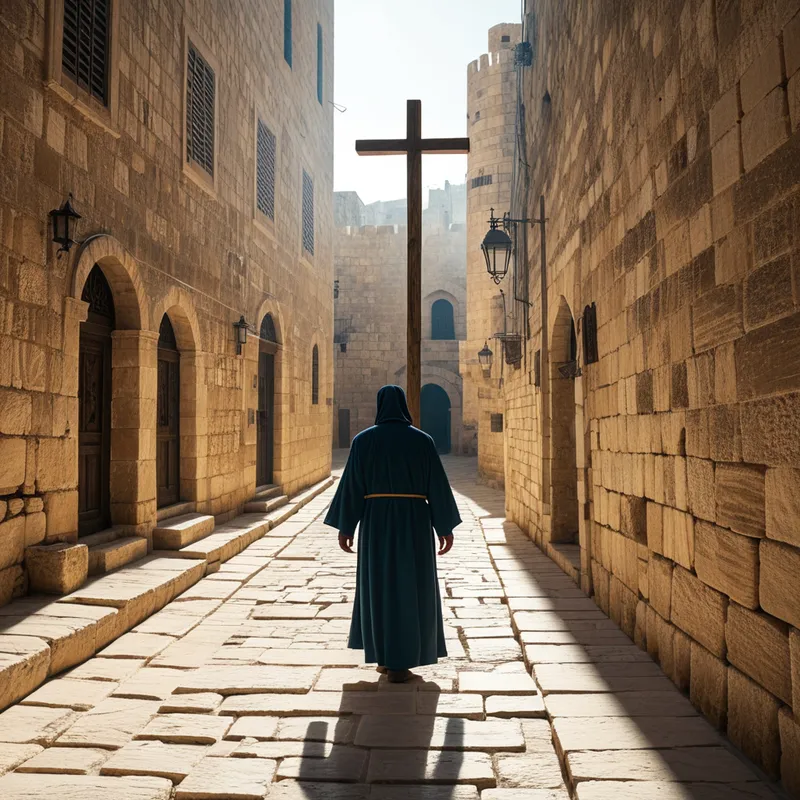
The air in [Jerusalem](/myths/jerusalem “Myth from Biblical culture.”/) was thick—a soup of dust, incense, and the metallic tang of fear. It was the hour when shadows, though short, felt longest. From the fortress of Antonia, a gate groaned open, and a procession stumbled into the white glare of the street. Not a parade of [triumph](/myths/triumph “Myth from Roman culture.”/), but a cortege of condemnation.
At its heart was the Nazarene. His form, once a carpenter’s frame of strength, was now a map of violence. A crown, not of gold but of twisted thorn branches, had been pressed into his scalp, and each movement sent fresh rivulets of crimson tracing the contours of his face. Upon his shredded shoulders lay the weight of [the world](/myths/the-world “Myth from Tarot culture.”/): a rough-hewn beam of cypress, the horizontal arm of the crux he would soon be nailed to. Its grain drank his sweat and blood.
This was the [Via Dolorosa](/myths/via-dolorosa “Myth from Christian culture.”/)—the Path of Sorrows. The stones, worn smooth by millennia of feet, were now slick with something more than dust. He moved not as a king, but as a beast of burden, each step a seismic event in the soul of the world. The crowd was a living wall of sound—jeers like jagged stones, wails of mourning women, the bored shouts of Roman soldiers clearing a path with their spears.
The journey was not a straight line, but a staggering liturgy of falls. The weight bore him down, first in [the shadow](/myths/the-shadow “Myth from Jungian culture.”/) of the judgment hall, then again where the street narrowed, and a final, profound collapse where the world’s agony seemed to concentrate into the press of stone against his cheek. Yet, he rose. Always, he rose.
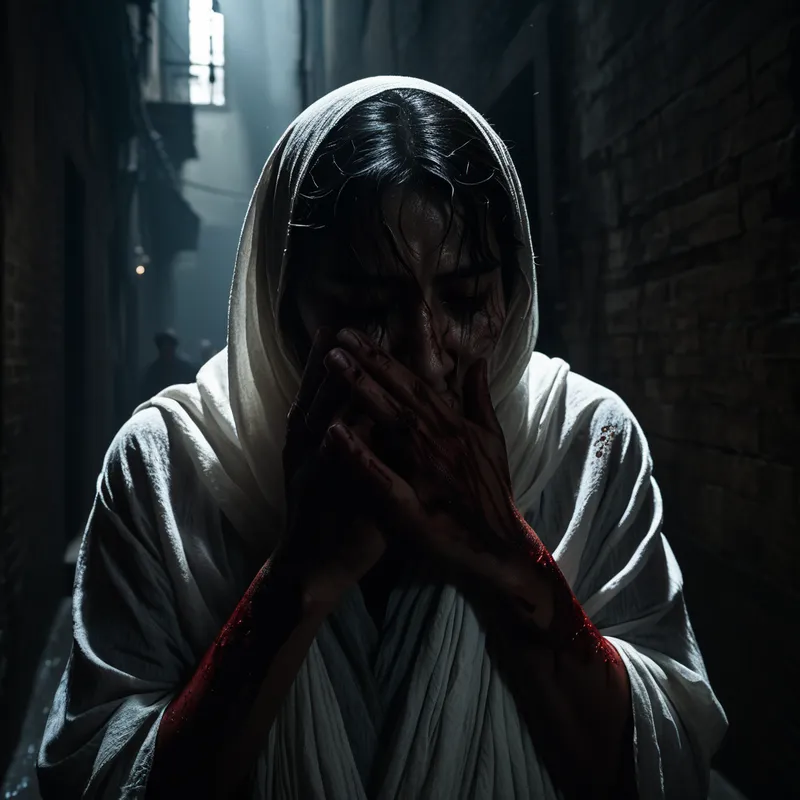
Figures emerged from the chaos, not as saviors, but as witnesses. A stranger from Cyrene, his own journey interrupted, was compelled to shoulder the beam. The touch of another’s burden was a mercy and a sharing of the curse. A woman, her face a mask of grief, pushed through the throng to offer a simple act: she wiped the blood and dust from his eyes with her veil. In that touch was a recognition of a shared humanity, a defiance of the dehumanizing spectacle.
He climbed, finally, to the place of the skull—[Golgotha](/myths/golgotha “Myth from Christian culture.”/). The journey of the cross ended where the journey of the spirit would begin its most terrible and magnificent work. The path was complete. The sorrow had found its home, and in finding it, began its transformation.
Cultural Origins & Context
The Via Dolorosa is not a single, canonical scripture, but a living narrative that grew from the soil of devotion. Its roots are in the Gospel accounts of [the Passion](/myths/the-passion “Myth from Christian culture.”/), but its specific path through Jerusalem’s streets crystallized centuries later, shaped by the footsteps of pilgrims. By the Byzantine era, faithful from across the world walked the city, yearning to trace, physically and spiritually, the final footsteps of their Lord.
The myth was passed down not just from pulpits, but through the soles of the feet and the tears of the eyes. Franciscan monks, custodians of the holy sites since the 14th century, formalized the practice and the Stations of the Cross. This ritual transformed the myth from a historical report into a participatory drama. The societal function was profound: it democratized sainthood. One did not need to perform miracles to understand sacred suffering; one needed only to walk, to kneel, to remember. It was a myth that taught how to carry a personal cross by first venerating the archetypal one.
Symbolic Architecture
At its core, the Via Dolorosa is the myth of the burden made sacred. It is the ultimate map of the individuation process, where [the ego](/myths/the-ego “Myth from Jungian culture.”/)’s inevitable crucifixion by [life](/symbols/life “Symbol: The symbol of ‘Life’ represents a journey of growth, interconnectedness, and existential meaning, encompassing both the joys and challenges that define human experience.”/)’s circumstances is not a meaningless defeat, but a necessary [passage](/symbols/passage “Symbol: A passage symbolizes transition, movement from one phase of life to another, or a journey towards personal growth.”/).
The [path](/symbols/path “Symbol: The ‘path’ symbolizes a journey, choices, and the direction one’s life is taking, often representing individual growth and exploration.”/) itself symbolizes the conscious life [journey](/symbols/journey “Symbol: A journey in dreams typically signifies adventure, growth, or a significant life transition.”/), with its predetermined yet personally walked route. The falling is not failure, but an essential part of the [rhythm](/symbols/rhythm “Symbol: A fundamental pattern of movement or sound in time, representing life’s cycles, emotional flow, and universal order.”/)—the ego’s repeated collapse under the [weight](/symbols/weight “Symbol: Weight symbolizes burdens, responsibilities, and emotional loads one carries in life.”/) of its own identification with suffering, and the imperative to rise again, transformed by the descent.
The cross is not merely what one carries; it is the shape of the intersection where the horizontal plane of human experience meets the vertical axis of divine will or transcendent meaning.
The figures encountered—Simon who carries, Veronica who wipes the face—represent the unexpected grace that emerges in the [depths](/symbols/depths “Symbol: Represents the subconscious, hidden emotions, or foundational aspects of the self, often linked to primal fears or profound truths.”/) of ordeal. They symbolize those parts of the [psyche](/myths/psyche “Myth from Greek culture.”/) (the helpful [stranger](/symbols/stranger “Symbol: A stranger in dreams can represent unfamiliar aspects of the self or new experiences.”/), the compassionate [anima](/symbols/anima “Symbol: The feminine archetype within the male unconscious, representing soul, creativity, and connection to the inner world.”/)) that arise from the unconscious to aid the conscious self when it is most broken. The [destination](/symbols/destination “Symbol: Signifies goals, aspirations, and the journey one is on in life.”/), Golgotha, is the psychic locus where one must finally face and integrate the ultimate [shadow](/symbols/shadow “Symbol: The ‘shadow’ embodies the unconscious, repressed aspects of the self and often represents fears or hidden emotions.”/): the [reality](/symbols/reality “Symbol: Reality signifies the state of existence and perception, often reflecting one’s understanding of truth and life experiences.”/) of [mortality](/symbols/mortality “Symbol: The awareness of life’s finitude, often representing transitions, impermanence, or existential reflection in dreams.”/), limitation, and profound pain.
The Dreamer’s Resonance
When this myth stirs in the modern dreamer, it signals a profound somatic and psychological process: the conscious bearing of an unconscious burden. To dream of walking a difficult, predetermined path through a familiar yet alien city is to feel the weight of a life pattern or a fate one did not consciously choose.
Dreaming of carrying an immense, awkward object (a cross, a heavy box, a strange artifact) points to the ego struggling with a burden of responsibility, guilt, trauma, or a destiny that feels imposed. The falls in the dream are critical. They are not nightmares of failure, but the psyche’s symbolic enactment of surrender. The body in the dream is doing the work the waking mind resists: it is allowing itself to be brought low, to feel the full weight, because only from that ground can new strength be drawn. The appearance of a helper or a moment of unexpected care (a drink of [water](/myths/water “Myth from Chinese culture.”/), a guiding hand) in such a dream indicates the mobilization of inner resources—[the Self](/myths/the-self “Myth from Jungian culture.”/) is providing aid to the struggling ego.

Alchemical Translation
The alchemy of the Via Dolorosa is the transmutation of leaden suffering into golden consciousness. It models the individuation process by presenting the stages not as a heroic conquest, but as a sacred submission.
The first alchemical stage, the [nigredo](/myths/nigredo “Myth from Alchemical culture.”/) or blackening, is the condemnation, the scourging, the crowning with thorns—the utter reduction of the [persona](/myths/persona “Myth from Greek culture.”/) to its broken, suffering essence. The walk itself is the mortificatio, the killing of the old identification with being an untouched, unscarred self. Each fall is a deliberate dissolution.
The path does not exist to be conquered, but to conduct the current of suffering until it becomes a current of meaning.
Carrying the cross is the opus contra naturam—the work against nature—where one consciously bears what the instinctual self desperately wants to flee. When Simon takes up the cross, it symbolizes the moment the ego relinquishes sole ownership of its burden, allowing the larger Self (the transpersonal psyche) to participate. This is the beginning of the albedo, the whitening.
Veronica’s veil, imprinting the true image, represents the revelation of the Self within the ruin of the ego. The face that appears is the imago Dei, the authentic, eternal identity revealed only through the ordeal. Arriving at Golgotha is the final stage of separation; one has carried the problem to its ultimate point. The subsequent crucifixion and resurrection, implied at the path’s end, are the [rubedo](/myths/rubedo “Myth from Alchemical culture.”/) and citrinitas—the reddening and yellowing—where the fully integrated consciousness, having died to its old form, is born into a new, liberated state of being.
For the modern individual, this myth teaches that the most direct route to the Self is not around suffering, but directly through its narrow gate. Our personal Via Dolorosa is the daily, often silent, bearing of our unique crosses—of illness, loss, anxiety, or purpose. The myth insists that this bearing is not pointless, but the very furnace of our transformation. We are not walking toward death, but through it, to find that the weight we carry is, in the end, the very [thing](/myths/thing “Myth from Norse culture.”/) that shapes us into who we are meant to become.
Associated Symbols
Explore related symbols from the CaleaDream lexicon: