The Veil of the Temple Myth Meaning & Symbolism
The sacred barrier in the Jerusalem Temple tears at the moment of a messiah's death, shattering the ancient division between the human and the divine.
The Tale of The Veil of the Temple
Hear now of the day the world held its breath, and the heart of heaven was torn open.
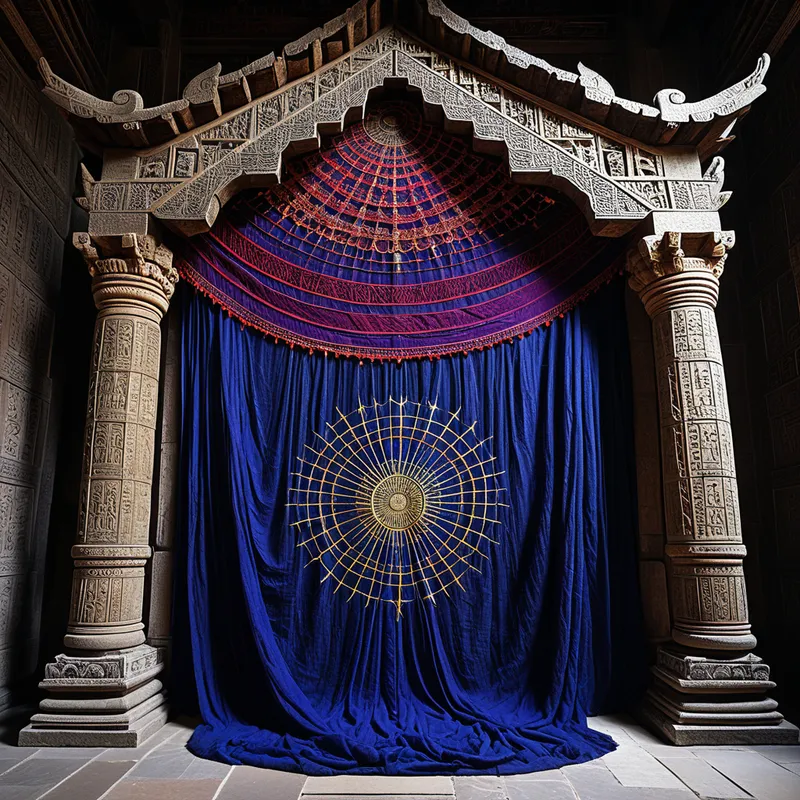
In the holy city, atop the mount that was the navel of creation, stood the Temple. Within its deepest chamber, a place called the Holy of Holies, it was said the very presence of the YHWH dwelt. No mortal foot, save that of the High Priest on one sacred day each year, dared tread there. Guarding this mystery was a vast curtain—the Veil. Woven thick as a man’s palm from threads of blue, purple, scarlet, and fine linen, embroidered with the forms of mighty cherubim, it was not merely cloth. It was a boundary. On one side, the noise of sacrifice, prayer, and human frailty. On the other, a silence so profound it was the womb of creation, the unseeable fire of the Absolute.
Beyond the city walls, on a skull-shaped hill, a different sacrifice reached its climax. A man, hailed by some as a king and by others as a blasphemer, hung upon a Roman cross. His breath came in ragged gasps. The sky, in defiance of nature, had grown black as midnight at the noon hour. The earth itself shuddered. With a final cry that seemed to hold both the despair of all abandonment and the triumph of a finished work, he yielded his spirit.
At that precise moment, within the Temple’s silent, inner court, the impossible happened. The massive Veil, without human hand touching it, was seized by an unseen force. From its pinnacle down to its foundations, it was rent in two with a sound like the tearing of the cosmos. The great cherubim were split asunder. The boundary that had stood since the days of Moses was abolished not by careful ritual, but by a cataclysmic act of grace. The way was opened. The most sacred secret was exposed, not to desecration, but to a terrifying and intimate possibility.
Cultural Origins & Context
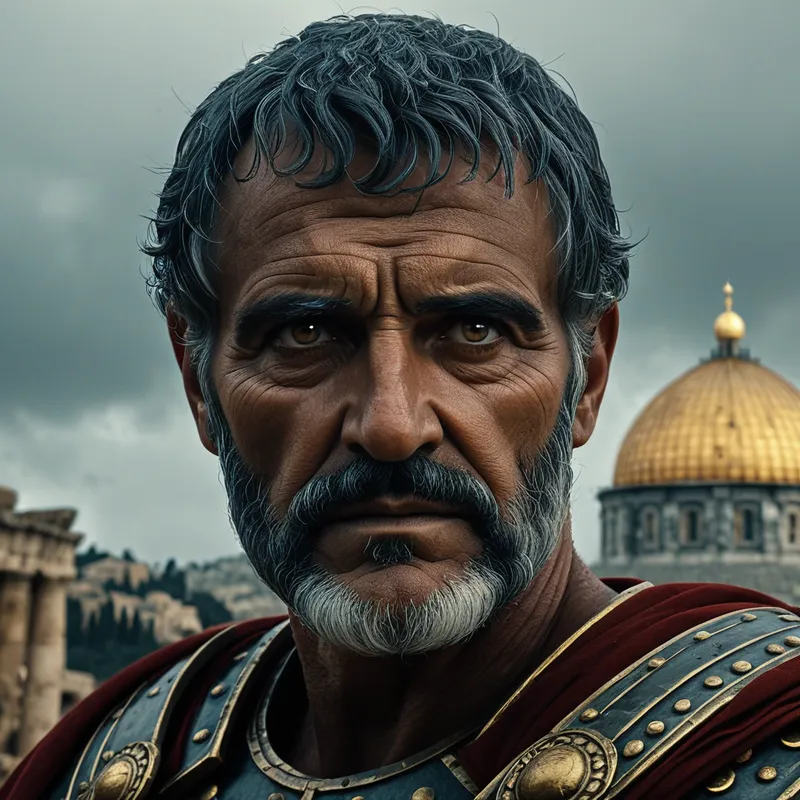
This narrative is recorded in the synoptic Gospels of the Christian New Testament (Matthew 27:51, Mark 15:38, Luke 23:45). For the authors and their early audience, deeply steeped in Second Temple Judaism, this was not a minor miracle but a theological earthquake. The Temple in Jerusalem was the axis mundi, the literal dwelling place of God on Earth, and its rituals—centered on the Day of Atonement (Yom Kippur)—were the prescribed means of dealing with sin and maintaining the covenant.
The Veil’s tearing was a divine editorial comment on the crucifixion event. It functioned as a cosmic sign, interpretable only to those who understood the symbolic architecture of the Temple. It signaled that the old system of mediated access—through priest, sacrifice, and sacred barrier—was being superseded. The story was passed down not as folklore, but as sacred history, a cornerstone of Christian proclamation that the death of Yeshua had effected a permanent, ontological change in the relationship between humanity and the divine.
Symbolic Architecture
The Veil is the ultimate symbol of separation. It represents the existential chasm between the profane and the sacred, the conscious ego and the unconscious Self, the known and the unknowable. It is the boundary that defines holiness by creating a “no-go” zone.
The most profound mysteries are always protected by a veil, not to keep us out forever, but to ensure we approach with the proper reverence—or the necessary, cataclysmic transformation.
The tearing, therefore, is not an act of vandalism, but of revelation and re-creation. It signifies the end of one order and the violent, graceful birth of another. Psychologically, it represents the shattering of a foundational complex or identification—perhaps a rigid religious belief, a parental introject, or the illusion of a perfectly curated persona—that once served as the defining boundary of the self. The “Holy of Holies” behind it is the Self, the core of one’s being, previously considered too potent, too other, to be approached directly.
The Dreamer’s Resonance
When this myth stirs in the modern psyche, it often manifests in dreams of sudden, irrevocable ruptures in barriers. One might dream of a cherished family home with a wall crumbling, a cherished book whose pages tear as you turn them, or a once-sturdy dam breaking. The somatic experience is one of simultaneous terror and release—a lurch in the stomach, a gasp, followed by an eerie calm.
This dream pattern signals a profound psychological process: the ego’s negotiated surrender to a larger reality. The “veil” in the dream is the current structure of meaning, identity, or defense that is being outgrown. Its tearing indicates that the psyche itself is initiating a move from a state of mediated, indirect living (living through roles, others’ expectations, old stories) toward a more direct, unmediated, and therefore more authentic—and more terrifying—encounter with the depths of one’s own soul. It is the process of the personality being made vulnerable to the numinous.

Alchemical Translation
The alchemical journey is one of solve et coagula—dissolve and coagulate. The myth of the Veil models the critical solve stage of psychic transmutation, the necessary dissolution of a previous form so a new, more integrated one can coalesce.
First, the old “Temple” of the personality—the carefully constructed system of values, defenses, and self-concepts—must be honored. It served its purpose. Then, through a supreme act of “sacrifice” (the conscious suffering of an insight, the enduring of a depression, the honest confrontation with a shadow), the central, defining boundary is torn. This is the death of the hero who identified with the old law.
Individuation is not about building a better veil, but about enduring the terrifying grace of its removal, and learning to stand in the holy darkness of what is finally revealed.
The new “coagulation” is not a return to a new, better separation. It is the birth of a consciousness that can inhabit the open space. The Holy of Holies is no longer a forbidden room but becomes the very ground of being. The individual moves from a psychology of atonement (being at-one-ment through external ritual) to an embodied state of at-one-ment, where the divine is no longer over-against the self, but is the deep, often unsettling, source from which the self flows. The journey is from sacred separation to a communion so direct it can only be born from a rending.
Associated Symbols
Explore related symbols from the CaleaDream lexicon: