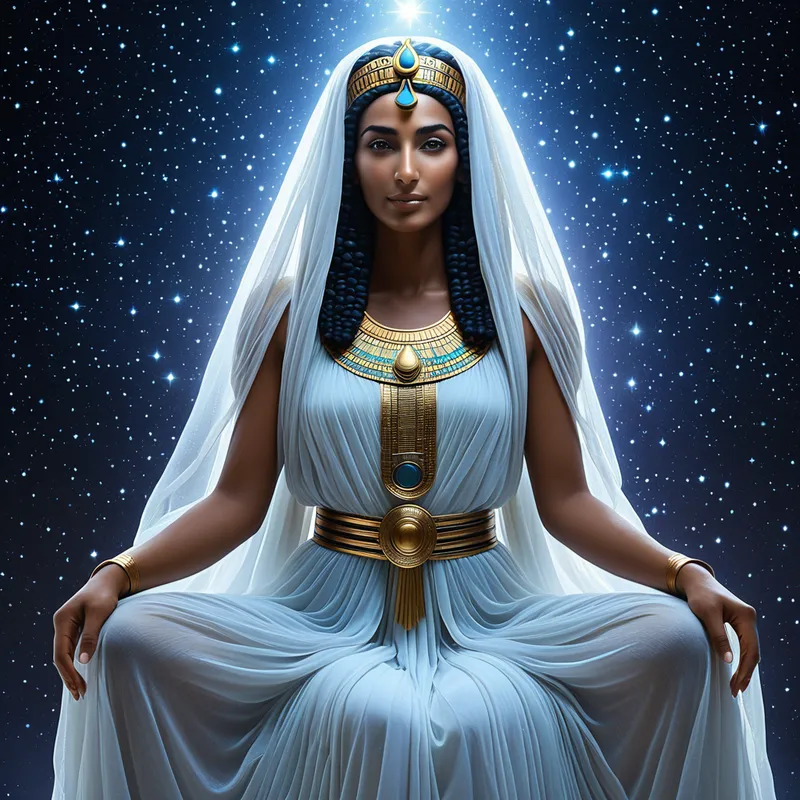
The Veil of Isis / Maya Myth Meaning & Symbolism
A timeless myth of a goddess veiling ultimate reality, challenging seekers to look beyond illusion to the numinous truth that lies beneath.
The Tale of The Veil of Isis / Maya
Hush, and listen. In the time before time, when the world was a whisper in the mind of the Absolute, there existed a Mystery. It was not hidden in a locked chest or a buried tomb, but hung in plain sight, a shimmering curtain between the worlds. They say the great goddess, she who is called Isis, sits enthroned in the silent heart of eternity. About her form is woven a veil. It is not of coarse cloth, but of starlight and shadow, of the breath of life and the sigh of death, of every joy that has ever swelled a heart and every tear that has ever been shed.
This veil is the world you know. The sun that warms your skin, the tree that rustles in the wind, the face of your beloved, the sting of loss—all are but the intricate embroidery upon her mantle. For ages untold, she has sat thus, the weaver and the wearer of this glorious, terrible, beautiful illusion. The veil dances with the forms of all things, convincing in its substance, yet it conceals the ultimate face of the goddess, the naked truth of what Is.
And so the seekers come. The philosopher with his logic, the priest with his ritual, the lover with his longing. They journey through deserts of doubt and climb mountains of thought, drawn by a rumor of the Real. At last, they stand in the inner sanctum, the air thick with incense and awe. Before them hangs the Veil, luminous and alive. It shows them everything they have ever desired: answers, power, union. Some are satisfied with this. They worship the splendid curtain and call it God.
But a rare few feel a deeper pull. A holy discontent. They sense that this splendor, for all its majesty, is still a garment. With a trembling hand, driven not by curiosity but by a sacred necessity, they reach out. The moment their fingers touch the shimmering fabric, the cosmos holds its breath. The images upon it—the dancing stars, the weeping willows, the faces of gods and mortals—ripple and begin to dissolve. There is no violent tearing, only a gentle parting, as if the universe itself were stepping aside.
And what is revealed when the Veil is lifted? The stories do not say. For to look upon the face of Isis Unveiled is to cease to be a seeker. It is to know. Some say the seeker is consumed in a fire of understanding. Others whisper they become the silence that remains after the final note of music. They do not return to tell the tale, for the tale itself is over. Only the Veil remains, waiting for the next heart brave enough, or desperate enough, to seek what lies behind the only world it has ever known.
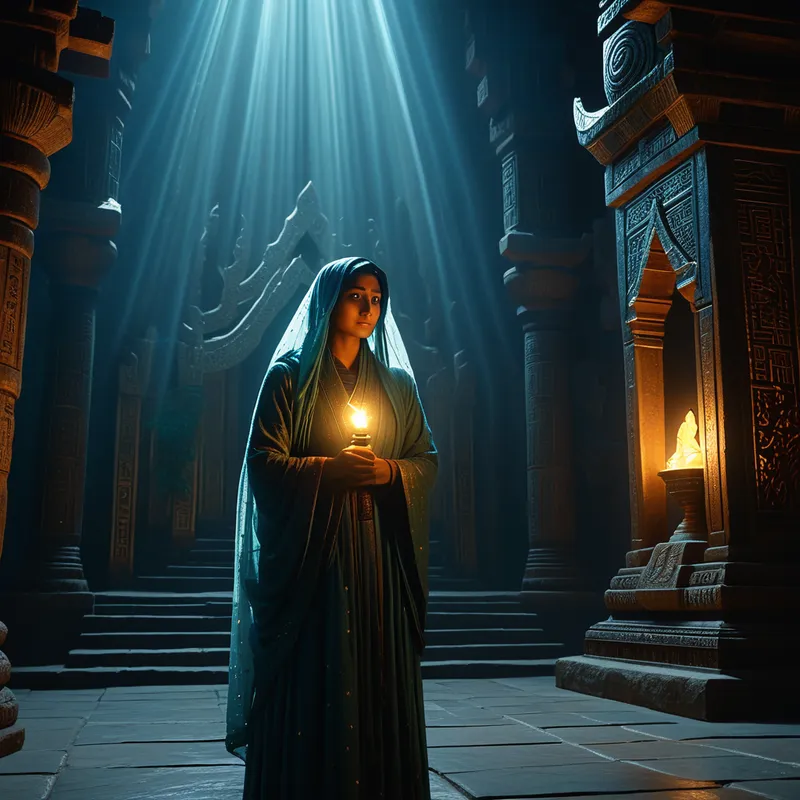
Cultural Origins & Context
The motif of the Veil is a rare and profound thread woven through disparate spiritual tapestries. Its most famous articulation is attached to the Hellenized Egyptian goddess Isis, with the dictum “I am all that has been and is and shall be; and no mortal has ever lifted my veil.” This was inscribed in the first century BCE at her temple in Sais, a statement of ineffable mystery that captivated Greco-Roman philosophers like Plutarch.
Concurrently, in the ancient Indian subcontinent, the concept of Maya was being elaborated in texts like the Upanishads. Maya is not merely illusion as falsehood, but the divine creative power (Shakti) that projects the manifold universe, veiling the singular, non-dual Brahman.
This was not popular folklore but esoteric wisdom, transmitted from teacher to initiated disciple (chela) in temple schools and forest retreats. Its societal function was radical: to provide a metaphysical map for liberating the individual soul (Atman) from the cycle of suffering (Samsara) by recognizing the veiled nature of conventional reality. It served as the ultimate critique of taking the world of appearances at face value.
Symbolic Architecture
The Veil is the central symbol, representing the entire field of phenomenal experience—the sensorium of reality we perceive and interact with. It is not an error to be condemned, but a divine manifestation to be seen through.
The Veil is the universe as a question. Lifting it is the soul becoming the answer.
The Goddess (Isis) or the Principle (Brahman) behind the veil symbolizes the numinous ground of being, the unconditioned reality that exists prior to and after the dance of form. She is both the mother of the world (the weaver of the veil) and the virgin truth concealed by it.
The seeker represents the human ego-consciousness on its evolutionary journey. The act of lifting is not a physical deed but an inner revolution of perception—the shift from identifying with the content of consciousness to abiding as consciousness itself. The “death” of the seeker is the dissolution of the separate self-sense, the final dropping of the primary illusion that one is a fragment looking at the Veil, rather than the awareness in which both Veil and Goddess arise.
The Dreamer’s Resonance
When this myth stirs in the modern unconscious, it often manifests in dreams of searching within vast, interior spaces—endless libraries with indecipherable books, or mazes within one’s own house. The dreamer may be trying to open a door that has no handle, or to read a text where the letters swim and dissolve.
Somatically, this can correlate with a feeling of profound frustration or poignant longing—a sense that the truth is right here, shimmering just beyond cognitive grasp. Psychologically, this marks a critical juncture in the process of individuation. The ego has exhausted its known resources. It has achieved worldly success, analyzed its childhood, and mastered its roles, yet a fundamental disquiet remains. The dream is signaling that the seeker is now ripe to question the very fabric of its perceived reality, to move from psychology to metaphysics, from healing the personality to inquiring into the nature of the one who is wounded.
Alchemical Translation
The alchemical journey mirrored in this myth is the opus contra naturam—the work against nature—which here means against the ingrained habit of perceiving only the Veil. The first stage, nigredo, is the seeker’s dark night, the crushing realization that all one’s knowledge and experience is of the Veil alone. This is a necessary despair.
The crucible for this work is not a furnace, but the silent, patient space between one thought and the next.
The albedo, or whitening, is the dawning, intuitive sense of something immutable behind the flux. Meditation, introspection, and a withdrawal of projection onto the outer world are the processes here. The final stages, citrinitas and rubedo, are not described in the myth because they are the transformation itself. To lift the Veil is to achieve the coniunctio oppositorum where seeker and sought, perceiver and perceived, are realized as one. The gold produced is not a commodity but a quality of being: liberation from the tyranny of form, while fully participating in the dance of form. The modern individual undergoes this not in a temple, but in the midst of life, learning to see the Veil of Maya in their daily routines, relationships, and sufferings, and in that very seeing, to glimpse the timeless Isis that wears it.
Associated Symbols
Explore related symbols from the CaleaDream lexicon: