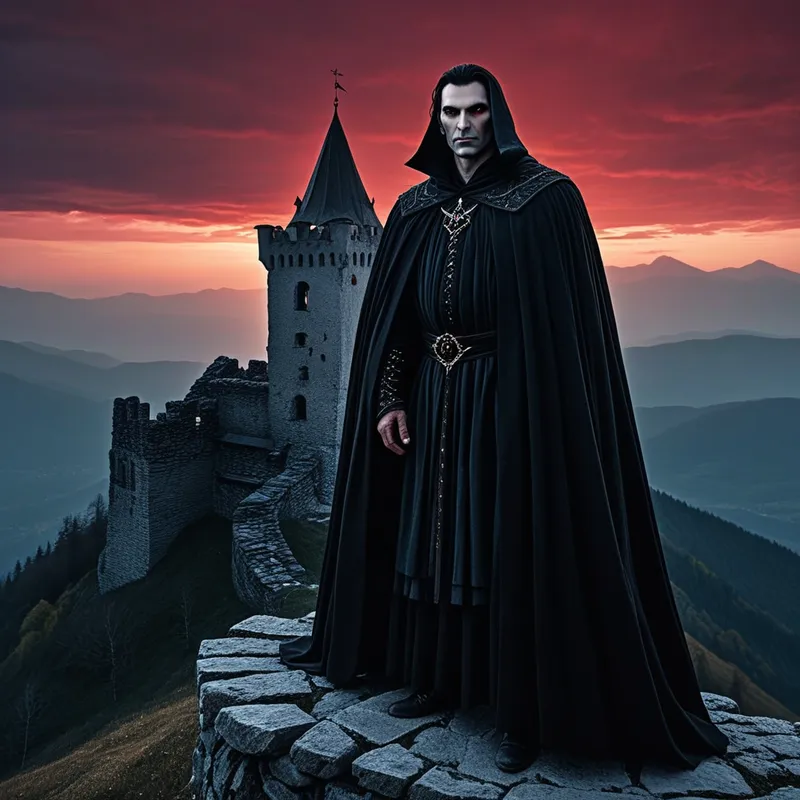
The Vampire Myth Meaning & Symbolism
An ancient, global myth of the undead, a soul trapped between worlds, feeding on the living to sustain its unnatural, eternal hunger.
The Tale of The Vampire
Listen, and hear the tale that is told when the sun dies and [the world](/myths/the-world “Myth from Tarot culture.”/) belongs to [the owl](/myths/the-owl “Myth from Celtic culture.”/) and the bat. It begins not with a birth, but with a death that did not take. In a village nestled in [the shadow](/myths/the-shadow “Myth from Jungian culture.”/) of the mountains, or perhaps in a city of stone and forgotten crypts, a soul departed this world. The body was washed, shrouded, and laid to rest with all proper rites. Earth was thrown upon the coffin lid. But the soul… the soul did not ascend. It was caught, snagged on the barbed hook of a life unfinished, a curse unbroken, or a sin so profound it weighted the spirit to the rotting flesh.
On the third night, when [the moon](/myths/the-moon “Myth from Tarot culture.”/) was a sliver of bone in [the sky](/myths/the-sky “Myth from Persian culture.”/), [the earth](/myths/the-earth “Myth from Hindu culture.”/) over the grave began to stir. Not from below, but from within. A pale hand, dirt caked under nails grown long and sharp, breached the soil. And he rose. Or she rose. Not as they were, but as a [strigoi](/myths/strigoi “Myth from Romanian culture.”/), a ekimmu, a aswang. The eyes, once familiar, now held the cold, flat gleam of a predator. The mouth, a grim line hiding elongated canines.
This is not a story of a monster from [the wilderness](/myths/the-wilderness “Myth from Biblical culture.”/). This is the horror of the familiar made alien. It returns to its own home first, standing silent outside the window, tapping with a single, insistent finger. It calls the names of its living kin in a voice that is almost, almost theirs. Inside, [the hearth](/myths/the-hearth “Myth from Norse culture.”/) fire gutters. The family dog whimpers and hides. The returned one seeks entry, not for warmth, but for sustenance.
Its hunger is a void. Not for bread or wine, but for the very essence of life: blood, breath, the vital force. It visits the sleeping, drawing out their vitality in long, draining sighs. The victim weakens, paling, fading day by day, marked by a languor no physician can cure. And upon their death, if the rites are not performed, they too will rise, joining the silent, hungry procession of the night. The village falls under a pall. Trust evaporates. Every shadow in the corner of the eye becomes a threat. The community is poisoned from within by a secret it must unearth and destroy.
The resolution comes not from a distant hero, but from the desperate courage of the afflicted. The grave must be reopened. The truth, hideous and undeniable, will be found: the corpse, plump and ruddy, lips stained, nails grown, perhaps turned face-down in the coffin. Then comes the ritual violence: the stake of [hawthorn](/myths/hawthorn “Myth from Celtic culture.”/) or ash, driven through the heart to pin the spirit to the earth; the decapitation, placing the head between the feet; the burning. Only when the body is reduced to ashes, scattered to [the wind](/myths/the-wind “Myth from Various culture.”/) or running [water](/myths/water “Myth from Chinese culture.”/), is the unnatural cycle broken. The hunger is silenced. The soul, perhaps, is finally released. The dawn that follows is the first true dawn in a long, long time.
Cultural Origins & Context
The vampire is a truly global myth, a polygenesis of fear found from the ancient cuneiform tablets of Mesopotamia to the oral traditions of the Philippines. Its most iconic form crystallized in the 18th-century folklore of Eastern Europe—the Slavic upir and Romanian strigoi—which provided the direct template for the literary vampire. But its roots are universal, born from humanity’s primal struggle to comprehend death, corruption, and the fate of the soul.
These stories were not entertainment; they were communal medicine. They were told by elders around fires, by mothers to warn children home before dark, by priests to enforce burial taboos. They functioned as etiological myths for unexplained illnesses (like tuberculosis, whose victims wasted away, coughing blood), sudden infant death, or blights upon livestock. The vampire was the named culprit for collective misfortune. The prescribed rituals—the exhumation, the staking—were acts of symbolic surgery performed on the social body, a desperate attempt to cut out the perceived source of decay and restore communal health. It was a myth told by the living, for the living, to police the terrifying boundary between the here and the hereafter.
Symbolic Architecture
Psychologically, the [vampire](/symbols/vampire “Symbol: Vampires symbolize the darker aspects of desire, fear of intimacy, and the fear of being drained emotionally or physically by others.”/) is the ultimate embodiment of the [Shadow](/symbols/shadow “Symbol: The ‘shadow’ embodies the unconscious, repressed aspects of the self and often represents fears or hidden emotions.”/) made autonomous. It is the part of the [psyche](/myths/psyche “Myth from Greek culture.”/) that did not die when it should have—a [trauma](/symbols/trauma “Symbol: A deeply distressing or disturbing experience that overwhelms the psyche, often manifesting in dreams as unresolved emotional wounds or psychological injury.”/), a [fixation](/symbols/fixation “Symbol: An obsessive focus on a single idea, object, or person, often representing a spiritual blockage or an unresolved archetypal pattern.”/), a consuming addiction, a narcissistic wound that refuses to be integrated and instead operates in the darkness of the unconscious.
The vampire does not create life; it parasitizes it. It is the psychic complex that drains our vitality to sustain its own unnatural, frozen state.
Its immortality is not transcendence, but stagnation—an eternal repetition of the same hungry [impulse](/symbols/impulse “Symbol: A sudden, powerful urge or drive that arises without conscious deliberation, often linked to primal instincts or emotional surges.”/). The [blood](/symbols/blood “Symbol: Blood often symbolizes life force, vitality, and deep emotional connections, but it can also evoke themes of sacrifice, trauma, and mortality.”/) it craves symbolizes [life](/symbols/life “Symbol: The symbol of ‘Life’ represents a journey of growth, interconnectedness, and existential meaning, encompassing both the joys and challenges that define human experience.”/) force, psychic [energy](/symbols/energy “Symbol: Energy symbolizes vitality, motivation, and the drive that fuels actions and ambitions.”/), or libido. The vampire’s predation represents how unintegrated shadow elements can “suck us dry,” leaving us listless, anemic, and disconnected from our own vitality. The fact it often preys on kin and loved ones speaks to how these psychic patterns most devastatingly affect our closest relationships, feeding on emotional bonds. The vampire’s aversion to sunlight, sacred symbols, and running [water](/symbols/water “Symbol: Water symbolizes the subconscious mind, emotions, and the flow of life, representing both cleansing and creation.”/) symbolizes the Shadow’s inability to withstand conscious scrutiny (light), higher meaning (the sacred), or the flow of [life](/symbols/life “Symbol: The symbol of ‘Life’ represents a journey of growth, interconnectedness, and existential meaning, encompassing both the joys and challenges that define human experience.”/) and change (water).
The Dreamer’s Resonance
To dream of a vampire is to encounter a profound somatic truth: something within feels undead and hungry. The dream may manifest as a seductive, charismatic figure who leaves the dreamer feeling drained upon waking, or as a terrifying pursuer in a nocturnal landscape. The somatic experience is key—a literal feeling of heaviness, paralysis (the classic nightmare), or a chilling cold.
This dream signals that a part of the psyche is operating in a predatory, extractive mode. It may reflect a real-life situation or relationship that is energetically draining, where boundaries have been violated and one’s essence is being consumed. Alternatively, it may point inward, to a self-perpetuating cycle of negative thought or behavior that feeds on your attention and life force, leaving the rest of the personality weakened. The dream is an alarm from the unconscious: “A part of you that should have died is still alive, and it is feeding on you. You are becoming anemic to your own life.”
Alchemical Translation
The vampire myth provides a stark, brutal map for the alchemical process of individuation, specifically the [nigredo](/myths/nigredo “Myth from Alchemical culture.”/)—the blackening, the confrontation with the rotting, base matter of the soul. The vampire is the un-transmuted lead of the psyche.
The hero’s journey in this myth is not to slay a distant dragon, but to exhume what is buried in one’s own backyard. The alchemical work begins with the courage to open the coffin of a repressed complex, to look directly at what we have tried to bury—the old grief, the frozen rage, the insatiable need for validation. This is the staking: the conscious, painful act of pinning the wandering, draining complex down, of saying, “Here you are. This is you.”
The stake does not kill the soul; it fixes the wandering hunger in place so it can be seen, and thus, transformed.
Decapitation symbolizes severing the complex from its irrational, driving “head” or logic. The burning is the final, transformative stage—the application of intense conscious energy (the ignis of the alchemists) to reduce the rigid, frozen form to ash, releasing its trapped energy. The ashes scattered to water signify the dissolution of the complex back into the flow of the unconscious, now neutralized. The [triumph](/myths/triumph “Myth from Roman culture.”/) is not annihilation, but liberation. The psychic energy that was locked in a cycle of hungry predation is freed, becoming available again for life, creativity, and connection. We integrate the hunger by understanding its source, not by feeding it. In doing so, we reclaim our stolen vitality and truly become the authors of our own lives, no longer haunted by the undead chapters of our past.
Associated Symbols
Explore related symbols from the CaleaDream lexicon: