The Unicorn Tapestries Myth Meaning & Symbolism
A mythic hunt where a pure, wild unicorn is captured by a maiden, slain, and miraculously resurrected, symbolizing the soul's sacred cycle.
The Tale of The Unicorn Tapestries
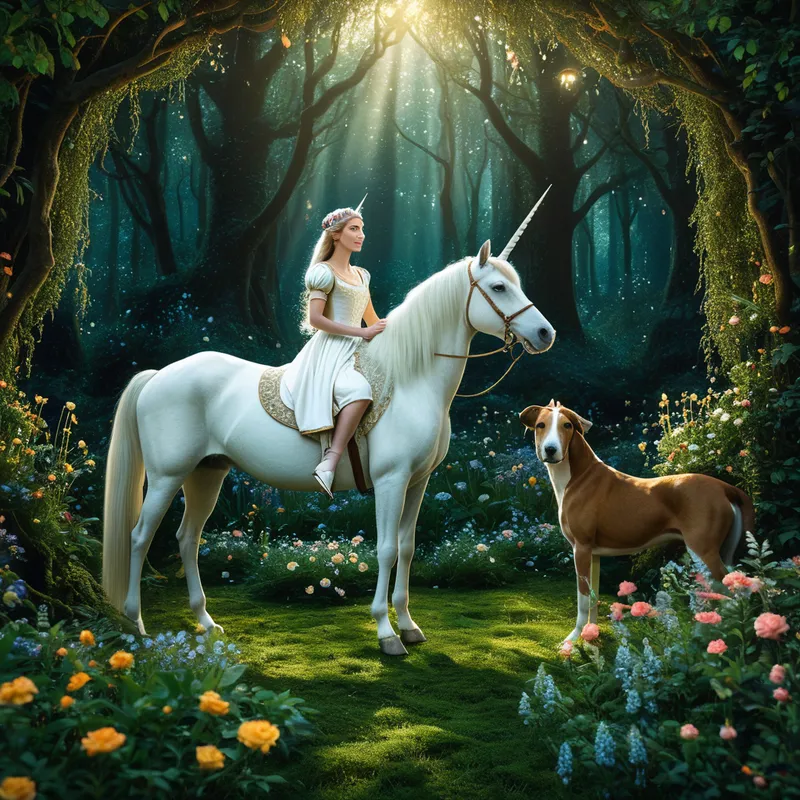
Listen, and let the threads of wool and silk, dyed with woad and madder, weave a world for you. It begins not with a sound, but with a seeking. In a forest so dense and green it breathes, the lords and their hounds move like shadows. They are not villains of this tale, but instruments of a deeper will. The air is thick with the scent of damp earth and blooming millefleurs. They seek the impossible: a creature of moonbeam and morning mist, a living paradox of untamed gentleness—the unicorn.
And there, in a sun-dappled glade, it stands. Its coat is whiter than the first winter snow, its horn a spiraled lance of pearl catching the fractured light. It is peace incarnate, a sovereign of a kingdom without walls. The hounds bay, the men tense, but their nets and spears are useless here. For the unicorn knows a law older than chivalry: it fears the violence of man, but it is drawn, irresistibly, to the purity of the innocent heart.
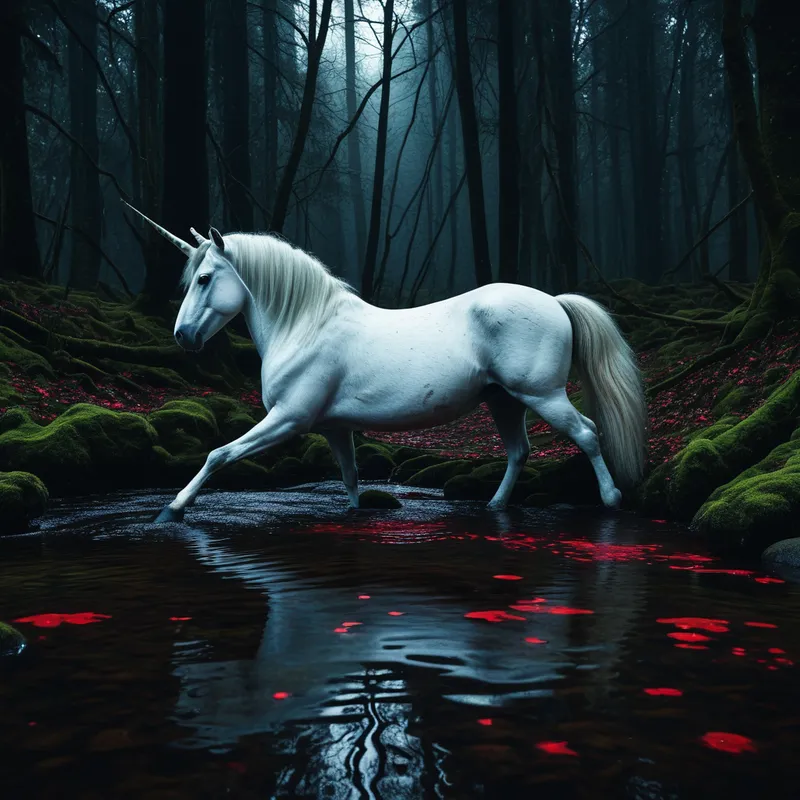
Enter the maiden. She sits alone by a pomegranate tree, her lap a haven, her gaze lowered. She is the still point in the turning world. The hunters have brought her here as their secret weapon, a living snare. The unicorn approaches. It slows its graceful gait. It lowers its majestic head, and with a trust that breaks the heart of the world, it lays itself in her lap. Its horn rests upon her skirt, and in that moment, the wild is tamed not by force, but by a sacred surrender. The spell of the glade is shattered by a signal. The hunters emerge. The hounds leap. The spears find their mark. The pristine white is marred; the crimson flow is a shocking scar upon the green. The unicorn is slain, its body borne away to the castle, a prize for a prince.
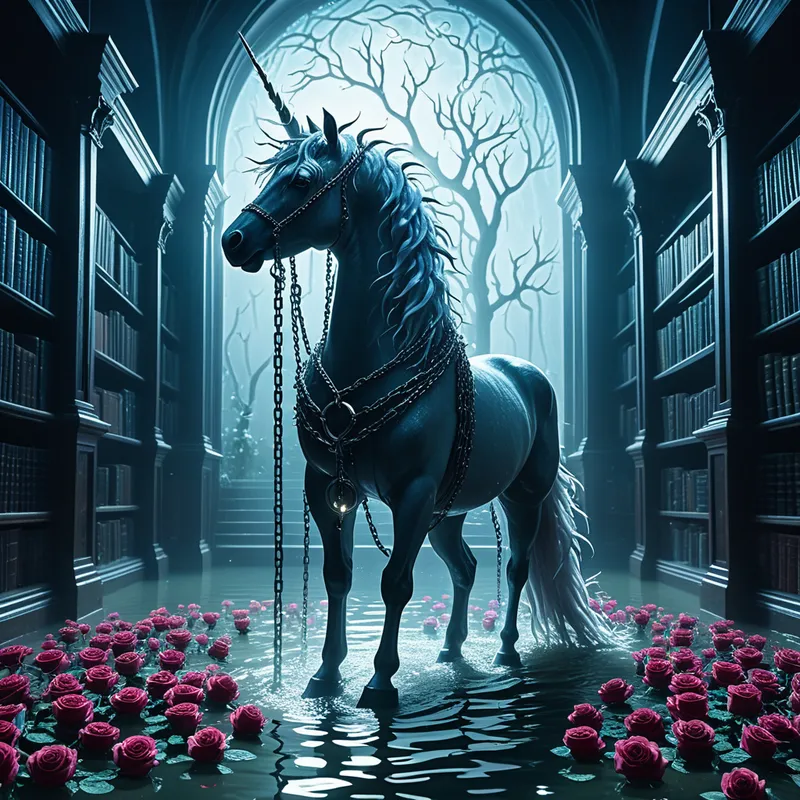
But the story does not end in the hall of trophies. Carry your grief to the final panel. See now the same unicorn, alive. It rests within a circular wooden pen, a fence of flowering hawthorn. A chain of gold links it to a pomegranate tree, heavy with split fruit. Its head is raised, its eyes are open. It is not a prisoner, but a resident. It has returned. The wound is gone. It lives, not in the wild forest, but in a garden of its own becoming, vital and eternal. The hunt was not for death, but for this.
Cultural Origins & Context
The so-called Hunt of the Unicorn tapestries are not illustrations of a single, codified myth from a medieval scripture. They are the myth itself, woven into being. Created in the Franco-Flemish workshops at the dawn of the 16th century, they exist at the crossroads of late medieval piety, aristocratic display, and alchemical curiosity. They were likely commissioned by a powerful noble family, like the La Rochefoucaulds, to adorn cold stone walls with a story of power, devotion, and mystery.
Their societal function was layered. On one hand, they were a spectacular display of wealth and refinement, the wool and silk threads literally woven from economic power. On another, they served as a complex visual sermon. The unicorn was a well-established allegory for Christ—the pure sacrifice captured through divine guile (the Virgin Mary as the maiden), slain, and resurrected. The tapestries allowed the nobility to visually participate in this sacred narrative, aligning their worldly hunts with a celestial drama. Furthermore, in the secretive language of alchemy, the hunt represented the pursuit of the elusive Philosopher’s Stone, with the unicorn symbolizing the purified, incorruptible spirit trapped within base matter. The myth was passed down not by bards, but by weavers, dyers, and designers, its meaning shifting like light on silk depending on the eye of the beholder—prince, priest, or philosopher.
Symbolic Architecture
The myth’s power lies in its tripartite symbolic architecture: Capture, Death, and Return. The unicorn represents the ultimate value of the soul—its pristine, instinctual, and untamed essence. It is our core authenticity, our spiritual vitality that exists beyond the compromises of the ego.
The unicorn is the soul’s wild integrity, which can only be approached through guileless innocence, never seized by force.
The Hunt is the necessary, often brutal, process of life and consciousness that seeks to bring this numinous value into the realm of the known, the tangible, and the human. It is ambition, desire, even spiritual longing, which in its raw form appears violent to the innocent spirit. The Maiden is the crucial intermediary. She represents the receptive, containing principle—the vessel. She is not active will but passive invitation; the quality of soul that can attract and temporarily “tame” the divine without destroying it, often symbolized by the pomegranate beside her. Her betrayal is the painful but necessary moment where the unconscious, instinctual self (the unicorn) is delivered over to the conscious, discriminating mind (the hunters) to be “understood,” and in that understanding, seemingly killed.
The Resurrection in the enclosed garden is the myth’s triumphant core. The unicorn does not return to the wild, uncontained forest. It is resurrected within a cultivated space, chained to the tree of life. This symbolizes the ultimate goal: not the loss of the instinctual spirit, but its transformation into a conscious possession. The wild soul is integrated, it becomes the central, living treasure of the cultivated self, eternally vital but now accessible.
The Dreamer’s Resonance
When this myth stirs in modern dreams, it speaks to a profound process of encountering and integrating the Self. To dream of the unicorn in a dark forest may signal a nascent, precious quality of the psyche making itself known—a creative impulse, a deep feeling, or a forgotten innocence—that feels both magnificent and vulnerable.
Dreaming of the hunt, especially from the perspective of the unicorn, often accompanies a somatic feeling of being pursued or cornered by the demands of life (work, relationships, inner criticism), where one’s true nature feels under threat. To dream as the maiden, sitting passively while a powerful force approaches, can indicate a necessary period of receptivity, where forcing an outcome would be destructive. The act of betrayal in the dream is critical; it rarely feels like malice, but like a fateful, sorrowful necessity, pointing to a part of the dreamer’s own psychology that must “hand over” an innocent state to a more conscious, and thus more painful, awareness.
The most potent dream resonance is the image of the resurrected unicorn in the circular enclosure. This dream manifests during or after a period of significant psychological “death”—a depression, a major loss, a collapse of an old identity. It signifies that the core spirit has not been lost, but secured. The chain is not a bondage, but a connection. The garden is the newly formed inner sanctuary, the conscious personality that has been rebuilt to house the immortal, rediscovered Self.
Alchemical Translation
For the modern individual, the tapestry myth is a perfect map of the alchemical individuation process. The journey begins with the Nigredo, the blackening. This is the hunt in the dark forest, the chaotic pursuit of something we sense we have lost—meaning, purpose, vitality. The ego, with its pack of hounds (desires, anxieties, ambitions), chases the elusive Self.
The capture by the maiden is the Albedo, the whitening. It is the moment of reflection, where the fierce pursuit stops, and we must simply be with ourselves in innocent receptivity. This is often meditation, therapy, or creative incubation—the necessary vessel for transformation.
The slaying is the crucial Rubedo, the reddening. It is the suffering inherent in consciousness. The beautiful, unconscious state (the unicorn in the forest) must “die” to be integrated. An ideal must confront reality; a talent must face discipline; love must endure loss. This feels like a sacrifice, a staining of purity. It is the death of the ego’s idealization and the birth of conscious relationship with the Self.
Finally, the resurrection in the enclosed garden is the Citrinitas, the yellowing, or the achievement of the Lapis Philosophorum. The Self is reborn, not as a distant, wild ideal, but as the central, living reality of the individual’s life. It is chained to the world (the pomegranate tree of life, relationships, and creativity), no longer fugitive but foundational. The individual has built a conscious psyche—a cultivated garden—sturdy and beautiful enough to contain the miraculous. The hunt, therefore, was never about possession or destruction, but about the ultimate homecoming: building a self where the soul, in all its wild and sacred glory, can finally, and forever, reside.
Associated Symbols
Explore related symbols from the CaleaDream lexicon: