The Underworld / Hades Myth Meaning & Symbolism
The story of Persephone's abduction by Hades, her mother Demeter's grief, and the creation of the seasons—a myth of descent, sovereignty, and cyclical transformation.
The Tale of The Underworld / Hades
Listen. Before the world knew winter, there was only the eternal, careless summer of the gods. In the sun-drenched fields of Nysa, the maiden Kore wandered, her laughter a silver chime among the asphodel. She was the darling of her mother, Demeter, she who made the wheat grow tall and golden. But beneath their feet, in the silent, sunless depths, a kingdom of shadows stirred.
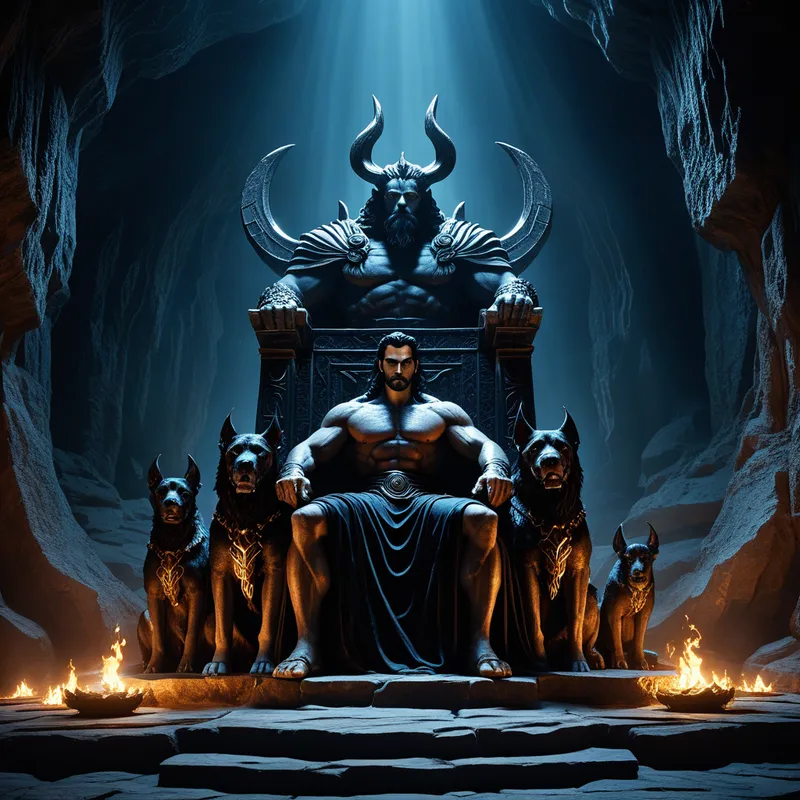
Its lord was Hades, brother to Zeus and Poseidon. To him fell the lot of the Underworld, a realm of vast, echoing caverns, meadows of ghostly pale asphodel, and the five dark rivers that bound the land of the living to the land of the dead. He ruled from an ebony throne, a solemn and inevitable god, attended by the many-headed hound Cerberus. And he was lonely.
With the consent of Zeus, a plan was woven. As Kore reached for a narcissus of breathtaking beauty—a flower sprung from the earth by divine design—the ground itself roared and split. From the chasm, a chariot of blackest iron drawn by immortal, smoke-maned horses erupted. A powerful, shadow-crowned arm seized the shrieking maiden. The earth closed over them as if it had never opened, leaving only a few scattered flowers and a silence so profound it was a sound in itself.
Demeter’s grief was a cataclysm. She cast off her divinity, donned mortal rags, and wandered the earth. Where her feet fell, the soil froze. Leaves withered. The green world died. Famine gripped humanity. The gods, deprived of sacrifice, grew weak. All light and life were leaching from the world, drawn down into the single, consuming well of a mother’s despair.
Meanwhile, in the Underworld, a transformation was taking place. The terrified maiden Kore was gone. In her place, through refusal of all food and drink, through the slow acceptance of her new, stark reality, Persephone began to emerge. She walked the fields of asphodel. She learned the names of the judges of the dead. She felt the weight of the crown Hades offered, not as a jailer’s chain, but as a scepter of a terrible, necessary domain.
Yet, compelled by the world’s dying gasps, the messenger Hermes was sent below. He found Persephone beside Hades, no longer a prisoner, but a queen. A deal was struck: she could return to the light. But as she turned to go, a gardener of the dead revealed a truth—Persephone had eaten. Not a feast, but a single, fateful seed from a pomegranate, offered in her hunger. In the ancient laws of the cosmos, to eat the food of a realm is to belong to it.
Thus, the great compromise was forged. For each seed eaten, a month of the year Persephone must reign as Queen beside Hades in the somber depths. For the rest, she could walk the sunlit world with her mother. Demeter, hearing this, allowed life to return—but henceforth, when her daughter descended, the world would mourn, the fields would lie fallow, and winter would hold sway. When Persephone ascended, spring would erupt in jubilant, verdant riot. The maiden had died. The queen was born. And the very rhythm of life and death, joy and grief, was etched into the bones of the world.

Cultural Origins & Context
This central myth of the Eleusinian Mysteries was not merely a story but the bedrock of a profound religious experience. Originating in the Mycenaean period and crystallizing in the poetry of Hesiod’s Theogony and the Homeric Hymn to Demeter, it served multiple societal functions. It was an etiological myth, explaining the origin of the seasons, a fundamental concern for an agrarian society. More importantly, it was the sacred narrative of the Mysteries celebrated at Eleusis, where initiates underwent rituals believed to grant them a blessed afterlife, freeing them from the bleak fate of the common shades in Hades.
The myth was passed down through sacred chant and ritual re-enactment by priests and priestesses, creating a direct, experiential link between the community, the fertility of the land, and the hope for life beyond death. It framed death not as a final, terrifying end, but as part of a divine, cyclical order presided over by a sovereign pair. The story of Persephone provided a template for the human soul’s journey, offering comfort and a sense of sacred structure in the face of life’s greatest inevitabilities.
Symbolic Architecture
Psychologically, the Underworld is the unconscious itself—the vast, interior kingdom of all we have repressed, forgotten, or never known. Hades represents the principle that pulls us downward into this necessary confrontation. He is not evil, but inevitable. His abduction is the sudden, often traumatic, eruption of unconscious content—a depression, a loss, a crisis—that forcibly removes us from the “sunlit” world of our conscious identity (Kore).
The descent into the underworld is the soul’s imperative to reclaim its wholeness from the dominion of the forgotten.
Demeter embodies the conscious mind’s reaction to this loss: a productive, life-giving force that becomes destructive in its refusal to accept the reality of the deeper, darker processes at work. Her famine is the stagnation and depression that sets in when we will not acknowledge the shadow.
Persephone’s transformation is the core of the myth. Her initial resistance (fasting) gives way to integration (accepting the pomegranate seed, accepting the crown). She becomes the queen of the very realm that abducted her, symbolizing the ego’s achievement of sovereignty over the contents of the unconscious. She is the integrated self who can navigate both the upper and lower worlds. The pomegranate seed is the compact with the depths; a tiny, irrevocable commitment to truth that forever changes one’s constitution.

The Dreamer’s Resonance
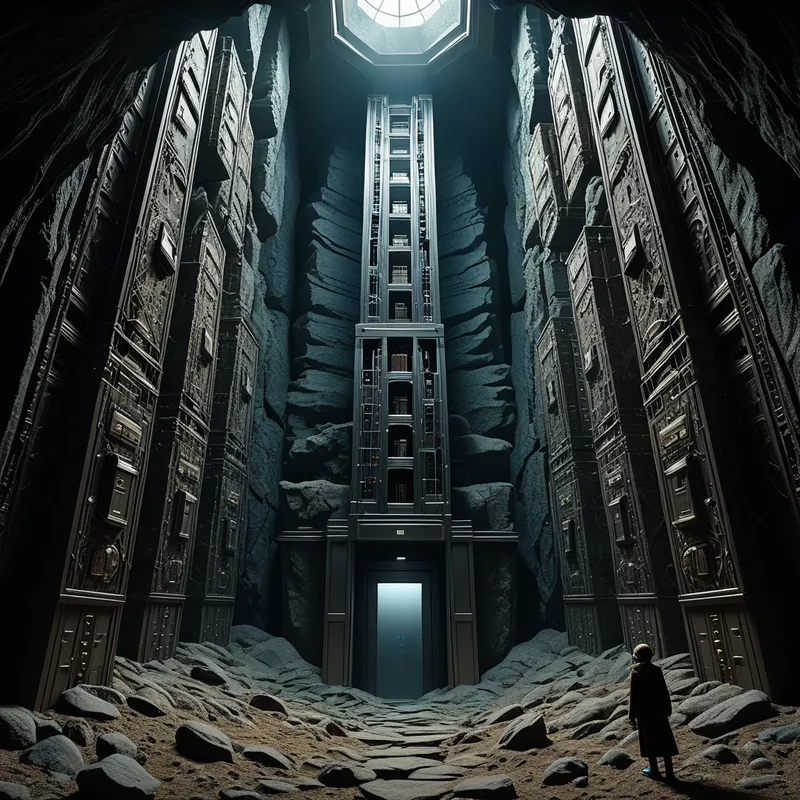
When this mythic pattern stirs in modern dreams, it signals a profound somatic and psychological initiation: a necessary descent. Dreaming of being pulled underground, of finding rooms beneath one’s house, of elevators descending into unknown basements, or of meeting a solemn, authoritative shadow figure points to this process.
The somatic experience is often one of weight, pressure, or chill—a literal feeling of being “down.” Psychologically, the dreamer is being compelled to confront what has been buried: unresolved grief, unexpressed rage, latent talents, or forgotten trauma. The figure of Hades in a dream is rarely monstrous; he is more likely to appear as a silent guide, a stern father, or a figure in a position of hidden authority, representing the psyche’s own imperative toward integration. To dream of eating in such a place, especially dark, jewel-like fruit, suggests the beginning of a conscious assimilation of this shadow material, the first taste of a new, more complex selfhood.
Alchemical Translation
The alchemical journey of individuation mirrors Persephone’s path exactly. The first stage, nigredo (the blackening), is the abduction itself—the crisis, the depression, the “dark night of the soul” that shatters the innocent, conscious standpoint (Kore). This is a descent into the prima materia, the chaotic base matter of the psyche.
The pomegranate seed is the philosopher’s stone in miniature: the minute, concentrated essence that contains the formula for transmuting leaden despair into golden wisdom.
The second stage involves the separatio and mortificatio—the fasting and refusal, which is the painful differentiation of the ego from its old identifications. This is Persephone’s mourning. The crucial alchemical act is the conjunctio, the sacred marriage. This is not her marriage to Hades as a personal event, but her acceptance of the crown—the ego (Persephone) consciously wedding itself to the sovereignty of the Self (the royal authority of the Underworld). She becomes the mediating queen, the one who can translate between the depths and the heights.
Finally, the albedo (whitening) and rubedo (reddening) are her cyclical return. She emerges not as the maiden, but as the knowing queen, bringing the wisdom of the depths back to the world of light. For the modern individual, this models the process of psychic transmutation: we are taken by a crisis (abduction), we struggle and resist (Demeter’s famine), we eventually accept and integrate a fundamental truth about ourselves (eating the seed), and we emerge cyclically transformed, capable of bearing fruit in our lives with a newfound depth and resilience, having made the unconscious, conscious. We become rulers of our own interior kingdom.
Associated Symbols
Explore related symbols from the CaleaDream lexicon: