The Two Men Creation Myth Meaning & Symbolism
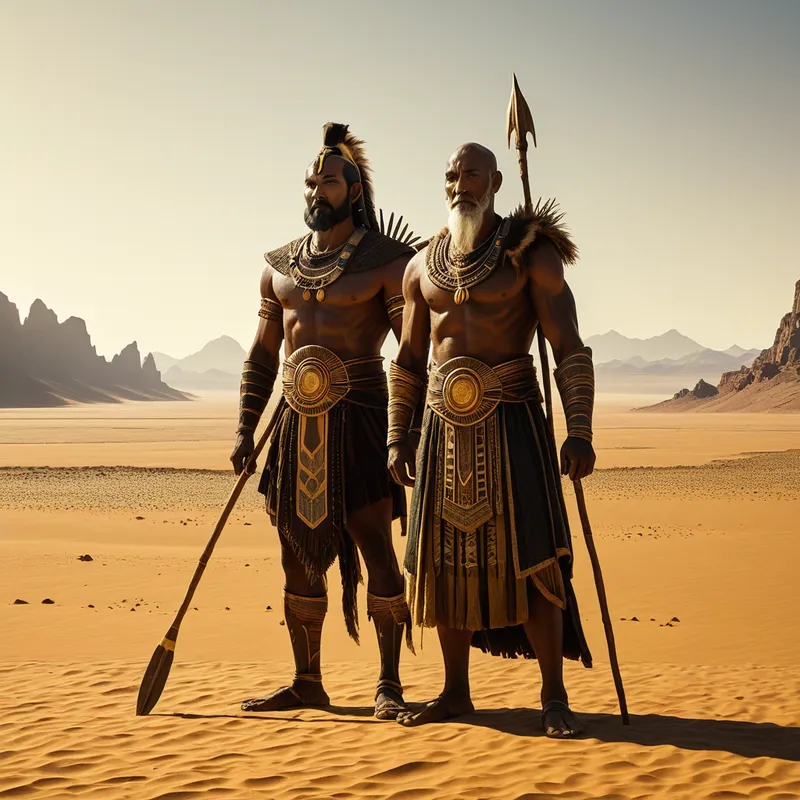
Two primordial beings traverse the formless world, singing its features into existence through their sacred, transformative journey.
The Tale of The Two Men Creation Myth
In the beginning, there was the Dreaming. The world lay quiet, a vast and featureless expanse of red earth and soft dust, waiting beneath a blank, starless sky. Then, they came.
They emerged from the nothingness, not as gods from a distant heaven, but as Men from the very substance of the earth itself. Two of them. They were not young, not old; they were primordial, complete, and potent. They carried the weight of all-that-would-be in their silent footsteps. One held a spear, straight and true, a line of intention. The other carried a digging stick, a tool of uncovering and sustenance.
They did not speak, not with words as we know them. Instead, they began to walk. And as they walked, they began to sing.
The song was not a melody for entertainment; it was a vibration of pure creation. It rose from deep within their beings, a low hum that shook the dust. With each step, the song changed. The man with the spear sang of lines, of boundaries and directions. His voice cut through the formlessness, and where his foot fell and his song echoed, a ridge of stone pushed upwards, becoming a mountain range. A sweep of his arm in rhythm with the chant carved a deep, winding channel that immediately began to fill with sweet water—a river was born.
The man with the digging stick sang a different song, one of depth and gathering. He sang of hollows and places of congregation. Where he paused and thrust his stick into the earth, singing, the ground opened into a wide, cool waterhole. Where he gestured, clusters of trees sprang from the soil, their leaves whispering the echo of his tune.
They journeyed for an eternity, their paths sometimes diverging, sometimes crossing. Their songs wove together, the linear and the circular, the raised and the sunken. They sang the salt flats into being, the stands of desert oak, the cliffs that faced the rising sun. They placed the first stones that would become sacred sites, singing the law and the story of each place directly into its rock and soil.
Finally, their great journey complete, the land now a living, singing map of their travels, they stopped. They looked upon what they had sung into existence—the creeks, the hills, the animal tracks that followed the paths of their songlines. Their work was done, but they did not vanish. They entered the features they had created. One became the essence of the mountain, his presence the enduring strength of the rock. The other sank into the deepest waterhole, his spirit the source of its never-failing spring. They became the land itself, and their song echoes in the wind through the gorges and the quiet lap of water on a shore, forever.

Cultural Origins & Context
This myth, in its many localized forms across the continent, is a cornerstone of Aboriginal Australian spiritual and cultural life. It belongs not to a distant, finished past, but to the Dreaming—an ongoing, eternal reality that underpins the present. The story was and is passed down not as mere folklore, but as sacred law, through song, dance, ceremony, and art by Elders and custodians.
Its function is multifaceted: it is a cosmological map explaining the origin of the physical landscape, a legal constitution encoding the relationships and responsibilities between people, land, and all living things, and a spiritual guide. The journey of the Two Men establishes the songlines, which serve as navigational routes, memory palaces, and connective tissue between communities. To know the story is to know the land, and to know the land is to know oneself and one’s place within a vast, living order.
Symbolic Architecture
The Two Men represent the fundamental creative duality inherent in existence. They are not opposites in conflict, but complementary forces whose [interaction](/symbols/interaction “Symbol: Interaction in dreams symbolizes communication, relationships, and connections with others, reflecting the dynamics of personal engagement and social settings.”/) generates the world.
The spear and the digging stick: one projects outward, defining and penetrating; the other turns inward, nourishing and uncovering. Together, they enact the full cycle of life.
The songline is the central [symbol](/symbols/symbol “Symbol: A symbol can represent an idea, concept, or belief, serving as a powerful tool for communication and understanding.”/) of conscious, intentional creation. It signifies that the world is not an [accident](/symbols/accident “Symbol: An accident represents unforeseen events or mistakes that can lead to emotional turbulence or awakening.”/), but a spoken, sung, and walked-into-being [reality](/symbols/reality “Symbol: Reality signifies the state of existence and perception, often reflecting one’s understanding of truth and life experiences.”/). The [journey](/symbols/journey “Symbol: A journey in dreams typically signifies adventure, growth, or a significant life transition.”/) itself is the act of creation; there is no [separation](/symbols/separation “Symbol: A spiritual or mythic division between realms, states of being, or consciousness, often marking a transition or loss of connection.”/) between the [creator](/symbols/creator “Symbol: A figure representing ultimate origin, divine power, or profound authorship. Often embodies the source of existence, innovation, or personal destiny.”/), the process, and the creation. Psychologically, this represents the [individuation process](/symbols/individuation-process “Symbol: The psychological journey toward self-realization and wholeness, integrating conscious and unconscious aspects of personality.”/): the ego (the walking being) must actively traverse the unconscious (the featureless [landscape](/symbols/landscape “Symbol: Landscapes in dreams are powerful symbols representing the dreamer’s emotional state, personal journey, and the broader context of life situations.”/)), using its unique “song” or [authentic voice](/symbols/authentic-voice “Symbol: The ‘Authentic Voice’ symbolizes the true expression of self, encompassing personal beliefs, emotions, and individuality.”/) to give form and meaning to the inner world, thereby creating a cohesive psyche.
Their final transformation into the landscape symbolizes the ultimate goal: not transcendence from the world, but complete immanence within it. The psyche becomes structured, a known and habitable inner territory.
The Dreamer’s Resonance
When this mythic pattern stirs in the modern dreamtime, it often manifests as dreams of purposeful travel through unknown or barren terrain. The dreamer may find themselves walking, driven by an internal compulsion, with a companion whose presence feels essential yet enigmatic.
The somatic experience can be one of rhythmic movement—a steady, grounding pace. The psychological process is one of world-building within the self. The dreamer is not lost; they are on their songline. The anxiety or awe in the dream corresponds to the responsibility and power of this internal creation. To dream of making a mark on the empty land—drawing a line, planting a seed, causing water to flow—signals the emergence of the creative will from the unconscious, beginning to structure one’s inner life according to one’s own authentic nature.

Alchemical Translation
The alchemy here is not of turning lead to gold in a furnace, but of turning silence into song, potential into form, and a wandering into a dwelling place. It is the individuation journey modeled in its purest form.
The prima materia is the unformed psyche, the “featureless expanse.” The Two Men are the dual aspects of the conscious mind—the differentiating principle (spear) and the nurturing, containing principle (digging stick)—that must be harnessed together.
The long, arduous journey is the necessary period of engagement with the unconscious, refusing the comfort of stagnation. The “singing” is the active, living application of one’s unique values, insights, and truths (the personal law). Each act of naming, each emotional insight, each hard-won understanding is a note in the song that creates an internal landmark—a memory complex, a healed trauma, a solidified talent.
The final stage, becoming the landscape, is the achievement of the Self. The ego-consciousness, having fully engaged with and shaped the unconscious, no longer sits apart from it as a separate traveler. It becomes integrated. The individual inhabits their own full psyche comfortably. The inner world is no longer a threatening wilderness to be crossed, but a sacred, known, and resonant homeland. The journey ends in belonging, because you have become what you sought.
Associated Symbols
Explore related symbols from the CaleaDream lexicon:
- Journey — The central action of the myth, representing the process of creation, exploration, and the necessary movement through the formless to bring forth form and meaning.
- Song — The creative power itself, the vibration that shapes reality, symbolizing law, story, and the authentic voice that structures the inner and outer worlds.
- Earth — The raw material of creation and the final form of the creators, representing the grounded, tangible reality born from spirit and the ultimate unity of being and place.
- Water — Created by the digging stick, symbolizing the deep, nourishing, and gathering aspects of the unconscious, the source of life and emotional depth.
- Mountain — Created by the spear, representing stability, enduring structure, and the raised, visible achievements of the conscious will and effort.
- Dream — The temporal and spiritual dimension in which the entire myth takes place, representing the foundational, unconscious layer of reality from which all forms emerge.
- Root — The deep, anchoring connection to the land and the ancestral past, symbolizing the way the creators’ essence becomes the permanent, sustaining foundation of the world.
- Origin — The myth is a quintessential origin story, not just of landscape, but of law, relationship, and the very principle of conscious creation from the void.
- Spirit — The animating force of the Two Men, which transitions from mobile beings to the immanent presence within all features of the land.
- Stone — The solidified song and law, representing permanence, memory, and the sacred sites that act as anchors of meaning in the created world.