The Twelve Olympians Myth Meaning & Symbolism
The story of the gods who rule from Olympus, a pantheon born from cosmic strife, embodying the fundamental archetypes of human consciousness and culture.
The Tale of The Twelve Olympians
Hear now of the mountain that holds up [the sky](/myths/the-sky “Myth from Persian culture.”/), and the ones who dwell there. It did not begin in peace. It began in the dark gullet of time, with a father’s fear and a mother’s grief. [Ouranos](/myths/ouranos “Myth from Global/Universal culture.”/), [the star](/myths/the-star “Myth from Tarot culture.”/)-strewn sky, lay heavy upon Gaia, the fertile earth, and would not let her children—[the Titans](/myths/the-titans “Myth from Greek culture.”/), the Cyclopes, the Hundred-Handers—see the light. [The world](/myths/the-world “Myth from Tarot culture.”/) was a prison of flesh and stone.
From that oppression, a sickle was forged. The youngest Titan, [Kronos](/myths/kronos “Myth from Greek culture.”/), sharp with ambition and his mother’s whispered plan, took the blade and severed sky from earth. Blood fell like rain, and from that rain sprang [the Furies](/myths/the-furies “Myth from Greek culture.”/) and the Giants. [Kronos](/myths/kronos “Myth from Greek culture.”/) took the throne, and his fear became a devouring curse. He swallowed his children whole as they were born from Rhea, lest they one day unseat him. The cosmos was silent, its future locked in a god’s belly.
But Rhea, her heart a wild, grieving drum, tricked him. When her last son was born in a Cretan cave, she gave Kronos a stone wrapped in swaddling clothes. He gulped it down, unaware. And that son, Zeus, grew strong on the milk of a goat and the honey of bees, his cries hidden by the clashing of shields. He became a cupbearer, and into his father’s drink he poured a potion of mustard and wine. Kronos retched, and out came the stone, and out came his children, whole and grown and blazing with wrath: Hera, [Poseidon](/myths/poseidon “Myth from Greek culture.”/), Demeter, [Hestia](/myths/hestia “Myth from Global/Universal culture.”/), [Hades](/myths/hades “Myth from Greek culture.”/).
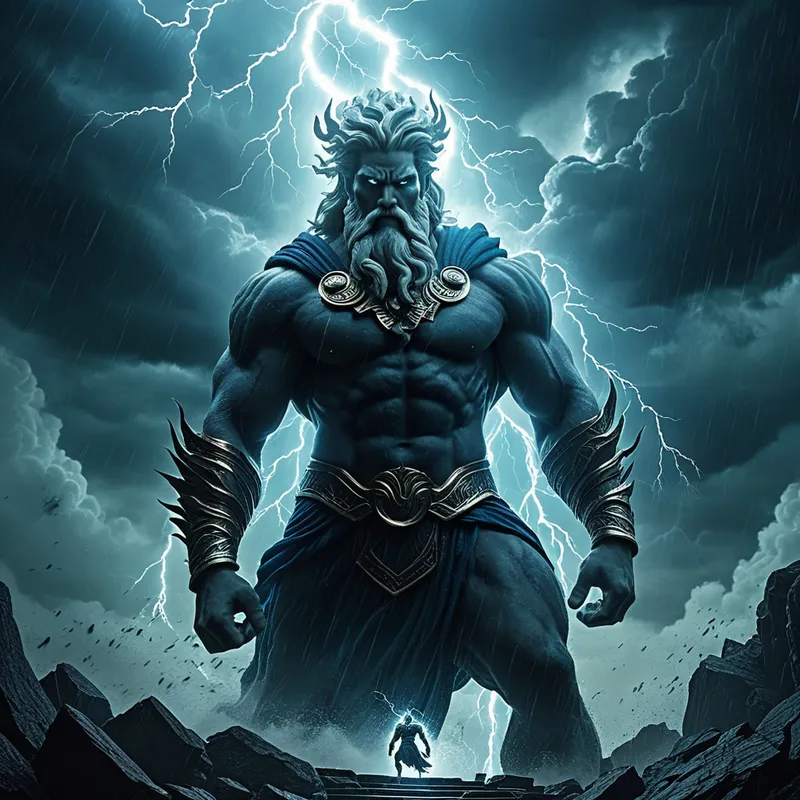
Then came the war that shook the pillars of the world. The Titanomachy. For ten years, lightning clashed against mountain, sea against fire. Zeus freed the Cyclopes, who gave him the thunderbolt; he freed the Hundred-Handers, whose countless arms hurled boulders like rain. The Titans were cast down, bound in chains, and hurled into the sunless pit of [Tartarus](/myths/tartarus “Myth from Greek culture.”/).
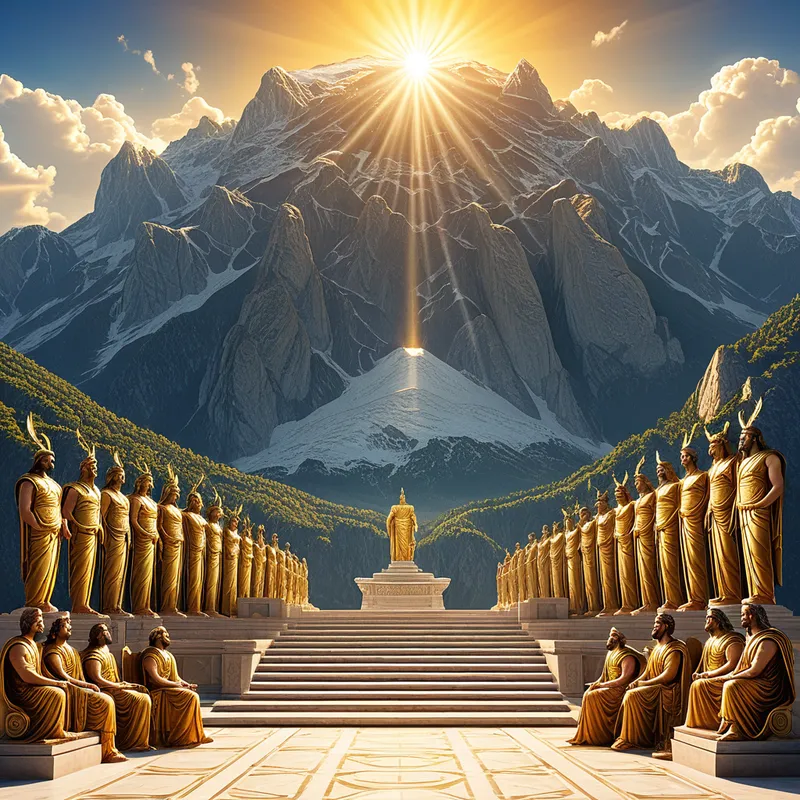
With the old order broken, the three brothers drew lots. The murky depths fell to Poseidon, the misty [underworld](/myths/underworld “Myth from Greek culture.”/) to Hades, and the bright air and high mountain to Zeus. And upon that mountain, Olympus, they built their shining halls. Not just the six siblings, but a new generation born of union and strife: Athena, springing fully armed from Zeus’s brow; Apollo and Artemis, twins of light and the wild; Ares, fierce and tumultuous; Aphrodite, born from sea-foam and sky; Hephaistos, the cunning artisan; [Hermes](/myths/hermes “Myth from Global/Universal culture.”/), the swift-footed trickster; and Dionysus, the late-arriving god of ecstasy. Twelve thrones were set. A council was formed. [The law](/myths/the-law “Myth from Biblical culture.”/) was established. From their high citadel, they gazed upon the world of mortals, their passions, their disputes, their favors and their punishments weaving [the fates](/myths/the-fates “Myth from Greek culture.”/) of heroes and the rise and fall of cities. The age of the Olympians had dawned, not as silent tyrants, but as vibrant, flawed, and potent rulers of a cosmos now alive with story.
Cultural Origins & Context
This [pantheon](/myths/pantheon “Myth from Roman culture.”/) was not born in a single tale, but coalesced over centuries, from the Mycenaean Bronze Age through the Archaic and Classical periods of Greece. It was a living, breathing theology performed, not just believed. The myths were the sacred narrative glue of the polis, recited by bards like [Homer](/myths/homer “Myth from Greek culture.”/) and Hesiod, enacted in the tragedies of Aeschylus, Sophocles, and Euripides, and celebrated in grand festivals like the Panathenaia for Athena or [the Olympic Games](/myths/the-olympic-games “Myth from Greek culture.”/) for Zeus.
The function was profound. The Olympians provided a divine mirror for human society. They explained natural phenomena (Zeus’s thunder, Poseidon’s earthquakes), sanctified social institutions (Hera’s marriage, Hestia’s hearth), and modeled the full spectrum of human behavior—from Apollo’s rational order to Dionysus’s ecstatic release. They were a system of meaning, a way to negotiate the chaos of existence by attributing it to a knowable, though often capricious, family of powers. Worship was a contract: piety and sacrifice in exchange for favor and protection. The Twelve were not distant, perfect beings; they were a magnified reflection of the Greek world itself—competitive, political, passionate, and deeply concerned with honor, beauty, and power.
Symbolic Architecture
The Olympians are not merely characters; they are a symbolic [architecture](/symbols/architecture “Symbol: Architecture in dreams often signifies structure, stability, and the framing of personal identity or life’s journey.”/) of the [psyche](/myths/psyche “Myth from Greek culture.”/). They represent the [differentiation](/symbols/differentiation “Symbol: The process of distinguishing or separating parts of the self, emotions, or identity from a whole, often marking a developmental or psychological milestone.”/) of a unified, unconscious totality (the [primordial chaos](/symbols/primordial-chaos “Symbol: The formless, undifferentiated state before creation in many cosmologies, representing potential, disorder, and the raw material of existence.”/) of Gaia and Ouranos, the undifferentiated swallowing of Kronos) into a pantheon of distinct, conscious faculties.
The birth of the Olympians is the birth of consciousness itself—the painful, violent separation of knowing from the womb of the unknown, establishing an inner council to govern the soul’s domain.
Zeus is the archetypal principle of order, will, and sovereign [consciousness](/symbols/consciousness “Symbol: Consciousness represents the state of awareness and perception, encompassing thoughts, feelings, and experiences.”/)—[the ego](/myths/the-ego “Myth from Jungian culture.”/) that seeks to integrate and rule the inner world. His siblings and children represent the specialized domains of that inner world: Hera (the drive for partnership and commitment), Poseidon (the emotional and [unconscious depths](/symbols/unconscious-depths “Symbol: The hidden, primordial layers of the psyche containing repressed memories, instincts, archetypes, and collective wisdom beyond conscious awareness.”/)), Demeter (the nurturing and cyclical [nature](/symbols/nature “Symbol: Nature symbolizes growth, connectivity, and the primal forces of existence.”/) of [life](/symbols/life “Symbol: The symbol of ‘Life’ represents a journey of growth, interconnectedness, and existential meaning, encompassing both the joys and challenges that define human experience.”/) and [loss](/symbols/loss “Symbol: Loss often symbolizes change, grief, and transformation in dreams, representing the emotional or psychological detachment from something or someone significant.”/)), Athena (strategic intellect and civilized wisdom), Ares (raw instinct and aggression), Aphrodite (eros, attraction, and relational [beauty](/symbols/beauty “Symbol: This symbol embodies aesthetics, harmony, and the appreciation of life’s finer qualities.”/)), Hephaistos (creative transformation through suffering and craft), Hermes (communication between conscious and unconscious), Artemis (the autonomous, untamed [spirit](/symbols/spirit “Symbol: Spirit symbolizes the essence of life, vitality, and the spiritual journey of the individual.”/)), Apollo (the light of reason, form, and [prophecy](/symbols/prophecy “Symbol: A foretelling of future events, often through divine or supernatural means, representing destiny, fate, and hidden knowledge.”/)), and Dionysus (the [dissolution](/symbols/dissolution “Symbol: The process of breaking down, dispersing, or losing form, often representing transformation, release, or the end of a state of being.”/) of boundaries, ecstatic union, and the raw [life](/symbols/life “Symbol: The symbol of ‘Life’ represents a journey of growth, interconnectedness, and existential meaning, encompassing both the joys and challenges that define human experience.”/) force). [Hades](/symbols/hades “Symbol: Greek god of the underworld, representing death, the unconscious, and hidden aspects of existence.”/), though not always counted among the Twelve on [Olympus](/symbols/olympus “Symbol: In Greek mythology, Mount Olympus is the divine home of the gods, representing ultimate power, perfection, and spiritual transcendence.”/), is the essential, shadowy counterpart—the ruler of the repressed, the forgotten, the [wealth](/symbols/wealth “Symbol: Wealth in dreams often represents abundance, security, or inner resources, but can also symbolize burdens, anxieties, or moral/spiritual values.”/) of the [underworld](/symbols/underworld “Symbol: A symbolic journey into the unconscious, representing exploration of hidden aspects of self, transformation, or confronting repressed material.”/) psyche.
The Dreamer’s Resonance
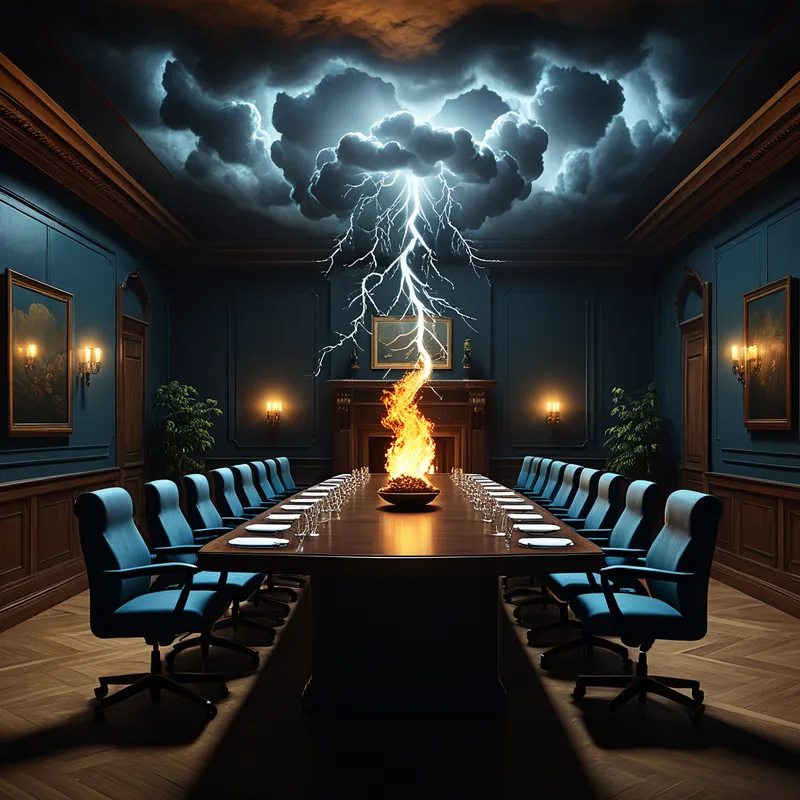
When this mythic pattern stirs in modern dreams, it seldom appears as literal gods on a mountain. Instead, one may dream of a powerful, conflicted family governing a vast corporation; a council of twelve distinct voices arguing within one’s own mind; or a recurring number twelve in a context of authority and tension. These are somatic signals of a psychological process of integration and hierarchy-building within the dreamer.
The dream may manifest anxiety (a Titan-like rebellion against an inner “Zeus” or authority), passion (an “Aphrodite” or “Ares” dynamic disrupting orderly life), or creative breakthrough (a “Hephaistos” moment forging something new from pain). To dream of [the Olympian council](/myths/the-olympian-council “Myth from Greek culture.”/) is to witness the psyche attempting to move from chaotic, monolithic impulses (the rule of the “inner Titan”) towards a more complex, differentiated, and hopefully harmonious self-governance. It is the soul negotiating its own internal politics.
Alchemical Translation
The journey from the tyranny of Kronos to the reign of the Twelve is the alchemical blueprint for individuation. Kronos represents the unconscious, undifferentiated state that devours potential—the stagnant personality that refuses to let new aspects of [the self](/myths/the-self “Myth from Jungian culture.”/) be born. The violent rebellion and the Titanomachy symbolize the necessary, often painful, crisis that shatters this stagnant totality.
The drawing of lots by the brothers is the psychic act of acknowledging and assigning value to the different realms of one’s being: the emotional depths (Poseidon), the shadow and hidden wealth (Hades), and the conscious, ruling principle (Zeus).
The establishment of Olympus is not the end, but the beginning of the real work. The gods quarrel, love, punish, and create. This mirrors the ongoing, dynamic process of individuation: the conscious ego (Zeus) does not tyrannize the other archetypes but is tasked with relating to them, integrating their power, and managing their conflicts. To become whole is not to become a single, bland unity, but to become a well-governed cosmos—a polis of the soul where Artemis’s wildness, Hephaistos’s craftsmanship, and Athena’s wisdom all have a seat at the table, and where even the disruptive, ecstatic energy of Dionysus is ultimately welcomed. The myth teaches that order is not the enemy of vitality, but its necessary vessel. The goal is not to defeat our inner Titans forever, but to build an Olympus strong enough to contain, and make meaning from, their enduring power.
Associated Symbols
Explore related symbols from the CaleaDream lexicon: