The Turtle Myth Meaning & Symbolism
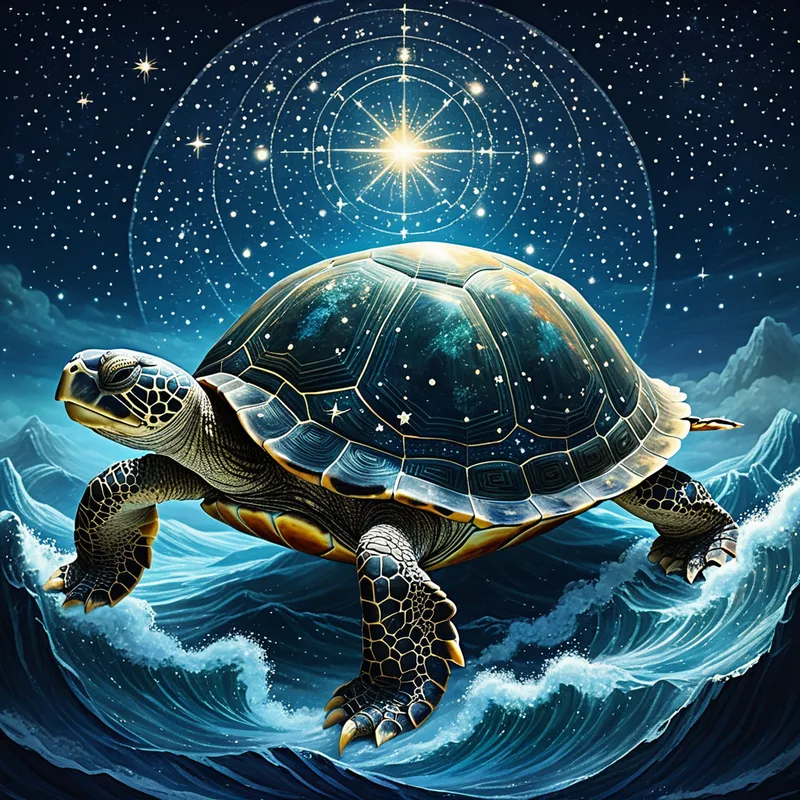
The celestial turtle who sacrificed its legs to hold up the heavens, becoming the enduring pillar of the world and the foundation of all order.
The Tale of The Turtle
In the time before time, when the breath of [Hundun](/myths/hundun “Myth from Chinese culture.”/) still swirled, [the world](/myths/the-world “Myth from Tarot culture.”/) was not yet fixed. [The sky](/myths/the-sky “Myth from Persian culture.”/), a dome of polished jade, rested upon four majestic pillars at the corners of [the earth](/myths/the-earth “Myth from Hindu culture.”/). But these pillars were not stone; they were the legs of the great cosmic beast, Ao. For eons, Ao swam through the formless waters of pre-creation, its slow, deliberate strokes the only rhythm in the silence.
Then came the war. The [water](/myths/water “Myth from Chinese culture.”/) god Gong Gong, in a rage of pride and defeat, smashed his head against the pillar of the northwest, the mountain Buzhou Shan. The sound was a crack that split eternity. The pillar shattered. The smooth jade sky tore, and stars began to weep fiery tears. The earth tilted, rivers poured backward, and fires raced across the plains. The heavens themselves began to sag, groaning toward the broken earth, threatening to crush all that was and would be.
Panic swept through the fledgling world. The newly formed creatures hid, and even the gods despaired. The fabric of order was unraveling, returning to the hungry maw of chaos. In this moment of cosmic crisis, the eyes of all turned to the one being whose nature was the opposite of rage, whose essence was steadfastness.
From the depths of the eastern sea, Ao emerged. Its shell was a continent, mossy with the ages, etched with the patterns of the first rivers and the earliest mountains. It did not roar or rush. With a silence more profound than [the void](/myths/the-void “Myth from Buddhist culture.”/), it swam to the place of the catastrophe. It looked upon the sagging sky, the three trembling remaining pillars, and the gaping wound in the northwest.
Without a word, without a plea for glory, the great turtle positioned its colossal body beneath the failing heavens. Then, with a movement of ultimate sacrifice, it drew its four mighty legs close to its shell. It did not break them; it offered them. It lifted, and lifted, and lifted. Each leg became a new, living pillar—warm, strong, and rooted in the turtle’s own enduring spirit. The groaning ceased. The sky settled, firm once more upon this living foundation. The turtle did not move again. It became the foundation. Its shell bore the weight of the heavens; its body became [the anchor](/myths/the-anchor “Myth from Christian culture.”/) of the earth. The world was saved, not by force, but by an act of silent, eternal bearing.

Cultural Origins & Context
This myth, part of the grand narrative of world repair following the Gong Gong catastrophe, is woven from threads found in early Chinese texts like the Shan Hai Jing (Classic of Mountains and Seas) and later philosophical compilations. It is not a single, standardized tale but a powerful motif that evolved within a cosmology deeply concerned with balance, stability, and the relationship between heaven and earth.
The turtle (gui) held immense cultural capital. Its shell was used for the earliest forms of divination (pyromancy), making it a direct conduit to ancestral wisdom and cosmic will. Its longevity made it a symbol of endurance, and its shape—a domed carapace over a flat plastron—mirrored the Chinese view of the cosmos: the round heaven over the flat, square earth. This myth gave that symbolism a divine, foundational story. It was likely told by shamans and philosophers to explain the very structure of reality and to model the supreme virtue of cheng, or steadfast sincerity—the quality of being an unmovable, reliable foundation for the community and the cosmic order itself.
Symbolic Architecture
The [turtle](/symbols/turtle “Symbol: The turtle symbolizes wisdom, longevity, and the importance of taking one’s time.”/) in this myth is the ultimate [symbol](/symbols/symbol “Symbol: A symbol can represent an idea, concept, or belief, serving as a powerful tool for communication and understanding.”/) of the [axis](/symbols/axis “Symbol: A central line or principle around which things revolve, representing stability, orientation, and the fundamental structure of reality or consciousness.”/) mundi, the world axis, but with a profoundly somatic twist. It is not an inert [pole](/symbols/pole “Symbol: A pole in dreams often symbolizes stability, support, or a point of reference in life.”/) but a living, suffering, enduring being that becomes [structure](/symbols/structure “Symbol: Structure in dreams often symbolizes stability, organization, and the framework of one’s life, reflecting how one perceives their environment and personal life.”/) through sacrifice.
The foundation of the world is not rock, but resolve. The support for the heavens is not a pillar, but a prolonged, conscious bearing.
Its four [legs](/symbols/legs “Symbol: Legs in dreams often symbolize movement, freedom, and the ability to progress in life, representing both physical and emotional support.”/), sacrificed to become the four pillars, represent the relinquishment of personal mobility for collective [stability](/symbols/stability “Symbol: A state of firmness, balance, and resistance to change, often represented by solid objects, foundations, or steady tools.”/). Psychologically, this maps to [the ego](/myths/the-ego “Myth from Jungian culture.”/)’s necessary sacrifice—giving up its “four [legs](/symbols/legs “Symbol: Legs in dreams often symbolize movement, freedom, and the ability to progress in life, representing both physical and emotional support.”/)” of autonomous wandering, defensiveness, grasping, and fleeing—to serve a larger, transpersonal order, [the Self](/myths/the-self “Myth from Jungian culture.”/). The [shell](/symbols/shell “Symbol: Shells are often seen as symbols of protection, transition, and the journey of personal growth.”/) is the perfected, resilient structure of the [psyche](/myths/psyche “Myth from Greek culture.”/) that can bear the immense [weight](/symbols/weight “Symbol: Weight symbolizes burdens, responsibilities, and emotional loads one carries in life.”/) of [consciousness](/symbols/consciousness “Symbol: Consciousness represents the state of awareness and perception, encompassing thoughts, feelings, and experiences.”/) (the heavens) and the complexities of embodied [life](/symbols/life “Symbol: The symbol of ‘Life’ represents a journey of growth, interconnectedness, and existential meaning, encompassing both the joys and challenges that define human experience.”/) (the [earth](/symbols/earth “Symbol: The symbol of Earth often represents grounding, stability, and the physical realm, embodying a connection to nature and the innate support it provides.”/)). The turtle does not fight the chaotic [dragon](/symbols/dragon “Symbol: Dragons are potent symbols of power, wisdom, and transformation, often embodying the duality of creation and destruction.”/) [Gong](/symbols/gong “Symbol: A ceremonial percussion instrument symbolizing transitions, announcements, and spiritual awakening across cultures.”/) Gong; it responds to [the dragon](/myths/the-dragon “Myth from Chinese culture.”/)’s [chaos](/symbols/chaos “Symbol: In Arts & Music, chaos represents raw creative potential, uncontrolled expression, and the breakdown of order to forge new artistic forms.”/) by becoming its opposite: perfect, patient order.
Furthermore, the turtle embodies the union of opposites: it is of the [water](/symbols/water “Symbol: Water symbolizes the subconscious mind, emotions, and the flow of life, representing both cleansing and creation.”/) (the unconscious, the formless) yet supports the heavens ([spirit](/symbols/spirit “Symbol: Spirit symbolizes the essence of life, vitality, and the spiritual journey of the individual.”/), consciousness). It is the [creature](/symbols/creature “Symbol: Creatures in dreams often symbolize instincts, primal urges, and the unknown aspects of the psyche.”/) that bridges the [depths](/symbols/depths “Symbol: Represents the subconscious, hidden emotions, or foundational aspects of the self, often linked to primal fears or profound truths.”/) and the [heights](/symbols/heights “Symbol: Represents ambition, fear, or spiritual elevation. Often symbolizes life challenges or a desire for perspective.”/), making the [connection](/symbols/connection “Symbol: Connection symbolizes relationships, communication, and bonds among individuals.”/) between them stable and enduring.
The Dreamer’s Resonance
When this myth stirs in the modern unconscious, it often manifests in dreams of immense, crushing weight. One may dream of holding up a collapsing ceiling, carrying a mountain on one’s back, or feeling one’s own bones transform into stone pillars. Somatic sensations upon waking—a stiff back, a feeling of being pressed down, profound fatigue—are the body echoing the myth.
This is not merely a dream of stress. It is the psyche’s profound enactment of the “foundation-making” process. The dreamer is at a point where some personal “pillar” has been shattered—a foundational belief, a relationship, a career path, a sense of identity (the Gong Gong rage). The chaotic waters of the unconscious are threatening to flood in. The dream of bearing weight signifies the psyche mobilizing its deepest, most ancient resources—the turtle archetype—to undergo the alchemy of becoming one’s own foundation. The ego is being asked to sacrifice its familiar modes of operation (the legs) to serve a greater structural integrity of the whole personality. The pain is the pain of metamorphosis from a creature that moves through life to one that holds life together.
Alchemical Translation
The individuation process modeled here is not one of heroic conquest, but of foundational endurance. The modern seeker’s “Gong Gong moment” is any shattering event that reveals the flimsiness of our personally-constructed heavens—our ideals, our spiritual aspirations, our sense of how life “should” be. When they come crashing down, the instinct is to rage, to flee, or to despair.
The turtle’s path is the alternative: the alchemical opus of holding. The first step is to withdraw from the fray, to retreat into the “deep waters” of introspection (the turtle submerging). The second is the critical, conscious sacrifice: What “legs” must I give up? Perhaps the leg of constant approval-seeking, of frantic productivity, of intellectual arrogance, or of spiritual bypassing? These are offered up, not destroyed, but transmuted into stable supports.
The ultimate alchemy is when the burden one bears ceases to be a weight and becomes one’s own skeletal truth, the very architecture of the soul.
Finally, one emerges not as a different person, but as a grounded person. The shell—the boundary between self and world, forged in patience—becomes strong enough to bear the tensions of existence. One becomes the living interface between the celestial dreams of the spirit and the terrestrial realities of the body and society. The reward is not freedom from weight, but the profound, unshakeable stability that comes from knowing you are, yourself, [the sacred vessel](/myths/the-sacred-vessel “Myth from Various culture.”/) upon which your world rests. You have become both the map (the shell’s patterns) and the territory, the enduring foundation in a universe of flux.
Associated Symbols
Explore related symbols from the CaleaDream lexicon: