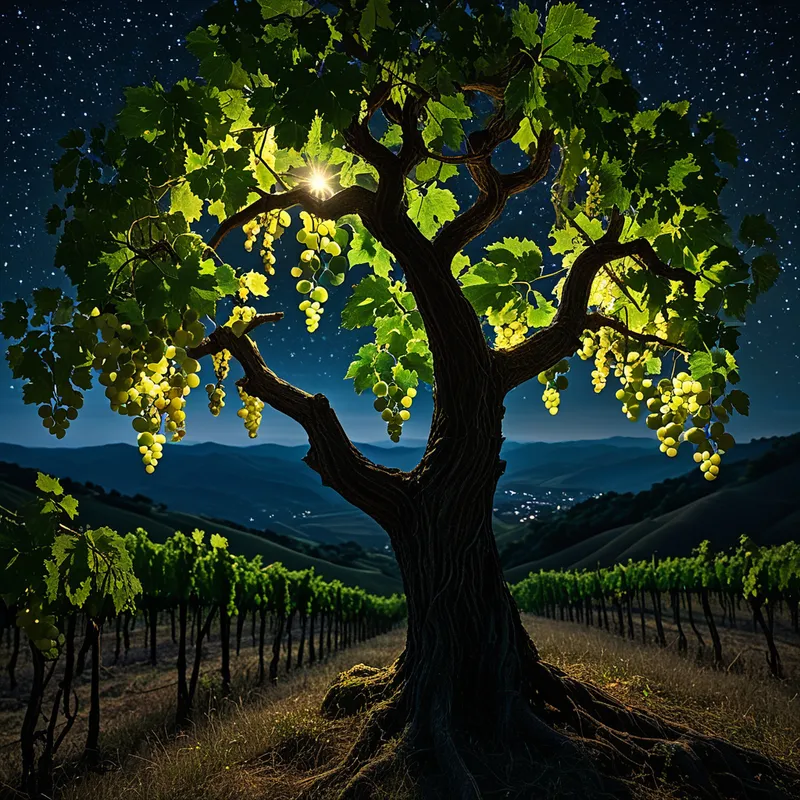
The True Vine Myth Meaning & Symbolism
A parable of divine union where the vine is the source, the branches are the people, and the fruit is the life born of abiding connection.
The Tale of The True Vine
Listen. The air is thick with the scent of crushed herbs and old stone, the last light of a dying sun painting the [upper room](/myths/upper-room “Myth from Biblical culture.”/) in long, sorrowful shadows. He speaks, and his voice is the sound of deep roots moving in [the earth](/myths/the-earth “Myth from Hindu culture.”/). The hour is upon him, the cup of bitterness waits, and yet his words are not of ending, but of a beginning so vast it swallows the coming darkness.
“I am,” he says, and the declaration hangs in the air like a ripe fruit, “the True Vine.”
See it in your mind’s eye. Not a frail tendril, but an ancient, gnarled trunk, its heartwood older than time, planted by the hand of the Husbandman. Its roots drink from the secret springs beneath [the world](/myths/the-world “Myth from Tarot culture.”/). From this one source, life pours forth—not a trickle, but a torrent—into every branch that is part of its being.
“You,” he continues, his gaze resting on each troubled face, “are the branches.”
Feel the truth of it. You are not separate shrubs, struggling alone in rocky soil. You are an extension of the Vine itself, its very life-sap—its [pneuma](/myths/pneuma “Myth from Greek culture.”/)—coursing through your fibers. To be cut off is to wither into mere kindling, fit only for the fire. But to abide? To abide is to know a union so complete it defies separation. “Abide in me, and I in you. As the branch cannot bear fruit by itself, unless it abides in the vine, neither can you, unless you abide in me.”
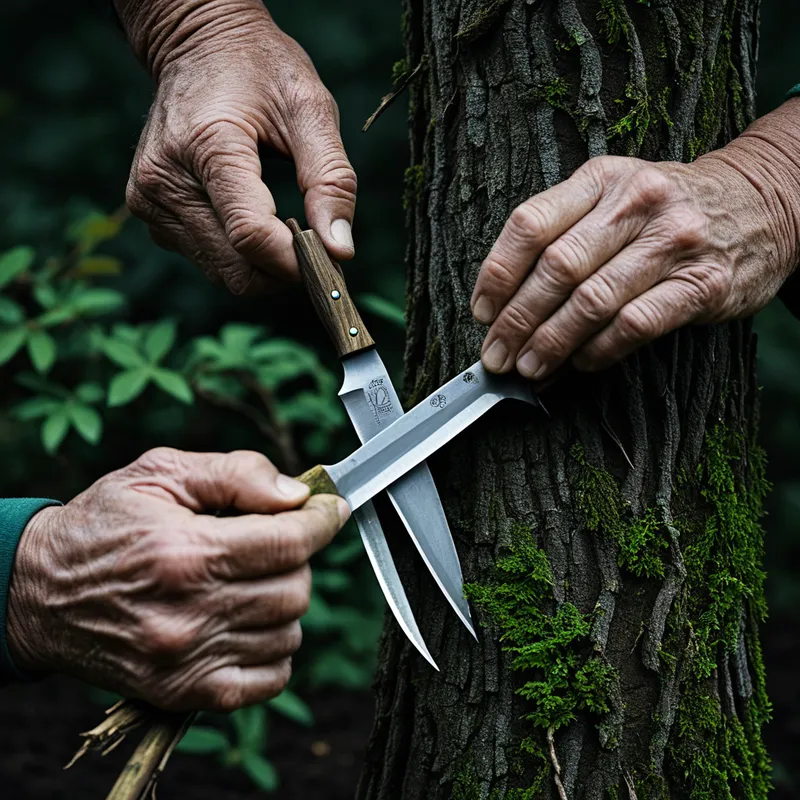
But here is the mystery, the sharp turn in the tale. The Husbandman is not a passive observer. He walks the rows with a keen eye and a sharp blade. He lifts a branch, heavy with leaf but barren of fruit. There is no condemnation in his touch, only a terrible, loving necessity. The knife flashes. The branch falls. It is a severing that is not an end, but a surgery of the soul. The fruitful branches he prunes—not to harm, but to make them bear more abundantly. The pain of the cut is the promise of greater life.
And what is this fruit? It is not mere obedience or correct belief. It is the inevitable, fragrant yield of a branch utterly surrendered to the Vine’s life: love, a love so potent it would lay down its own life for its friends. This is the final, shocking flourish of the myth. The life of the Vine is a life given, poured out, so that the branches might live. The sap is sacrifice. The fruit is love born from death.
The story ends not with a conclusion, but with an invitation hanging in the hushed air: “Abide.” [The dark night of the soul](/myths/the-dark-night-of-the-soul “Myth from Christian Mysticism culture.”/) approaches, but the Vine stands, an eternal fact in a temporal world.
Cultural Origins & Context
This myth originates not from a distant, fog-shrouded antiquity, but from a specific, tense moment in 1st-century Judea, recorded in the Gospel of John. It is part of the Farewell Discourse, a poignant, intimate sermon delivered on the eve of crucifixion. The audience was a small band of followers, about to be plunged into terror and disillusionment.
The storyteller was, according to tradition, John the Beloved, who frames the entire narrative with a [Logos](/myths/logos “Myth from Christian culture.”/)-centered theology. The vine was a powerful cultural symbol. For Jewish listeners, it evoked the Song of the Vineyard in [Isaiah](/myths/isaiah “Myth from Abrahamic culture.”/), a symbol of Israel herself, often chastised for producing wild grapes. By declaring himself the True Vine, the narrative makes a profound theological claim: the ultimate source of covenantal life and identity is now centered in his person, not merely in a national institution.
Its societal function was one of re-orientation and sustenance for a nascent community facing persecution. It was a myth for a diaspora in the making, teaching that their life, identity, and productivity were not rooted in a temple or a land, but in an unbreakable, spiritual connection to a living source. It was passed down orally within house churches before being codified, a story to be whispered and remembered when the world seemed intent on pruning them away.
Symbolic Architecture
At its core, this is a myth about the metaphysics of [connection](/symbols/connection “Symbol: Connection symbolizes relationships, communication, and bonds among individuals.”/). The [Vine](/symbols/vine “Symbol: Represents connection, growth, entanglement, or suffocation. Often symbolizes relationships, life force, or binding emotions.”/) is not a [symbol](/symbols/symbol “Symbol: A symbol can represent an idea, concept, or belief, serving as a powerful tool for communication and understanding.”/) of [hierarchy](/symbols/hierarchy “Symbol: A structured system of ranking or authority, often representing social order, power dynamics, and one’s position within groups or institutions.”/) but of radical, organic interdependence.
The self is not a fortress, but a branch. Its strength is not in its isolation, but in its connection to a source beyond itself.
The Husbandman represents the transcendent, structuring principle of [reality](/symbols/reality “Symbol: Reality signifies the state of existence and perception, often reflecting one’s understanding of truth and life experiences.”/)—[the Self](/myths/the-self “Myth from Jungian culture.”/), in Jungian terms—which is concerned with the totality of the [psyche](/myths/psyche “Myth from Greek culture.”/), not the comfort of [the ego](/myths/the-ego “Myth from Jungian culture.”/). His pruning is the archetypal process of nekrosis, the necessary [death](/symbols/death “Symbol: Symbolizes transformation, endings, and new beginnings; often associated with fear of the unknown.”/) of what is sterile, inflated, or non-essential in our [personality](/symbols/personality “Symbol: Personality in dreams often symbolizes the traits and characteristics of the dreamer, reflecting how they perceive themselves and how they believe they are perceived by others.”/). It is the withdrawal of psychic [energy](/symbols/energy “Symbol: Energy symbolizes vitality, motivation, and the drive that fuels actions and ambitions.”/) from outdated complexes, a painful but purposeful narrowing of focus to encourage [depth](/symbols/depth “Symbol: Represents profound layers of consciousness, hidden truths, or the unknown aspects of existence, often symbolizing introspection and existential exploration.”/) and [fertility](/symbols/fertility “Symbol: Symbolizes creation, growth, and abundance, often representing new beginnings, potential, and life force.”/).
The “[fruit](/symbols/fruit “Symbol: Fruit symbolizes abundance, nourishment, and the fruits of one’s labor in dreams.”/)” is the symbol of authentic, embodied [life](/symbols/life “Symbol: The symbol of ‘Life’ represents a journey of growth, interconnectedness, and existential meaning, encompassing both the joys and challenges that define human experience.”/)—the tangible manifestation of inner transformation. It is not efforted [virtue](/symbols/virtue “Symbol: A moral excellence or quality considered good, often representing inner character, ethical principles, or spiritual ideals in dreams.”/), but the natural produce of a psyche in right [relationship](/symbols/relationship “Symbol: A representation of connections we have with others in our lives, often reflecting our emotional state.”/) with its [depths](/symbols/depths “Symbol: Represents the subconscious, hidden emotions, or foundational aspects of the self, often linked to primal fears or profound truths.”/). Conversely, the “fire” for the barren branches symbolizes the [fate](/symbols/fate “Symbol: Fate represents the belief in predetermined outcomes, suggesting that some aspects of life are beyond human control.”/) of psychic energy that remains trapped in sterile, ego-centric patterns: it becomes a self-consuming, destructive force.
The supreme symbol is abiding (Greek: menō). This is not passive waiting, but active, conscious, and sustained connection—the practice of remaining in alignment with the deep, nourishing currents of the unconscious Self.
The Dreamer’s Resonance
When this myth stirs in the modern unconscious, it often manifests in dreams of profound connection or terrifying severance. A dreamer might find themselves as a tree with roots drinking from an underground river, or conversely, as a potted plant whose roots are bound and dying, desperate for true soil.
To dream of being pruned—of having a limb cleanly cut away—often coincides with a life transition where an identity, a relationship, or a career is being forcibly shed. The somatic sensation upon waking can be one of phantom limb pain mixed with a strange lightness. This is the psyche processing the Husbandman’s work. The ego experiences it as loss; the deeper Self knows it as liberation for growth.
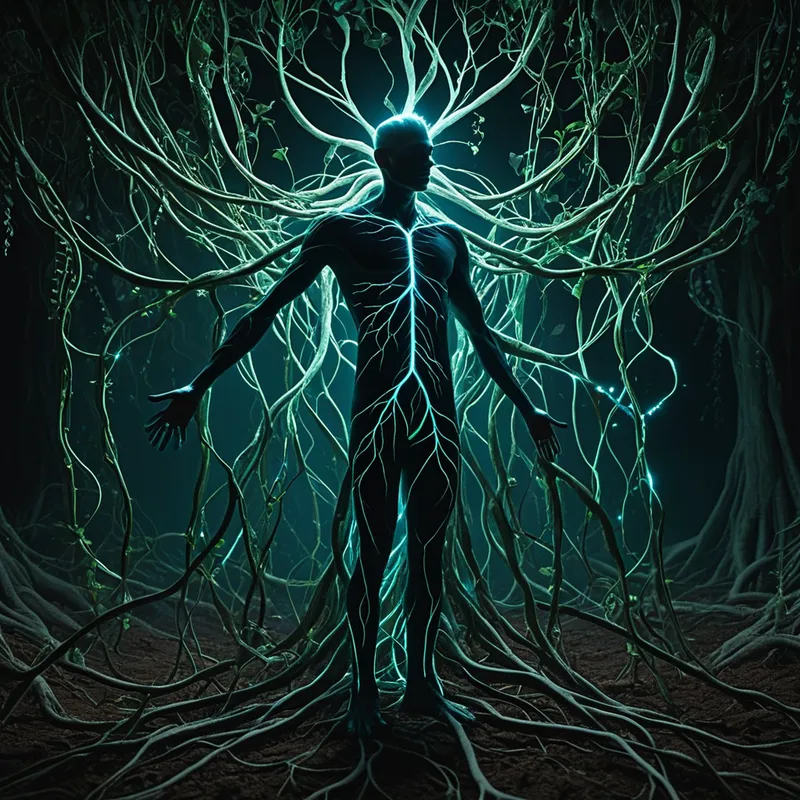
Dreams of bearing strange, luminous fruit, or of sap like golden light rising within one’s veins, signal a period of creative or spiritual fertility emerging from a period of abiding—perhaps after a depression or a quiet, introspective phase. The myth reassures the dreamer that the painful cut was not an arbitrary punishment, but part of a cultivation process aiming for this very yield.
Alchemical Translation
The alchemical journey mirrored here is that of [separatio](/myths/separatio “Myth from Alchemical culture.”/) followed by coniunctio—separation for the sake of a higher union. The initial state is one of assumed, but perhaps superficial, connection. The first operation is the shocking separatio of the pruning knife, which severs the ego’s attachment to its barren, performative, or rigid aspects.
The crucible of individuation is not fueled by the ego’s ambitions, but by the slow, sacrificial sap of the Vine—the willing descent of consciousness into the nourishing darkness of the source.
This forced separation creates the [solutio](/myths/solutio “Myth from Alchemical culture.”/)—a dissolution of old forms, a feeling of being cut adrift. The critical work is the abi, the abiding. This is the alchemical mortificatio and [putrefactio](/myths/putrefactio “Myth from Alchemical culture.”/) endured not in resistance, but in patient, trusting surrender to the process. The ego learns to “remain” in the Vine, to draw its sense of being not from its own productions, but from the nourishing flow of the Self.
The final stage is the coniunctio, [the sacred marriage](/myths/the-sacred-marriage “Myth from Various culture.”/). The branch no longer struggles for the Vine but exists as the Vine. Its fruit—the integrated personality, love, wisdom, creativity—is the [lapis philosophorum](/myths/lapis-philosophorum “Myth from Alchemical culture.”/), the philosopher’s stone. It is the proof of the transmutation. The individual life becomes a transparent vessel for the life of the greater Whole. The myth thus maps the path from ego-centric isolation to a participation in a reality that is both profoundly personal and cosmically vast—a journey of becoming truly, and fully, alive.
Associated Symbols
Explore related symbols from the CaleaDream lexicon: