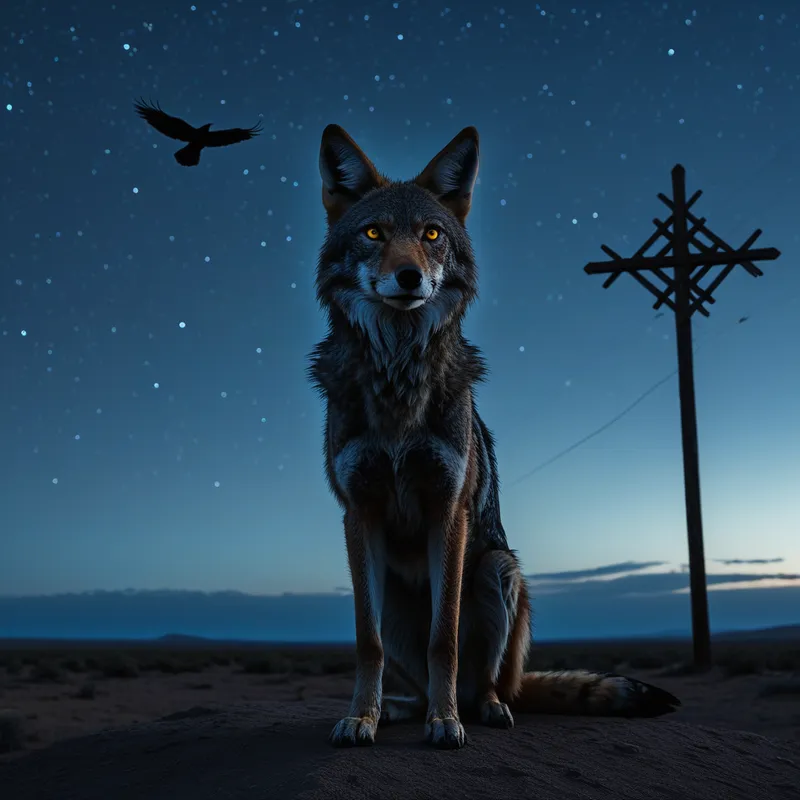
The Trickster-Animal Myth Meaning & Symbolism
A shape-shifting, rule-breaking figure from world folklore who steals fire, tricks gods, and creates the world through cunning chaos.
The Tale of The Trickster-Animal
In the time before time, when [the world](/myths/the-world “Myth from Tarot culture.”/) was soft and unformed, the great beings had finished their work and rested. Order was established, the first laws set in stone. But the world was dark, and cold, and predictable. It lacked the spark of the unexpected, the vital crack in the monotony. It was then, from the edges of the known, from the thicket and the dust, that they came.
You would hear them first—a rustle where no wind blew, a chuckle from [the shadow](/myths/the-shadow “Myth from Jungian culture.”/) of a rock. Sometimes they wore the shape of Coyote, with lolling tongue and eyes full of knowing mischief. Other times, they were [Raven](/myths/raven “Myth from Haida culture.”/), black feathers drinking the light, a thief with a purpose. Or perhaps they were Anansi, eight legs weaving plans as deftly as webs.
The great ones hoarded the fire, keeping it for themselves in a high lodge or a secret bundle. They commanded the waters, hid the stories, and declared how things must forever be. But [the Trickster](/myths/the-trickster “Myth from Various culture.”/)-Animal looked upon this static world and found it… boring. And in that boredom was a kind of sacred hunger.
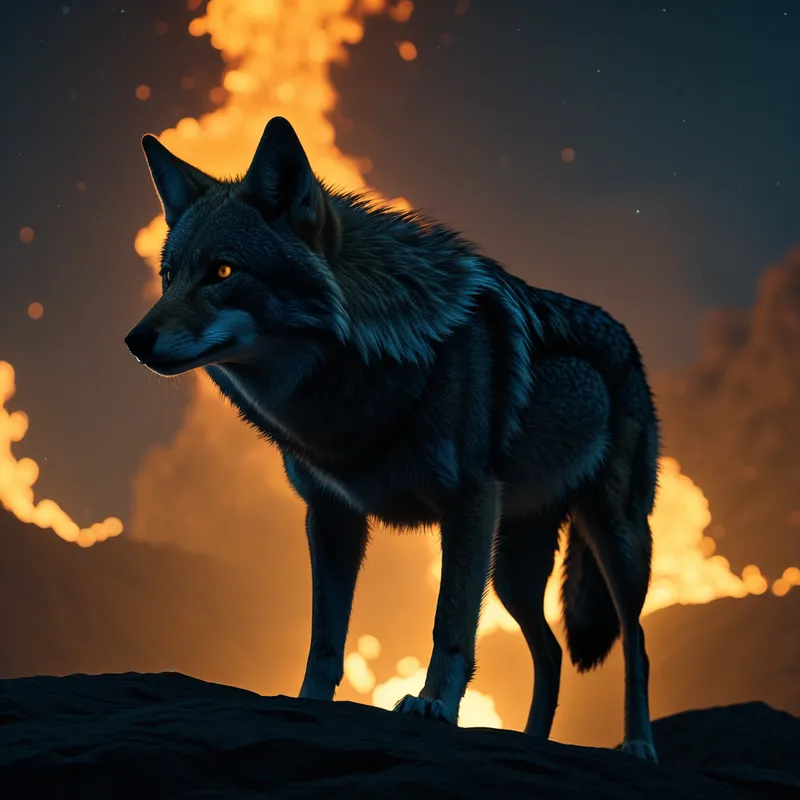
So, they began to play. They pretended to be foolish, tripping over their own feet, singing ridiculous songs. They flattered the guardians, offered them foolish gifts. While the mighty ones were distracted by the absurd spectacle, a quick paw darted in, a beak snatched, a thread was pulled. [The sacred fire](/myths/the-sacred-fire “Myth from Native American culture.”/) was stolen, not through brute force, but through a joke that turned into a diversion. The waters were released not by command, but because the Trickster-Animal tricked a giant into laughing so hard he spilled the [water](/myths/water “Myth from Chinese culture.”/) jar.
Chaos erupted. The world was scorched by the runaway fire, flooded by the spilled waters. The great ones roared in fury, chasing the laughing shadow through the newborn landscapes. But in the wake of this glorious mess, something new happened. The fire warmed the people in their caves. The waters filled the rivers and gave life. The broken rules left spaces where new things could grow—corn from a stolen seed, the first stories from a won contest, the very stars sometimes scattered from a spilled bag.
The tale always ends with the Trickster-Animal escaping, but changed. Perhaps they lose their beautiful fur to the flames, or are forced to forever walk awkwardly. They are wounded by the very chaos they unleashed, but they do not regret it. They slink back to the edge of the village, the border of the forest, forever outside the order they irrevocably altered, carrying the smell of smoke and the echo of laughter.
Cultural Origins & Context
The Trickster-Animal is not a myth of a single culture, but a psychic fingerprint found on every continent. This figure thrives in oral traditions, told around fires by elders not to preach morality, but to explain the inexplicable texture of reality. In North America, the stories of Coyote or Raven were (and are) told by countless Indigenous nations to account for the world’s imperfections, its humor, and its inherent unpredictability. In West Africa, Anansi stories traveled the [Middle Passage](/myths/middle-passage “Myth from African Diaspora culture.”/), transforming and surviving in the Caribbean and the Americas as a vessel of cultural memory and subversive wisdom under oppression.
These stories were not for children alone, though children heard them. They were societal pressure valves. The Trickster-Animal acted out the repressed desires of the community—to defy authority, to seize what was withheld, to break taboos. By laughing at the Trickster’s antics and their often-comeuppance, the community safely explored the boundaries of its own social order. The storyteller, channeling the Trickster, became a temporary agent of chaos, reminding everyone that the established order was not divine and eternal, but contingent and human.
Symbolic Architecture
Psychologically, the [Trickster](/symbols/trickster “Symbol: A boundary-crossing archetype representing chaos, transformation, and the subversion of norms through cunning and humor.”/)-Animal is the archetypal embodiment of the unconscious [shadow](/symbols/shadow “Symbol: The ‘shadow’ embodies the unconscious, repressed aspects of the self and often represents fears or hidden emotions.”/) in its most creative, disruptive form. It represents all that is suppressed by the conscious ego’s need for control, predictability, and propriety: raw instinct, uncensored desire, amoral curiosity, and radical freedom.
The Trickster does not destroy the world to end it, but to crack its shell so that a new, more complex world may be born. It is the necessary chaos before creation.
Its animal form signifies its rootedness in the primal, pre-rational [psyche](/myths/psyche “Myth from Greek culture.”/). Its tricks are not mere mischief, but alchemical operations. Theft becomes procurement for the [community](/symbols/community “Symbol: Community in dreams symbolizes connection, support, and the need for belonging.”/). Lies become the creation of new narratives. Taboo-breaking becomes the [expansion](/symbols/expansion “Symbol: A symbol of growth, increase, or extension beyond current boundaries, often representing personal development, opportunity, or overwhelming change.”/) of what is possible. The Trickster is the ultimate [shape-shifter](/myths/shape-shifter “Myth from Native American culture.”/) because [consciousness](/symbols/consciousness “Symbol: Consciousness represents the state of awareness and perception, encompassing thoughts, feelings, and experiences.”/) cannot pin down the fluid, contradictory [nature](/symbols/nature “Symbol: Nature symbolizes growth, connectivity, and the primal forces of existence.”/) of the unconscious. It is both culture [hero](/symbols/hero “Symbol: A hero embodies strength, courage, and the ability to overcome significant challenges.”/) and buffoon, [creator](/symbols/creator “Symbol: A figure representing ultimate origin, divine power, or profound authorship. Often embodies the source of existence, innovation, or personal destiny.”/) and [destroyer](/symbols/destroyer “Symbol: A figure or force representing radical change through dismantling existing structures, often evoking fear and awe.”/), because the unconscious is the [source](/symbols/source “Symbol: The origin point of something, often representing beginnings, nourishment, or the fundamental cause behind phenomena.”/) of both our highest art and our most primal urges.
The Dreamer’s Resonance
When the Trickster-Animal pads into our modern dreams, it signals a psyche straining against its own confines. To dream of a clever, chaotic animal causing disruptive, bewildering events is to experience the unconscious protesting a life that has become too rigid, too predictable, or too tightly controlled by the conscious [persona](/myths/persona “Myth from Greek culture.”/).
The somatic feeling is often one of frustrated energy—a laugh stuck in the throat, a limb twitching to move in a forbidden direction. Psychologically, it is the process of enantiodromia—the emergence of the unconscious opposite. The over-controlled executive dreams of the office being flooded by a trickster monkey. The overly serious academic dreams of a raven stealing their meticulously written notes and replacing them with nonsensical, brilliant poetry. The Trickster-dream does not come to comfort, but to destabilize, forcing the dreamer to confront the sterile order they have imposed and the vital, messy creativity they have exiled.
Alchemical Translation
For the individual on the path of individuation, the myth of the Trickster-Animal models the essential, terrifying stage of dissolution. The conscious ego, like the mythic “great ones,” builds a stable, orderly world—a personality, a career, an identity. But this structure can become a prison, cutting us off from the transformative powers of the unconscious.
The Trickster’s intervention represents the involuntary eruption of the shadow. A midlife crisis, a sudden creative burst that dismantles old habits, a humiliating failure that breaks a cherished self-image—these are the modern “tricks.” They steal the fire of our comfortable illusions and flood the ordered landscape of our lives with chaotic, unknown potential.
The goal is not to become the Trickster, but to endure its lesson: to hold the tension between the ego’s order and the shadow’s chaos until a third, more resilient consciousness is forged.
The alchemical work is to not simply repair the old order in a panic, but to sift through the wreckage for what the Trickster has brought: the stolen fire of authentic passion, the released waters of emotion, the new stories born from broken old ones. We integrate the Trickster not by acting out impulsively, but by acknowledging the part of us that is bored by our own perfection, that hungers for the unpredictable, and that knows true creation is always, necessarily, a little bit lawless. The wound the Trickster receives—the singed fur, the limp—becomes our own earned wisdom, the scar that reminds us we are larger, stranger, and more capable of transformation than our orderly self ever dared believe.
Associated Symbols
Explore related symbols from the CaleaDream lexicon: