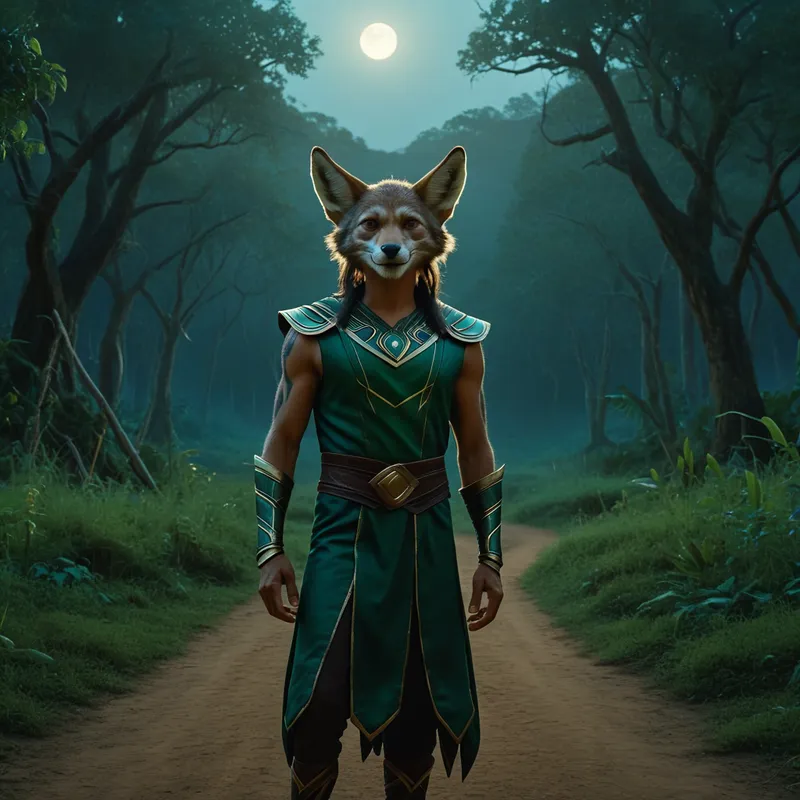
The Trickster Myth Meaning & Symbolism
A boundary-breaking, shape-shifting force of chaos and creation, the Trickster disrupts order to reveal deeper truths and catalyze necessary change.
The Tale of The Trickster
In the time before time was fixed, when [the world](/myths/the-world “Myth from Tarot culture.”/) was soft and the rules were still being written, there walked a figure on the edge of the firelight. He was not a god of the high throne, nor a spirit of the deep earth, but something that slipped between. Some knew him as the one with the Coyote grin, whose laughter cracked like dry brush. Others whispered of the Loki who walked in Asgard’s halls, his smile a blade sheathed in wit. Across [the sea](/myths/the-sea “Myth from Greek culture.”/), in the heat where stories are spun, he was Anansi, small and many-legged, weaving plans in the dark.
The world then was orderly, but brittle. The gods had decreed, the chiefs had ruled, and the people moved in their set paths, their eyes on the ground. The sun rose and set by command; [the river](/myths/the-river “Myth from Buddhist culture.”/) flowed only in its bed. There was a great, silent tension in this perfection, a hunger unspoken.
And so the Trickster came to the village at the center of the world. He saw the people, their lives measured in safe, dull increments. He saw the Sky-King hoarding the storm clouds, keeping the rain for his own gardens. He saw the sacred drum, the heartbeat of the tribe, locked away, its sound only a memory for the elders.
He did not come with a sword, but with a question. He did not bring an army, but a joke.
First, he shifted his skin. One moment a weary traveler, the next a beautiful stranger, then a helpless animal caught in a snare. With each face, he learned a secret. With each lie, he uncovered a truth. He flattered the gatekeeper and slipped inside the walls. He spun a tale so compelling to [the Sky](/myths/the-sky “Myth from Persian culture.”/)-King’s cook that he was served the food of the gods themselves—and in doing so, he scattered the seeds of a forgotten fruit onto the mortal earth.
The conflict was not a battle, but a unraveling. The Trickster, caught in his own game, found the sacred drum. Not to worship it, but to play it. His rhythm was all wrong—syncopated, chaotic, irresistible. Feet that had only marched began to dance. Hearts that beat in time began to race. The perfect order trembled to its foundations.
The Sky-King roared, [the earth](/myths/the-earth “Myth from Hindu culture.”/) shook. The Trickster was seized, bound by unbreakable oaths. This was the price, the consequence. Yet, as they prepared a punishment to end all tricks, the people tasted the fruit that had grown from the scattered seeds. They remembered the wild rhythm. They looked at the unbending laws and saw, for the first time, that they could be otherwise.
The resolution was not the Trickster’s victory, nor his defeat. It was the crack in the world. Through it, rain fell on the parched fields of the common folk. Through it, laughter and music returned, now laced with the memory of chaos. The Trickster, often punished, eternally bound, had changed everything by breaking the one [thing](/myths/thing “Myth from Norse culture.”/) that seemed unbreakable: the illusion of a perfect, immutable order. He was gone, but his echo remained in every unexpected gift, every clever solution, and every rule that was ever questioned.

Cultural Origins & Context
The Trickster is not a myth of a single culture, but a psychic imprint found across the globe, from the Plains Nations to West Africa, from Scandinavia to Japan. This is not a case of cultural diffusion, but of parallel emergence. The figure arose wherever human communities solidified their norms, codified their hierarchies, and established their sacred laws. The Trickster myth was the necessary counter-narrative.
In oral traditions, these stories were rarely told in solemn, ceremonial tones. They were the stories told around secondary fires, to the sound of stifled laughter and gasps of shock. They were the province of clever grandmothers, witty hunters, and rebellious youth. Their societal function was profoundly complex: they were a pressure valve for social tension, a tool for critiquing authority without direct insurrection, and a foundational lesson in critical thinking. By celebrating the figure who outsmarts the powerful, steals fire, or redistributes wealth, these myths embedded a deep-seated understanding that the established order is not divine, but constructed—and therefore, changeable.
Symbolic Architecture
Psychologically, the [Trickster](/symbols/trickster “Symbol: A boundary-crossing archetype representing chaos, transformation, and the subversion of norms through cunning and humor.”/) represents the raw, untamed force of the unconscious [psyche](/myths/psyche “Myth from Greek culture.”/) breaking into the conscious [realm](/symbols/realm “Symbol: The symbol of ‘Realm’ often signifies the boundaries of one’s consciousness, experiences, or emotional states, suggesting aspects of reality that are either explored or ignored.”/) of order, the [Persona](/symbols/persona “Symbol: The social mask or outward identity one presents to the world, often concealing the true self.”/), and [the ego](/myths/the-ego “Myth from Jungian culture.”/)’s need for control. He is the embodiment of the [Shadow](/symbols/shadow “Symbol: The ‘shadow’ embodies the unconscious, repressed aspects of the self and often represents fears or hidden emotions.”/), not in its purely dark [aspect](/symbols/aspect “Symbol: A distinct feature, quality, or perspective of something, often representing a partial view of a larger whole.”/), but in its [role](/symbols/role “Symbol: The concept of ‘role’ in dreams often reflects one’s identity or how individuals perceive their place within various social structures.”/) as the keeper of repressed vitality, instinct, and creativity.
The Trickster does not destroy the world; he shatters the world as we know it, to make room for the world as it could be.
His tools are deception, humor, and [chaos](/symbols/chaos “Symbol: In Arts & Music, chaos represents raw creative potential, uncontrolled expression, and the breakdown of order to forge new artistic forms.”/)—each a symbolic [instrument](/symbols/instrument “Symbol: An instrument symbolizes creativity, communication, and the means by which one expresses oneself or influences the world.”/). Deception here is not mere lying, but the [revelation](/symbols/revelation “Symbol: A sudden, profound disclosure of truth or insight, often through artistic or musical means, that transforms understanding.”/) that [reality](/symbols/reality “Symbol: Reality signifies the state of existence and perception, often reflecting one’s understanding of truth and life experiences.”/) is not as it seems. His humor is the cosmic joke that humbles the arrogant ego. His [chaos](/symbols/chaos “Symbol: In Arts & Music, chaos represents raw creative potential, uncontrolled expression, and the breakdown of order to forge new artistic forms.”/) is the fertile void from which new structures must be born. He operates at liminal spaces: [crossroads](/symbols/crossroads “Symbol: A powerful spiritual symbol representing a critical decision point where paths diverge, often associated with fate, transformation, and life-altering choices.”/), [dawn](/symbols/dawn “Symbol: The first light of day, symbolizing new beginnings, hope, and the transition from darkness to illumination.”/), the edge of the [village](/symbols/village “Symbol: Symbolizes community, connection, and a reflection of one’s roots or origins.”/). This is the symbolic locus of transformation, the point where one state of being passes into another.
The ultimate theft of the Trickster—be it fire, the [mead of poetry](/symbols/mead-of-poetry “Symbol: The Mead of Poetry is a mythical drink that inspires wisdom and creativity, associated with knowledge and poetic talent.”/), or the sun—is always the theft of a monopolized resource: [consciousness](/symbols/consciousness “Symbol: Consciousness represents the state of awareness and perception, encompassing thoughts, feelings, and experiences.”/), inspiration, or enlightenment, hoarded by a ruling power (be it god, chief, or the conscious ego). His act is one of radical redistribution, bringing the power of creation and destruction back into the realm of mortal, psychological experience.
The Dreamer’s Resonance
When the Trickster pattern erupts in modern dreams, it signals a profound somatic and psychological process: the ego’s rigid structures are being challenged from within. You do not dream of a wise sage offering counsel; you dream of a chaotic, laughing figure who turns your house upside down, who shows up to your important meeting in clown shoes, or who leads you down an alley that shouldn’t exist.
This is the psyche’s rebellion against a life that has become too predictable, too constrained, or too inauthentic. The somatic feeling upon waking is often a mix of anxiety and exhilaration—the body registering both the threat to stability and the thrill of potential energy being released. The Trickster in dreams exposes the “scams” we run on ourselves: the personas we’ve over-identified with, the rules we follow blindly, the sacred cows we refuse to question. He creates a beneficial crisis, forcing a cognitive dissonance so acute that adaptation becomes necessary.

Alchemical Translation
The journey of the Trickster myth is a direct map for the alchemical process of individuation—the psychic transmutation of [the self](/myths/the-self “Myth from Jungian culture.”/) from a state of unconscious identification with collective norms to a state of wholeness that includes the wild, creative, and amoral depths.
The myth begins with a stagnant order (the ego’s identified state). The Trickster’s entrance is the [nigredo](/myths/nigredo “Myth from Alchemical culture.”/), the blackening, the chaotic intrusion of [the shadow](/myths/the-shadow “Myth from Jungian culture.”/) that dissolves the old, rigid forms. His thefts and deceptions are the painful, often embarrassing process of bringing unconscious contents—our repressed cunning, our denied desires, our instinctual intelligence—into the light.
The binding of the Trickster is not his end, but his integration. The conscious ego must learn to contain, not eliminate, this chaotic force.
His subsequent punishment or binding represents the crucial phase of conjunction. The conscious mind (the gods, the society) must engage with this chaotic energy, struggle with it, and ultimately find a way to relate to it. We do not become the Trickster; we learn to harness his energy. The new fruit growing from scattered seeds is the albedo and [rubedo](/myths/rubedo “Myth from Alchemical culture.”/)—the whitening and reddening—the creation of a new conscious attitude that is more flexible, more creative, and more resilient because it has acknowledged and made peace with its own capacity for chaos.
For the modern individual, this translates to the courage to question one’s own most cherished beliefs, to humor the heretical thought, to break a personal “rule” in service of a deeper truth. It is the process by which a midlife crisis, if navigated with awareness, can become a creative rebirth, or a professional failure can unveil a more authentic path. The Trickster’s legacy is not anarchy, but a more fluid, authentic, and complete self, forged in the fires of necessary disruption.
Associated Symbols
Explore related symbols from the CaleaDream lexicon: