The Tree People Myth Meaning & Symbolism
An ancient myth of humans transformed into trees, embodying the soul's deep longing for rooted connection and the alchemy of sacrifice into enduring life.
The Tale of The Tree People
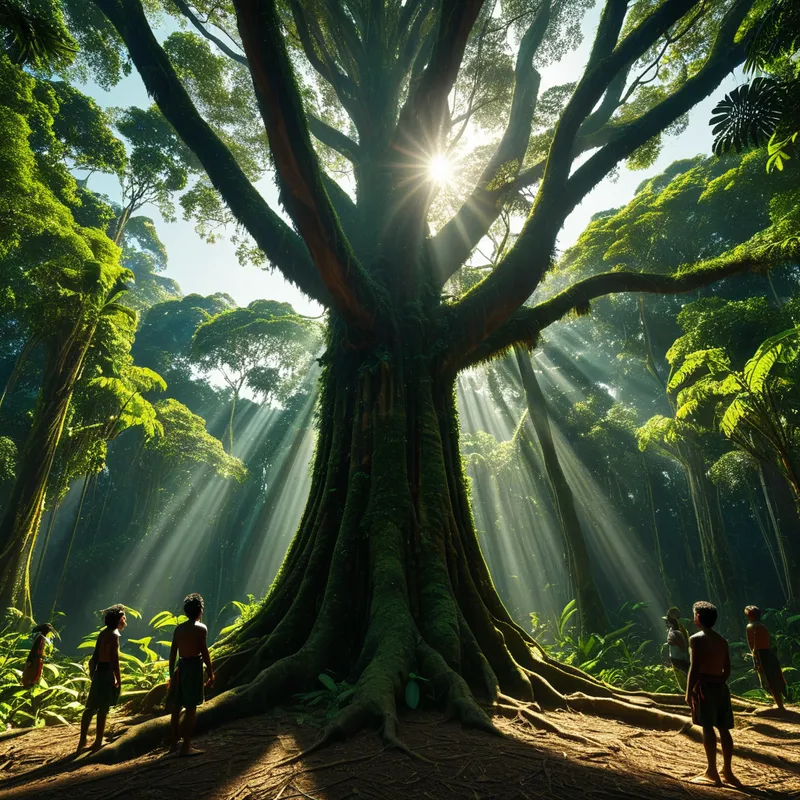
Listen. In the time before time, when the world was soft and the rivers sang their first songs, the people walked. They walked the forest floor, but their hearts were restless, like birds with no nest. They looked at the towering Kapok and the ancient Victoria Regia, and felt a hollow ache. “We are visitors here,” they whispered. “We touch the earth, but we do not belong to it.”
The great spirit, Maira, heard their longing. It was not a cry for food or shelter, but a deeper, more profound hunger—a hunger for connection so complete it would silence the restless heart. One evening, as the sun bled into the river and the first stars pricked the darkening canopy, Maira spoke. His voice was the rustle of ten thousand leaves.
“The forest offers you a choice,” the voice murmured on the wind. “You may continue to walk upon her, taking and moving on. Or you may become part of her breath, her bones, her very life. You may exchange your fleeting steps for an eternal embrace. But know this: the change is forever. You will feel the rain in a new way. You will know the sun and the darkness from a single, fixed point. You will be still.”
A great stillness fell upon the people. Some felt fear, a cold serpent coiling in their stomachs. They saw only the loss of motion, the end of their stories. But others—their eyes wide with a recognition older than memory—felt the hollow ache begin to fill with a strange, sweet certainty.
One by one, those who heard the call stepped forward. They did not march; they walked slowly to a clearing where the moonlight pooled like liquid silver. They placed their hands upon the dark soil. They did not dig, but rather, let their fingers relax, unclench from the need to grasp.
It began with a tingling, a warmth rising from the earth through their soles. It was not pain, but a profound and terrifying unraveling. Their skin, once soft and pliant, began to texture, to harden into patterns of bark. Their toes and fingers lengthened, stretched, branched into delicate twigs and seeking roots. Their hair became a cascade of leaves, tasting the air. Their final breath was not an exhalation, but a sigh that became the soft, eternal whisper of the canopy.
By morning, where people had stood, a new grove breathed. Their faces, serene and watchful, were visible in the knots and contours of the trunks. Their arms were strong branches, offering fruit and shelter. Their roots drank deeply from the same waters, intertwined below the surface in a hidden community. They were home.
Cultural Origins & Context
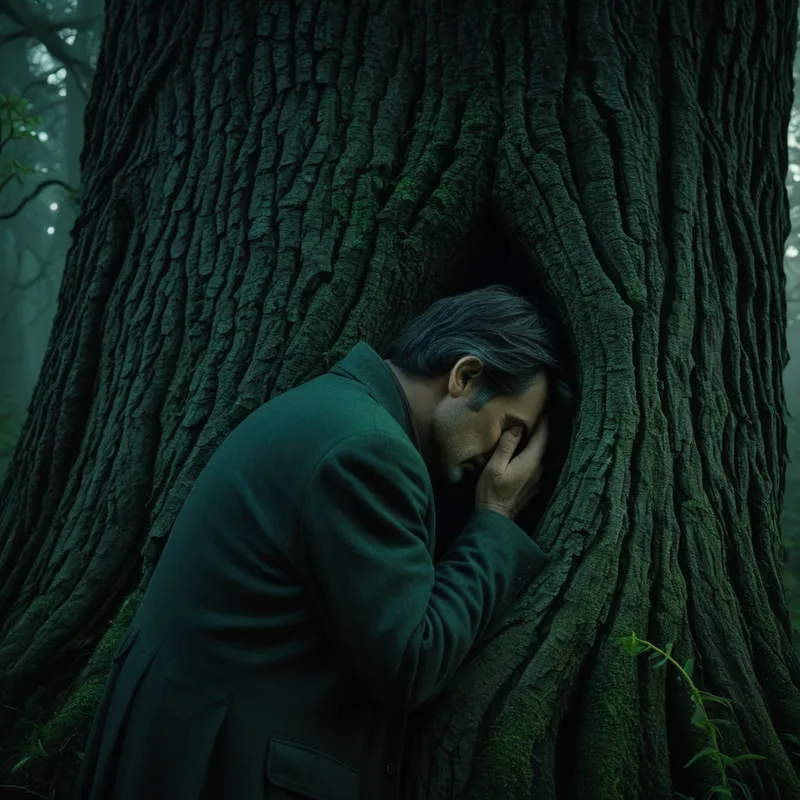
This myth, in its many variations, belongs to numerous Indigenous peoples of the Amazon basin, including the Desana, the Yanomami, and the Kayapó. It is not a story of a singular, historical event, but a foundational narrative explaining the relationship between humans and the more-than-human world. Traditionally told by elders and shamans (payés) during rites of passage or communal gatherings, its function was pedagogical and ontological.
It taught the ethics of reciprocity: humans are not masters of the forest, but potential kin to it. The myth provided a template for understanding sacrifice not as loss, but as metamorphosis into a more sustainable and connected form of existence. It answered the child’s question, “Why do the trees look like people?” with a story that wove humanity directly into the ecosystem’s fabric. The telling was often accompanied by specific rituals, songs, and the use of sacred plants, reinforcing the idea that the boundary between human and plant is permeable, a lesson vital for societies whose survival depended on profound botanical knowledge and respect.
Symbolic Architecture
At its core, the myth of The Tree People is a profound allegory for the psyche’s journey from a state of existential wandering to one of rooted being.
The ultimate sacrifice is not of life, but of separateness. To become the tree is to surrender the illusion of the isolated self and accept the vulnerability and strength of interconnection.
The restless walking people represent the modern, or perhaps eternal, human condition: the ego-consciousness that feels itself adrift, a thinking reed cut off from the nourishing mud. The Tree is the symbol of the Self in its complete, individuated form—grounded, vertical (connecting earth and sky), generative, and patient. The transformation is the alchemical process of individuation itself, where the conscious mind (ego) must consent to its own dissolution and reformation within a larger, unconscious pattern (the Self).
The Earth that warmly receives them is the primal, nurturing unconscious. The Rain and Sun they learn to feel in a new way are the affects and insights that nourish the newly configured psyche. The choice presented by Maira is the critical juncture in any deep psychological work: to continue in familiar suffering, or to submit to a terrifying, transformative process whose outcome is a more authentic state of being.

The Dreamer’s Resonance
When this myth stirs in the modern dreamer, it often manifests as dreams of radical transformation or immobilization within nature. One might dream of their feet becoming roots, anchoring them to a spot as a storm rages—a somatic expression of the psyche’s attempt to ground during a life crisis. Another might dream of tender green shoots sprouting from a Wound on their body, symbolizing the emergence of new, organic growth from a place of hurt.
These dreams signal a profound process of re-orientation. The somatic feeling is often one of heavy, sinking pressure (the rooting) followed by a paradoxical lightness or expansion (the branching). Psychologically, the dreamer is negotiating the death of an old identity—the “walking” identity of career, relationship, or self-image—that has become unsustainable. The dream is the unconscious offering the blueprint of the Tree as the new form. Resistance to the change in the dream mirrors resistance in waking life, often felt as anxiety, depression, or a sense of being stuck. The dream invites the surrender.
Alchemical Translation
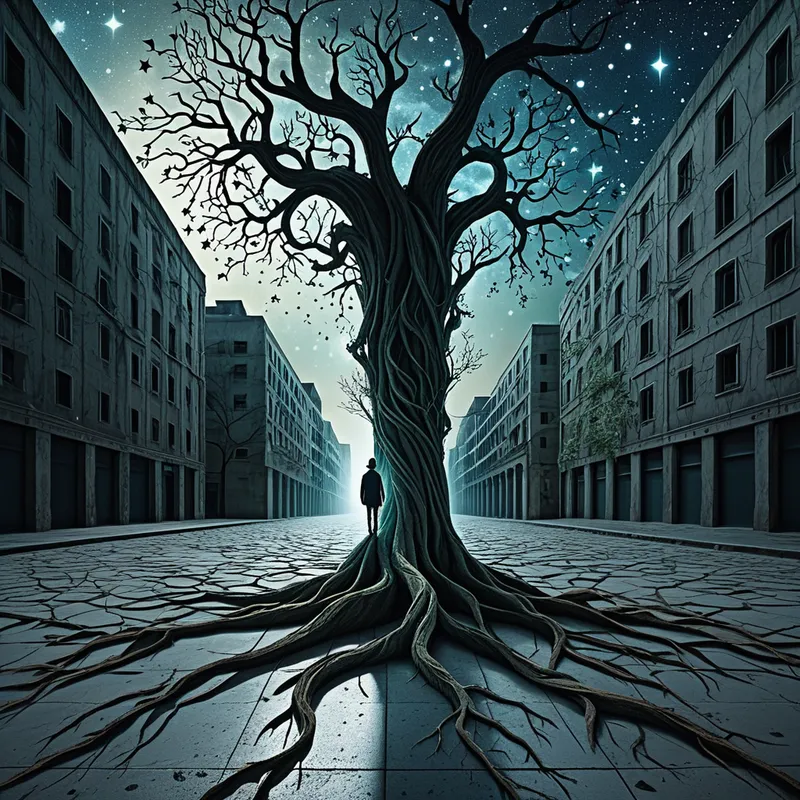
For the individual, the myth models the complete arc of psychic transmutation. The initial “restless walking” is the neurosis, the feeling of life being meaningless, repetitive, or ungrounded. The call from Maira is the emergence of a compelling inner image or feeling—perhaps through therapy, art, loss, or love—that points toward a more integrated way of being.
Individuation is the conscious becoming of what you always, unconsciously, were. The tree does not strive to be a tree; it surrenders to its own treeness.
The “clearing under moonlight” is the liminal, sacred space of inner work—the therapy hour, the journal, the meditation cushion—where the old self is made vulnerable. The transformation itself is the dark, non-linear phase of the work, where conscious understanding fails and one must trust the process. The hardening into bark is the development of new boundaries and resilience. The branching is the differentiation of new capacities and perspectives. The intertwining roots are the establishment of a new, deeper relationship with the inner Mother and the collective unconscious.
The final state—being a fixed, generative part of the forest—translates to achieving a sense of authentic vocation and belonging. One is no longer a tourist in one’s own life, but a vital, contributing member of one’s own psychic ecosystem and the wider human community. The fruit one bears is the creative output, wisdom, and stability that comes from a soul finally at home in its own skin, its own wood, its own world.
Associated Symbols
Explore related symbols from the CaleaDream lexicon:
- Tree — The central symbol of the myth, representing the individuated Self, wholeness, grounded wisdom, and the transformation from restless ego to rooted being.
- Root — The hidden, nourishing connection to the earth and the ancestral/unconscious foundation; the part of the self that seeks and secures sustenance from the depths.
- Earth — The primal mother, the receptive unconscious that welcomes the transforming self and provides the substance for new growth and stability.
- Sacrifice — The voluntary surrender of a familiar, lesser state of being (separateness) for a greater, more connected state of existence (unity).
- Transformation — The core process of the myth, the alchemical change from one state of matter and consciousness to another, more enduring form.
- Forest — The symbolic realm of the collective unconscious and the interconnected community of souls, of which the individual tree-self becomes a part.
- Mother — The archetypal nurturing principle, embodied by the forest and the earth, who receives the sacrifice and midwifes the transformation.
- Journey — The internal, spiritual passage from a state of wandering alienation to a state of arrived belonging, which is the myth’s narrative arc.
- Rebirth — The outcome of the transformation; not a recycling of the old life, but the birth of an entirely new mode of being with a different ontological foundation.
- Light — The consciousness and awareness that the transformed self now experiences in a new, fixed, and enduring way, like a tree experiencing the daily path of the sun.