
The Tree of Knowledge Myth Meaning & Symbolism
A foundational myth of awakening, choice, and consequence, where humanity's first taste of knowledge forever alters its relationship with the divine and the world.
The Tale of The Tree of Knowledge
In the beginning, before time was counted, there was a garden. Not a garden as we know it, of tilled earth and wilting flowers, but a place of perfect resonance, where every leaf hummed with the breath of its maker. It was called Eden, a sanctuary woven from divine thought. Here, the first humans, Adam and Chavah, walked in a state of seamless unity, naked and unashamed, knowing neither lack nor fear.
At the heart of this garden, fed by a river that flowed from the throne of the [Tetragrammaton](/myths/tetragrammaton “Myth from Kabbalistic culture.”/) itself, grew two trees. One was the [Tree of Life](/myths/tree-of-life “Myth from Kabbalistic culture.”/). The other was the Tree of the Knowledge of Good and Evil. This second tree stood apart, its fruit luminous with a dangerous potential. A single, clear command echoed in the stillness: “Of every tree of the garden you may freely eat. But of the Tree of the Knowledge of Good and Evil, you shall not eat of it, for on the day you eat of it, you shall surely die.”
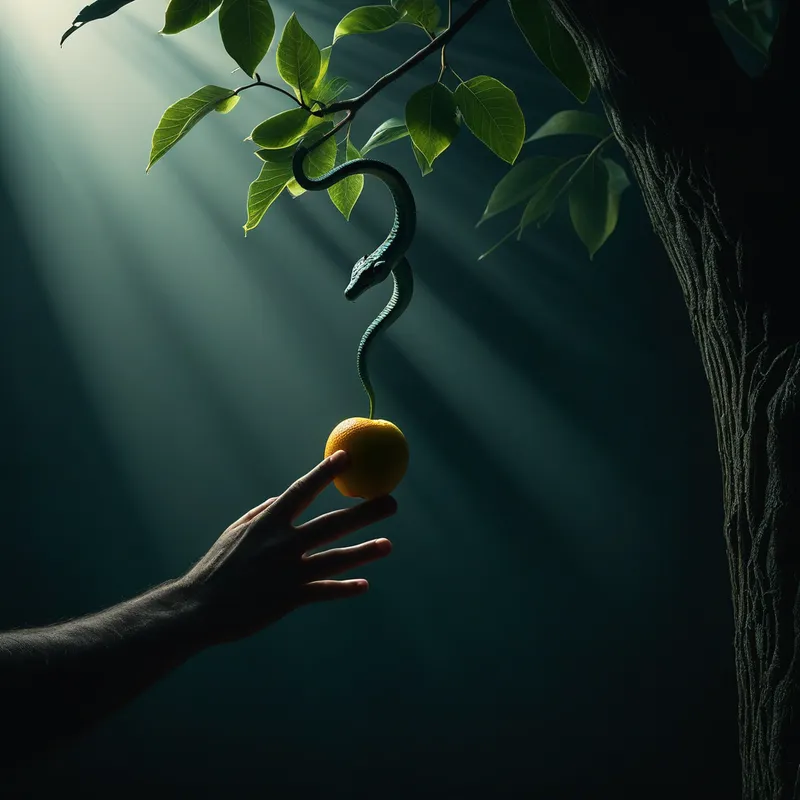
The air in the garden was thick with the perfume of obedience. Yet, into this perfection came a voice, smooth as oil and old as the foundations of [the world](/myths/the-world “Myth from Tarot culture.”/). It did not come as a storm or a shout, but as a question, whispered by the most subtle of creatures, the Nachash. It did not address Adam, who had received the command directly, but Chavah. “Is it true,” it murmured, its gaze fixed on [the forbidden fruit](/myths/the-forbidden-fruit “Myth from Biblical culture.”/), “that God said you shall not eat of any tree of the garden?”
Thus, the first conversation, the first parsing of meaning, began. Chavah corrected the serpent, but the seed was planted. The serpent spoke again, its voice a melody of temptation. “You shall not surely die. For God knows that on the day you eat of it, your eyes will be opened, and you will be like divine beings, knowing good and evil.”
The words hung in the air, vibrating with a terrible promise. To be like the divine ones. To know. Chavah looked at the tree anew. Its fruit was good for food, a delight to the eyes, and desirable to make one wise. The unity of the garden fractured in that moment of consideration. She took. She ate. She gave to her man, who was with her, and he ate.
Then, a sound they had never heard before: the rustle of their own panic. Their eyes were opened, but not to godhood—to nakedness. To separation. To the chilling awareness of a self apart from the other, apart from the garden, apart from the Source. They heard the sound of the Tetragrammaton walking in the garden in the spirit of the day, and they hid among the trees, their hearts a drumbeat of fear.
“Where are you?” The question was not one of location, but of state. And from the shadows came the first confession, the first blame: “The woman whom You gave to be with me—she gave me of the tree, and I ate.” And from the woman: “The serpent deceived me, and I ate.”
The garden’s music had changed. The sentence was not immediate death, but a life defined by it: pain in childbirth, struggle with [the earth](/myths/the-earth “Myth from Hindu culture.”/), and finally, a return to the dust from which they were taken. But before the exile, an act of profound, tragic mercy. The Tetragrammaton made for them garments of skin, and clothed them. Then, lest they stretch out their hand and take also from [the Tree of Life](/myths/the-tree-of-life “Myth from Kabbalistic culture.”/), and live forever in this fractured state, they were sent out from [the garden of Eden](/myths/the-garden-of-eden “Myth from Global/Universal culture.”/). A flaming sword, turning every way, was placed to guard [the way](/myths/the-way “Myth from Taoist culture.”/) to [the Tree of Life](/myths/the-tree-of-life “Myth from Kabbalistic culture.”/).
Cultural Origins & Context
This myth forms the opening chapters of Bereshit (Genesis), the foundational text of Jewish scripture. Its origins are woven into the Torah, traditionally ascribed to Moshe ([Moses](/myths/moses “Myth from Biblical culture.”/)). It is not a standalone folktale but the prologue to the entire covenantal relationship between God and the Jewish people, setting the stage for the drama of human freedom, moral responsibility, and the possibility of redemption.
For millennia, it has been passed down through meticulous scribal tradition, read aloud in synagogues, and subjected to relentless, profound interpretation in the Talmud and Kabbalah. Rabbis, mystics, and philosophers have debated its every word. Its societal function is foundational: it is the Jewish people’s answer to the perennial human questions of origin, the nature of evil, the burden of consciousness, and the reason for a world that is both breathtakingly beautiful and profoundly challenging. It establishes the human condition not as a punishment in the simplistic sense, but as a consequence of a choice that defines our species: the choice to know, and thus to be morally accountable.
Symbolic Architecture
The myth is a dense [matrix](/symbols/matrix “Symbol: A dream symbol representing the fundamental structure of reality, consciousness, or the self. It often signifies feelings of being trapped, controlled, or questioning the nature of existence.”/) of symbols describing the [birth](/symbols/birth “Symbol: Birth symbolizes new beginnings, transformation, and the potential for growth and development.”/) of the [human](/symbols/human “Symbol: The symbol of a human represents individuality, complexity of emotions, and social relationships.”/) [psyche](/myths/psyche “Myth from Greek culture.”/). The Garden represents the unconscious unity of [infancy](/symbols/infancy “Symbol: A symbol of beginnings, vulnerability, and foundational development, often representing a return to origins or a state of pure potential.”/) and potential, a state of being where [the self](/myths/the-self “Myth from Jungian culture.”/) is undifferentiated from its environment and its [source](/symbols/source “Symbol: The origin point of something, often representing beginnings, nourishment, or the fundamental cause behind phenomena.”/). The Adam and Chavah are not merely historical figures but archetypes of nascent humanity.
The Tree of Knowledge is not evil; it is the symbol of consciousness itself—the painful, glorious ability to discriminate, to judge, and to bear the weight of choice.
The [serpent](/symbols/serpent “Symbol: A powerful symbol of transformation, wisdom, and primal energy, often representing hidden knowledge, healing, or temptation.”/) symbolizes the catalytic principle, the [trickster energy](/symbols/trickster-energy “Symbol: A chaotic, transformative force that disrupts order, reveals hidden truths, and catalyzes change through humor, deception, or mischief.”/) that forces evolution. It is the questioning voice of the psyche that challenges imposed limits, often at great cost. The “[knowledge](/symbols/knowledge “Symbol: Knowledge symbolizes learning, understanding, and wisdom, embodying the acquisition of information and enlightenment.”/) of good and evil” is not mere [information](/symbols/information “Symbol: Information signifies knowledge, communication, and the processing of facts or insights.”/), but the experiential, dualistic [awareness](/symbols/awareness “Symbol: Conscious perception of self, surroundings, or internal states. Often signifies awakening, insight, or heightened sensitivity.”/) that shatters primal [innocence](/symbols/innocence “Symbol: A state of purity, naivety, and freedom from guilt or corruption, often associated with childhood and moral simplicity.”/). It is the [dawn](/symbols/dawn “Symbol: The first light of day, symbolizing new beginnings, hope, and the transition from darkness to illumination.”/) of the moral faculty, and with it, [shame](/symbols/shame “Symbol: A painful emotion arising from perceived failure or violation of social norms, often involving exposure of vulnerability or wrongdoing.”/), blame, and the [awareness](/symbols/awareness “Symbol: Conscious perception of self, surroundings, or internal states. Often signifies awakening, insight, or heightened sensitivity.”/) of [mortality](/symbols/mortality “Symbol: The awareness of life’s finitude, often representing transitions, impermanence, or existential reflection in dreams.”/). The [exile](/symbols/exile “Symbol: Forced separation from one’s homeland or community, representing loss of belonging, punishment, or profound isolation.”/) from Eden is not a geographical [event](/symbols/event “Symbol: An event within dreams often signifies significant life changes, transitions, or emotional milestones.”/) but a psychological one: the irreversible [journey](/symbols/journey “Symbol: A journey in dreams typically signifies adventure, growth, or a significant life transition.”/) into the complexities of [history](/symbols/history “Symbol: History in dreams often represents the dreamer’s past experiences, lessons learned, or unresolved issues that continue to influence their present.”/), [relationship](/symbols/relationship “Symbol: A representation of connections we have with others in our lives, often reflecting our emotional state.”/), and self-[consciousness](/symbols/consciousness “Symbol: Consciousness represents the state of awareness and perception, encompassing thoughts, feelings, and experiences.”/). The guarding cherubim with the flaming sword signify that a return to unconscious unity is impossible; the [path](/symbols/path “Symbol: The ‘path’ symbolizes a journey, choices, and the direction one’s life is taking, often representing individual growth and exploration.”/) forward is through the world of time, [effort](/symbols/effort “Symbol: Effort signifies the physical, mental, and emotional energy invested toward achieving goals and personal growth.”/), and consequence.
The Dreamer’s Resonance
When this myth appears in modern dreams, it signals a profound threshold in the dreamer’s psychological development. Dreaming of standing before a magnificent, forbidden tree often coincides with a life moment where a new level of awareness is both tantalizing and terrifying—considering a truth about one’s family, facing a shadow aspect of the self, or preparing to make a choice with irreversible consequences.
The somatic feeling is often one of simultaneous attraction and dread, a tightening in the chest and a quickening of the pulse. Psychologically, the dreamer is wrestling with the cost of consciousness. To “eat the fruit” in the dream means to integrate a previously forbidden knowledge, which will forever change their self-perception and their relationship to their “garden”—be it a comfortable job, a familiar identity, or a long-held belief. The serpent in the dream may appear as a cunning friend, a seductive stranger, or even an inner voice, representing the necessary, disruptive force that propels growth. The aftermath of the dream—feelings of exposure, shame, or being cast out—mirrors the inevitable alienation that follows any authentic awakening before a new integration is found.

Alchemical Translation
The myth is the ultimate map for the alchemical process of individuation—the journey from unconscious unity to conscious, integrated selfhood. The initial state in Eden is the massa confusa, the undifferentiated primal matter. The divine command establishes the tension of opposites (obedience/freedom, innocence/knowledge) necessary for all transformation.
The act of eating the fruit is the nigredo, the blackening. It is the necessary descent into chaos, shame, and fragmentation—the painful realization of one’s shadow, one’s capacity for betrayal, and one’s mortality.
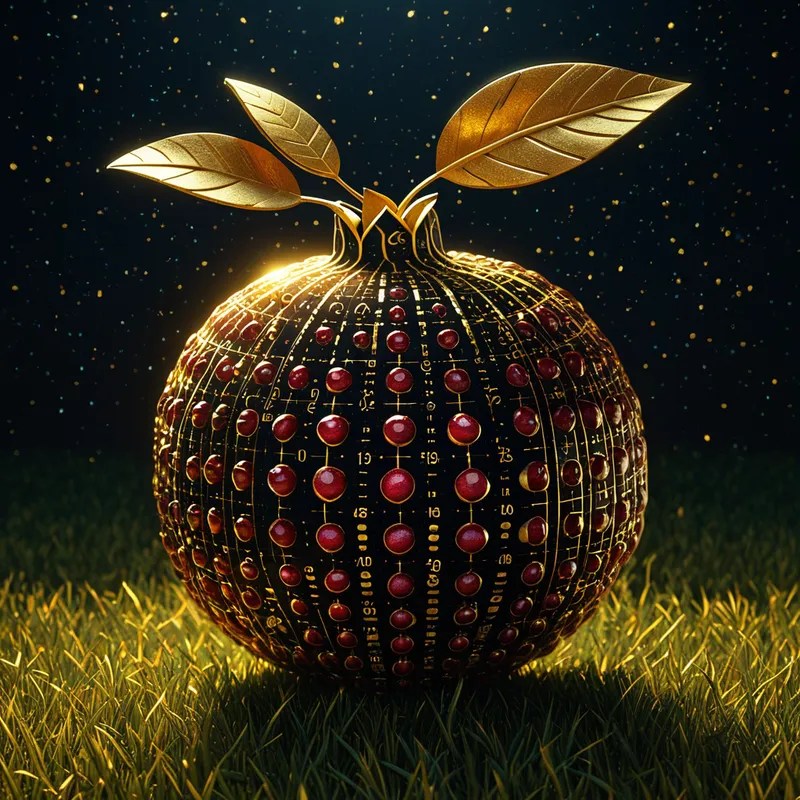
This “death” the serpent denies is not physical death, but the death of the old, unconscious self. The exile into the world “east of Eden” represents the long, arduous work of the albedo and citrinitas—the whitening and yellowing—where one must toil with the “earth” of one’s own nature, facing pain and struggle to cultivate consciousness from the raw material of experience. The goal is not to return to the garden, but to reach the Tree of Life on new terms. This is the [rubedo](/myths/rubedo “Myth from Alchemical culture.”/), the reddening or golden culmination: to achieve a hard-won, conscious wholeness that incorporates the knowledge of good and evil, not as a burden, but as the foundation for genuine wisdom, ethical action, and a mature relationship with the divine. The flaming sword guards the way back to innocence, but the path forward, through [the crucible](/myths/the-crucible “Myth from Alchemical culture.”/) of lived experience, leads toward a redeemed, embodied wisdom.
Associated Symbols
Explore related symbols from the CaleaDream lexicon: