
The Treaty of Ginnungagap Myth Meaning & Symbolism
A primordial pact between fire and ice in the yawning void, forging the first world from the tension of opposing cosmic forces.
The Tale of The Treaty of Ginnungagap
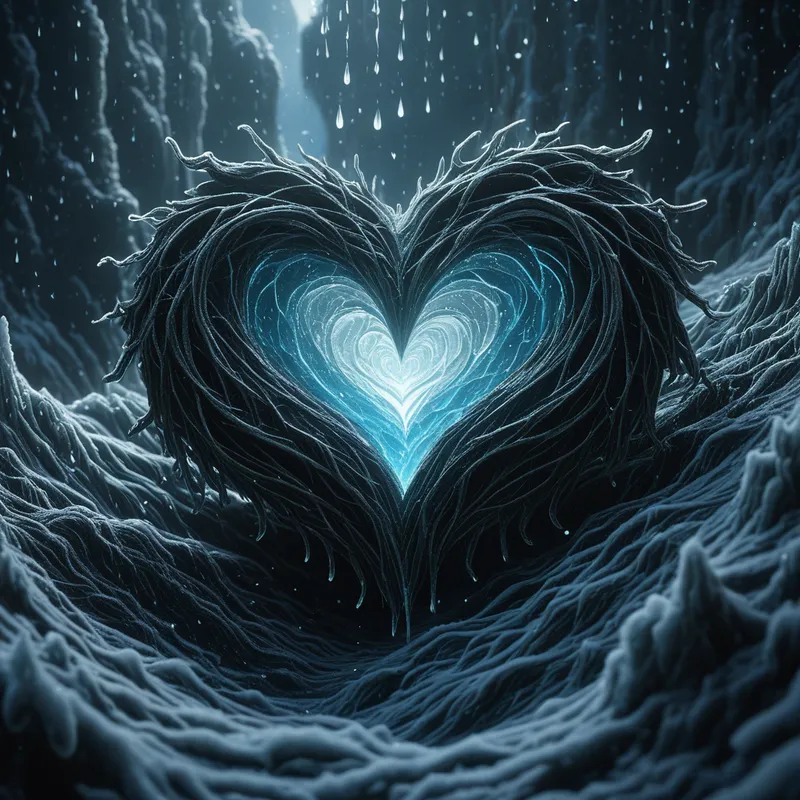
Listen. Before the winds had a name, before the first stone knew its place, there was the Yawning Void. [Ginnungagap](/myths/ginnungagap “Myth from Norse culture.”/). It was not emptiness, but potential—a breath held in the throat of eternity. To the north of it lay [Niflheim](/myths/niflheim “Myth from Norse culture.”/), a realm of grinding frost and silent fog, where eleven rivers of ice, the Élivágar, crept like cold serpents. To the south blazed [Muspelheim](/myths/muspelheim “Myth from Norse culture.”/), a roaring furnace of sparks and molten stone, a land of unmaking light.
And between them, the Gap. For an age without measure, the cold rivers dripped their rime into [the void](/myths/the-void “Myth from Buddhist culture.”/), and the fiery winds cast their embers across [the abyss](/myths/the-abyss “Myth from Kabbalistic culture.”/). They did not meet. They were separate songs in a silent hall.
But time, even primordial time, has a turning. The chill from Niflheim grew heavy, forming vast glaciers that crept into the Gap. The heat from Muspelheim grew restless, sending great gusts of sparks and burning winds to lick at the darkness. And in the very center of Ginnungagap, where the breath of fire met the exhalation of ice, a miracle of conflict occurred.
It was not a battle, but a treaty written in the language of elements. The meeting was a hiss that shook the foundations of non-being. Where the fiery particles kissed the frozen droplets, they did not destroy one another. They melted and mingled. From this chaotic, steaming cauldron of opposites—a drizzle of thawing poison and a spark of quenching flame—life leaked. Not as a design, but as a consequence. The rime itself became fertile, and from the dripping, warming slush coalesced a form: vast, sleeping, and terrible. This was Ymir, the first of the [frost giants](/myths/frost-giants “Myth from Norse culture.”/).
And from the same melting ground, where the ice had been warmed into a gentle flow, emerged Audhumla. She was sustenance, a great cow whose udders flowed with rivers of milk. As Ymir slept and fed, Audhumla licked at the salty, icy stones. With each lick, over three days, she freed another form: Buri, handsome and powerful. From Buri came Borr, and from Borr and the giantess Bestla came the gods—Odin and his brothers.
The treaty was never spoken. It was enacted. It was [the law](/myths/the-law “Myth from Biblical culture.”/) that from the sustained tension of Fire and Ice, in [the crucible](/myths/the-crucible “Myth from Alchemical culture.”/) of the Void, something other must emerge. [The world](/myths/the-world “Myth from Tarot culture.”/) itself was born not from a victory, but from this primal, creative stalemate.
Cultural Origins & Context
This is not a myth of heroes, but of origins. The story of Ginnungagap forms the foundational prologue of Norse cosmology, primarily preserved in the 13th-century Prose Edda by Snorri Sturluson, who drew upon older poetic traditions. It served as the necessary “before” to every other story—the explanation for the very substance of the world and the entangled origins of gods and giants.
Its societal function was ontological. It answered the profound human questions: What was here before? Where did the stuff of the world come from? The answer was not a benevolent creator god shaping things from nothing, but an impersonal, dynamic process arising from inherent cosmic opposites. This reflected a worldview that saw the universe as a place of dynamic, often violent, equilibrium, where order (örlög) is carved from chaos through sustained effort and sacrifice. The myth established the fundamental tension (fire/ice, god/giant) that would define all subsequent Norse mythology and, by extension, the human condition within that cosmos.
Symbolic Architecture
The Treaty is not an [event](/symbols/event “Symbol: An event within dreams often signifies significant life changes, transitions, or emotional milestones.”/), but a principle—[the principle](/symbols/the-principle “Symbol: A fundamental truth, law, or doctrine that serves as a foundation for a system of belief, behavior, or reasoning, often representing moral or ethical standards.”/) of creation through dynamic [opposition](/symbols/opposition “Symbol: A pattern of conflict, duality, or resistance, often representing internal or external struggles between opposing forces, ideas, or desires.”/). Ginnungagap itself symbolizes the fertile void of the unconscious, the potential that exists before [consciousness](/symbols/consciousness “Symbol: Consciousness represents the state of awareness and perception, encompassing thoughts, feelings, and experiences.”/) forms. It is the psychological [space](/symbols/space “Symbol: Dreaming of ‘Space’ often symbolizes the vastness of potential, personal freedom, or feelings of isolation and exploration in one’s life.”/) before thought, where raw affects and instincts swirl.
The first world is not built, it precipitates. It is the inevitable residue of sustained tension.
Muspelheim represents the active, expansive, differentiating principle—libido, [passion](/symbols/passion “Symbol: Intense emotional or physical desire, often linked to love, creativity, or purpose. Represents life force and deep engagement.”/), the drive toward form and [expression](/symbols/expression “Symbol: Expression represents the act of conveying thoughts, emotions, and individuality, emphasizing personal communication and creativity.”/). Niflheim represents the passive, contractive, preserving principle—[stasis](/symbols/stasis “Symbol: A state of inactivity, equilibrium, or suspension where no change or progress occurs, often representing psychological or existential paralysis.”/), inertia, the undifferentiated [mass](/symbols/mass “Symbol: Mass often symbolizes a gathering or collective experience, representing shared beliefs, burdens, or the weight of emotions within a community.”/) of potential. Ymir, born from their meeting, is the emergent Ego, the first coherent “I” that arises from the chaotic soup of the unconscious. He is primal, monstrous, and self-generating, representing an undifferentiated state of being where the [psyche](/myths/psyche “Myth from Greek culture.”/) is a closed, self-feeding [system](/symbols/system “Symbol: A system represents structure, organization, and interrelated components functioning together, often reflecting personal or social order.”/). Audhumla, the nourisher who reveals Buri (the first god, or the first spark of divine consciousness), symbolizes the nurturing, ordering instinct that makes [differentiation](/symbols/differentiation “Symbol: The process of distinguishing or separating parts of the self, emotions, or identity from a whole, often marking a developmental or psychological milestone.”/) and higher consciousness possible.

The Dreamer’s Resonance
To dream of this myth is to be in a state of profound psychic reorganization. The dreamer may experience sensations of extreme heat and cold simultaneously, or visions of vast, empty spaces (the Gap) where two powerful, opposing forces or emotions are slowly moving toward each other. There is often a feeling of immense pressure and anticipation, a somatic sense that something must give.
This dream pattern manifests when the conscious attitude (perhaps fiery, active, and wilful) has become too distant from the unconscious contents (cold, frozen, or neglected). The treaty is the psyche’s attempt to initiate a creative process by forcing a confrontation. The resulting “dripping rime” or “steaming mist” in the dream represents the raw, often messy, emotional and imaginal material that is being generated as these opposites engage. It is the birth of new psychic substance—unformed, potent, and potentially monstrous (like Ymir) or nourishing (like Audhumla). The dreamer is in the Gap, experiencing the often uncomfortable alchemy that precedes a new phase of life or self-understanding.
Alchemical Translation
The individuation process mirrors the Treaty of Ginnungagap perfectly. The modern individual must become the crucible. Our conscious mind (aligned with fiery Muspelheim’s desire for control and light) often seeks to reject or burn away the cold, shadowy aspects of the unconscious (Niflheim’s inertia, depression, forgotten trauma). Conversely, the unconscious can freeze our initiative in layers of fear and stasis.
Individuation begins not with conquering one’s inner giant, but with allowing the giant to be born from the honest confrontation of one’s own fire and ice.
The “treaty” is the conscious, enduring act of holding these opposites in tension without fleeing to one pole. It is to let our passion and our numbness, our ambition and our despair, exist in the same psychic space. This is the work of the Gap. From this sustained, often painful tension, a new third [thing](/myths/thing “Myth from Norse culture.”/) precipitates—not chosen, but born. This is the new attitude, the creative insight, the symbol that resolves the conflict. First, it may appear as a chaotic, all-consuming “Ymir” (a powerful complex that takes us over). But if we tend to it with the nourishing, patient attention of “Audhumla,” it can yield the freed god “Buri”—a new level of consciousness and selfhood. The world of the psyche is created anew not by avoiding conflict, but by submitting to the creative law of the Treaty, forging a self from the elemental meeting of all that we are and all that we have tried not to be.
Associated Symbols
Explore related symbols from the CaleaDream lexicon: