The Transfiguration Myth Meaning & Symbolism
A teacher ascends a mountain with his disciples and is revealed in his true, radiant nature, witnessed by prophets and affirmed by a divine voice.
The Tale of The Transfiguration
The air on the mountain was thin, sharp with the scent of stone and ancient cold. He led them up [the winding path](/myths/the-winding-path “Myth from Taoist culture.”/), these three who followed closest—[Peter](/myths/peter “Myth from Biblical culture.”/), John, and James. Their breaths came in white puffs, their thoughts heavy with his recent, troubling words about suffering and loss in the city below. The climb was a silent prayer, a lifting away from [the world](/myths/the-world “Myth from Tarot culture.”/) of markets and Roman roads into a realm of wind and sky.
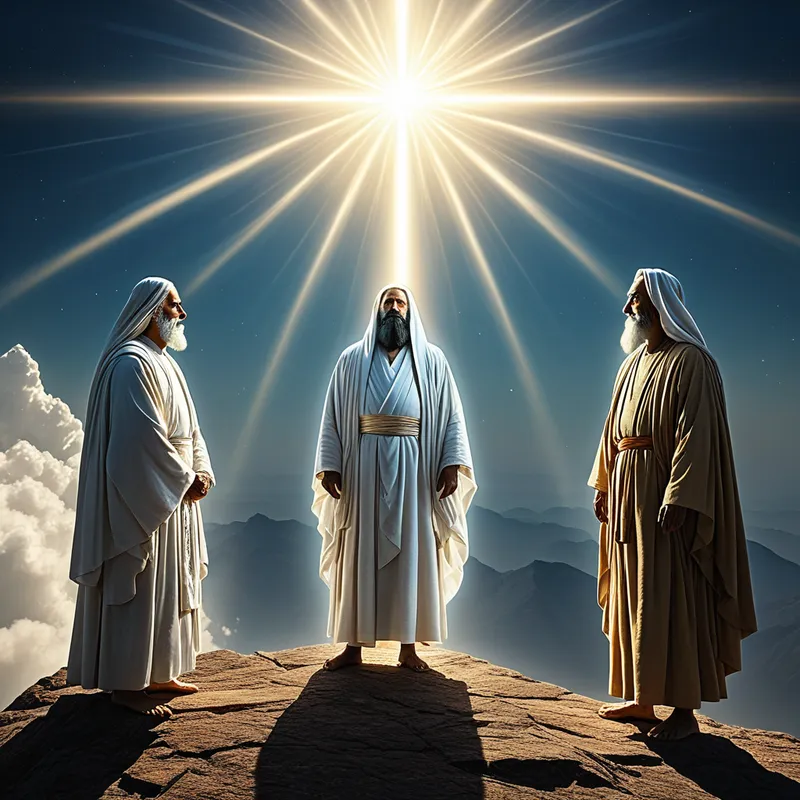
Then, on [the summit](/myths/the-summit “Myth from Taoist culture.”/), as the sun’s angle grew long and the shadows stretched like prophecies, it happened. The man they knew—the teacher with dust on his sandals, the friend who broke bread with sinners—was taken from their sight. Not taken, but unveiled. His face, which they had seen lined with fatigue, now shone like the sun itself. His simple garments became blinding white, whiter than any fuller on earth could bleach them, a light not cast upon him but erupting from within. It was a radiance that spoke of a world behind the world, a fundamental fire at the heart of being.
And he was not alone. From the luminous cloud of his presence, two figures coalesced: [Moses](/myths/moses “Myth from Biblical culture.”/), whose face once shone from speaking with God, and Elijah. They spoke with him, their forms shimmering with the authority of [the Law](/myths/the-law “Myth from Biblical culture.”/) and the fierce passion of [the Prophets](/myths/the-prophets “Myth from Biblical culture.”/). The very air vibrated with a conversation outside of time.
Peter, terrified and ecstatic, his mind scrambling to build a shrine in the midst of this apocalypse, stammered, “Master, it is good for us to be here. Let us make three shelters…” But his words were swallowed by a greater presence. A bright cloud descended, enveloping them all in a tangible, holy darkness within light. And from the cloud came a Voice, not of thunder, but of absolute origin: “This is my Son, the Beloved; with him I am well pleased. Listen to him.”
The disciples fell on their faces, overcome by a dread that was also worship, a terror that was the only appropriate response to the naked truth of things. Then, a touch. A familiar voice, gentle now, stripped of its cosmic resonance. “Get up,” he said. “Do not be afraid.” They lifted their eyes. The mountain was just a mountain again. The twilight was ordinary. Only the teacher stood there, alone, as he had always been. Yet nothing would ever be the same. The descent awaited, the path back down into the shadowed valley of the world, now carrying an impossible secret blazing in their hearts.

Cultural Origins & Context
This account, recorded in the synoptic gospels of Matthew, Mark, and Luke, is a foundational pillar within the Christian narrative. It sits at a crucial hinge-point in the story of [Jesus](/myths/jesus “Myth from Christian culture.”/), after his ministry of teaching and healing has been established but immediately before his final turn toward [Jerusalem](/myths/jerusalem “Myth from Biblical culture.”/) and [the passion](/myths/the-passion “Myth from Christian culture.”/). Historically, it functions as a divine authentication for the disciples—and for the early Church community hearing the tale—amidst the scandal of the coming crucifixion. It answers the unspoken question: Who is this, really?
Passed down as sacred testimony, its societal function was multifaceted. It served as a bridge, connecting Jesus directly to the foundational authorities of Judaism (Moses and Elijah), asserting continuity and fulfillment. It was a story of confirmation for times of doubt and a narrative icon of hope, a promise that the human form could bear and reveal ultimate divine reality. It was, and remains, not merely a report of an event, but an initiation into a mystery.
Symbolic Architecture
At its core, the [Transfiguration](/myths/transfiguration “Myth from Christian culture.”/) is a myth of [epiphany](/symbols/epiphany “Symbol: A sudden, profound realization or insight, often experienced as a moment of clarity that transforms understanding.”/)—a sudden, shocking manifestation of true essence. The [mountain](/symbols/mountain “Symbol: Mountains often symbolize challenges, aspirations, and the journey toward self-discovery and enlightenment.”/) is the ancient [axis](/symbols/axis “Symbol: A central line or principle around which things revolve, representing stability, orientation, and the fundamental structure of reality or consciousness.”/) mundi, the place where [heaven](/symbols/heaven “Symbol: A symbolic journey toward ultimate fulfillment, spiritual transcendence, or connection with the divine, often representing life’s highest aspirations.”/) and [earth](/symbols/earth “Symbol: The symbol of Earth often represents grounding, stability, and the physical realm, embodying a connection to nature and the innate support it provides.”/) meet, where the [veil](/symbols/veil “Symbol: A veil typically symbolizes concealment, protection, and transformation, representing both mystery and femininity across cultures.”/) between realms grows thin. Jesus is the [human](/symbols/human “Symbol: The symbol of a human represents individuality, complexity of emotions, and social relationships.”/) who is also the divine template, the [archetype](/symbols/archetype “Symbol: A universal, primordial pattern or prototype in the collective unconscious that shapes human experience, behavior, and creative expression.”/) made flesh. His [transfiguration](/myths/transfiguration “Myth from Christian culture.”/) is the [revelation](/symbols/revelation “Symbol: A sudden, profound disclosure of truth or insight, often through artistic or musical means, that transforms understanding.”/) of that archetypal [reality](/symbols/reality “Symbol: Reality signifies the state of existence and perception, often reflecting one’s understanding of truth and life experiences.”/) shining through the personal, historical container.
Moses and Elijah represent the complete testament of a culture’s spiritual striving—[the Law](/symbols/the-law “Symbol: Represents external rules, societal order, moral boundaries, and the tension between personal freedom and collective structure.”/) and the Prophets, [structure](/symbols/structure “Symbol: Structure in dreams often symbolizes stability, organization, and the framework of one’s life, reflecting how one perceives their environment and personal life.”/) and fire, tradition and revolutionary [spirit](/symbols/spirit “Symbol: Spirit symbolizes the essence of life, vitality, and the spiritual journey of the individual.”/). Their [presence](/symbols/presence “Symbol: Presence in dreams often signifies awareness or acknowledgment of something significant in one’s life.”/) signifies that this revelation is not a [rupture](/symbols/rupture “Symbol: A sudden break or tear in continuity, often representing abrupt change, separation, or the shattering of established patterns.”/) from the past, but its consummation.
The cloud is the mysterium tremendum et fascinans, the terrifying and fascinating mystery of the divine ground itself, which both reveals and conceals.
The command “Listen to him” is pivotal. The [vision](/symbols/vision “Symbol: Vision reflects perception, insight, and clarity — often signifying the ability to foresee or understand deeper truths.”/) is not an end in itself; it is validation for the difficult, earthly teaching to come. The light must be integrated, not merely witnessed. The disciples’ [terror](/symbols/terror “Symbol: An overwhelming, primal fear that paralyzes and signals extreme threat, often linked to survival instincts or deep psychological trauma.”/) and Peter’s desire to build permanent shelters represent [the ego](/myths/the-ego “Myth from Jungian culture.”/)’s desperate attempt to institutionalize, capture, and dwell within the numinous experience, rather than be transformed by it and return to the world.

The Dreamer’s Resonance
When this mythic pattern stirs in the modern [psyche](/myths/psyche “Myth from Greek culture.”/), it often manifests in dreams of radical, luminous self-discovery. One might dream of a familiar mentor, parent, or even oneself suddenly glowing with an unearthly, peaceful light. Or a dream of being on a high place—a rooftop, a cliff—where the very air becomes charged with meaning and a profound, wordless truth is communicated.
Somatically, this can correlate to a process of psychological integration where a core, but previously hidden, aspect of [the Self](/myths/the-self “Myth from Jungian culture.”/) breaks through to consciousness. It is often preceded by a period of arduous “climbing”—therapy, creative struggle, or spiritual practice. The feeling upon waking is one of awe, expansion, and sometimes disorientation. The ego, like the disciples, is both illuminated and terrified by the encounter with its own greater reality. This dream signals that a foundational identity is being reconfigured; the [persona](/myths/persona “Myth from Greek culture.”/) is being seen through, and the archetypal core of the individual is announcing its presence.

Alchemical Translation
In the alchemy of the soul, the Transfiguration is the glorious, fleeting stage of the albedo—the whitening—following the [nigredo](/myths/nigredo “Myth from Alchemical culture.”/) of confusion and descent. It is the moment when the base matter of the personality, subjected to the heat of conscious suffering and the dissolution of old forms, suddenly reveals its latent, noble essence. The light is the lumen naturae, the light of nature, which is also the light of spirit, shining from within the transformed substance.
For the modern individual, this myth models the process of individuation not as a gradual improvement, but as a series of shocking recognitions. We spend our lives identified with our historical self—our wounds, our roles, our accomplishments. The “ascent” is the difficult work of introspection, lifting our awareness above the daily drama. The “transfiguration” is that irreversible moment when we glimpse, not who we think we are, but who we are at the level of archetype: our essential, non-negotiable nature beyond personal history.
The voice from the cloud commands, “Listen to him.” In psychological terms, this is the imperative to heed the guidance of this revealed Self, the inner sage, especially when it directs us toward necessary, difficult truths and sacrifices (the descent to Jerusalem).
The myth’s full cycle is critical. The light is revealed, affirmed, and then veiled again. The disciples must descend. This is the alchemical rub: the gold of the peak experience must be brought down and applied in the shadowed valleys of relationship, work, and community. The transfiguration is not an escape from humanity, but the revelation of divinity within it, a mandate to live from that integrated, luminous core in the very midst of the ordinary, suffering world. The true transformation is not just in the shining, but in carrying that light down the mountain, where it becomes not a spectacle, but a way of being.
Associated Symbols
Explore related symbols from the CaleaDream lexicon: