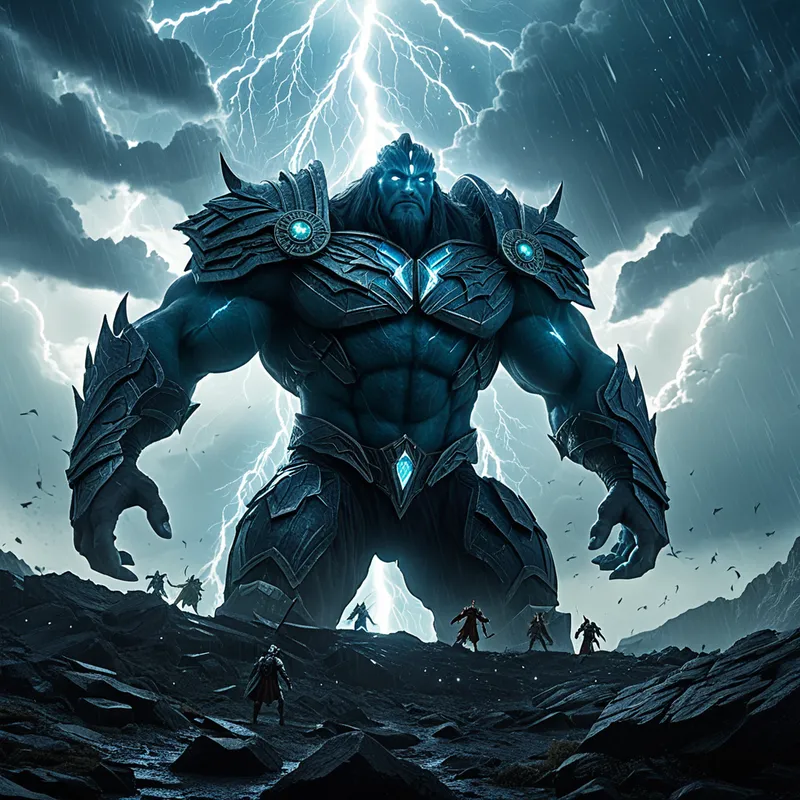
The Titans of Greek mythology Myth Meaning & Symbolism
The primordial deities of Greek myth, overthrown by their Olympian children, embody the raw, foundational forces of the cosmos and the psyche.
The Tale of The Titans of Greek mythology
Listen, and hear the tale of [the world](/myths/the-world “Myth from Tarot culture.”/)’s first bones. Before the sun knew its path and [the moon](/myths/the-moon “Myth from Tarot culture.”/) its phases, there was only Chaos, a yawning, formless deep. From its silent [ferment](/myths/ferment “Myth from Alchemical culture.”/), the first beings stirred: Gaia, the broad-breasted earth, solid and sure; [Tartarus](/myths/tartarus “Myth from Greek culture.”/), [the pit](/myths/the-pit “Myth from Christian culture.”/) of despair deep below; and Eros, the sweet, urgent force of desire.
Gaia, alone in the dark, bore [Uranus](/myths/uranus “Myth from Greek culture.”/), the starry sky. He lay upon her, a blanket of constant, smothering weight, and from their union came the first race: the Titans. They were not gods as we might dream them, but forces made flesh. [Oceanus](/myths/oceanus “Myth from Greek culture.”/) was the ceaseless, serpentine flow of all waters. [Mnemosyne](/myths/mnemosyne “Myth from Global/Universal culture.”/) was the very substance of thought and remembrance. Cronus, the youngest and most cunning, held a sickle of adamant, its edge sharp as the concept of ending.
But Uranus was a fearful king. He hated his next children—the monstrous Cyclopes and the hundred-handed Hecatoncheires—and thrust them back into Gaia’s womb, into the tormenting dark of her own body. [The earth](/myths/the-earth “Myth from Hindu culture.”/) groaned in agony, her soil compacted with pain. She forged the grey sickle and called her Titan children. Only Cronus answered her cry.
That night, when Uranus descended to embrace the earth, Cronus emerged from hiding. With a grunt of primordial effort, he swung the sickle. Not flesh, but cosmic substance was severed. [The sky](/myths/the-sky “Myth from Persian culture.”/) screamed, recoiling from the earth forever, and from the drops of his blood falling upon the land sprang the Erinyes and the martial Giants. Cronus now was lord, and he cast his father’s genitals into [the sea](/myths/the-sea “Myth from Greek culture.”/), from whose foam would later rise Aphrodite.
Yet fear had been sown in the heart of the new king. A prophecy echoed that he, too, would be overthrown by his own child. So, when his sister-queen Rhea bore their children—[Hestia](/myths/hestia “Myth from Global/Universal culture.”/), Demeter, Hera, [Hades](/myths/hades “Myth from Greek culture.”/), [Poseidon](/myths/poseidon “Myth from Greek culture.”/), and Zeus—Cronus opened his mighty jaws and swallowed each whole, imprisoning the new order within the dark of his own belly.
Rhea’s grief turned to cunning. When Zeus was born, she gave Cronus a stone wrapped in swaddling clothes to devour and hid the infant in a cave on Crete, where the goat Amalthea nursed him, and the Curetes danced their clamorous dance. Zeus grew strong on the milk of a primordial beast and the food of the future.
Come of age, Zeus confronted his father. With a potion crafted by the Titaness [Metis](/myths/metis “Myth from Greek culture.”/), he forced Cronus to disgorge his siblings, whole and full of wrath. Thus began the Titanomachy, a war that shook the pillars of the cosmos. [The Titans](/myths/the-titans “Myth from Greek culture.”/) rallied on Mount Othrys. The Olympians fought from Olympus. For ten years, the clash of elemental forces tore the world. Mountains were hurled as weapons, seas boiled, and the very air caught fire.
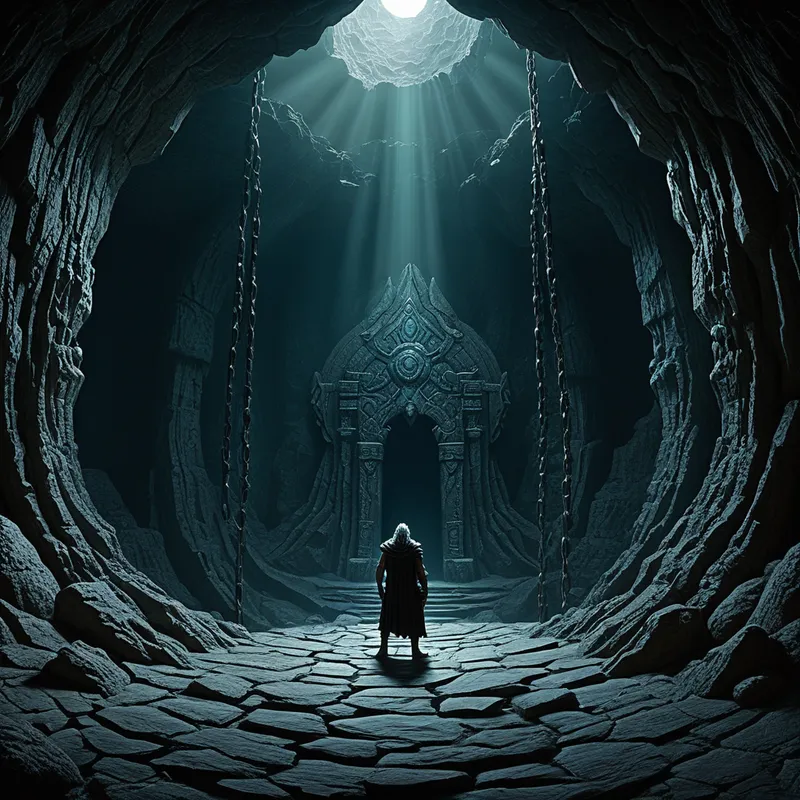
The stalemate broke when Zeus freed the Cyclopes and Hecatoncheires from Tartarus. The Cyclopes forged his thunderbolts, weapons of focused, terrible power. The hundred-handed ones rained three hundred stones at once upon the Titans. With a final, cataclysmic surge, the Olympians prevailed. Most of the defeated Titans were cast into the abyssal dungeons of Tartarus, bound and guarded by the very Hecatoncheires they had once scorned. There, in the deep, silent dark below the roots of the world, the old order was chained. The age of the Titans had ended. The age of the Olympians had dawned, built upon the imprisoned foundation of the world that was.
Cultural Origins & Context
The myth of the Titans is not a singular story but a foundational layer of Greek cosmology, pieced together from the epic poetry of Hesiod’s Theogony and fragments from other archaic sources. It functioned as the divine genealogy and theogony—the birth of the gods—establishing a cosmic chronology of power. This was not mere entertainment; it was a sacred narrative performed by bards and rhapsodes, explaining the origin of the world’s structure and the legitimacy of the current Olympian order. By framing Zeus’s reign as the overthrow of a tyrannical, cannibalistic, and stagnant previous regime, the myth provided a divine sanction for order, [justice](/myths/justice “Myth from Tarot culture.”/) (dike), and the rule of law over brute, cyclical force. It answered profound questions: Why is the sky separate from the earth? Why do rulers fear their heirs? From where do vengeance and love arise? The Titans represented the raw, unchanneled forces of nature that the civilized Greek world saw itself as having mastered and organized.
Symbolic Architecture
Psychologically, the Titans symbolize the foundational, often unconscious, structures of the [psyche](/myths/psyche “Myth from Greek culture.”/). They are the archaic, impersonal patterns—the instincts, the deep familial complexes, the inherited traumas, and the primordial drives—that exist before the light of conscious [identity](/symbols/identity “Symbol: Identity represents the sense of self, encompassing personal beliefs, cultural background, and social roles.”/) (the Olympians) forms.
The Titan is the psychic bedrock, the raw material of being that must be encountered, struggled with, and ultimately integrated or contained for consciousness to rule.
Cronus (Time, the Harvest) embodies the devouring [aspect](/symbols/aspect “Symbol: A distinct feature, quality, or perspective of something, often representing a partial view of a larger whole.”/) of time and the paranoid, conservative [impulse](/symbols/impulse “Symbol: A sudden, powerful urge or drive that arises without conscious deliberation, often linked to primal instincts or emotional surges.”/) that seeks to consume the future to preserve the present. His swallowing of his children is the ultimate [image](/symbols/image “Symbol: An image represents perception, memories, and the visual narratives we create in our minds.”/) of a complex that prevents new psychic content from emerging. Gaia represents the somatic, bodily unconscious, the ground of being that feels pain and eventually sponsors rebellion against oppressive structures (Uranus). The war itself, the Titanomachy, is the necessary, violent struggle within the individual where emerging [consciousness](/symbols/consciousness “Symbol: Consciousness represents the state of awareness and perception, encompassing thoughts, feelings, and experiences.”/) (Zeus, with his [lightning](/symbols/lightning “Symbol: Lightning symbolizes sudden insights or revelations, often accompanied by powerful emotions or disruptive change.”/)—sudden [insight](/symbols/insight “Symbol: A sudden, deep understanding of a complex situation or truth, often arriving unexpectedly and illuminating hidden connections.”/)) battles the entrenched, automatic patterns of the past. The imprisonment in Tartarus does not signify eradication, but containment. The old patterns are not gone; they become the [foundation](/symbols/foundation “Symbol: A foundation symbolizes the underlying support systems, values, and beliefs that shape one’s life, serving as the bedrock for growth and development.”/) upon which the new psyche is built, a buried but essential [stratum](/symbols/stratum “Symbol: A distinct layer or level, often in rock or soil, representing depth, history, and hidden structures.”/).
The Dreamer’s Resonance
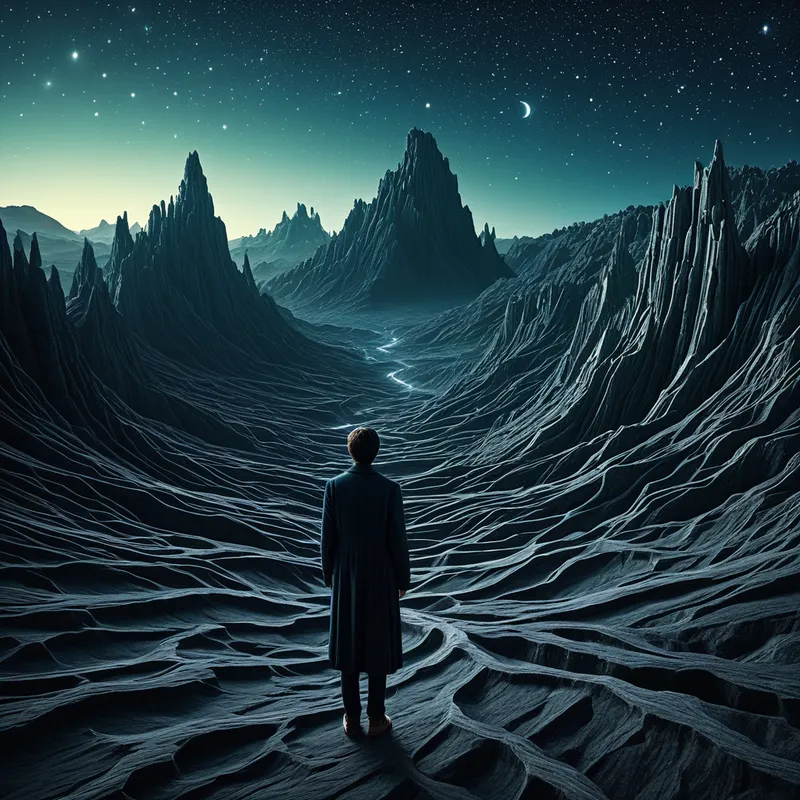
To dream of Titans is to dream of foundational upheaval. The dreamer may encounter vast, slow-moving landscapes that are alive, immense figures sleeping beneath cities, or feel the ground of their own identity cracking open. These are not dreams of personal neuroses, but of impersonal, archetypal shifts.
Somatically, this can manifest as feelings of immense pressure, deep tectonic rumbles of anxiety, or a sense of being crushed by a weight of inheritance (family, culture, personal history). Psychologically, it signals a process where long-buried, primordial aspects of [the self](/myths/the-self “Myth from Jungian culture.”/)—perhaps a rage as deep as the Erinyes, or a creative potential as vast and untamed as Oceanus—are stirring. The dreamer is in a state of pre-rebellion. The old, Cronus-like order within (a rigid self-concept, a swallowed potential) is being challenged. The dream is the inner Gaia groaning, preparing the sickle for a necessary severance.
Alchemical Translation
The alchemical journey modeled by the Titan myth is the opus contra naturam—the work against nature, or more precisely, against the first nature. Our first nature is the Titanic state: identification with raw drives, familial fate, and unconscious patterns. Individuation requires a rebellion against this autocratic inner regime.
The Olympian victory is not the destruction of the Titans, but their transmutation from ruling tyrants into foundational elements. The goal is not to live in Tartarus, but to build a conscious life upon it.
The process begins with the Severance (Cronus vs. Uranus): One must enact a courageous, often painful cut from the smothering “sky” of internalized parental complexes or collective expectations. This is wielding the adamant sickle of conscious choice. Next is the Confrontation (Zeus vs. Cronus): The new, nascent consciousness must force the devouring complex to disgorge what it has swallowed—the repressed talents, emotions, and potentials (the sibling deities). Finally, the Integration (The Titanomachy and Imprisonment): The epic inner battle ensues. With the aid of once-rejected powers (the Cyclopes as focused skill, the Hecatoncheires as the ability to multi-focus), consciousness establishes its reign. The defeated Titanic forces are bound, not killed. They become the stable ground, the raw power source, and the deep memory of the psyche. The wise ruler (the integrated ego, akin to Zeus) does not deny Tartarus; he knows it is there, and that his throne rests upon it. To individuate is to move from being a passive subject of the Titanic order to becoming the conscious ruler of an Olympian psyche, respectfully aware of the ancient, chained giants in its depths.
Associated Symbols
Explore related symbols from the CaleaDream lexicon: