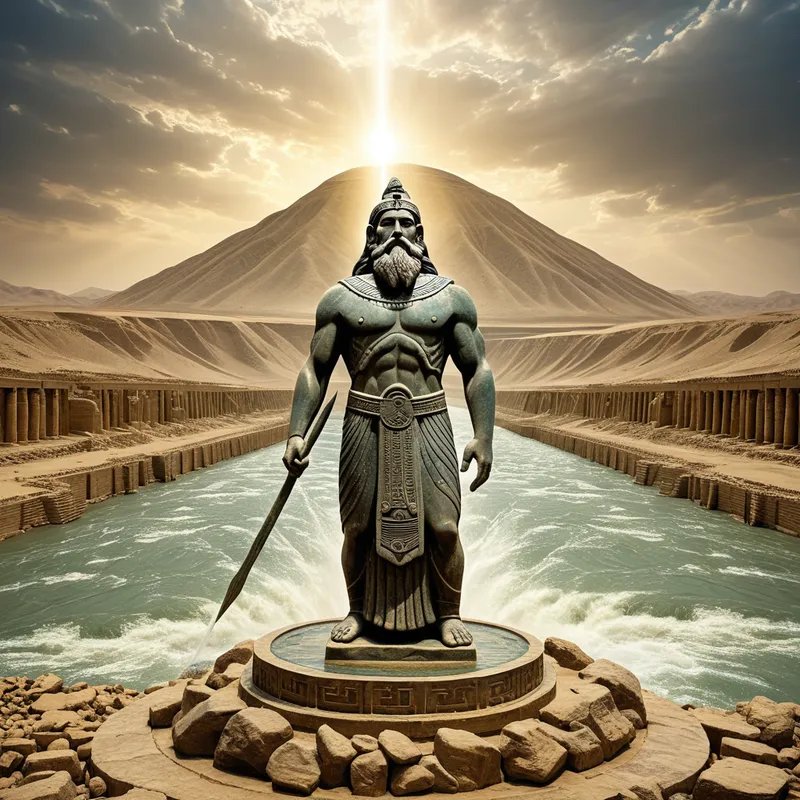
The Tigris and Euphrates Myth Meaning & Symbolism
A myth of divine creation where the god Enki brings forth the life-giving rivers from the body of a slain mountain, birthing civilization from chaos.
The Tale of The Tigris and Euphrates
Listen, and hear the tale written before time was counted. In the age when [the world](/myths/the-world “Myth from Tarot culture.”/) was young and raw, the lands of Sumer and Akkad lay parched and silent. The sun, Utu, beat down upon a cracked and barren plain. The air was thick with dust, and life was a desperate, gasping [thing](/myths/thing “Myth from Norse culture.”/). But beneath this desolation slept a terrible power—the great mountain, Kur. He was not merely stone and earth; he was a living god, vast and slumbering, and within his stony veins he held captive all the sweet, life-giving waters of [the world](/myths/the-world “Myth from Tarot culture.”/).
The gods in the high heavens looked down and saw the suffering. An decreed that the waters must be freed. Enlil stirred the winds, but the mountain would not yield. It fell to Enki, the cunning one, the lord of the deep Abzu, to undertake the perilous journey. Enki, whose essence was the very [water](/myths/water “Myth from Chinese culture.”/) that was trapped, descended from the divine abode. He traveled across the bleak expanse, his form shimmering with latent potency, until he stood before the monstrous bulk of Kur.
The mountain god awoke. His voice was the grinding of tectonic plates, his breath a hot, dry wind. “The waters are mine,” he roared, “the seed of the world sleeps in my darkness. I will not release it.” A battle ensued, not of brute force alone, but of profound cunning. Enki, the wise, sought not to shatter the mountain, but to transform it. He wielded his spear, not as a weapon of destruction, but as a divine instrument of incision, of sacred surgery.
He struck not at the heart of the mountain, but at its towering peaks and its deep, hidden flanks. And where the spear of Enki touched the living stone, a miracle erupted. From the wounds of Kur, not blood, but torrents of pure, rushing water burst forth. The first was a mighty, swift-flowing river, fierce and unpredictable—this was the Idiglat, the Tigris. The second flowed forth, broader, more deliberate, carrying rich, dark silt—this was the Buranun, the Euphrates.
The death-cry of Kur became the birth-cry of the land. The waters did not merely flow; they sang. They carved channels through the dust, bringing not just moisture, but order. Where they passed, the hard earth softened. Green shoots pushed through the mud. Fish leaped in the new currents. Enki, watching his work, then performed his second act of creation. He filled the newborn rivers with his own creative spark, sowing them with fish and populating their banks with reeds. He decreed their courses and placed them under the care of a god, ensuring they would forever be the arteries of the world. From the body of chaos, life was born.
Cultural Origins & Context
This myth is not a single, codified story from one text, but a foundational narrative woven from the fabric of Mesopotamian thought, found in fragments of Sumerian hymns, creation accounts, and praise poetry for the god Enki. It was recited by temple priests and scribes, the literate custodians of cosmic order, during rituals to ensure the annual, life-giving floods of the two rivers. The myth served a vital societal function: it explained the origin of the region’s absolute geographical and agricultural reality. The Tigris and Euphrates were civilization. Their unpredictable floods were both a source of fertile silt and of catastrophic destruction. The myth provided a divine rationale for this duality—the rivers were born from a violent, creative act, explaining their simultaneous life-giving and fearsome nature.
By attributing their creation to Enki, the god of wisdom and fresh water, the myth placed the rivers at the center of the cosmic battle between order (Me) and chaos (Kur). It was a story that told the people they lived in a world wrested into being by divine intelligence, a world where survival depended on understanding and honoring the delicate, hard-won balance between the cultivated land and the wild, primordial waters.
Symbolic Architecture
At its core, this is a myth of [differentiation](/symbols/differentiation “Symbol: The process of distinguishing or separating parts of the self, emotions, or identity from a whole, often marking a developmental or psychological milestone.”/) and the [birth](/symbols/birth “Symbol: Birth symbolizes new beginnings, transformation, and the potential for growth and development.”/) of [consciousness](/symbols/consciousness “Symbol: Consciousness represents the state of awareness and perception, encompassing thoughts, feelings, and experiences.”/) from the undifferentiated [mass](/symbols/mass “Symbol: Mass often symbolizes a gathering or collective experience, representing shared beliefs, burdens, or the weight of emotions within a community.”/) of the unconscious. The great [mountain](/symbols/mountain “Symbol: Mountains often symbolize challenges, aspirations, and the journey toward self-discovery and enlightenment.”/) Kur represents the primordial, unconscious state—a totality that contains all potential (the waters of [life](/symbols/life “Symbol: The symbol of ‘Life’ represents a journey of growth, interconnectedness, and existential meaning, encompassing both the joys and challenges that define human experience.”/)) but in a trapped, unusable form. It is the inert [mass](/symbols/mass “Symbol: Mass often symbolizes a gathering or collective experience, representing shared beliefs, burdens, or the weight of emotions within a community.”/) of undirected psychic [energy](/symbols/energy “Symbol: Energy symbolizes vitality, motivation, and the drive that fuels actions and ambitions.”/), the “mountain of neurosis” or the overwhelming, monolithic [problem](/symbols/problem “Symbol: Dreams featuring a ‘problem’ often symbolize internal conflicts or challenging situations that require resolution and self-reflection.”/) that blocks the flow of [life](/symbols/life “Symbol: The symbol of ‘Life’ represents a journey of growth, interconnectedness, and existential meaning, encompassing both the joys and challenges that define human experience.”/).
The river cannot flow until the mountain consents to be carved.
Enki represents the archetypal force of conscious, discerning intelligence. He is not a [warrior](/symbols/warrior “Symbol: A spiritual archetype representing inner strength, discipline, and the struggle for higher purpose or self-mastery.”/) who destroys, but a surgeon who liberates. His [spear](/symbols/spear “Symbol: The spear often symbolizes power, aggression, and the drive to protect or conquer.”/) is the penetrating [insight](/symbols/insight “Symbol: A sudden, deep understanding of a complex situation or truth, often arriving unexpectedly and illuminating hidden connections.”/), the difficult [decision](/symbols/decision “Symbol: A decision in a dream reflects the choices one faces in waking life and can symbolize the pursuit of clarity and resolution.”/), the act of discernment that makes distinctions. The creation of the two distinct rivers—the swift Tigris and the steady Euphrates—symbolizes the necessary differentiation of psychic forces. One cannot have a functioning [psyche](/myths/psyche “Myth from Greek culture.”/) (or civilization) with a single, homogenous flow; one needs the dynamic [tension](/symbols/tension “Symbol: A state of mental or emotional strain, often manifesting physically as tightness, pressure, or unease, signaling unresolved conflict or anticipation.”/) between opposites: [logic](/symbols/logic “Symbol: The principle of reasoning and rational thought, often representing order, structure, and intellectual clarity in dreams.”/) and [intuition](/symbols/intuition “Symbol: The immediate, non-rational understanding of truth or insight, often described as a ‘gut feeling’ or inner knowing that bypasses conscious reasoning.”/), [action](/symbols/action “Symbol: Action in dreams represents the drive for agency, motivation, and the ability to take control of situations in waking life.”/) and [reflection](/symbols/reflection “Symbol: Reflection signifies self-examination, awareness, and the search for truth within oneself.”/), speed and [depth](/symbols/depth “Symbol: Represents profound layers of consciousness, hidden truths, or the unknown aspects of existence, often symbolizing introspection and existential exploration.”/).
The myth maps the process of bringing something from the unconscious (the trapped waters) into the conscious world (the flowing rivers), where it can become a nourishing, structuring force. The “[body](/symbols/body “Symbol: The body in dreams often symbolizes the dreamer’s self-identity, personal health, and the relationship they have with their physical existence.”/)” of the old, monolithic state (Kur) must be transformed, its substance repurposed to create the very channels for new life.
The Dreamer’s Resonance
When this myth stirs in the modern dreamer, it often manifests as dreams of blocked or released water. To dream of a vast, dry, cracked landscape speaks of a psychic aridity, a feeling of creative or emotional drought. The dreamer may feel “stuck,” with potential that is present but inaccessible. The mountain may appear as a literal obstacle, a looming problem at work, or as a heavy, oppressive feeling in the body—a somatic sense of being weighed down by an undifferentiated mass of worry or obligation.
The pivotal dream moment is the breakthrough: a pipe bursting in a wall, a dam cracking, a spring suddenly welling up in a desert. This is the Enki moment—the insight, the therapy session, the courageous conversation, the creative act that finally releases the flow. The somatic response upon waking can be profound: a feeling of relief, a literal lightness in the chest, or a surge of energy. The dream is signaling that a process of necessary differentiation has begun within the psyche; a monolithic, chaotic problem is being broken down into manageable, flowing streams of thought, feeling, and action.
Alchemical Translation
For the individual on the path of individuation, the myth of the Tigris and Euphrates models the alchemical stage of [separatio](/myths/separatio “Myth from Alchemical culture.”/)—the separation of the pure from the impure, the distinct from the mixed. [The prima materia](/myths/the-prima-materia “Myth from Alchemical culture.”/), the raw stuff of the soul, is often experienced as a confusing, overwhelming totality (Kur). The work is not to reject this material, but to engage with it wisely (Enki’s cunning) and perform the precise, often painful, operation that releases its trapped value.
Individuation is not about building a new self from nothing, but about liberating the living waters already imprisoned within the mountain of the old self.
The “spear” is one’s developing capacity for conscious reflection and disciplined focus. It is the willingness to confront the monolithic shadow, the complex, or the ingrained pattern, and to make a cut—to set a boundary, to make a choice that differentiates one’s own values from internalized expectations. The resulting “rivers” are the newly differentiated psychic functions: a clear channel for emotion (perhaps the Tigris, more turbulent and immediate) and a steady channel for intellect or spirit (the Euphrates, deeper and more nourishing). This process creates an internal landscape that can be irrigated and cultivated. What was once a barren, paralyzed plain of the soul becomes a fertile alluvium, capable of sustaining the growth of a conscious, authentic life. The myth assures us that chaos is not the end, but the necessary, raw material for creation, awaiting only the transformative touch of awakened consciousness.
Associated Symbols
Explore related symbols from the CaleaDream lexicon: