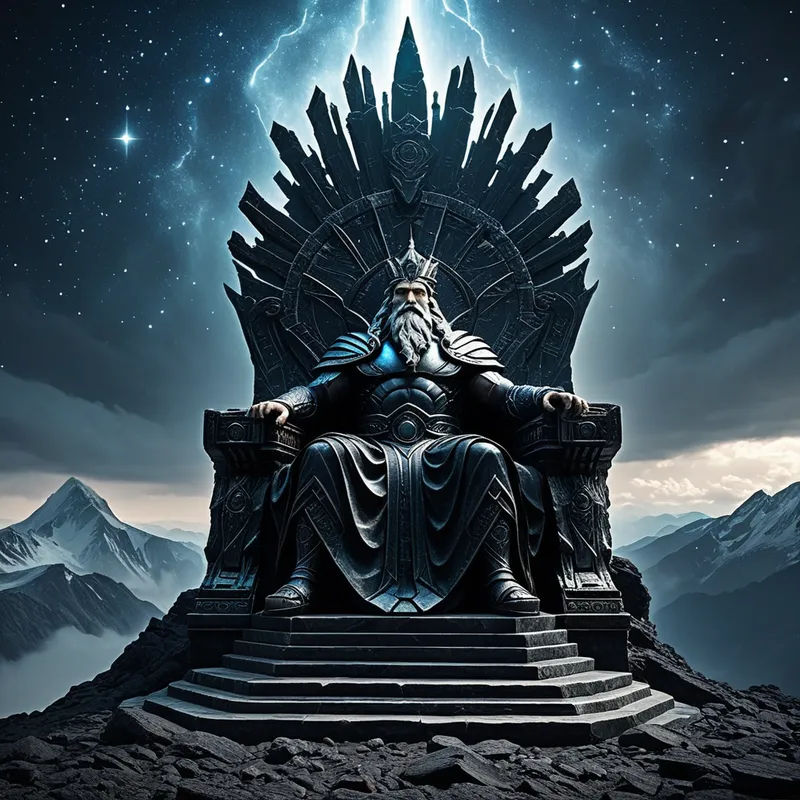
The Throne of Zeus on Mount Ol Myth Meaning & Symbolism
A myth of cosmic sovereignty where Zeus's ascent to a primordial throne tests his rule, forging order from chaos through a confrontation with the deep past.
The Tale of The Throne of Zeus on Mount Ol
Before the ordering of [the world](/myths/the-world “Myth from Tarot culture.”/), before the first river found its bed or the first star was hung in its place, there was the Mountain. Not the bright Olympus, home of laughter and nectar, but its darker, elder sibling: Mount Ol. Its peaks were not of stone, but of solidified time; its shadows were not cast by the sun, but by things forgotten. And at its summit, older than [the Titans](/myths/the-titans “Myth from Greek culture.”/), older than Chaos itself, sat the Throne.
It was not built. It had occurred. A confluence of all potential rule, all unclaimed authority, a vortex of silent, waiting power. The Protogenoi—those formless beings of Earth, Night, and the Deep—knew of it. They whispered of it in the voids between spaces. To sit upon it was not to claim a kingdom, but to define what a kingdom was. It was the fulcrum upon which the cosmos would either tilt into eternal, warring chaos or rise into harmonious, lawful order.
Zeus, the Thunderer, fresh from his victory over the Titans, felt a chill that was not of [the wind](/myths/the-wind “Myth from Various culture.”/). His rule was new, his sky-palace splendid, yet a profound unease gnawed at him. [The earth](/myths/the-earth “Myth from Hindu culture.”/) still trembled with ancient grudges; monsters born of older blood slithered in the deep places. His sovereignty was a title, not yet a truth woven into the fabric of reality. The whispers of Ol reached him. To be truly Pater, he must face the First Seat.
His journey was not across land, but through strata of memory. He descended from the bright air, through the realm of his brother [Hades](/myths/hades “Myth from Greek culture.”/), into the roots of the world. There, he began the ascent of Ol. The mountain tested him not with boulders, but with echoes. He heard the wails of the Titans he had imprisoned, the mournful sighs of the Gaia he had subdued, the shapeless, hungry thoughts of the Protogenoi who resented this new, defining light. Each step was heavier, as if the weight of all past and future rule pressed upon his shoulders.
When he breached [the summit](/myths/the-summit “Myth from Taoist culture.”/), the air was thin and tasted of iron and ozone. No glorious vista greeted him, only a howling, grey void. And in its center, the Throne. It was austere, carved from a substance that drank the light—a black mirror that showed not his reflection, but swirling, formless possibilities. As he approached, the whispers became screams. Phantoms of the old order—[Ouranos](/myths/ouranos “Myth from Global/Universal culture.”/) castrated, [Kronos](/myths/kronos “Myth from Greek culture.”/) devouring—lashed at him with psychic fury. This was the conflict: not for his life, but for his very concept of rule. Would he be a tyrant like [Kronos](/myths/kronos “Myth from Greek culture.”/)? A detached sky-god like [Ouranos](/myths/ouranos “Myth from Global/Universal culture.”/)? Or something new?
With a roar that was part defiance, part agony, Zeus turned his back on the phantoms and sat.
The moment his form touched the seat, the cosmos shuddered. The formless power of the Throne surged into him, a tsunami of raw, chaotic authority. It sought to overwrite him, to make him its vessel. But Zeus did not merely receive; he imposed. He channeled the lightning of his will—not the bolt that smashes, but the spark that organizes. He poured into the Throne’s chaos his new laws: [justice](/myths/justice “Myth from Tarot culture.”/), oath, hospitality, the balance of fates. It was a battle of essences, a silent, titanic struggle within [the crucible](/myths/the-crucible “Myth from Alchemical culture.”/) of his own soul. For an aeon that lasted a heartbeat, he was both the unformed All and the defining One.
Then, silence. [The void](/myths/the-void “Myth from Buddhist culture.”/) cleared. The phantoms faded, not in defeat, but in integration. The Throne of Ol remained, but its substance had changed subtly; it now held a faint, steady pulse, like a distant thunderhead. Zeus rose. He did not feel more powerful; he felt responsible. His sovereignty was now etched into the foundation of things. Order had confronted the memory of Chaos and had not destroyed it, but had given it a frame. He descended, and the world, though unchanged to the eye, felt suddenly, irrevocably, solid.
Cultural Origins & Context
The myth of the Throne on Mount Ol exists in the liminal space between the established Hellenic canon and the deeper, more universal strata of human myth-making. It is not found in a single text like Hesiod’s Theogony, but emerges from fragments, scholarly commentary, and the logical “gaps” in the narrative of Zeus’s consolidation of power. It functions as a necessary myth, answering a profound question: how does a new ruler’s authority become legitimate and foundational, rather than merely the result of a violent coup?
It was likely a tale told not in public festivals, but in philosophical schools, mystery cults, and by poets exploring the metaphysics of power. Its tellers were those who pondered the transition from the old, chthonic world to the new, Olympian order. The myth served to root Zeus’s rule not just in strength, but in a transformative, almost initiatory ordeal. It provided a divine model for the concept that true kingship requires a descent into the chaotic origins of power itself to return and establish a lasting, just law. It was a myth for rulers and philosophers, a narrative justification for civilization’s hard-won order over nature’s raw, primordial potential.
Symbolic Architecture
At its core, the myth is a masterful depiction of the [psyche](/myths/psyche “Myth from Greek culture.”/) confronting its own foundational [authority](/symbols/authority “Symbol: A symbol representing power structures, rules, and control, often reflecting one’s relationship with societal or personal governance.”/). The [Throne](/symbols/throne “Symbol: A seat of authority, power, and sovereignty, representing leadership, divine right, or social hierarchy.”/) of Ol is not a seat of comfort; it is the archetypal [symbol](/symbols/symbol “Symbol: A symbol can represent an idea, concept, or belief, serving as a powerful tool for communication and understanding.”/) of Sovereign Principle itself—the empty, potent center around which [identity](/symbols/identity “Symbol: Identity represents the sense of self, encompassing personal beliefs, cultural background, and social roles.”/) and order coalesce.
The Throne is the silent question at the center of every self: “By what authority do you exist, and what law will you impose upon the chaos of your being?”
Zeus represents the nascent, conscious ego, victorious in its initial struggles (overthrowing the parental Titans, the “personal past”) but now facing the impersonal, [collective unconscious](/symbols/collective-unconscious “Symbol: The Collective Unconscious refers to the part of the unconscious mind shared among beings of the same species, embodying universal experiences and archetypes.”/)—the Protogenoi and the formless void. Mount Ol is the [axis](/symbols/axis “Symbol: A central line or principle around which things revolve, representing stability, orientation, and the fundamental structure of reality or consciousness.”/) of this descent, the [path](/symbols/path “Symbol: The ‘path’ symbolizes a journey, choices, and the direction one’s life is taking, often representing individual growth and exploration.”/) into the deepest layers of the psyche where archetypes exist in their raw, unintegrated state. The phantoms of Ouranos and Kronos are not just memories of fathers; they are the haunting patterns of failed or tyrannical authority that reside within everyone.
The climactic act of sitting is the ultimate psychological risk: the conscious self voluntarily exposing itself to the full, disintegrating force of the unconscious to be remade. The struggle is the process of individuation—[the ego](/myths/the-ego “Myth from Jungian culture.”/) does not annihilate the [chaos](/symbols/chaos “Symbol: In Arts & Music, chaos represents raw creative potential, uncontrolled expression, and the breakdown of order to forge new artistic forms.”/) but engages with it, imposes a personal ethic (Zeus’s laws) upon it, and in doing so, transforms both itself and the unconscious [material](/symbols/material “Symbol: Material signifies the tangible aspects of life, often representing physical resources, desires, and the physical world’s influence on our existence.”/). The newly resonant Throne symbolizes a psyche that has integrated its shadowy origins. Authority is no longer something claimed from the outside (a Titanomachy), but something forged from within through a terrifying, authentic confrontation.
The Dreamer’s Resonance
When this myth stirs in the modern dreamer, it often manifests in periods of life transition where one is called to assume a new level of authority or self-definition: a major promotion, parenthood, artistic creation, or a crisis that demands a foundational re-evaluation of one’s principles.
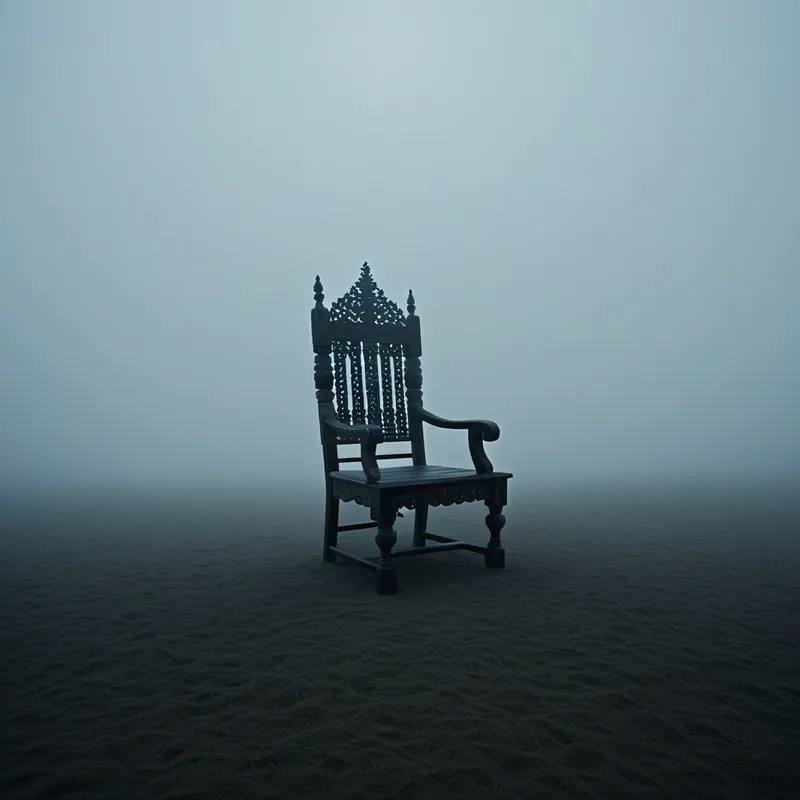
The dream imagery is potent. One might dream of finding a strange, imposing chair in an attic or a forgotten room—a place of memory. Attempting to sit in it brings anxiety, a sense of being watched or judged by vague, shadowy figures. The chair may feel terrifyingly large or painfully small. Alternatively, the dreamer may be climbing an endless, arduous staircase or mountain toward an unknown goal, burdened by a heavy weight (the “weight of [the crown](/myths/the-crown “Myth from Various culture.”/)”). The somatic experience upon waking is key: a feeling of profound exhaustion, as from a great internal labor, or a strange, solid calm, as if a deep-seated tension has been resolved into structure.
This dream pattern signals that the psyche is undergoing the Ol-ascent. The ego is being compelled to leave the comfortable “Olympus” of its current identity and descend to confront the older, more chaotic patterns and potentials within. The dread is the resistance to this necessary ordeal; the pull is the soul’s imperative toward greater, more authentic integration and responsibility.
Alchemical Translation
The myth of the Throne on Mount Ol is a perfect allegory for the alchemical [Magnum Opus](/myths/magnum-opus “Myth from Alchemical culture.”/), specifically the stage of [Nigredo](/myths/nigredo “Myth from Alchemical culture.”/) leading to Albedo. [The prima materia](/myths/the-prima-materia “Myth from Alchemical culture.”/)—the raw, chaotic stuff of the soul—is the unformed power of the Throne and the void of Ol.
The ascent is the descensus ad inferos, the descent into the underworld of the self. The confrontation with the phantoms is the mortificatio, where old, rigid forms of the self (the tyrannical father-complexes) must be seen and dissolved.
The act of sitting is the crucial moment of coniunctio, where the conscious principle (Zeus, the King) engages with the unconscious, feminine principle (the receptive yet chaotic Throne/Void). This is not a gentle union but a violent, transformative clash—the calcinatio by the lightning of conscious will.
The resolution—the solidified world, the Throne now pulsing with ordered resonance—is the achievement of the [Lapis Philosophorum](/myths/lapis-philosophorum “Myth from Alchemical culture.”/). Chaos has been transmuted into Cosmos. The individual has moved from being a ruler who merely controls external territory (the defeated Titans) to a sovereign who has integrated the very source of authority within. [The law](/myths/the-law “Myth from Biblical culture.”/) they now live by is no longer an external imposition, but an emanation of their own hard-won, authentic essence. They have faced the First Seat and returned, not just with a crown, but with a Constitution for the soul.
Associated Symbols
Explore related symbols from the CaleaDream lexicon: