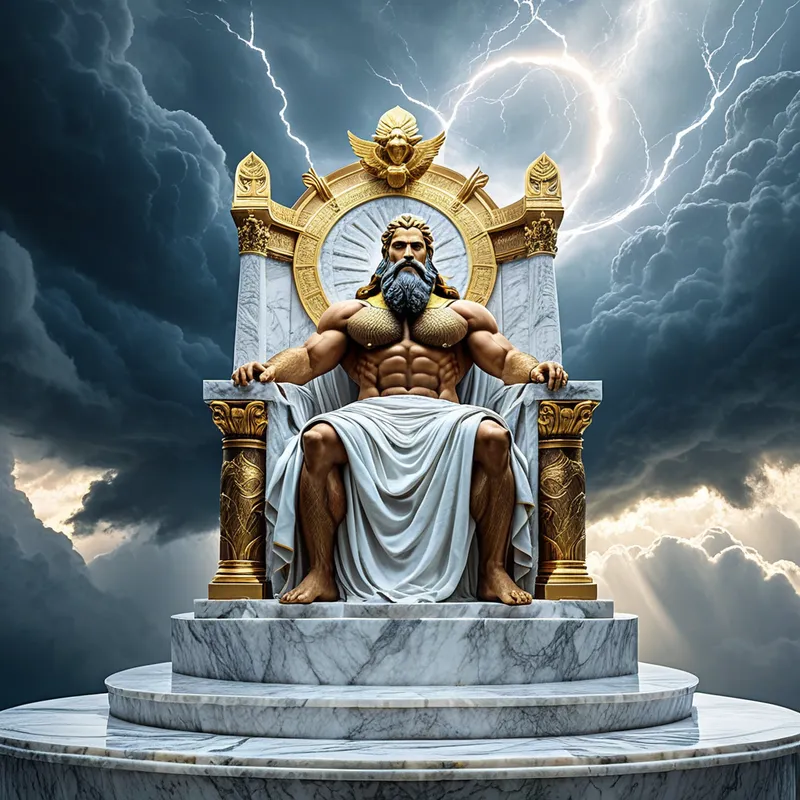
The Throne of Zeus Myth Meaning & Symbolism
The myth of Zeus's throne is the story of cosmic sovereignty, forged in rebellion and secured by divine law, representing the ultimate seat of order and power.
The Tale of The Throne of Zeus
Listen, and hear of the seat that was not built, but born. Before time had a name, there was only chaos—a yawning, formless chasm. From its dark womb sprang the first powers: the wide-breasted Gaia, and the starry [Ouranos](/myths/ouranos “Myth from Global/Universal culture.”/). Their union birthed [the Titans](/myths/the-titans “Myth from Greek culture.”/), mighty and wild as the untamed earth. [Ouranos](/myths/ouranos “Myth from Global/Universal culture.”/), fearing their strength, pushed them back into Gaia’s depths, a crime that cried out for vengeance.
From that pain rose [Kronos](/myths/kronos “Myth from Greek culture.”/), the cunning one. With a sickle of adamant, he severed sky from earth, casting his father down and claiming the vacant throne of the cosmos. But a prophecy echoed in his halls: You too shall be overthrown by your own child. So, [Kronos](/myths/kronos “Myth from Greek culture.”/) swallowed them whole—[Hestia](/myths/hestia “Myth from Global/Universal culture.”/), Demeter, Hera, [Hades](/myths/hades “Myth from Greek culture.”/), [Poseidon](/myths/poseidon “Myth from Greek culture.”/)—each infant divinity consumed into his dark belly.
But his consort, Rhea, her heart a storm of grief and cunning, saved the last. She fled to a Cretan cave, where the very earth rocked with the cries of her newborn. She gave Kronos a stone wrapped in swaddling clothes, and he, in his haste, swallowed the deception. And in that hidden cave, [the child](/myths/the-child “Myth from Alchemy culture.”/) grew. His name was Zeus.
He drank from the she-goat Amaltheia, and his laughter was the first rumble of thunder. When his strength matched his destiny, he returned. With a potion of cunning from the Titaness [Metis](/myths/metis “Myth from Greek culture.”/), he made Kronos disgorge his swallowed siblings, whole and raging. Then began the war that shook the foundations of [the world](/myths/the-world “Myth from Tarot culture.”/)—the Titanomachy. For ten years, the Titans, led by Atlas, clashed with the new gods upon the plains of Thessaly. The cosmos itself was the battlefield.
Victory was not won by strength alone. From [the pit](/myths/the-pit “Myth from Christian culture.”/) of [Tartarus](/myths/tartarus “Myth from Greek culture.”/), Zeus freed the Cyclopes and the hundred-handed Hekatoncheires. The Cyclopes forged his weapons: the thunderbolt, the lightning, and the thunder—the very voice of his will. With these arms and the titanic aid of his new allies, the Titans were cast down, imprisoned in [Tartarus](/myths/tartarus “Myth from Greek culture.”/), with the Hekatoncheires as their eternal guards.
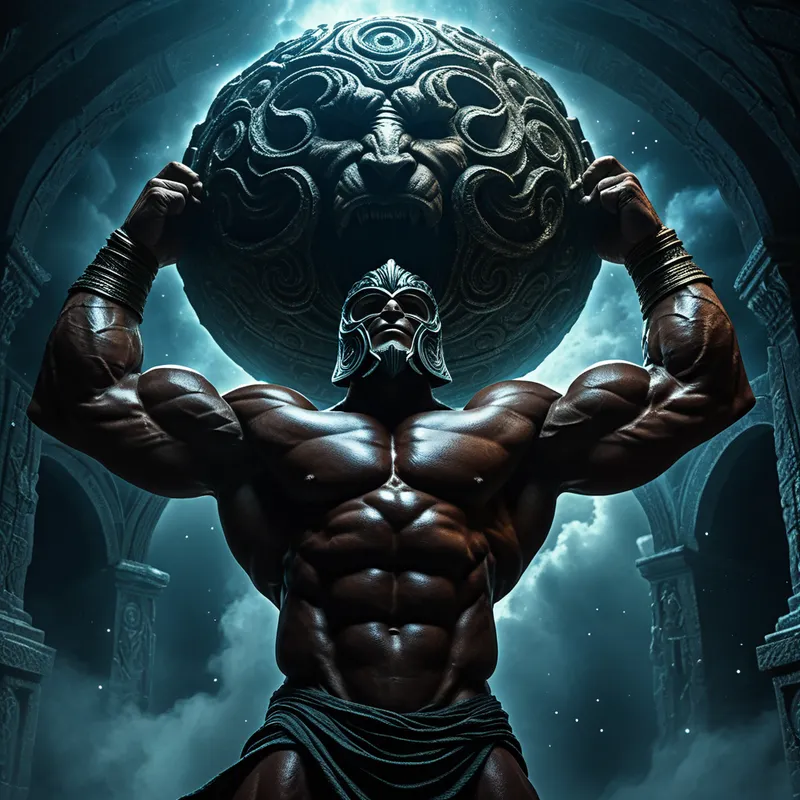
And Atlas, mightiest of them all, was given a burden fitting his ambition: to bear the weight of the celestial dome upon his shoulders for all time.
Then, in the sudden, resonant silence after the cataclysm, the victors gathered on the sun-drenched peaks of [Mount Olympus](/myths/mount-olympus “Myth from Global/Universal culture.”/). The air was clear, scented with nectar and the ozone of recent storms. It was not a palace they built first, nor a temple. It was a seat. From the essence of the cosmos—from [the law](/myths/the-law “Myth from Biblical culture.”/) of victory and the necessity of order—the Throne manifested. It was not ornate by mortal standards; it was authority made solid. To sit upon it was to accept the dreadful, beautiful responsibility for all that is. Zeus ascended. He did not conquer it; he became it. And from that seat, he apportioned the realms: to Hades, the unseen world below; to Poseidon, the shifting seas; for himself, the bright air and the overarching sky. The Throne was the fixed point, the axis. The rebellion was over. The reign had begun.
Cultural Origins & Context
The myth of Zeus’s ascension and his throne is not a single, codified tale from one source. It is a foundational narrative woven from threads in Hesiod’s Theogony and echoed throughout the Homeric hymns and later poetic cycles. It was the grand origin story of the Olympian order, recited by bards and rhapsodes not merely as entertainment, but as sacred cosmology. Its function was societal and psychological: it explained how the chaotic, primordial world of family violence (Ouranos vs. Kronos, Kronos vs. Zeus) was ultimately superseded by a system of law, order, and allotted domains.
The throne itself was central to Greek religious imagination. Cult statues of Zeus, such as the colossal chryselephantine statue by Phidias at Olympia, depicted him enthroned. This was no mere chair; it was the visual anchor of the cosmos—the organized world as opposed to chaos. The myth justified and sanctified the hierarchical structure of the Greek polis, the authority of kings and fathers, and the ultimate, if sometimes inscrutable, [justice](/myths/justice “Myth from Tarot culture.”/) (Dike) that governed human and divine affairs. To understand Zeus’s throne was to understand the principle of sovereignty itself.
Symbolic Architecture
The [Throne](/symbols/throne “Symbol: A seat of authority, power, and sovereignty, representing leadership, divine right, or social hierarchy.”/) of Zeus is the ultimate [symbol](/symbols/symbol “Symbol: A symbol can represent an idea, concept, or belief, serving as a powerful tool for communication and understanding.”/) of achieved and legitimate sovereignty. It is not a seat of tyranny, but of order born from necessary [revolution](/symbols/revolution “Symbol: A fundamental, often violent transformation of social, political, or personal structures, representing upheaval, liberation, and the overthrow of established order.”/). Psychologically, it represents the establishment of a conscious, ruling principle within the individual [psyche](/myths/psyche “Myth from Greek culture.”/).
The throne is not taken; it is manifested when chaos is given a law, and rebellion is transformed into responsibility.
The myth maps a profound psychic transition. Kronos represents the devolving [archetype](/symbols/archetype “Symbol: A universal, primordial pattern or prototype in the collective unconscious that shapes human experience, behavior, and creative expression.”/) of time—the past that consumes the future, the old order that cannot innovate, only repeat and suppress. His reign is the rule of the unconscious compulsion, the “way things have always been.” Zeus’s rebellion is the necessary uprising of a new [consciousness](/symbols/consciousness “Symbol: Consciousness represents the state of awareness and perception, encompassing thoughts, feelings, and experiences.”/). His allies are crucial: Metis (cunning wisdom) and the Cyclopes (focused, creative force). Victory requires both intelligence and potent, newly-forged tools (the thunderbolts of focused will and decisive [action](/symbols/action “Symbol: Action in dreams represents the drive for agency, motivation, and the ability to take control of situations in waking life.”/)).
The [fate](/symbols/fate “Symbol: Fate represents the belief in predetermined outcomes, suggesting that some aspects of life are beyond human control.”/) of Atlas is a pivotal symbol. He who sought to hold up the old sky (the [Titan](/symbols/titan “Symbol: Titans represent immense power, strength, and a connection to the primordial forces of nature and creation.”/)’s dominion) is condemned to eternally bear its [weight](/symbols/weight “Symbol: Weight symbolizes burdens, responsibilities, and emotional loads one carries in life.”/). He embodies the crushing psychological burden of upholding an outdated worldview or carrying a [responsibility](/symbols/responsibility “Symbol: Responsibility in dreams often signifies the weight of duties and the expectations placed upon the dreamer.”/) that is not truly one’s own—the [weight](/symbols/weight “Symbol: Weight symbolizes burdens, responsibilities, and emotional loads one carries in life.”/) of the “shoulds” imposed by a fallen regime.
The Dreamer’s Resonance
When this myth stirs in the modern dreamer, it often signals a profound crisis of authority within the psyche. Dreaming of an immense, empty throne can evoke feelings of daunting potential and terrifying vacancy—a call to step into a role of greater self-authority that the dreamer feels unprepared for. Conversely, dreaming of being forcibly removed from a throne, or of it crumbling, may speak to the collapse of an existing identity structure, a job, a relationship, or a belief system that once provided a sense of order.
Somatically, this process can feel like the “Atlas burden”—a literal ache in the shoulders and neck, a feeling of carrying a weight that is not authentically one’s own. The dream-work involves recognizing which inner “Titans” (outmoded patterns, parental complexes, societal expectations) one is still at war with, or still carrying. The resolution lies not in simply defeating them, but in consigning them to their proper place—the deep containment of Tartarus—and freeing the “Hekatoncheires,” the hundred-handed capacities for holding and managing the complexities of one’s new reality.

Alchemical Translation
The alchemical journey modeled here is the transmutation of rebellion into sovereignty. The initial state is one of oppression under a Saturnian (Kronos) rule: rigid, time-bound, and devouring of potential. The [nigredo](/myths/nigredo “Myth from Alchemical culture.”/), or darkening, is the experience of being swallowed, of feeling one’s true voice and power trapped within the belly of an old complex.
The [separatio](/myths/separatio “Myth from Alchemical culture.”/) is the act of rebellion—the courageous, often frightening decision to challenge the internalized status quo. This requires the potion of Metis (deep, strategic self-reflection) and the forging of new weapons in the workshop of the Cyclopes (focused skill-building, developing one’s unique talents and voice). The great battle is the inner conflict, the “Titanomachy” of the soul, where old habits and new possibilities war for dominion.
Individuation is not the absence of conflict, but the establishment of a ruling principle conscious enough to administer it.
Victory leads to the coniunctio, the sacred division of realms. This is the integration of the psyche’s different aspects (the emotional depths of Poseidon, the unconscious riches of Hades) under [the aegis](/myths/the-aegis “Myth from Global/Universal culture.”/) of a conscious, overseeing Self (Zeus). The Throne that then manifests is the [lapis philosophorum](/myths/lapis-philosophorum “Myth from Alchemical culture.”/), the philosopher’s stone of this process: it is the integrated, centered Self, capable of holding authority without tyranny, administering inner justice ([Themis](/myths/themis “Myth from Global/Universal culture.”/)), and weathering the storms of emotion and fate. To claim this throne is to move from a life ruled by the ghosts of the past to a life authored by the sovereign present.
Associated Symbols
Explore related symbols from the CaleaDream lexicon: