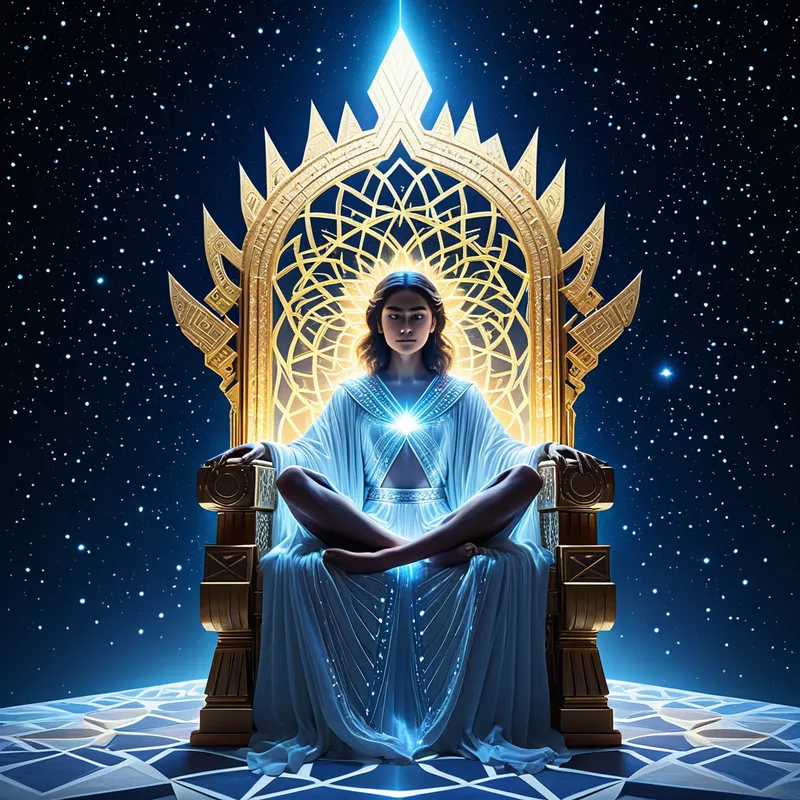
The Throne of Grace Myth Meaning & Symbolism
A myth of a divine spark, Sophia, whose yearning creates a flawed world, and the Throne of Grace that offers a path of gnosis for the soul's return.
The Tale of The Throne of Grace
Listen. Before the worlds you know, there was the Fullness, the [Pleroma](/myths/pleroma “Myth from Gnostic culture.”/). It was a silence so profound it sang, a light so pure it had no shadow. Within this perfection, the last of the Aeons, she who was named [Sophia](/myths/sophia “Myth from Gnostic culture.”/), gazed not at the Source, but into [the abyss](/myths/the-abyss “Myth from Kabbalistic culture.”/) of her own heart. A yearning stirred within her—a desire not for the Father, but to know the Father’s power, to grasp the un-graspable, to give birth from herself alone.
This thought, this passionate, solitary longing, was a vibration that could not be contained within the harmony of [the Pleroma](/myths/the-pleroma “Myth from Gnostic culture.”/). It was a note of discord. And from this note, from Sophia’s anguish and her wish made without her divine counterpart, something was cast out. It fell. It was not a child, but a miscarriage—a formless, blind, and howling entity, the Demiurge. Shamed and grieving, Sophia was restrained at the border of the Fullness, a boundary called the Horos.
But her grief did not end. [The Demiurge](/myths/the-demiurge “Myth from Gnostic culture.”/), ignorant of the Pleroma above, believing itself alone and supreme, took the psychic power shed by Sophia in her passion and began to craft a world. He fashioned the heavens and [the earth](/myths/the-earth “Myth from Hindu culture.”/), the stars and the seas, but it was a prison of matter, a [labyrinth](/myths/labyrinth “Myth from Various culture.”/) of forgetfulness. He modeled humanity from the clay of this world, but within their breasts he unknowingly breathed the spark of his mother—the divine light, the [pneuma](/myths/pneuma “Myth from Greek culture.”/), a fragment of Sophia herself.
And so humanity awoke, blind in a dazzling world, hungry in a world of plenty, feeling a homesickness for a home they could not name. They were orphans in a kingdom built by an orphaned god.
Then, from the highest light, a mercy descended. Not Sophia herself, for she was bound, but an emanation of the collective compassion of the Aeons. It took the form of a Soter, a redeemer. But before the redeemer could walk the earth, a place had to be prepared. At the very limit of the heavens, just below the boundary where Sophia wept, a station was established. It was not in the Pleroma, nor was it in the dark world. It was a waystation, a beacon in the cosmic night.
This was the Throne of Grace.
It shone with a borrowed light, softer than the unbearable radiance of the Fullness, yet purer than any star in the Demiurge’s sky. It was a seat of intercession and remembrance. From this throne, the redeemer would descend into the nightmare of history, wearing the garment of flesh. And to this throne, the redeemer would guide the awakened souls—those who heard the call, the gnosis, within them. It was the first step out of [the labyrinth](/myths/the-labyrinth “Myth from Greek culture.”/), the place where the soul, heavy with the forgetfulness of matter, could remember its true name, shed the psychic garments of [the world](/myths/the-world “Myth from Tarot culture.”/), and prepare for the final, terrifying leap across the abyss, back into the arms of the weeping, waiting Sophia, and beyond her, into the silent song of the Fullness.

Cultural Origins & Context
This myth, in its many variations, is not the product of a unified “Gnostic” church but emerges from the fragmented, persecuted, and intensely mystical sects of the early centuries CE—groups like the Valentinians and Sethians. It was an underground theology, passed in secret gatherings, whispered in [the shadow](/myths/the-shadow “Myth from Jungian culture.”/) of the rising orthodox Christian empire. The storytellers were often teachers who saw themselves not as priests of a new creed, but as guides (didaskaloi) for those feeling spiritually orphaned by the world.
Its societal function was radical. It provided a symbolic framework that made profound sense of human suffering, divine absence, and the palpable injustice of the material world. It was a myth for the alienated, offering not salvation from sin, but liberation from ignorance (agnoia) and the very fabric of a flawed reality. The Throne of Grace served as a crucial mythological device—it was the guarantee that the gulf between the divine and the human was not absolute, that a bridge of conscious compassion existed, even from within the system of exile itself.
Symbolic Architecture
At its [heart](/symbols/heart “Symbol: The heart symbolizes love, emotion, and the core of one’s existence, representing deep connections with others and self.”/), this is a myth of the [psyche](/myths/psyche “Myth from Greek culture.”/)’s [origin](/symbols/origin “Symbol: The starting point of a journey, often representing one’s roots, source, or initial state before transformation.”/) and trajectory. Sophia is not a distant [goddess](/symbols/goddess “Symbol: The goddess symbolizes feminine power, divinity, and the nurturing aspects of life, embodying creation and wisdom.”/) but the very [archetype](/symbols/archetype “Symbol: A universal, primordial pattern or prototype in the collective unconscious that shapes human experience, behavior, and creative expression.”/) of the [soul](/symbols/soul “Symbol: The soul represents the essence of a person, encompassing their spirit, identity, and connection to the universe.”/)’s creative, yearning, and erring [aspect](/symbols/aspect “Symbol: A distinct feature, quality, or perspective of something, often representing a partial view of a larger whole.”/). Her “fall” is not a moral [crime](/symbols/crime “Symbol: Crime in dreams often symbolizes guilt, inner conflict, or societal rules that are being challenged or broken.”/) but a psychological inevitability: the [moment](/symbols/moment “Symbol: The symbol of a ‘moment’ embodies the significance of transient experiences that encapsulate emotional depth or pivotal transformations in life.”/) [consciousness](/symbols/consciousness “Symbol: Consciousness represents the state of awareness and perception, encompassing thoughts, feelings, and experiences.”/) turns [inward](/symbols/inward “Symbol: A journey toward self-awareness, introspection, and the exploration of one’s inner world, thoughts, and unconscious mind.”/) upon itself, fascinated by its own potential, separate from the unifying Self. This act of introspection births [the ego](/myths/the-ego “Myth from Jungian culture.”/)—the Demiurge—a [creator](/symbols/creator “Symbol: A figure representing ultimate origin, divine power, or profound authorship. Often embodies the source of existence, innovation, or personal destiny.”/) who, in its arrogance, constructs a complex, compelling, but ultimately false [reality](/symbols/reality “Symbol: Reality signifies the state of existence and perception, often reflecting one’s understanding of truth and life experiences.”/) (the [persona](/symbols/persona “Symbol: The social mask or outward identity one presents to the world, often concealing the true self.”/), the adapted self) and identifies it as the whole of existence.
The world is not a punishment, but a symptom of a soul in love with its own reflection.
Humanity, then, symbolizes the individual who lives within this ego-constructed reality, yet carries within a spark of that original, deeper consciousness (the pneuma). This is the feeling of “there must be more than this,” the core of spiritual longing. The [Throne](/symbols/throne “Symbol: A seat of authority, power, and sovereignty, representing leadership, divine right, or social hierarchy.”/) of Grace is the [symbol](/symbols/symbol “Symbol: A symbol can represent an idea, concept, or belief, serving as a powerful tool for communication and understanding.”/) of the transcendent function—the psychic [organ](/symbols/organ “Symbol: An organ symbolizes vital aspects of life and health, often representing one’s emotional or physical state.”/) that emerges from the [tension](/symbols/tension “Symbol: A state of mental or emotional strain, often manifesting physically as tightness, pressure, or unease, signaling unresolved conflict or anticipation.”/) between the ego’s world and the call of [the Self](/myths/the-self “Myth from Jungian culture.”/). It is not the Self (the [Pleroma](/symbols/pleroma “Symbol: In Gnostic cosmology, the Pleroma is the divine fullness or totality of spiritual powers, representing the realm of perfection beyond the material world.”/)), but the first conscious recognition of a reality beyond the ego’s domain. It is the [capacity](/symbols/capacity “Symbol: A measure of one’s potential, limits, or ability to contain, process, or achieve something, often reflecting self-assessment or external demands.”/) for self-[reflection](/symbols/reflection “Symbol: Reflection signifies self-examination, awareness, and the search for truth within oneself.”/), for grace, for receiving the insights ([gnosis](/symbols/gnosis “Symbol: Direct, intuitive spiritual knowledge or enlightenment that transcends ordinary understanding, often associated with mystical experiences and esoteric traditions.”/)) that begin the process of unraveling the ego’s illusion.
The Dreamer’s Resonance
When this myth stirs in the modern unconscious, it often manifests not as a literal throne, but as a pattern of experience. The dreamer may find themselves in an endless, bureaucratic building (the archonic world) seeking a permit or key that is always withheld. The somatic feeling is one of profound frustration, weight, and suffocation. Alternatively, they may dream of discovering a hidden room in their own house, a portal, or a forgotten, beautiful object that radiates a strange peace—the spark of pneuma.
The pivotal dream symbol is the waystation or beacon. A quiet train platform at night, a lighthouse on a foggy shore, a serene waiting room in the midst of chaos. This is the Throne of Grace active in the psyche. These dreams often occur during life transitions, depressive episodes, or after a painful disillusionment—when the ego’s constructed world is failing. The psychological process is one of initial despair ([the fall](/myths/the-fall “Myth from Biblical culture.”/)) giving way to a quiet, internal reorientation. The dream is signaling that the psyche is building a capacity for self-compassion and witnessing, creating an inner space of grace from which the long journey of re-collection can begin.
Alchemical Translation
The individuation process modeled here is not one of heroic conquest, but of humble remembrance and return. The first alchemical stage, the [nigredo](/myths/nigredo “Myth from Alchemical culture.”/), is lived experience itself: the darkness, confusion, and suffering of life in the “world,” which the myth reframes not as meaningless pain, but as the necessary evidence that one is identified with a false reality.
The call to gnosis is the albedo, the whitening. This is the arrival at the Throne of Grace within. It is the moment one stops trying to fix the nightmare on its own terms and instead turns inward to ask, “Who is the dreamer having this dream?” This requires a sacrifice—the sacrifice of the ego’s certainty and its god-like control. One must sit in the grace of not-knowing, in the intercessory space between the old identity and the unknown Self.
Liberation is not an ascent, but a recollection. The throne is not a destination, but the seat from which one unlearns the world.
The final stages, the citrinitas and [rubedo](/myths/rubedo “Myth from Alchemical culture.”/), are the guided journey from the Throne back to the Source. This is the integration of the redeemed Sophia aspect—the creative, intuitive, feminine principle that is no longer errant but now serves as a guide. The soul, having gathered its scattered fragments of light (insights, healed wounds, acknowledged shadows), finally makes the leap across the Horos—the dissolution of the last boundary between the individual consciousness and the transpersonal Self. The orphan comes home, not by becoming a ruler, but by realizing it was never truly separate. The Throne of Grace, its purpose fulfilled, dissolves back into the light from which it was emanated, a temporary structure of mercy in the soul’s long night of exile.
Associated Symbols
Explore related symbols from the CaleaDream lexicon: