The Three Treasures Myth Meaning & Symbolism
A cosmic tale of theft, restoration, and the sacred energies of essence, vitality, and spirit that animate the universe and the self.
The Tale of The Three Treasures
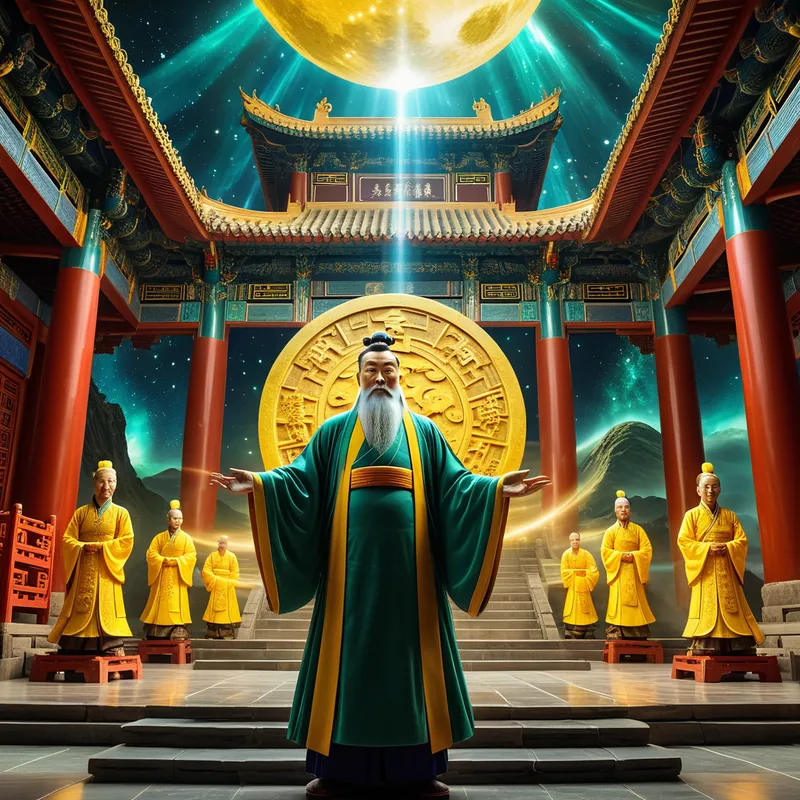
In the time before time was measured, when the Dao breathed its first silent sigh, the heavens were not yet settled. The Celestial Bureaucracy, that vast and orderly mirror of the earthly realm, was in its infancy. At its heart, in a palace of jade and cloud, sat the Jade Emperor, keeper of the cosmic mandate. Yet, for all his celestial authority, a profound unease stirred in the chambers of his spirit. The world below was raw, chaotic; its creatures lived brief, frantic lives, burning like sparks and vanishing into the dark. They possessed the clay of form, but not the fire of enduring spirit; they had the water of life, but not the vessel to contain it.
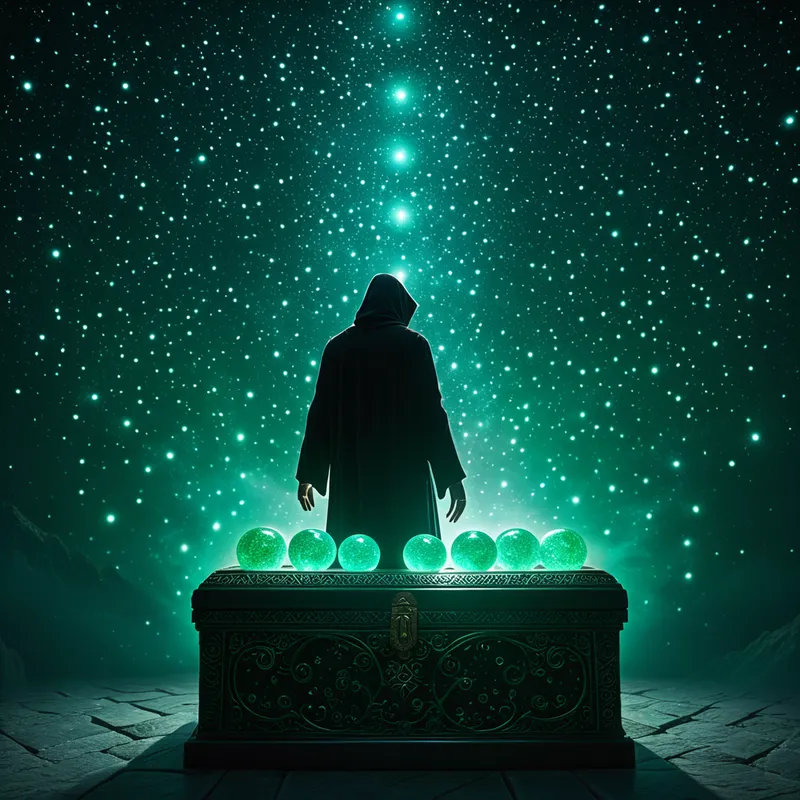
This sorrow moved the heart of Laozi, the Ancient One, who dwelt beyond the stars. He descended on a ray of purple light, bearing a casket of unblemished jade. Within it, humming with the music of the spheres, pulsed three luminous treasures. The first was the Treasure of Jing, a orb of deep, sanguine light, dense as a mountain root and sweet as a hidden spring. It was the seed of all physical form, the primal essence. The second was the Treasure of Qi, a sphere of vibrant, golden vapor, swirling like a dragon in flight. It was the breath that animates the seed, the dynamic force of life itself. The third was the Treasure of Shen, a pearl of pure, white radiance, still and vast as a winter sky. It was the light of awareness, the spirit that comprehends the Dao.
With great ceremony, the Jade Emperor, Laozi, and the Yellow Emperor convened. They opened the casket at the axis of heaven and earth. A triple-rayed light poured forth, weaving itself into the fabric of creation. Where Jing touched, longevity took root; where Qi flowed, vitality surged; where Shen shone, wisdom dawned. Harmony, for a timeless moment, seemed assured.
But in the deepest crevices of the cosmos, where the light of the Dao grows thin, a being of lack observed this gift. This was no demon of flame and fury, but a thief of profound silence—a entity born from the primordial fear of dissipation. It coveted not to destroy, but to hoard; to swallow the light and sit in the cold satisfaction of absolute possession. With a shadow that cast no darkness, it slipped past the celestial guards, its form a void that drank in starlight. It reached into the jade casket and stole the three glowing treasures, fleeing to a fortress of frozen comets at the edge of reality.
The heavens trembled. The flow of life in the mortal realm stuttered. Seasons faltered; wisdom faded into superstition; vitality ebbed into lethargy. The Jade Emperor’s court was in dismay. The theft was an offense not merely against law, but against the very principle of generative flow.
The restoration would not come by legion, but by essence. The Yellow Emperor, master of inner alchemy, did not draw a sword. Instead, he sat in meditation at the center of the palace. He turned his awareness inward, gathering the scattered echoes of the Three Treasures that still resonated within his own being—the Jing of his body, the Qi of his breath, the Shen of his mind. He aligned them into a single, focused beam of intent, a compass needle of pure orientation. Laozi, the embodiment of the Dao, extended his hand, not in grasping, but in allowing. He became a conduit for the Wu Wei of the cosmos itself.
Guided by the Yellow Emperor’s inner alignment, the silent pull of the stolen treasures became audible. The thief, in its frozen fortress, found the treasures it coveted becoming restless. They resonated with the call of their true function—not to be owned, but to flow. Jing yearned for embodiment, Qi for movement, Shen for connection. The vault of comets could not contain a song that belonged to the entire symphony. One by one, they dissolved the thief’s hoarding grasp, not by conflict, but by fulfilling their own nature. They streamed back across the void, not as captives returned, but as rivers returning to the sea.
The light was restored, not to the casket, but woven more deeply into the fabric of all that is. The lesson was written in the event itself: the treasures were never meant to be guarded in a palace, but integrated into the very process of life. The cosmic order was re-established, not by force, but by a realignment with the inherent, nurturing power of the Dao.
Cultural Origins & Context
The concept of the Sanbao is foundational to Taoist thought, appearing in philosophical, religious, and alchemical texts. While the specific narrative of the celestial theft is a mythological elaboration, its roots are in the deepest strata of Taoist practice. The earliest clear reference is in the Daodejing, Chapter 67, where Laozi states, “I have three treasures, which I hold and cherish. The first is compassion, the second is frugality, the third is not daring to be ahead in the world.” This ethical triad later evolved and merged with the vitalistic cosmology of Taoist inner alchemy (Neidan).
By the late Han dynasty and into the Tang and Song periods, as Taoism developed its rich pantheon and mythological corpus, the abstract principles of Jing, Qi, and Shen were personified and narrativized. This myth served a crucial pedagogical function. In a culture with a strong oral and illustrative tradition, stories of the Jade Emperor, Laozi, and the Yellow Emperor grappling with cosmic imbalance made the elusive internal processes of alchemy tangible. It was told by masters to disciples not as mere folklore, but as a map encoded in allegory. Its societal function was to teach that health, longevity, and spiritual insight (Xian) were not gifts capriciously granted by gods, but the natural result of recognizing, conserving, and harmonizing sacred energies that are one’s birthright and microcosmic reflection of the macrocosm.
Symbolic Architecture
The myth is a masterclass in symbolic psychology. The Three Treasures are not external objects, but fundamental strata of existence.
- Jing (Essence) symbolizes our inherited, foundational capital—the body, genetic potential, and deep life force. It is the “root.” Its theft represents the universal human experience of depletion, aging, and the sense that our primal vitality is being drained by the demands of life.
- Qi (Vital Energy) symbolizes the dynamic process of life—our breath, emotions, and the flow of interaction between self and world. It is the “flow.” Its theft manifests as stagnation, lethargy, anxiety, and the feeling of being stuck or disconnected from life’s current.
- Shen (Spirit) symbolizes consciousness, awareness, and transcendent insight—the capacity for reflection, wisdom, and connection to the greater whole. It is the “light.” Its theft results in confusion, meaninglessness, spiritual alienation, and the “dark night of the soul.”
The theft is not an external catastrophe, but the internal condition of alienation from our own nature.
The cosmic thief is the shadow aspect of the ego—the part that believes wholeness can be achieved through possession, hoarding, and separation. It is the psyche turned in on itself, attempting to secure its treasures by isolating them, which ultimately leads to their paralysis and its own desolation. The restoration via inner alignment (Huangdi) and effortless action (Wu Wei) models the core Taoist solution: harmony is not fought for, but realized through attunement. The treasures return when they are recognized as aspects of the self in tune with the Dao.
The Dreamer’s Resonance
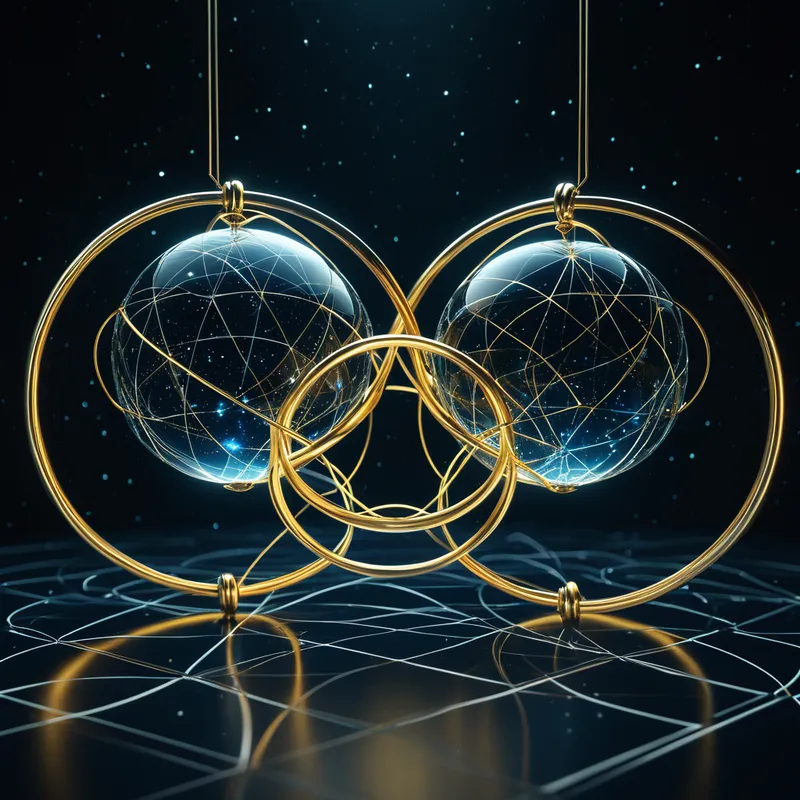
When this myth stirs in the modern unconscious, it often surfaces in dreams of profound lack or urgent seeking. One might dream of a priceless heirloom stolen from a childhood home (Jing), of a car running out of fuel or a battery dying at a critical moment (Qi), or of being in a familiar place that has become utterly alien and meaningless (Shen). The setting is frequently liminal—empty airports, deserted houses, vast libraries with illegible books.
Somatically, this can correspond to periods of burnout (Jing depletion), chronic anxiety or depression (Qi dysregulation), or existential crisis (Shen obscured). The dream is not merely reporting a state, but initiating a process. The feeling of theft creates the necessary tension for the quest. The dream ego’s frantic search for the external thief mirrors the psyche’s dawning realization that the solution is not “out there.” The turning point in such dreams often involves the dreamer stopping the search, sitting down, and looking inward—a direct enactment of the Yellow Emperor’s meditative realignment. The treasures are then “found” in the most obvious, yet overlooked, place: within the dreamer’s own body, breath, and field of awareness.

Alchemical Translation
The myth provides a complete model for the individuation process, framed as Taoist inner alchemy. The journey from fragmentation to wholeness follows its arc.
- Theft (Awareness of Lack): This is the beginning of the psychological journey—the “symptoms” that force us to attend to ourselves. It is the crisis that shatters the illusion of being whole while living in a state of self-alienation. We feel our energy is stolen by others, our time is robbed by obligations, our spirit is dimmed by the world.
- The Inner Alignment (Turning Inward): This is the critical shift from projection to introspection. Like the Yellow Emperor, we must stop seeking the thief in the external world (blaming circumstances, others, fate) and instead cultivate inner observation. In psychological terms, this is the development of consciousness, or the “transcendent function,” which can hold the tension of opposites.
- The Nature of the Treasures (Understanding the Psyche): We come to know Jing as the wisdom of the body and its limits, requiring conservation and respectful care. We experience Qi as the flow of psychic energy, which must be allowed to move without blockages (repressed emotions) or wasteful leakage (compulsive action). We cultivate Shen as the observing, non-attached consciousness that can witness the play of Jing and Qi without being consumed by it.
- The Return (Integration): The treasures “return” not as a recovery of a lost past, but as a new synthesis. Integrated Jing becomes embodied presence and resilience. Integrated Qi becomes authentic expression and creative vitality. Integrated Shen becomes intuitive wisdom and a sense of participating in a meaningful whole.
The alchemical furnace is not found in a cave, but in the still point between inhalation and exhalation, where the stolen self is remembered and remade.
The myth concludes not with the treasures locked away, but woven into the fabric of being. So too, the goal of individuation is not to achieve a static state of perfection, but to live in a dynamic, flowing integration where essence, energy, and spirit cooperate spontaneously—a human life living in accordance with its own inherent, and now realized, Dao.
Associated Symbols
Explore related symbols from the CaleaDream lexicon: