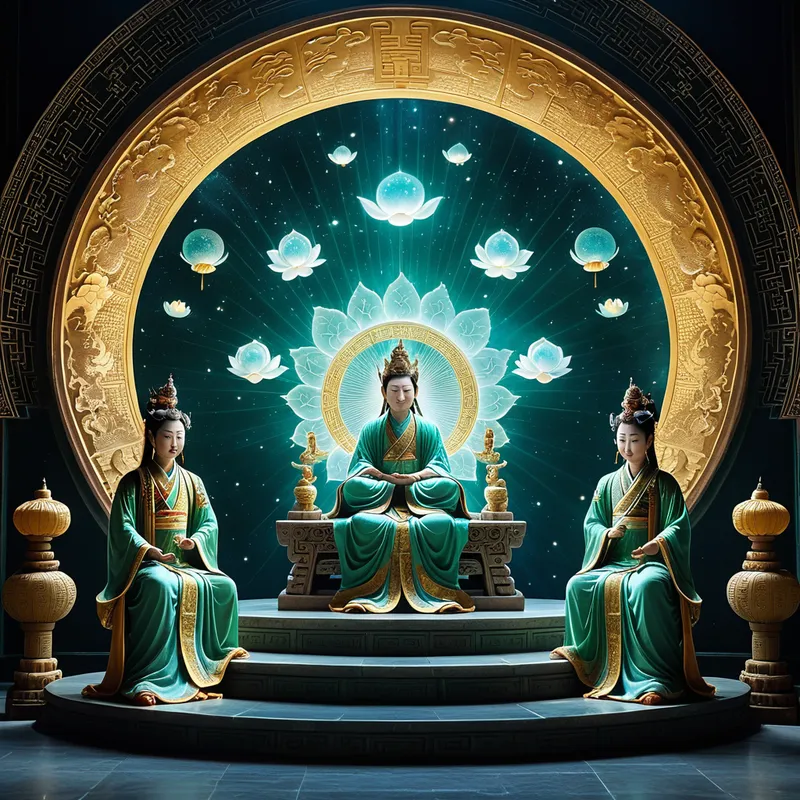
The Three Pure Ones Myth Meaning & Symbolism
The supreme Taoist trinity embodying primordial essence, universal law, and divine power, representing the foundational principles of cosmic and psychic order.
The Tale of The Three Pure Ones
Before the ten thousand things took form, there was the Dao. From its profound and silent womb, a breath was exhaled—a vibration that crystallized into a single point of pure, undifferentiated light. This was the Yuanshi Tianzun. He did not awaken, for he had never slept; he simply was, the uncreated ancestor of all creation, seated upon a throne of lotus and cloud in the Heaven of Jade Purity. In his stillness was the potential of every star, every mountain, every breath.
From the radiance of this Primordial One, a second light coalesced. This light was not static but dynamic, a swirling pattern of order emerging from the formless. This was the Lingbao Tianzun. Where Yuanshi held the seed, Lingbao held the blueprint. In his hands rested the sacred texts—not of paper and ink, but of celestial jade slips inscribed with the patterns of the Tao. His heaven was the Heaven of Highest Purity, a library of cosmic law where the music of the spheres was written in silent scripture.
And from the harmonious interplay of Primordial Essence and Cosmic Law, a third and final brilliance was born. This light was vibrant, creative, and imbued with the power to manifest. This was the Daode Tianzun, also known as the Taishang Laojun. His realm was the Heaven of Great Purity, a forge of divine energy. Here, the abstract laws received from Lingbao were given force and form. He is often depicted with the cosmic fan that stirs the cauldron of creation, the alchemist who transforms principle into reality.
They are not three separate gods quarreling on a mountain, but three aspects of a single, ineffable truth—the holy trinity of the Tao. They exist in eternal council, a silent symphony of being, ordering, and doing. Their myth is not one of battle or quest, but of sublime, perpetual emanation. They are the breath, the word, and the act of the cosmos itself.
Cultural Origins & Context
The myth of the Sanqing is the theological pinnacle of religious Taoism, a tradition that evolved over centuries from the philosophical roots of Daodejing. While early Taoist thought focused on the impersonal Dao, by the late Han dynasty and into the Six Dynasties period, a pantheon of deities began to form, systematizing the cosmos into celestial bureaucracies. The Three Pure Ones emerged as the supreme administrators of this divine order.
Their story was not passed down by bards around a fire, but by priests, monks, and alchemists in monasteries and imperial courts. It was codified in esoteric texts like the Lingbao Scriptures. Their primary societal function was to provide a complete cosmological model that explained the origin and structure of reality, offering a path for adherents to spiritually ascend through meditation, ritual, and ethical living to ultimately harmonize with these pure celestial principles.
Symbolic Architecture
The Three Pure Ones represent the fundamental triadic structure of existence, a pattern echoed in countless wisdom traditions. They are not merely gods “out there,” but a map of the cosmos and the psyche.
Yuanshi Tianzun symbolizes the Unconscious Source—the undifferentiated, potential-laden ground of being. He is the psyche before consciousness, the blank canvas, the deep well of the Self from which all else springs.
Lingbao Tianzun symbolizes the Ordering Principle—the archetypal patterns, laws, and structures that give form to chaos. He is the logos, the inherent grammar of reality, the DNA of the cosmos and the innate moral and psychological laws within us.
Daode Tianzun symbolizes the Manifesting Power—the energy that brings the blueprints of Lingbao into tangible reality. He is the focused will, the creative act, the alchemical fire that transforms inner potential into outer life.
The triad is a single process: from the formless potential of the Self (Yuanshi), through the structuring wisdom of the archetypes (Lingbao), to the embodied creation of the personality (Daode).
Together, they model a complete system: Source, Law, and Expression. Psychologically, they represent the journey from the unconscious totality of the Self, through the mediating structures of the ego and persona, to a life lived in authentic alignment with one’s deepest nature.
The Dreamer’s Resonance
When this mythic pattern stirs in the modern dreamer, it rarely appears as three bearded sages. Instead, it manifests as a profound experience of triadic wholeness or its disturbing absence.
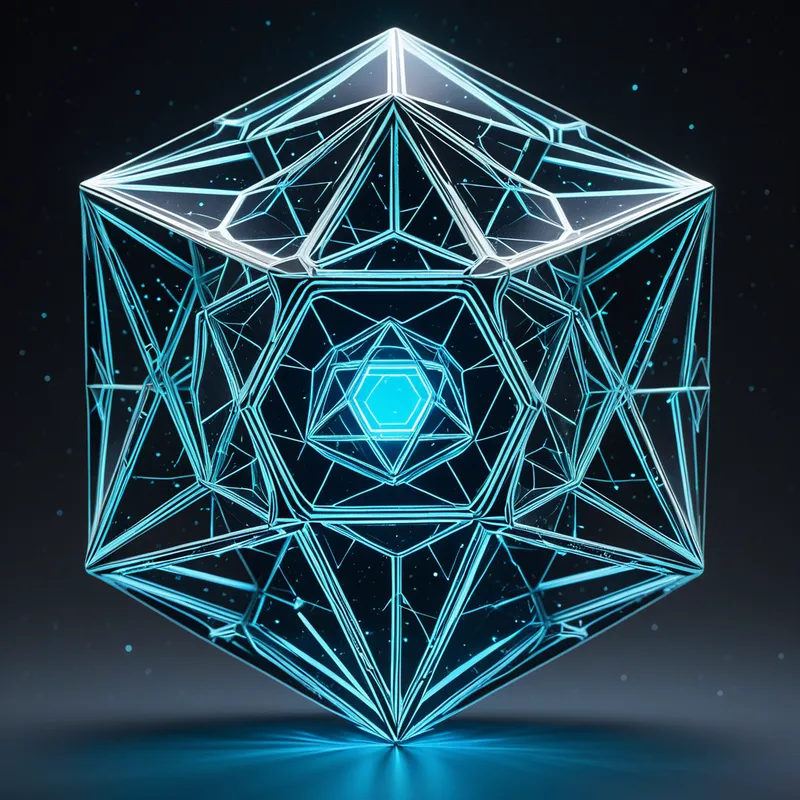
One might dream of three identical keys, three interconnected rooms (one empty and silent, one full of complex blueprints, one a vibrant workshop), or a triangle that completes itself. These are dreams of psychic integration, signaling that the dreamer is connecting with their foundational sources—their raw potential, their inner moral compass, and their capacity for action—and finding them in harmony.
Conversely, dreams of a broken triad—a missing figure, two forces fighting while a third lies dormant, or a triangle that will not hold its shape—point to a critical imbalance. Perhaps the dreamer is all chaotic potential with no structure (missing Lingbao), or all rigid rule-following with no connection to source or creativity (missing Yuanshi and Daode). These dreams are a somatic call from the psyche to restore its inherent, tripartite order. The body may feel this as being “ungrounded,” “scattered,” or “stuck in a loop.”
Alchemical Translation
The individuation process, the journey toward psychological wholeness, is precisely the work of integrating the Three Pure Ones within oneself. It is an inner alchemy.
First, one must descend to meet their own Yuanshi—to sit in the silent, often frightening, void of the unconscious Self. This is the nigredo of alchemy, the blackening, where one confronts the raw, unformed material of their being without judgment.
Then, one must engage with their Lingbao—to discern the innate patterns and laws that govern their soul. What are the non-negotiable truths of your existence? What archetypal stories are you living? This is the albedo, the whitening, where the chaotic material begins to be ordered according to its own inherent nature.
Finally, one must harness their Daode—to take that self-knowledge and structured understanding and forge it into a life. This is the conscious application of will, the creation of a personality that is a true vessel for the Self. This is the rubedo, the reddening, the creation of the philosophical gold: an individuated life.
The goal is not to worship the Three Pure Ones in a temple, but to become the temple in which their triad is perfectly balanced. The adept does not pray to Daode Tianzun for power; they stoke their own inner alchemical fire to manifest their destiny.
The modern struggle is often a denial of one or more of these aspects. We ignore the silent call of Yuanshi (our intuition, our dreams) in favor of endless doing. We rebel against the necessary laws of Lingbao (personal limits, ethical boundaries) in the name of freedom. We lack the disciplined fire of Daode to follow through. The myth instructs us that transcendence is not escape from reality, but the profound ordering and expression of our most fundamental reality. We are, each of us, a microcosm of the Jade Pure Heaven, tasked with governing our inner universe with the same sublime harmony.
Associated Symbols
Explore related symbols from the CaleaDream lexicon: