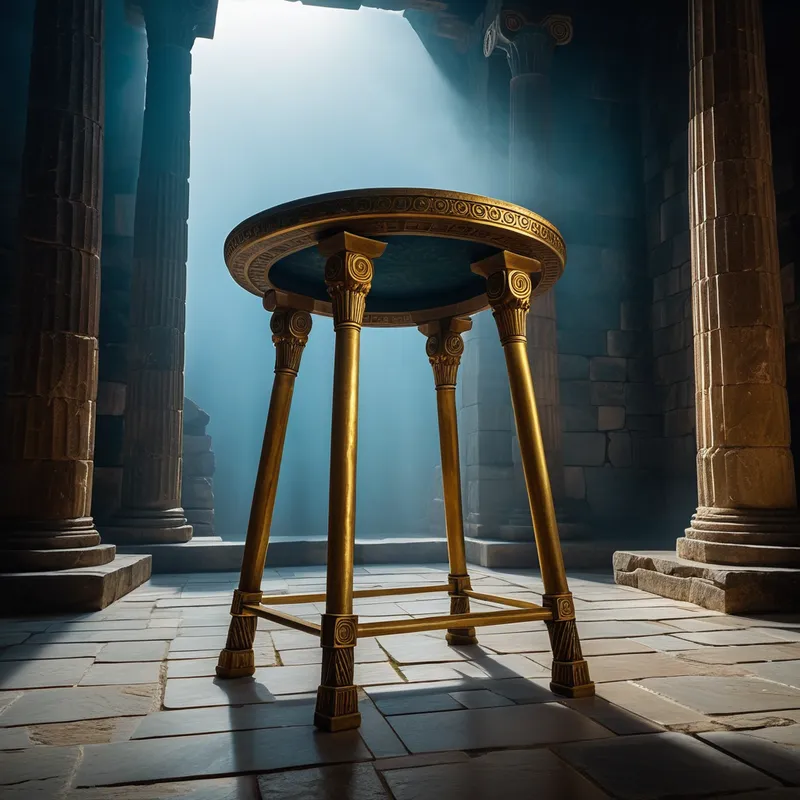
The Three-Legged Stool of Delphi Myth Meaning & Symbolism
An ancient myth of a sacred, unstable seat at the heart of the world, representing the precarious balance of divine truth, human nature, and cosmic order.
The Tale of The Three-Legged Stool of Delphi
Listen. The air is thick with the scent of bay laurel and burnt barley, a perfume of dread and hope. High on the slopes of Mount Parnassus, where eagles carve circles in the thin, clear sky, lies the navel of the world. A stone, the Omphalos, marks the spot. But the true heart, the trembling, whispering heart, beats in the darkness below the great temple of Apollo.
This is the Adyton, a chamber forbidden to all but the chosen. Here, in the perpetual gloom, a fissure splits the living rock. From it, a breath rises—not of air, but of the earth’s own dreaming, a chthonic vapor that smells of damp stone and forgotten things. And over this crack, placed with a precision lost to mortal geometry, stands a stool. Not a throne. A humble, three-legged thing of wood, perhaps of bronze, its legs splayed for stability on the uneven floor.
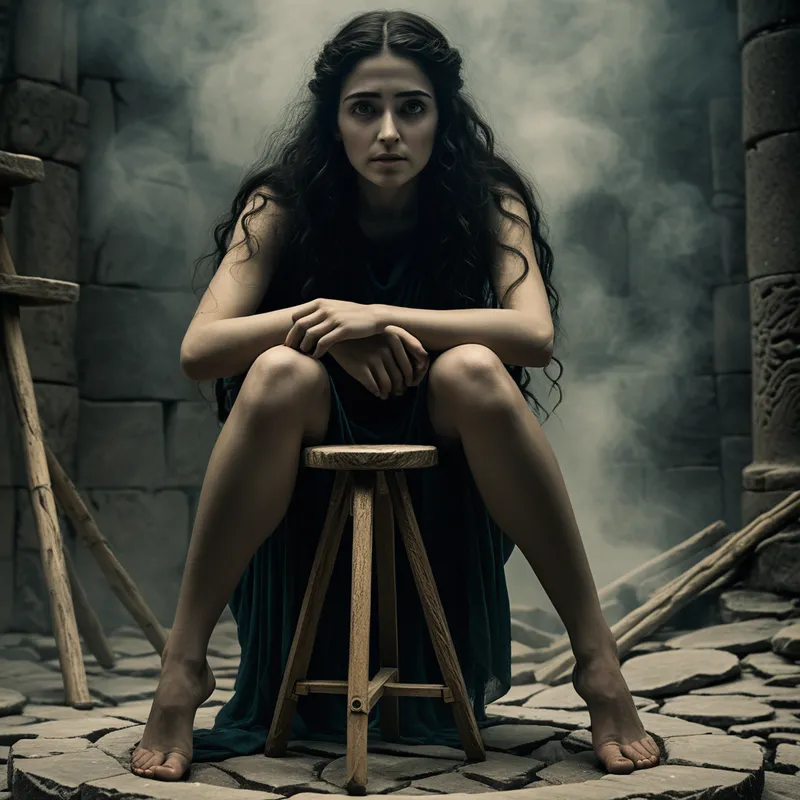
Upon this stool sits the Pythia. She is an ordinary woman of Delphi, chosen by lot, her life left at the temple door. She has bathed in the Castalian Spring, chewed the leaves of the sacred laurel, and now she lowers herself onto the seat. The vapors find her. They coil up from the abyss, entering her, and the stool trembles. It is the first tremor, the sign that the god approaches.
Her body stiffens. The humble stool becomes the axis of the cosmos. Her head lolls back, eyes wide and unseeing, fixed on the darkness of the ceiling vault. A sound begins, not from her throat but from the earth itself—a guttural sigh, a babble of half-words. Attendant priests, their own faces pale with holy fear, lean close. They must translate the chaos into hexameter, the god’s rage and wisdom into a riddle for kings and beggars alike.
The stool holds her, this vessel of divine madness, suspended between the underworld’s breath and Apollo’s celestial light. It does not promise comfort, only a precarious purchase at the very edge of understanding. When the god departs as suddenly as he came, the Pythia slumps, exhausted, emptied. The three-legged stool stands silent once more over the crack, a simple object holding the memory of chaos, the only witness to the moment when a human mind became a conduit for the voice of the earth and the sun god combined. The tripod remains, waiting in the dark for the next mortal to dare the seat where heaven, earth, and the underworld meet.
Cultural Origins & Context
The image of the sacred tripod is not a singular myth from a lost epic, but a central, recurring artifact in the historical and religious reality of Delphi, the most revered oracular site in the ancient Greek world. For nearly a millennium, from the 8th century BCE onward, the procedure was a cornerstone of Hellenic civilization. City-states, colonists, generals, and private individuals journeyed to Delphi with lavish gifts, seeking guidance on matters of war, politics, founding new cities, and personal destiny.
The tripod itself was a potent cultural symbol beyond the Adyton. It was the prize for victors in musical and poetic contests at the Pythian Games, a direct link between artistic triumph and divine inspiration. The mythic foundation often involved Pan and the slaying of the serpent Python by Apollo, who then established his oracle. The tripod was his instrument of conquest and communication. This story was passed down not by a single bard, but through a tapestry of hymns (like the Homeric Hymn to Apollo), historical accounts by visitors like Herodotus, and the countless dedications—actual tripods—that filled the temple treasuries. Its societal function was immense: it was the stabilizing mechanism for a world perceived as inherently chaotic, a direct line to divine order that could legitimize laws, justify wars, and assuage the profound anxiety of an uncertain future.
Symbolic Architecture
The Three-Legged Stool is a master symbol of paradoxical stability. Its power lies not in a monolithic solidity, but in a dynamic, tensile balance.
The tripod does not deny chaos; it provides a seat from which to observe its currents. True wisdom is found not in rigid certainty, but in the conscious maintenance of a sacred instability.
The three legs are its primary architecture. They represent the tripartite structure of reality as the Greeks perceived it: the Ouranic (Heavenly/Celestial), the Chthonic (Earthly/Underworld), and the Human realm. The stool exists where these three planes intersect. The Pythia’s possession signifies the temporary and terrifying alignment of these spheres within a single human consciousness. Psychologically, these legs map onto the tripartite soul: the transcendent spirit or Self (Ouranic), the instinctual and shadowy unconscious (Chthonic), and the conscious ego (Human). The stool is the symbolic function that allows these three often-warring aspects to commune.
The crack in the earth beneath it is the mouth of the unconscious, the source of raw, unformed psychic material—dreams, impulses, ancestral memory. The vapors are the sublimation of that material, rising to be interpreted. The Pythia is the ego forced into a state of hieros gamos (sacred marriage) with contents far beyond its normal capacity, a model for the ego’s necessary surrender to the larger Self during profound psychological work. The stool itself, then, is the structure of the psyche that makes such a dangerous communion possible without total disintegration.
The Dreamer’s Resonance
When the Three-Legged Stool appears in a modern dream, it rarely manifests as a literal artifact. Instead, one dreams of triangular structures that feel fundamental yet unstable: a three-legged table wobbling on an uneven floor, a tripod camera that won’t stay level, a stool where one leg is shorter than the others. The somatic experience is one of precarious balance—a feeling of being both supported and on the verge of a great tipping over.
Psychologically, this dream pattern signals that the dreamer’s foundational worldview or sense of self is undergoing a profound reassessment. The three legs often correspond to three core pillars of their life: perhaps career, relationship, and personal identity; or body, mind, and spirit; or past, present, and future. One of these pillars is revealed to be unsound, rotten, or of the wrong length, throwing the entire structure into disquieting motion. The dream is an expression of the ego’s terror and fascination as it sits upon this shifting base, directly above the “crack” of emerging unconscious material—a long-repressed truth, a new calling, or a shadow aspect demanding integration. The dreamer is, for a night, the Pythia, receiving chaotic, unsettling information from the depths, tasked upon waking with the hard work of “translation” into the coherent language of their waking life.

Alchemical Translation
The myth of the Tripod is a precise alchemical manual for the process of individuation. The goal is not to build an impregnable fortress of the self, but to construct a resilient, adaptive vessel for transformation.
The first operation is Nigredo, the descent into the dark. This is represented by the chthonic crack, the acknowledgment of the shadow, the chaotic unconscious. The ego (the Pythia) must willingly descend to this place and take its seat, a act of immense courage. The second is Albedo, the washing in the Castalian Spring and the chewing of the laurel—the purification and preparation of the conscious mind to receive.
The transmutation occurs in the tension. The ego does not conquer the unconscious, nor is it drowned by it. It holds the space between, allowing the opposing forces to generate a third, transcendent thing: the prophecy.
The crucial, central phase is Coniunctio Oppositorum—the conjunction of opposites on the tripod. Here, solar consciousness (Apollo) and lunar unconscious (the chthonic vapors) meet and marry within the human vessel. The resulting “babble” is the prima materia of the new self, raw and confusing. The final stage is Rubedo, the embodiment of the new consciousness. This is the work of the attending priests—the observing, interpreting functions of the psyche that labor to shape the chaotic revelation into a usable, life-directing wisdom. For the modern individual, the alchemical translation is clear: we must construct our own inner tripod. We must find the three points of balance that allow us to sit consciously over our own depths, endure the terrifying influx of truth, and patiently translate the resulting chaos into a more authentic, grounded, and paradoxically stable way of being. The stool is not a place of rest; it is the apparatus of revelation.
Associated Symbols
Explore related symbols from the CaleaDream lexicon: