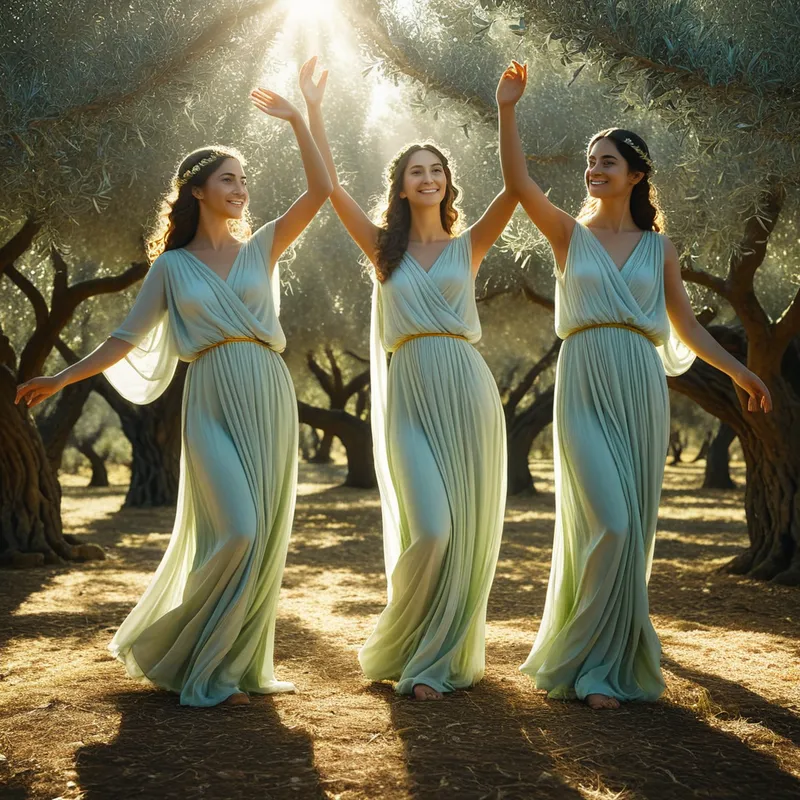
The Three Graces Myth Meaning & Symbolism
The myth of Aglaia, Euphrosyne, and Thalia, goddesses of beauty, mirth, and abundance, embodying the sacred flow of grace that binds all things.
The Tale of The Three Graces
Listen. Before [the world](/myths/the-world “Myth from Tarot culture.”/) knew its own name, when the air was still thick with the perfume of creation, there was a rhythm. It was not a sound you could hear with your ears, but a pulse you felt in the blood, a warmth in the chest, a softening at the edge of a smile. This rhythm was the heartbeat of the cosmos itself, and its dancers were three.
They were born of the union between Zeus, the storm-bringer, and Eurynome, the wide-flowing one. From the thunder’s might and the ocean’s grace, they emerged not as warriors or queens, but as the very essence of delight. Their names were whispered by the rustling leaves: Aglaia, whose presence was Radiance itself; Euphrosyne, who was the soul of Joy; and [Thalia](/myths/thalia “Myth from Greek culture.”/), the spirit of Blooming.
They did not dwell in a palace of cold stone, but in the dappled light of a grove sacred to Aphrodite. Here, where sunlight filtered through olive leaves to paint the ground in gold, they moved. They were always moving. They danced in a circle, their bodies a perfect, flowing triad. One would step forward with a gift of shining light, another would receive it with a burst of laughter, and the third would weave that laughter into a garland of flowers, passing it on. Their arms were always linked or resting upon one another’s shoulders; to separate them was unthinkable, for their power was in their connection.
Mortals who stumbled upon their dance, not by seeking but by a blessed accident, felt a change. The weary soldier forgot the weight of his shield, feeling instead the warmth of the sun on his neck. The grieving mother found her tears drying, replaced by the memory of her child’s first laugh. The artist, blocked and despairing, saw not a blank wall but a cascade of color and form. [The Graces](/myths/the-graces “Myth from Greek culture.”/) bestowed no tangible treasure, no sword or crown. They bestowed the condition for all treasure to be seen and cherished: a heart opened by radiance, joy, and fecundity. They were the sacred lubricant of the universe, making the gears of society, friendship, creativity, and love turn without screeching, without seizing. Where they danced, contracts were sealed with trust, songs were composed from sheer feeling, and strangers became companions. Their myth is not one of conflict and resolution, but of perpetual, graceful motion—the eternal rising action of life itself, beautifully sustained.

Cultural Origins & Context
The myth of the Three Graces is woven deep into the fabric of ancient Greek life, far beyond the pages of Hesiod or the hymns of poets. They were not merely decorative figures in a [pantheon](/myths/pantheon “Myth from Roman culture.”/) of powerful gods; they were functional deities, essential to the social and spiritual mechanics of [the polis](/myths/the-polis “Myth from Greek culture.”/).
Their worship was ancient, with roots possibly in pre-Hellenic fertility goddesses. By the classical era, they were everywhere and nowhere specific. They had no major temples of their own, for their domain was not a building, but the space between people. They were invoked at the beginning of symposia (drinking parties) to ensure good fellowship, at weddings to bless the union with charm and fertility, and in political assemblies to encourage eloquent and agreeable speech. Artists, poets, and craftsmen called upon them to grace their work with that ineffable quality that pleases the senses and the soul. A statue without “charis” (grace) was just a block of stone; a law without it was mere tyranny.
They were the daughters of Zeus and Eurynome, a lineage that places them at the very center of the Olympian order—divine legitimacy married to oceanic flow. Their most constant companion was Aphrodite, a relationship that reveals a profound Greek understanding: raw desire or beauty (Aphrodite) is chaotic and potentially destructive without the civilizing, socializing influence of grace, charm, and mutual joy (the Charites). They made beauty relational, reciprocal, and life-giving.
Symbolic Architecture
At its core, the [symbol](/symbols/symbol “Symbol: A symbol can represent an idea, concept, or belief, serving as a powerful tool for communication and understanding.”/) of the Three Graces is a map of a fundamental psychic and cosmic law: that vitality flows through [connection](/symbols/connection “Symbol: Connection symbolizes relationships, communication, and bonds among individuals.”/), and that the highest states of being are triadic, not dual.
Grace is not a solitary virtue; it is the current that moves between selves, the sacred circuit that completes only in communion.
The trio—Aglaia ([Radiance](/symbols/radiance “Symbol: A powerful symbol of illumination, divine presence, and inner awakening, often representing clarity, truth, and spiritual energy.”/)), Euphrosyne (Joy), Thalia ([Bloom](/symbols/bloom “Symbol: Represents growth, vitality, and the flourishing of potential, often tied to emotional awakening or physical health.”/))—represents a complete cycle of giving, receiving, and integrating. Aglaia is the initial spark, the brilliant [idea](/symbols/idea “Symbol: An ‘Idea’ represents a spark of creativity, innovation, or realization, often emerging as a solution to a problem or a new outlook on life.”/), the attractive force. Euphrosyne is the heartfelt [reception](/symbols/reception “Symbol: The symbol of ‘reception’ often signifies the act of welcoming or accepting new ideas, experiences, or people into one’s life.”/), the pleasure in the spark, the [celebration](/symbols/celebration “Symbol: The symbol of ‘celebration’ represents joy, accomplishment, and community, often serving as a collective acknowledgment of achievements or significant life milestones.”/). Thalia is the fruitful [outcome](/symbols/outcome “Symbol: Outcome symbolizes the results of actions or decisions, often reflecting hopes, fears, and the consequences of choices.”/), [the thing](/myths/the-thing “Myth from Norse culture.”/) that grows from that celebratory exchange, which then becomes a new [radiance](/symbols/radiance “Symbol: A powerful symbol of illumination, divine presence, and inner awakening, often representing clarity, truth, and spiritual energy.”/) to offer. This is the [pattern](/symbols/pattern “Symbol: A ‘Pattern’ in dreams often signifies the underlying structure of experiences and thoughts, representing both order and the repetitiveness of life’s situations.”/) of creative inspiration, of deepening [friendship](/symbols/friendship “Symbol: A bond characterized by mutual affection and support, representing an essential aspect of human social interaction.”/), of successful [dialogue](/symbols/dialogue “Symbol: Conversation or exchange between characters, representing communication, relationships, and narrative flow in games and leisure activities.”/). Psychologically, they represent the [integration](/symbols/integration “Symbol: The process of unifying disparate parts of the self or experience into a cohesive whole, often representing psychological wholeness or resolution of internal conflict.”/) of our [capacity](/symbols/capacity “Symbol: A measure of one’s potential, limits, or ability to contain, process, or achieve something, often reflecting self-assessment or external demands.”/) to shine (Aglaia), to feel authentic pleasure (Euphrosyne), and to let our lives flourish as a result (Thalia). A person blocked in one Grace finds their [life](/symbols/life “Symbol: The symbol of ‘Life’ represents a journey of growth, interconnectedness, and existential meaning, encompassing both the joys and challenges that define human experience.”/) force stagnating.
Their eternal, interlinked dance is perhaps the most potent symbol. They face [outward](/symbols/outward “Symbol: Movement or orientation away from the self or center; expansion, expression, or externalization of inner states into the world.”/) in a circle, suggesting an openness to the world, yet their bodies are turned toward one another, their touch constant. This embodies the ideal of [community](/symbols/community “Symbol: Community in dreams symbolizes connection, support, and the need for belonging.”/) and the healthy ego: an individual capable of engaging with the world ([outward](/symbols/outward “Symbol: Movement or orientation away from the self or center; expansion, expression, or externalization of inner states into the world.”/)-facing), but whose [strength](/symbols/strength “Symbol: ‘Strength’ symbolizes resilience, courage, and the ability to overcome challenges.”/) and orientation are rooted in secure, nourishing connections ([inward](/symbols/inward “Symbol: A journey toward self-awareness, introspection, and the exploration of one’s inner world, thoughts, and unconscious mind.”/)-facing touch). To break the circle is to break the flow of grace.
The Dreamer’s Resonance
When the pattern of the Three Graces stirs in the modern unconscious, it often manifests in dreams of triadic harmony, flowing movement, or its painful absence.
You may dream of three figures (often feminine, but not exclusively) dancing in perfect sync, or three interlocking shapes forming a satisfying whole. This can signal a somatic experience of integration, where previously disparate parts of [the self](/myths/the-self “Myth from Jungian culture.”/)—perhaps the striving mind, the feeling heart, and the sensual body—are finding a new, graceful rhythm together. The dreamer may awaken with a sense of ease, creativity, or social warmth.
Conversely, dreams of the broken circle are more common for those in a state of psychic disconnection. Dreaming of a stalled car with three flat tires, a triangle that won’t close, or three people arguing with their backs turned to each other points to a blockage in the flow of charis. Which Grace is missing? Is your life lacking radiance (feeling dull, invisible)? Is it devoid of true joy (pleasure feels forced or guilty)? Or is it failing to bloom (projects stall, relationships don’t deepen)? The dream highlights the triadic nature of the blockage; solving one part requires attending to the flow between all three.

Alchemical Translation
The individuation process, the alchemical journey toward psychic wholeness, is often imagined as a heroic quest or a dark night of the soul. The myth of the Graces offers a different, essential model: the alchemy of relationship.
The great work is not only the confrontation with the shadow in solitude, but the cultivation of the graceful circuit within and between.
The first step is Recognizing the Solitary Element. The modern ego often identifies with one Grace in isolation: the relentless brilliance of Aglaia (the workaholic), the forced festivity of Euphrosyne (the people-pleaser), or the unchecked proliferation of Thalia (the accumulator). This is the leaden state—a heavy, unbalanced existence that feels effortful and brittle.
The alchemical fire is applied through Conscious Circulation. This is the practice of completing the circuit. If you are all radiant output (Aglaia), you must consciously practice receptive joy (Euphrosyne)—allowing yourself to truly enjoy a meal, a piece of music, a compliment without deflecting it. If you are lost in receptive pleasure, you must focus on creating a tangible bloom (Thalia)—gardening, writing, building something. If your blooms feel empty, you must reconnect them to their original radiance—remembering the why behind your work.
The final transmutation, the gold, is Becoming the Dance Itself. This is not about having grace, but being a vessel for graceful exchange. The individual no longer rigidly identifies as “the brilliant one” or “the cheerful one,” but becomes the space where radiance, joy, and bloom can flow freely. They become a node in a larger network of grace, facilitating connection, creativity, and beauty in their community. The [psyche](/myths/psyche “Myth from Greek culture.”/) becomes like the grove: a sacred, living space where the eternal, triadic dance of life is perpetually sustained, and where all who enter feel the burdens of their isolated egos momentarily lifted, caught up in the sacred, flowing circle.
Associated Symbols
Explore related symbols from the CaleaDream lexicon: