The Thread of the Moirai Myth Meaning & Symbolism
The three goddesses of destiny spin, measure, and cut the thread of every life, from mortal to god, embodying the inescapable law of the cosmos.
The Tale of The Thread of the Moirai
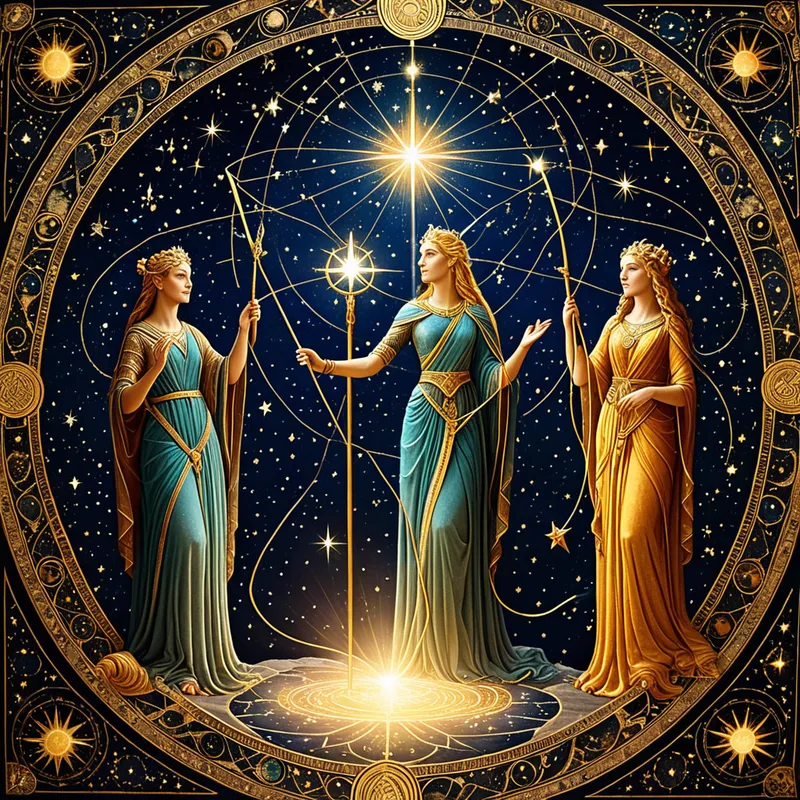
Listen. In the deep, before the first word was spoken, there was a hum. It was not a sound of the throat, but the vibration of the spindle, turning in the darkness. In a cavern where time is not a river but a tapestry, they sit. [Three sisters](/myths/three-sisters “Myth from Native American culture.”/), older than memory, older than the gods themselves.
There is Clotho. Her fingers are deft, her touch is the beginning of all things. From a distaff that holds the raw stuff of potential—starlight, breath, and the first cry—she draws forth the thread. It is not merely wool or flax, but the essence of a being. It shimmers with the color of its nature: the gold of a hero, the silver of a poet, the sturdy brown of a farmer, the faint, tragic grey of one destined for sorrow. With each turn of her spindle, a life is set into motion.
Beside her sits Lachesis. Her eyes see not the present, but the path. She takes the newborn thread from Clotho’s spindle. In her hands is a rod, not of wood or metal, but of law. It is etched with the measures of a life: its triumphs, its trials, its loves, its losses. She lays the thread against it, her touch assessing its strength, its texture. She determines its length. She apportions the lot—the moira—that this life will carry. No plea, no bribe, can make her rod longer or shorter. Hers is the cold, beautiful mathematics of destiny.
And then, there is Atropos. She is the smallest, the oldest, and her gaze is the stillest. She does not spin, she does not measure. She waits. In her lap rests a pair of shears, simple and terrible. Their blades are so sharp they do not reflect light; they consume it. When Lachesis’s measure is complete, when the thread has run its appointed course through the loom of [the world](/myths/the-world “Myth from Tarot culture.”/), Atropos’s hand moves. There is no hesitation, no malice, no mercy. A soft, final snip. The hum of that particular thread ceases. Its light winks out. The shears return to her lap, and she waits for the next.
Even Zeus himself, the cloud-gatherer, the thunderer, must bow his head to their decree. It is said he holds the scales of fate, but it is [the Moirai](/myths/the-moirai “Myth from Greek culture.”/) who provide the weight. A hero may rage, a lover may weep, a king may command armies, but all paths lead back to the cavern, to the hum of the spindle, to the unerring measure, to the silent shears. Their threads are woven into the very fabric of Gaia and stretch to the pillars of [Ouranos](/myths/ouranos “Myth from Global/Universal culture.”/). To see them work is to understand the first and last law: there is a pattern, and you are a part of it. The thread is spun, it is measured, it is cut. This is [the way](/myths/the-way “Myth from Taoist culture.”/) of all things.
Cultural Origins & Context
The myth of the [Moirai](/myths/moirai “Myth from Greek culture.”/) is not a story told for mere entertainment around a fire. It is a foundational pillar of the Greek worldview, a theological and philosophical answer to the chaos of existence. Their origins are pre-Olympian, likely descending from earlier Indo-European concepts of cosmic order and apportionment. In Hesiod’s Theogony, they are born of Nyx (Night) alone, placing them among the primeval forces that even [the Olympian gods](/myths/the-olympian-gods “Myth from Greek culture.”/) did not create, but must obey.
They were worshipped, albeit with a reverence tinged with dread, as the ultimate arbiters. No major undertaking—a journey, a marriage, a battle—was begun without some acknowledgment of [the Fates](/myths/the-fates “Myth from Greek culture.”/). Their function was societal as much as it was metaphysical: they encoded the concept of ananke (necessity) and moira (portion, share) into the cultural [psyche](/myths/psyche “Myth from Greek culture.”/). This was not a fatalism that encouraged passivity, but one that framed the heroic struggle. A hero’s greatness was not in changing his fate, but in meeting it with arete (excellence). The myth was passed down through epic poetry, tragic drama, and religious practice, serving as the immutable backdrop against which all human ambition and divine will played out.
Symbolic Architecture
Psychologically, the Moirai represent the tripartite [structure](/symbols/structure “Symbol: Structure in dreams often symbolizes stability, organization, and the framework of one’s life, reflecting how one perceives their environment and personal life.”/) of time and [consciousness](/symbols/consciousness “Symbol: Consciousness represents the state of awareness and perception, encompassing thoughts, feelings, and experiences.”/) itself: the [birth](/symbols/birth “Symbol: Birth symbolizes new beginnings, transformation, and the potential for growth and development.”/) of potential (Clotho), the development of [pattern](/symbols/pattern “Symbol: A ‘Pattern’ in dreams often signifies the underlying structure of experiences and thoughts, representing both order and the repetitiveness of life’s situations.”/) and [identity](/symbols/identity “Symbol: Identity represents the sense of self, encompassing personal beliefs, cultural background, and social roles.”/) through lived experience (Lachesis), and the inevitable [dissolution](/symbols/dissolution “Symbol: The process of breaking down, dispersing, or losing form, often representing transformation, release, or the end of a state of being.”/) or transformation that ends one state of being (Atropos). They are not [death](/symbols/death “Symbol: Symbolizes transformation, endings, and new beginnings; often associated with fear of the unknown.”/) in the crude sense, but [the principle](/symbols/the-principle “Symbol: A fundamental truth, law, or doctrine that serves as a foundation for a system of belief, behavior, or reasoning, often representing moral or ethical standards.”/) of limits, of definition. A [thing](/myths/thing “Myth from Norse culture.”/) must have a beginning, a middle, and an end to have meaning.
The thread is not a prison, but the definition that makes form possible. Without the cut, there is no story.
Clotho symbolizes the raw, unconscious [impulse](/symbols/impulse “Symbol: A sudden, powerful urge or drive that arises without conscious deliberation, often linked to primal instincts or emotional surges.”/) of [life](/symbols/life “Symbol: The symbol of ‘Life’ represents a journey of growth, interconnectedness, and existential meaning, encompassing both the joys and challenges that define human experience.”/)—the initial spark of an [idea](/symbols/idea “Symbol: An ‘Idea’ represents a spark of creativity, innovation, or realization, often emerging as a solution to a problem or a new outlook on life.”/), the birth of a feeling, the onset of an instinct. Lachesis is [the ego](/myths/the-ego “Myth from Jungian culture.”/)-consciousness that takes this raw [material](/symbols/material “Symbol: Material signifies the tangible aspects of life, often representing physical resources, desires, and the physical world’s influence on our existence.”/) and tries to measure it, give it a narrative, a [purpose](/symbols/purpose “Symbol: Purpose signifies direction, meaning, and intention in life, often reflecting personal ambitions and core values.”/), a “[life](/symbols/life “Symbol: The symbol of ‘Life’ represents a journey of growth, interconnectedness, and existential meaning, encompassing both the joys and challenges that define human experience.”/) [story](/symbols/story “Symbol: The symbol of ‘Story’ represents the narrative woven through our lives, embodying experiences, lessons, and emotions that shape our identities.”/).” She represents the choices, habits, and circumstances that shape our identity over time. Atropos is the most profound and feared: she is the function of the unconscious that ultimately dismantles [the ego](/myths/the-ego “Myth from Jungian culture.”/)‘s constructions. She is the [crisis](/symbols/crisis “Symbol: A crisis symbolizes turmoil, urgent challenges, and the need for immediate resolution or change.”/) that ends a [career](/symbols/career “Symbol: The dream symbol of ‘career’ often represents one’s ambitions, goals, and personal identity in a professional context.”/), the [insight](/symbols/insight “Symbol: A sudden, deep understanding of a complex situation or truth, often arriving unexpectedly and illuminating hidden connections.”/) that shatters a long-held belief, the psychological death that must precede [rebirth](/symbols/rebirth “Symbol: A profound transformation where old aspects of self or life die, making way for new beginnings, growth, and renewal.”/). She is the necessary end of a [chapter](/symbols/chapter “Symbol: Chapters symbolize phases or segments of life, often representing transitions or new beginnings.”/) so a new one, spun by Clotho, can begin.
The Dreamer’s Resonance
When the motif of the Thread of the Moirai appears in modern dreams, it signals a profound encounter with the archetype of destiny and personal limits. The dreamer is not merely worrying about a deadline; they are brushing against the foundational laws of their own psyche.
Dreaming of tangled threads often speaks to a feeling of confusion in life’s path, a sense that one’s “measure” (Lachesis) is unclear or contested. Dreaming of a thread being cut can be terrifying, but in the symbolic language of the psyche, it rarely signifies literal death. Instead, it points to an imminent and necessary ending: the close of a life phase, the dissolution of an outdated self-image, the severing of a toxic bond or dependency. The somatic experience is often one of sudden release, a gasp, or a feeling of falling—the ego’s structure giving way. Conversely, dreaming of spinning a thread can indicate a creative awakening, the birth of a new project, identity, or relationship from the raw material of [the self](/myths/the-self “Myth from Jungian culture.”/).
Alchemical Translation
The individuation process, the journey toward psychic wholeness, is mirrored perfectly in the myth. Initially, we identify solely with the thread—our ego, our personal story, spun and measured. We believe we are the narrative. The first alchemical step is to recognize the Spinner within: to connect with the autonomous, creative life force (Clotho) that generates our being beyond our conscious control.
The deeper work involves submitting to the Measurer. This is the difficult, conscious work of self-reflection—assessing our true length and lot, owning our past, our talents, and our flaws without inflation or diminishment. It is the act of taking responsibility for our portion.
The ultimate alchemy is not to steal the shears, but to willingly offer one’s own thread to them.
The final, most sacred transmutation is to make peace with the Cutter. This is the ego’s surrender to a greater order. In psychological terms, it is the dissolution of the [persona](/myths/persona “Myth from Greek culture.”/) and the integration of [the shadow](/myths/the-shadow “Myth from Jungian culture.”/) and the Self. It is accepting that certain things—childhood, a particular role, a cherished ambition—must end for new growth to occur. The [triumph](/myths/triumph “Myth from Roman culture.”/) is not in avoiding Atropos, but in understanding that her shears do not destroy meaning; they complete it. The one who has integrated this truth no longer lives in fear of the cut, but sees it as part of the sacred, three-fold rhythm of their own becoming. They move from being a passive length of thread to a conscious participant in the eternal spinning, measuring, and cutting of their own soul’s substance.
Associated Symbols
Explore related symbols from the CaleaDream lexicon: