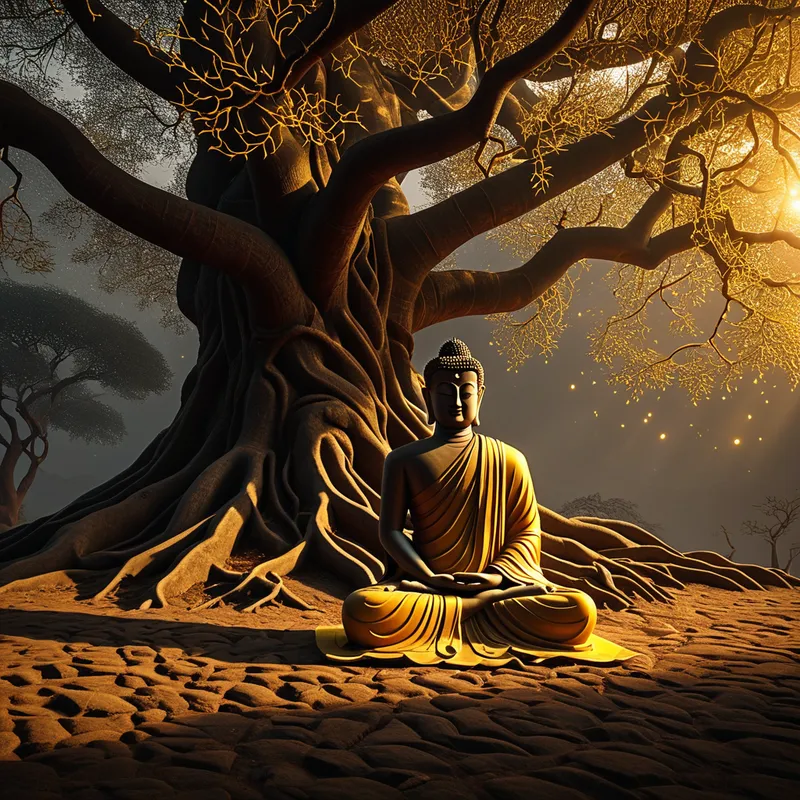
The Third Noble Truth Myth Meaning & Symbolism
The story of the Buddha's discovery that the cessation of suffering is possible, a truth born not from denial but from radical, compassionate inquiry.
The Tale of The Third Noble Truth
Listen. The night is long, and the roots of the world are thirsty.
For six years, the ascetic Siddhartha Gautama had walked the dust of the Ganges plain. His body was a map of deprivation, his ribs like the bars of a cage he had built himself. He had followed the paths of severe penance, starving the flesh to feed the spirit, until he was little more than a skeleton clad in determination. Yet the great knot of suffering—the dukkha that had driven him from his palace—remained tied, tighter than ever. The more he fought it, the more it constricted. He had pursued pleasure and found it hollow; he had embraced pain and found it equally so. He was trapped between two desolations.
Beneath the ancient, spreading arms of the Bodhi tree, he made a final, radical decision. He would not move. He would not seek. He would simply sit, with the resolve of a mountain. The demon Mara came, as he must. He sent armies of fear, legions of doubt, and finally, his three daughters—Desire, Discontent, and Lust—to sway the seeker. Siddhartha did not fight. He touched the earth, and the earth herself bore witness to his right to be there. Mara vanished like a shadow at noon.
Then, in the deep, silent watch of the night, the real work began. It was not an assault, but an observation of breathtaking intimacy. With a mind sharpened to a diamond point and a heart soft as moonlight, he turned his attention inward, tracing the river of experience to its source. He saw life as it is: birth, aging, sickness, death, separation from the loved, union with the unloved. He saw the First Noble Truth: There is suffering. He did not flinch.
He looked deeper, into the very engine of this suffering. He saw the grasping, the craving, the desperate thirst—tanha—that reaches for pleasure and pushes away pain. The Second Noble Truth: There is a cause of suffering. It was not a condemnation, but a diagnosis. The thirst for existence, for non-existence, for sensory delight. This thirst, he saw, was the fuel on the fire.
And then… a pause in the cosmos. A space opened in his perception. He followed the chain: with the complete fading away and cessation of this very thirst, comes cessation. When the fuel is removed, the fire… goes out. It does not go somewhere else. It ceases. It is not annihilated; it is simply no longer fed. A profound, cool peace flooded his being, not as an emotion, but as the fundamental nature of a reality stripped of craving. This was the Third Noble Truth: There is a cessation of suffering. He named it Nirodha. The Unbinding. The door, which he had spent lifetimes pounding upon, was not locked. It had never been locked. It opened inward, onto a freedom so vast it contained the entire world without clinging to a single speck of dust. With that, the seeker was no more. The Buddha had arisen.

Cultural Origins & Context
This is not a myth of gods on a mountain, but the core narrative of a human discovery. The story of the Third Noble Truth originates in the Pali Canon, specifically in the Dhammacakkappavattana Sutta, or “The Setting in Motion of the Wheel of Dhamma.” Delivered in the Deer Park at Sarnath to his first five disciples, this discourse laid out the foundational framework of the Four Noble Truths, with the Third Truth being their triumphant pivot point.
It functioned as a radical, therapeutic proclamation in the context of 5th-century BCE Shramanic culture, which was intensely preoccupied with liberation (moksha). While other traditions posited liberation in merging with a divine absolute or escaping to a heavenly realm, the Buddha’s Third Truth grounded liberation squarely in the cessation of a psychological process—craving—here and now. It was passed down orally for centuries by monastic communities, not as a dogma to be believed, but as a truth to be realized. Its societal function was to offer a clear, actionable diagnosis and prognosis for the human condition: suffering has a cause, and that cause can be ended. This made enlightenment not a mystical prize for the few, but a potential reality for anyone willing to undertake the path.
Symbolic Architecture
The Third Noble Truth, Nirodha, is the ultimate symbol of possibility. It represents the negative space that gives form to liberation. It is not a thing to be acquired, but a process of cessation to be realized.
The goal of the path is not a better state of becoming, but the end of becoming itself. It is the still point where the wheel of conditioned existence, samsara, loses its momentum and comes to rest.
Psychologically, the Buddha under the Bodhi tree symbolizes the fully integrated Self that turns consciousness back upon its own mechanisms. The “thirst” or tanha he identifies is the symbolic representation of the ego’s endless project of self-construction through identification—“I am this feeling, I want that object, I must avoid this experience.” Nirodha is the de-identification, the withdrawal of psychic energy from these compulsive patterns. It is the realization that the “I” that craves is itself part of the conditioned chain, and that freedom lies in seeing through it, not in satisfying it. The “extinction of the fires” of passion, aversion, and delusion is not a cold nihilism, but the profound peace that emerges when the constant, low-grade war with reality is called off.

The Dreamer’s Resonance
When this myth stirs in the modern unconscious, it rarely appears as a robed figure under a tree. Instead, it manifests as dreams of profound release from invisible burdens. A dreamer may find themselves in a room filled with screaming televisions, and discover a single, silent “off” switch. They may dream of shedding a heavy, wet coat they didn’t realize they were wearing, or of a deafening noise that suddenly stops, leaving a ringing, peaceful silence.
Somatically, this points to a psychological process of letting go at a cellular, nervous-system level. The dreamer is not actively battling a monster (the heroic ego’s task), but is arriving at a point of exhaustion or insight where the struggle itself is recognized as the problem. This is the dream equivalent of the Second Truth giving birth to the Third. The psyche is signaling that it has traced a pattern of anxiety, craving, or self-judgment to its root and is ready to cease feeding it. It is often a dream that accompanies burnout, the end of a long obsession, or the quiet aftermath of a crisis, indicating the unconscious is initiating a healing process of de-identification and rest.

Alchemical Translation
For the modern individual on the path of individuation, the alchemy of the Third Noble Truth is the transmutation of seeking into being. Our culture is built on the Second Truth—the endless causation of desire, the promise that the next achievement, relationship, or purchase will end our lack. The alchemical work is to stop adding ingredients to the flask and instead, allow the heat to subside.
Individuation is not about building a better, shinier ego, but about discovering the ground of being that exists when the ego’s compulsive narratives cease.
This translates to a practical psychology of cessation. It is the moment in therapy when a client stops trying to “fix” a painful childhood memory and simply allows it to be present without resistance, witnessing how its power dissolves when not fought. It is the decision to stop ruminating on a past mistake, not through forced positivity, but through a gentle, firm dropping of the thread of thought. It is the “unhooking” from a toxic pattern not by willpower alone, but by seeing, with clear-eyed compassion, the emptiness of its promise. This is the asankhata—the unconditioned—breaking into conditioned life. The triumph is not an explosion, but an exhalation. The goal is not to become a hero who conquers suffering, but to become a sage who, through profound understanding, lets the war end, and in that peace, finds a freedom that includes all things.
Associated Symbols
Explore related symbols from the CaleaDream lexicon: